Weekend links 67

hofstatter.jpg

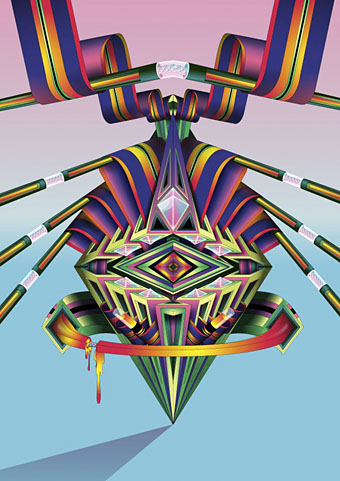
Neutron Drip (2011) by Amrei Hofstätter.

The Lavender Scare is “the first feature-length documentary film to tell the story of the U.S. government’s ruthless campaign in the 1950s and ’60s to hunt down and fire every Federal employee it suspected was gay”. A film by Josh Howard based on the book by David K Johnson which the author has made a free download here.

• “Annette Peacock, the avant garde American composer, collaborator with Salvador Dalí, friend of Albert Ayler and Moog-synth pioneer, brought this seismically influential session out in 1972…” John Fordham reviews Annette Peacock’s I’m The One which can be purchased here.

• Writer and graphic design historian Steven Heller looks at The Steampunk Bible (edited by SJ Chambers & Jeff VanderMeer) in his column for The Atlantic. He also talks to Galen Smith about the book’s design.

M John Harrison reveals more about his forthcoming sf novel Pearlent, a partial sequel to Light and Nova Swing. I just re-read Light, and I’m currently In The Event Zone with the follow-up, so I’m looking forward to this one.

The Raven, a book by Lou Reed & Lorenzo Mattotti (and Edgar Allan Poe). A Journey Round My Skull previewed this in 2009.

Orson Welles’ Falstaff film, Chimes at Midnight, emerges into the light once more. When do we get a decent DVD release?

• More of the usual concerns: Iain Sinclair’s struggles with the city of London and Erik Davis talks to Alan Moore about psychogeography, John Dee, comic gods, and the art of magic.

Eddie Campbell takes a tip from Jim Steranko. Related: “Hey! A Jim Steranko effect!

Lambshead Cabinet: Win Jake von Slatt’s Mooney & Finch Somnotrope!

• Tilda Swinton is The Woman Who Fell to Earth.

XXth Century Avantgarde [sic] Books at Flickr.

Sound sculptures & installations by Zimoun.

I’m The One (1972) by Annette Peacock.

Weekend links 66

kunz.jpg

A design by Emma Kunz (1892–1963).

• Following the news this week it’s worth reminding people of a great post put together by Adam Curtis back in January, Rupert Murdoch—A portrait of Satan. One detail there concerns the death of chat show host Russell Harty in 1988. This week the London Review of Books posted an extract from Alan Bennett’s diaries referring to the Harty episode where he notes how the tabloid practice of getting private phone numbers from the police was common and widespread, not simply the actions of a single newspaper. For more about the deathbed hounding of Russell Harty (and Bennett’s loathing of Murdoch) see Writing Home. Related: Dennis Potter shortly before his death discussing his desire to kill Rupert Murdoch.

• Don’t get mad, get even: Hakim Bey’s Black Djinn Curse: “How to invoke a terrible curse on a malign institution.” See also: Black magic as revolutionary action.

Village Voice talks to Linda Manz about her experience as a young actor in Days of Heaven, The Wanderers and Out of the Blue.

Truth Wins Out infiltrates the “ex-gay” clinic run by Michelle Bachmann’s husband.

Free Situationist booklets by Larry Law. Related: films by Guy Debord at Ubuweb.

• Have tea with Doctor Dee in Mortlake, London, next Wednesday.

Publisher Peter Owen: Sixty years of innovation.

Wilhelm Reich: the man who invented free love.

A conversation with Brian Eno by Ben Sisario.

The mysterious minaret of Jam, Afghanistan.

Stereolab cover designs at Hardformat.

Orgone Accumulator (1973) by Hawkwind | Cloudbusting (1985) by Kate Bush | Orgasmatron (1986) by Motörhead | Orgasmatron (1993) by Sandoz | Orgone Donor (2004) by Deathprod.

Derek Jarman’s Neutron

tilda.jpg

Tilda Swinton in The Last of England (1988).

John Dee turned up in Derek Jarman’s Jubilee after scenes from an earlier script about the Elizabethan magus were grafted onto the punk dystopia. Jarman’s career was to be littered with these unrealised projects, the strangest of which was Neutron, an apocalyptic science fiction film he was planning following the comparative success of The Tempest in 1979. The description he gives in his “Queerlife”, Dancing Ledge, is as follows:

There are six published manuscripts of Neutron, which zig-zag their anti-heroes Aeon and Topaz across the horizon of a bleak and twilit post-nuclear landscape. ‘Artist’ and ‘activist’ in their respective former lives, they are caught up in the apocalypse, where the PA systems of Oblivion crackle with the revelations of John the Divine. Their duel is fought among the rusting technology and darkened catacombs of the Fallen civilization, until they reach the pink marble bunker of Him. The reel of time is looped—angels descend with flame-throwers and crazed religious sects prowl through the undergrowth. The Book of Revelations is worked as science fiction.

Lee [Drysdale] and I pored over every nuance of this film. We cast it with David Bowie and Steven Berkoff, set it in the huge junked-out power station at Nine Elms and in the wasteland around the Berlin Wall. Christopher Hobbs produced xeroxes of the pink marble halls of the bunker with their Speer lighting—that echo to ‘the muzak of the spheres’ which played even in the cannibal abattoirs, where the vampire orderlies sipped dark blood from crystal goblets.

If that doesn’t whet your appetite I don’t know what would. Later drafts of the script were written with Jon Savage. If the film had been made it might well have been terrible, of course, but Christopher Hobbs, who worked with Jarman on later films, as well as on Velvet Goldmine and the BBC’s Gormenghast, would at least have made it look great. David Bowie is very good in The Man Who Fell to Earth but his acting is seldom as successful elsewhere. Steven Berkoff would have been a better bet but a Bowie film would have received far more attention. Bowie discusses his involvement in a 1999 interview here (and also slags off Velvet Goldmine…booo!).

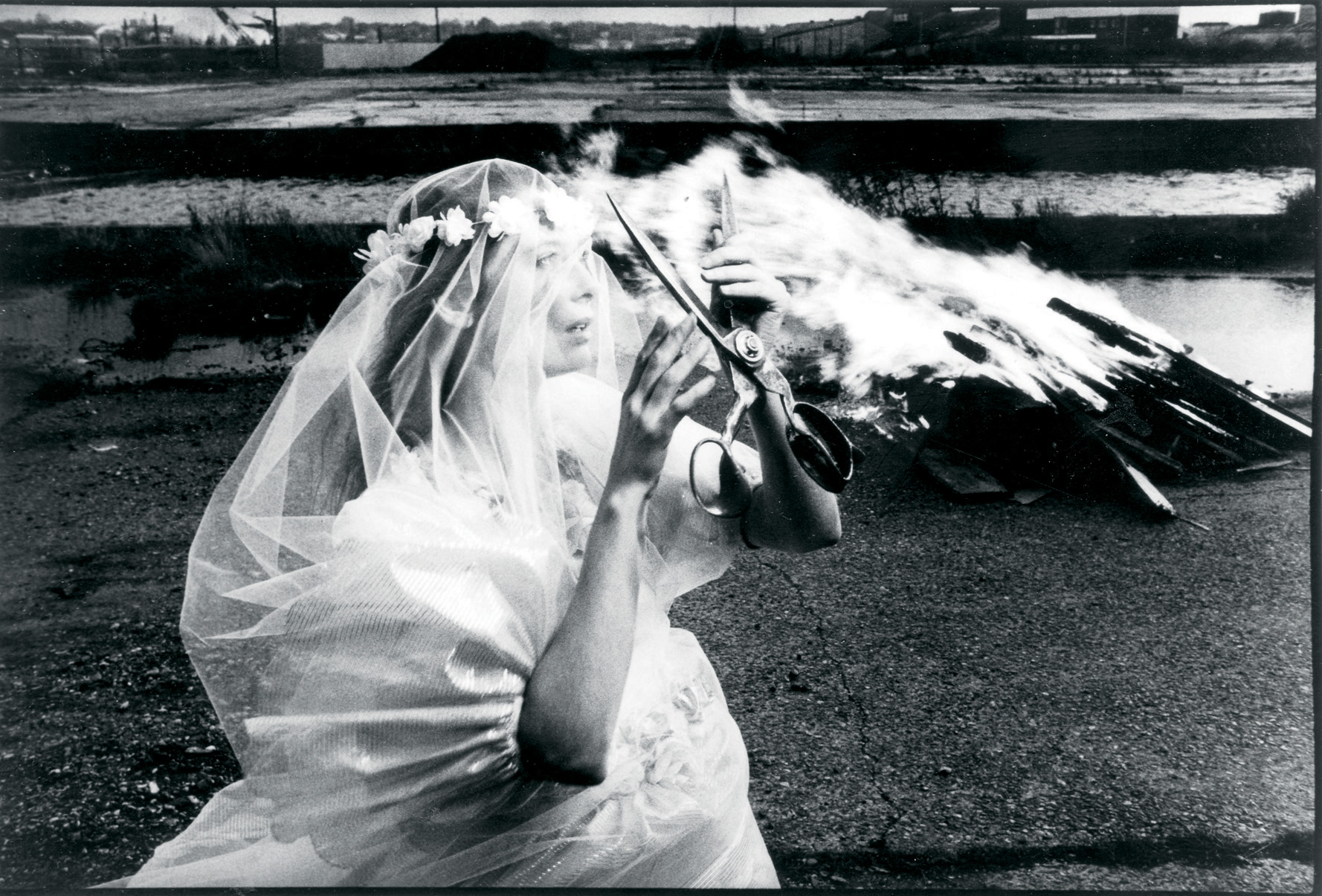
All this was happening circa 1980 when Reagan and Thatcher had just begun their insidious reigns and the Cold War was moving into a new era which generated a great deal of apocalyptic anxiety. Jarman’s response to all of this materialised in 1988 with The Last of England, his bleakest film, and a work in which we can perhaps see some of the nightmare scenes which Neutron would have conjured. I’ve never liked The Last of England very much but it contains a few sequences worth savouring, especially shots of the luminous Tilda Swinton dancing through the wasteland devastation. There’s a fragment of that here with her ripping her dress to pieces accompanied by the voice of Diamanda Galás. Meanwhile, does David Bowie still have the production designs for Neutron? If so, when do we get to see them?

Previously on { feuilleton }
Mister Jarman, Mister Moore and Doctor Dee
The Tempest illustrated
In the Shadow of the Sun by Derek Jarman
Derek Jarman at the Serpentine
The Angelic Conversation
The life and work of Derek Jarman

Weekend links 64

magritte.jpg

The Sixteenth of September (1956) by René Magritte.

To Magritte admirers, The Sixteenth of September is a deceptively realistic work painted in 1956, one of a series in which the artist plays tricks with light and time of day. It shows a crescent moon impossibly shining through the dark mass of a tree, against a dawn sky.

To [Marc] Bolan fans, the painting has an entirely different significance: 16 September 1977 was the date the singer was returning home in the small hours from a night out, in a Mini driven by his girlfriend Gloria Jones. […] Fans say the tree in the painting closely resembles the sycamore the car crashed into, and the moon was at the same phase on 16 September 1977. (more)

• New Yorkers finally got a successful vote for gay marriage making New York state the sixth and largest in the US giving full marriage rights to its gay citizens. One of America’s conservative journals, National Review, made the striking point that forty years ago New York was in the vanguard of gay liberation while Spain under Franco was a dictatorship with no gay rights at all. No one then would have bet on Spain beating New York to gay marriage rights as it did in 2005. Allow me to note that we still only have civil unions here in the UK.

• Related: Queer Beacon: LGBT spaces in New York City by Kian Goh, and at Scientific American: The Intelligent Homosexual’s Guide to Natural Selection and Evolution, with a Key to Many Complicating Factors by Jeremy Yoder.

• A pair of intrepid photographers breach the midnight security at St Paul’s Cathedral to bring back photos of the building rooftop. Related (and looking like a good location for a British equivalent of Stalker), photos of the disused Thorpe Marsh Power Station, Yorkshire.

• Mixtape of the month: the ATP I’ll Be Your Mirror collection by Portishead, a great blend of rock, rap and electronic odds-and-ends. Also a dash of Alan Moore & Stephen O’Malley.

Eddie Campbell is blogging again. Welcome back to the madhouse, Eddie. His smart and witty daughter, Hayley Campbell, continues to file regular bulletins from her London bunker.

• Your Tumblrs this week: Fuck Yeah Ken Russell and Fuck Yeah Powell & Pressburger.

Robot Flâneur: Exploring Google Street View.

Paris Visages by Marco Gervasio.

• “Push the button, Max!

Written On The Forehead (2011) by PJ Harvey.

Weekend links 63

solaris.jpg

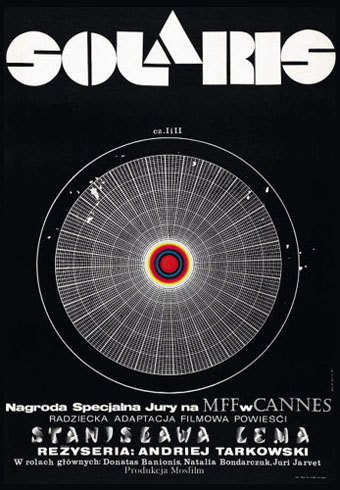
Polish poster by Andrzej Bertrandt for Andrei Tarkovsky’s 1972 film of Solaris.

• Stanisław Lem’s Solaris receives its first ever direct English translation by Bill Johnston (only on Audible for the moment), all previous editions having been sourced from a poor French translation. An all-too-common state of affairs for non-English fiction where bad or bowdlerised translations persist for years.

• Now that Minnesota politician Michelle Bachmann is running for US president it’s a good time to examine her views when (theoretically) her actions could one day impact on us all. The Daily Beast gathered together some of her worst pronouncements, including the following about gay people: “It’s a very sad life. It’s part of Satan, I think, to say that this is gay.” Her husband describes his attempts to counsel (ie: cure) gay teenagers with the words “Barbarians need to be educated.” It’s no surprise that both these people find confirmation of their views in the usual narrow interpretation of Christian doctrine. Not all American Christians are this ignorant or offensive, of course. The Heartland Proclamation calls for “an end to all religious and civil discrimination against any person based on sexual orientation and gender identity and expression”.

Journalist Andrew Sullivan in 2003 proposed a label for people like Bachmann: “I have a new term for those on the fringes of the religious right who have used the Gospels to perpetuate their own aspirations for power, control and oppression: Christianists. They are as anathema to true Christians as the Islamists are to true Islam.” It’s a term that ought to have more widespread use.

solaris-czech.jpg

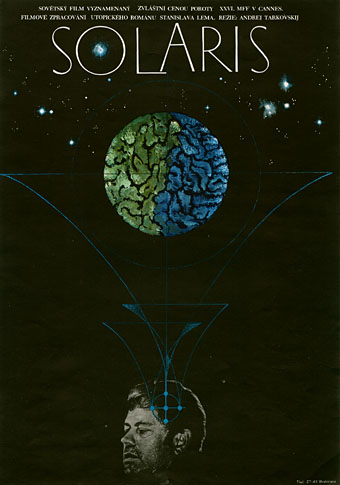
Czech poster for Solaris. No designer credited.

• Probing the secrets of psilocybin: “Scientists at the Johns Hopkins University School of Medicine have zeroed in on the dose levels of the ‘sacred mushroom’ chemical capable of yielding positive, life-changing experiences, while minimizing the chance of transient negative reactions in screened volunteers under supportive, carefully monitored conditions.”

• Rick Poynor relates a visit to the Frederic Marès Museum, Barcelona, home to the 50,000 objects Marès collected over his lifetime. Further details of the collection can be found at the museum website.

In her 1969 essay “The Pornographic Imagination,” [Susan] Sontag insisted that Story of O could be correctly defined as “authentic” literature. She compared the ratio of first-rate pornography to trashy books within the genre to “another somewhat shady subgenre with a few first-rate books to its credit, science fiction.” She also maintained that like science fiction, pornography was aimed at “disorientation, at psychic dislocation.”

If so, that aim is far more interesting than what most generic “mainstream” novels set out to do. No one could describe O as predictable or sentimental. Its vision was dark and unrelenting; everything about it was extreme. Sontag also compared sexual obsession (as expressed by Réage) with religious obsession: two sides of the same coin.

Carmela Ciuraru on the story of The Story of O by Pauline Réage.

• “No hay banda! There is no band. It is all an illusion.” David Lynch will be opening a Club Silencio in Paris (Montmartre, of course). Facebook pages here and here.

• Sad to say that Chateau Thombeau is now closed but Thom has begun a more personal journal here.

• Picture galleries of the Vorticists at the Tate here and here. Related: Into the Vortex.

• Illuminated Persian pages from 1604 at BibliOdyssey.

• Tape drawings by Chris Hosmer.

• Miles Davis and co. at the Isle of Wight Festival, 1970: part 1 | part 2 | part 3 | part 4