Weekend links 776

hoffmeister.jpg

Illustration by Adolf Hoffmeister for a Czech edition of The First Men in the Moon by HG Wells.

• It’s good to hear that Czech animator Jiří Barta is back at work on his long-gestating feature film based on the Golem legend. The new iteration looks like a reimagining of the entire project.

• Among the new titles at Standard Ebooks, the home of free, high-quality, public-domain texts: The First Men in the Moon by HG Wells.

• This week in the Bumper Book of Magic: Ben Wickey breaks down more of his Great Enchanters pages.

• At Colossal: Charles Brooks photographs the interiors of musical and scientific instruments.

• At Igloomag: Philippe Blache on neo-noir, doom jazz and related atmospheric music.

• At The Daily Heller: The book-brick that is the 1,264-page Emigre Specimen Encyclopedia.

• New music: Changing States by Matmos, and Of Shadow Landscapes by Skotógen.

• At the BFI: Josh Slater-Williams selects 10 great Japanese time-travel films.

• Lawrence English remembers the sound-art pioneer Alan Lamb.

Tunde Adebimpe’s favourite albums.

Time Machine (1967) by Satori | Time Machine (1968) by Lemon Tree | Turn Back Time (1971) by Time Machine

Weekend links 774

jakuchu.jpg

Fish and Octopus (Colourful Realm of Living Beings) (circa 1765) by Ito Jakuchu.

• At Aeon: “Could extraterrestrial technology be lurking in our backyard—on the Moon, Mars or in the asteroid belt? We think it’s worth a look.” Ravi Kopparapu and Jacob Haqq Misra explain.

• At Smithsonian magazine: The first confirmed footage of the Colossal Squid. Only a baby one, however, so not very colossal.

• The eighth installment of Smoky Man’s exploration of The Bumper Book of Magic has been posted (in Italian) at (quasi).

Less than six months later, Lindsay signed an executive order that effectively turned the city into a movie set. The new Mayor’s Office of Film, Theatre, and Broadcasting was designed to cut through existing red tape and facilitate location filming. Script approval was centralized in a single agency. A production now needed but a single permit to shoot on the streets; a specific police unit would remain with the filmmakers as they moved from location to location. Thus, Lindsay created the necessary conditions for the tough cop films, bleak social comedies, and gritty urban fables that captured the feel of New York in the late sixties and early seventies—the cinema of Fun City.

J. Hoberman explores New York City’s popularity as a film location

• Mixes of the week: A mix for The Wire by John King; and DreamScenes – April 2025 at Ambientblog.

• At Colossal: Water droplets cling to fluorescent plant spines in Tom Leighton’s alluring photos.

• At the BFI: Alex Barrett on Carl Theodor Dreyer’s unmade film about Jesus.

• Anne Billson ranks 20 films starring Julie Christie.

Voyage To The Bottom Of The Sea (1964) by Paul Sawtell | Das Boot (1981) by Klaus Doldinger | Ambient Block (Sequenchill/Mission Control #2/Lost In The Sea) (1993) by Sequential

Minotaure, 1933–1939

minotaure35.jpg

Art by Diego Rivera for the Mexican supplement in Minotaure no. 13.

I was tempted to title this one Minotaure! since I’ve been searching for copies of the magazine in question for many years. I’m certain I went looking in all the usual sources last year in the run-up to the Surrealist centenary, without success. Anyway, here they all are at last, a complete run of one of the major Surrealist periodicals.

Minotaure was notable for a number of reasons, first among them the publisher, Albert Skira, whose resources enabled the production of a very desirable item, with good design, colour prints in each issue, and plenty of photos and other artwork throughout. The Surrealist publications of the 1920s had been historically important but all of them were monochrome documents with few pictures and few pages. Minotaure had the production values of a quality magazine and an impressive roster of artists and writers to fill each issue. Skira and editor E. Tériade originally intended their periodical to cover a wide range of art, past and present, but with most of the early contributors being members of André Breton’s Surrealist circle the magazine quickly became a showcase for Surrealist art and theorising. The first issue featured a cover by Pablo Picasso, with more Picasso artwork inside. Subsequent issues had covers by leading Surrealist artists–Dalí, Ernst, Magritte, Masson–which captured the movement at a time before Breton’s persistent expulsions hollowed out the original group. Breton writes in nearly all the issues but was forbidden from using Minotaure as a political platform (the previous Surrealist journal had been the very political Le Surréalisme au service de la révolution), a restriction he kept to. His manner was often dictatorial but he always had an eye for the main chance, or the bonne chance in this case.

The written contents of Minotaure are mostly in French but the pictorial matter is worth seeing even if much of it is very familiar today. Among the written highlights are two essays by Salvador Dalí, the first on the “edible” nature of Art Nouveau architecture, with an emphasis on the work of Gaudí; the second about Pre-Raphaelite painting. It’s understandable that Dalí would be attracted by the meticulous realism of early Millais and William Holman Hunt but I didn’t know his essay included an analysis of Hunt’s The Hireling Shepherd, a painting I look at every time I’m in the Manchester Art Gallery. Elsewhere there are articles about automatism, mediumship, the decalcomania technique in painting, the esoteric symbolism of the alchemists, naive or untutored art, and plenty of single-page items and visual novelties. Photography by Man Ray and Brassaï is a recurrent feature. Skira’s magazine established a template which the two American Surrealist periodicals of the 1940s, View and VVV, did their best to follow. Now that Minotaure is freely available I’ll be waiting impatiently for complete runs of its followers to turn up somewhere.

(Note: some of the copies linked below have had their colour prints removed.)


Minotaure no. 1 (1933)

minotaure01.jpg

Cover art by Pablo Picasso.

minotaure02.jpg

minotaure03.jpg


Minotaure no. 2 (1933)

minotaure04.jpg

Cover art by Gaston-Louis Roux.

Continue reading “Minotaure, 1933–1939”

Weekend links 771

druillet.jpg

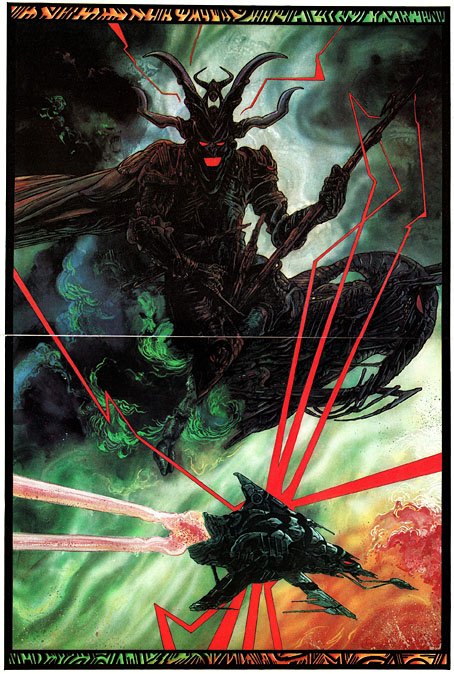
A page by Philippe Druillet from Salammbo (1980).

• At the BFI: Alex Ramon suggests 10 great British films of 1975 (the Britishness of Barry Lyndon seems a little debatable), while Jonathan Romney talks to the Quay Brothers about their latest exhibition and Sanatorium Under the Sign of the Hourglass.

• At Public Domain Review: The Cameraman’s Revenge (1912), an early animated film by Wladyslaw Starewicz concerning the domestic affairs of a pair of beetles.

Saga de Xam (previously), the science-fictional bande dessinée by Nicolas Devil and Jean Rollin, will be published in English for the first time in June.

When I first came across Ernest Berk, I assumed he was somebody’s Ursula Bogner style joke. An anti-Nazi exile turned fearless electronic pioneer, who had been a dancer in the Weimar Republic and worked both with Max Reinhardt and with Peter Zinovieff? Who nobody had ever heard of? I smelled a rat, but was wrong: Berk was very real. He was one of many dancers who fled Nazism and ended up at Dartington Hall, a school founded by wealthy hobbyists in Devon which has been slightly fancifully described as the ‘English Bauhaus’; he danced and choreographed at Glyndebourne and Covent Garden, and in the 1950s, became interested in the electronic music that was emerging out of his native Cologne. Berk gradually built a studio in Camden where he would be able to compose music for his own ballets…

Owen Hatherley on the legacy of the emigré composers who found refuge in Britain from the 1930s on

• “…distant and unrelated juxtapositions are at the very heart of Surrealism—both in France and in Japan.” Leanne Ogasawara on Surrealism in Japan.

• “What’s happening? Where are we? What about the investigation?” Mark Harris on Alan Sharp and Arthur Penn’s Night Moves.

• At Bandcamp: Dark Dreams and Bright Nightmares: Jim Allen‘s artist guide to Coil.

• At Colossal: Winners of the 2025 British Wildlife Photography Awards.

• DJ Food found more psychedelic posters from the web.

Wildlife (1987) by Penguin Cafe Orchestra | Night Moves/Fear (1988) by Jon Hassell/Farafina | Dark Dreams (1989) by Brian Eno

Weekend links 769

koitsu.jpg

Araki Street in Yotsuya (1935) by Tsuchiya Koitsu.

• “Cambridge, home of analytic philosophy, was also a hotbed of psychical research. How did this spooky subject take root?” Matyás Moravec on philosophers and precognitive dreams, Alan Turing’s interest in telepathy, and more.

• DJ Food remembers Doug Lear, founder of the Magic Lantern Narrowboat Theatre. Related: Lear’s Magical Lanterns, a TV documentary from 1983.

• New music: WEM Dominator (Live in London NW1, 2016) by Earth; and Rubber Band Music by Kate Carr.

• At Public Domain Review: Master of Claude de France’s book of flower studies (ca. 1510–1515).

• At Colossal: Landscapes, customs, and culture shape the 2025 Sony World Photography Awards.

• At the BFI: Carmen Gray offers suggestions for ten great Baltic films.

• Mix of the week: DreamScenes – March 2025 at Ambientblog.

• At Dennis Cooper’s: Room Temperature Day.

Vinyl sleeves from Supraphon.

Telephone And Rubber Band (1981) by Penguin Cafe Orchestra | Rubbermiro (1981) by Liquid Liquid | Onions Wrapped In Rubber (1994) by Tortoise