Weekend links 818

paunzen.jpg

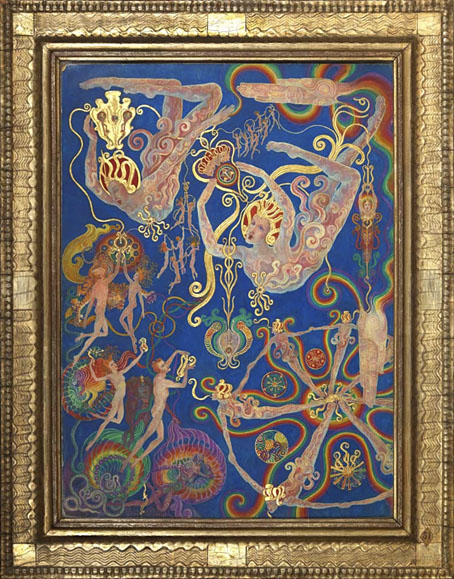
The Bookworm (no date) by Arthur Paunzen.

• New Cabaret Voltaire: Nag Nag Nag (Live 2025 Single Edit). Good to hear they’ve reinstated the Patrick Moore dialogue sample, something that’s on the studio version but usually missing from live recordings. The single is a trailer for a forthcoming album based on the group’s recent anniversary tour.

The Mysterious Castle in the Carpathians (1981), a wacky Czech comedy, one of many directed by Oldřich Lipský. With a story by Jules Verne, music by Luboš Fišer, and steampunk props by Jan Švankmajer.

• More new music: Butch’s Guns by Sunn O))); Sidings by Craven Faults; Frequencies In The Fog by Rod Modell.

What strikes me most is the difference between people who’ve learned to construct what I call “containers for attention”—bounded spaces and practices where different modes of engagement become possible—and those who haven’t. The distinction isn’t about intelligence or discipline. It’s about environmental architecture. Some people have learned to watch documentaries with a notebook, listen to podcasts during walks when their minds can wander productively, read physical books in deliberately quiet spaces with phones left behind. They’re not rejecting technology. They’re choreographing it.

What we think is a decline in literacy is a design problem, says librarian Carlo Iacono

• At Colossal: “Striking photos by Peter Li capture the soaring majesty of sacred spaces.”

• At Public Domain Review: The Eight Horses of King Mu, Son of Heaven (ca. 1300).

• At the BFI: Brogan Morris selects 10 great political thrillers.

• At Dennis Cooper’s: Roland Topor’s Brain.

• RIP Robert Duvall and Tom Noonan.

The Book Lovers (1997) by Broadcast | Tiny Golden Books (2000) by Coil | Library Of Solomon Book 2 (2011) by Demdike Stare

Weekend links 816

rossignol.jpg

The Creative Power of the Spirit, No. 31 of A Goodly Company series, 1920–1933 by Ethel le Rossignol.

• “One moment it was a little blip. The next, our friends are dying”: the gay porn soundtrack composers lost to the Aids crisis. More gay porn: Pink Narcissus, James Bidgood’s micro-budget homoerotic fantasy, will receive a UK blu-ray release later this year.

• Old music: Thirst by Clock DVA gets a very welcome reissue later this year, having been unavailable in any form since 1992. I’m not so happy about the changes to Neville Brody’s original cover design but the album itself is a major post-punk statement.

• “Graphic design was thought to be a man’s discipline,” she says. “So I think it was quite a surprise for people to find me there.” A profile of Margaret Calvert, designer of (among other things) Britain’s road signs.

• At Colossal: A major survey in Paris chronicles Leonora Carrington’s esoteric Surrealism.

• At Public Domain Review: Sara Weiss’ Journeys to the Planet Mars (1903).

• At the BFI: The mystery music video for The Beatles’ Penny Lane.

Winners and entrants for Close-up Photographer of the Year 7.

• “Cats to blame for octopus deity enshrinement delay.”

• Steven Heller’s font of the month is Cattivo.

• At Dennis Cooper’s it’s Jack Arnold’s Day.

Pink Noir (1996) by David Toop | Pink Dust (2013) by Sqürl | The Pink Room 2 (2024) by Seigen Ono

Weekend links 815

hawksmoor.jpg

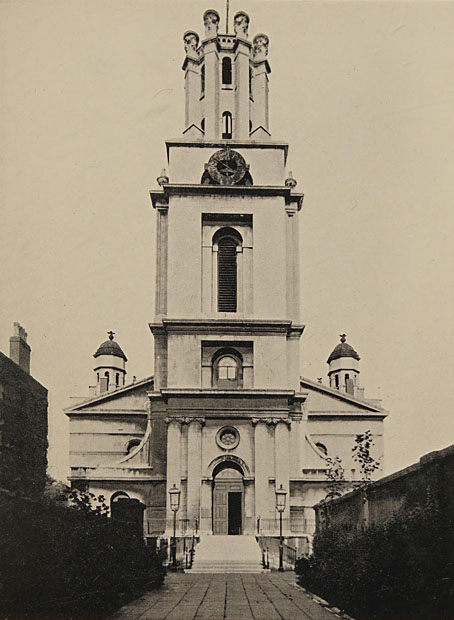
A photograph by FR Yerbury of St George’s-in-the-East, London. From Nicholas Hawksmoor (1924) by HS Goodhart-Rendel.

• “Sixty years later, the Spectacle saturates us in ways the Situationists never imagined. Online platforms structure our personal relationships; algorithms nudge us toward the platform owners’ preferred choices. ‘Intelligence’ is embedded into everything from our phones to our kitchen appliances. But back in the Sixties, the Situationists saw the physical environment of the city as an expression of the mass society created by consumerism and governed by the Spectacle, and they felt power closing in around them: ‘All space is occupied by the enemy. We are living under a permanent curfew. Not just the cops—the geometry.'” Hari Kunzru takes a psychogeographical dérive through the streets of London, encompassing the Hawksmoor churches, Iain Sinclair’s own peregrinations, Alan Moore’s Sinclair-influenced script for From Hell, Arthur Machen and more. (No mention of Alan’s ongoing Long London series, however, the first book of which is a deep dive into Machen territory.) Kunzru could be accused of being 30 years too late with his piece but for younger readers and many Americans these paths are worth retracing.

Enemies from Venus!: “The only surviving fragment of a Dutch science fiction series for children from the mid-sixties (that never was).” CGI animation by Ernst-Jan van Melle in the style of black-and-white puppet shows like Fireball XL5, Space Patrol, etc.

• “If this is a horror story, it’s a horror story about being desperate for love, and about the vulnerability, loneliness, and difficulty in understanding other people that might drive this state.” Olivia Laing on Jonathan Glazer’s second feature film, Birth.

• At the BFI: Rory Doherty selects 10 great British heist films.

• At The Daily Heller: Posting Posters about Fellini.

• RIP Sly Dunbar; James Sallis; Catherine O’Hara.

• At Dennis Cooper’s it’s Peter Whitehead’s Day.

• The Strange World of…Toumani Diabaté.

• New music: Errata by WF 98.

Birth (1971) by Keith Jarrett | Birth (1995) by Howie B | Birth (2013) by Roly Porter

Weekend links 814

dameron.jpg

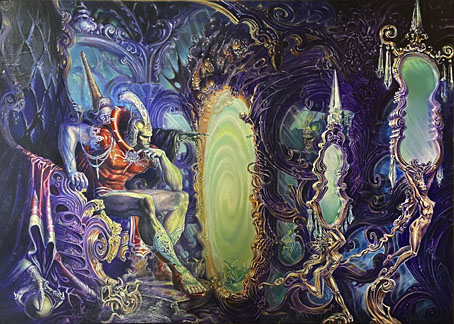
Kull of Atlantis—The Mirrors of Tuzun Thune by Ned Dameron for Kull (1985) by Robert E. Howard. Via.

Jeremy Allen reviews the latest reissue of The New Worlds Fair by Michael Moorcock and The Deep Fix, describing the album as “a fascinating and quixotic document from the time it was made, deserving to be taken seriously in its own right”.

• Among the new titles at Standard Ebooks, the home of free, high-quality, public-domain texts: Short Fiction, a small collection of early stories by Clark Ashton Smith.

• New music: Geometry of Murder: Extra Capsular Extraction Inversions by Earth x Black Noi$e; Live At Nonseq by WNDFRM.

The book is not just loaded with words or tongues. Its also loaded with genres, or more accurately, different modes of literature. And one of the modes I particularly enjoyed this time around is, appropriately, the Weird. In ways long noted on forlorn and unspeakable subreddits, there is a decidedly Lovecraftian dimension to Melville’s Whale, which the Master of Providence did read and enjoy months before writing his game-changing “Call of Cthulhu.” We begin the novel with a sick soul, who may or may not be named after an Old Testament outcast, wandering through a macabre and fetid New England whale-town, following grim portents that lead him on towards a cursed ship doomed to confront a monster who sleeps or at least feeds, and presumably dreams, at the bottom of the sea. And that’s just the first couple of chapters.

Erik Davis on the pleasures of re-reading Moby-Dick, in a piece which makes me want to read the novel again

• At the BFI: Phil Hoad on David Lynch’s efforts to keep making films in an industry resistant to his kind of art.

• Exploration Log 12: Adam Rowe on the best retro science fiction art collections.

• At Public Domain Review: The Nine Birds of Jacques de Fornazeris (1594).

Winners and finalists for the 2025 Ocean Art Contest.

• Mix of the week: A mix for The Wire by Hilary Woods.

The Whale (1977) by Electric Light Orchestra | Don’t Kill The Whale (1978) by Yes | School For Whales (1980) by Marc Barreca

Weekend links 808

kometen.jpg

Comets from Meyers Konversationslexikon (1885–90).

• At The Daily Heller: Steven Heller reviews A Life in Ink, a new monograph about the art of Ralph Steadman. Heller is full of praise for Steadman, and discusses commissioning his work for The New York Times. But in his bewilderment at Steadman’s lack of a knighthood he seems unaware of the degree to which state honours are frequently refused by Britons, especially those who position themselves in opposition to the established order. Americans are obsessed with awards and “halls of fame”, and appear to regard Britain’s state honours as something like the Oscars with a royal seal, rather than what JG Ballard once described as “a Ruritanian charade that helps to prop up the top-heavy monarchy.” If Steadman has deliberately shunned the honours list he’d be joining a venerable company.

• “In mid-19th century Italy, two eccentric aristocrats set forth on parallel projects: constructing ostentatious castles in a Moorish Revival style. Iván Moure Pazos tours the psychedelic chambers of Rochetta Mattei, optimised for electrohomeopathic healing, and Castello di Sammezzano, an immersive, orientalist fever dream.”

• New music: Ithaqua by Cryo Chamber Collaboration is this year’s installment in the Lovecraft-themed album series (previously) from Cryo Chamber. Also this week: Analog 2025 by Various Artists; and Flux (music for a performance by still still / Marta & Kim) by Rutger Zuydervelt and Lucija Gregov.

For all their bravura and maximalism, Powell and Pressburger understood the power of leaving things out, building into their films chasms that the mind must leap, gaps that the imagination must fill. Like Joan Webster, we discover that we don’t want things to be made too easy. We want to catch our own fish rather than have them delivered, to swim in the ocean rather than in a pool.

Imogen Sara Smith on I Know Where I’m Going, one of the films from Michael Powell and Emeric Pressburger’s golden decade, the 1940s

• Among the new titles at Standard Ebooks, the home of free, high-quality, public-domain texts: In the Days of the Comet by HG Wells.

• At the BFI: David Parkinson selects 10 great Sherlock Holmes films and TV adaptations.

• Winning entries for the Capture The Atlas Northern Lights Photographer of the Year.

• Books and original drawings by Austin Osman Spare on sale at Gerrish Fine Art.

• At Unquiet Things: The art of Chie Yoshii.

Kohoutek-Kometenmelodie (1973) by Kraftwerk | Cometary Wailing (1981) by Bernard Xolotl | Kometenmelodie Part 1 (1994) by 300,000 VK