Weekend links 273

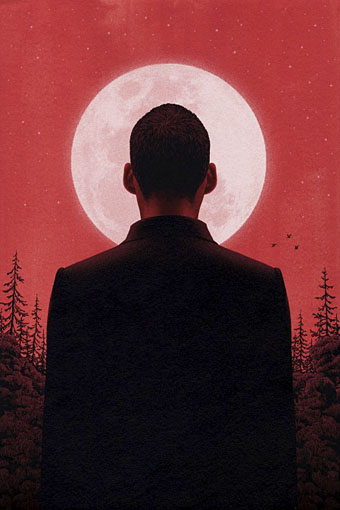
pelcer.jpg

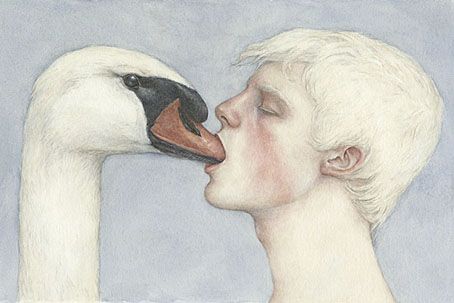
Byronic I by Boris Pelcer. Via Full Fathom Five.

• “Music determines everything in terms of our narrative. Music demands, music suggests. Whereas traditional Hollywood animation is all based on character development—you know, there’s Toy Story and it’s Tom Hanks’s voice pushing the thrust of the action. For us, décor is all part of it. It’s the objects, a sense of atmosphere, the stimmung (mood) of what’s happening in this landscape where the puppet is just, invariably, a tiny element.” The Brothers Quay talking to JW McCormack about their films, and about Quay, a short documentary by Christopher Nolan.

• Croissants with Cthulhu: Stephanie Gorton Murphy reports on the Cthulhu Prayer Breakfast at last week’s NecronomiCon. I didn’t attend this: abject silliness is the last thing I want at 8 o’clock in the morning.

• “…a light daze for the rest of the afternoon, detrimental to studying but advantageous for daydreaming.” Italo Calvino on his cinema-going youth.

Only in that brief moment of absolute uncertainty – when both options seem equally plausible and implausible, when neither thought can be accepted or rejected, when everything can be explained and nothing can be explained – only in that moment do we really have this horror of philosophy, this questioning of the principle of sufficient reason. It is for this reason that Todorov qualifies his definition by stating that the “fantastic occupies the duration of this uncertainty.”

Eugene Thacker in an extract from Tentacles Longer Than Night (Horror of Philosophy, vol. 3), Zero Books, 2015

• It’s always good to hear some new rumblings by Emptyset. The Guardian has a stream of side 1 of the latest release, Signal.

• David Rudkin’s Penda’s Fen receives a film screening at the Whitechapel Gallery, London, on Saturday, 5th September.

Sea Calls Me Home, another song from the forthcoming Julia Holter album.

• Digital visualizations of imagined future landscapes by Mike Winkelmann.

• Mix of the week: The Ivy-Strangled Path Vol. IX by David Colohan.

• Cherchez la femme: Women and Surrealism at Sotheby’s, NYC.

• At It’s Nice That: 50 years of A Humument by Tom Phillips.

April 16, 1963: Housewife on LSD

Tentaclii: a Lovecraft blog

Signal (1981) by Phew | Signals (1983) by Brian Eno with Daniel Lanois and Roger Eno | Signals (2010) by The Soundcarriers

Dark arts

pvd05.jpg

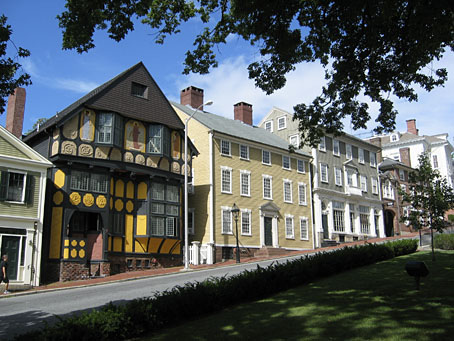
Thomas Street, Providence: on the left is the Fleur-de-Lys Studios; two doors along is the Dodge House Gallery which housed an additional part of the art exhibition; the Providence Art Club is the red-brick building next door.

I’m back from Providence, returned early on Tuesday but took the day off to recover from jet lag. The city was hot and humid for much of the time but I didn’t mind that, it was good to be able to walk around in the evening without a jacket, something that seldom happens here. I don’t go to many conventions so although NecronomiCon was the best I’ve been to, there isn’t a great deal of competition. I always enjoy meeting and talking to creators of any stripe—writers, artists, filmmakers, editors, etc—and it’s a pleasure to meet readers face to face, but conventions in general aren’t always attractive in themselves. NecronomiCon was inviting for being relatively small and with a strong focus not just on Lovecraft but on weird fiction as a whole: there were panels on Clark Ashton Smith, Lord Dunsany, Robert Chambers, and one on the legacy of what M. John Harrison designated “the New Weird”. I’ve been told that if there’s a NecronomiCon in 2017 the intention is to develop this area of discussion.
pvd07.jpg

And then there’s Providence itself: Lovecraft’s stories will read in a very different light now I’ve visited the city that inspired so much of his work. The one walking excursion I took to College Hill was curtailed by an afternoon of 30-degree temperatures but I did get to see a small part of Angell Street where Lovecraft lived for many years, and I also walked down Benefit Street as far as house number 135, familiar to readers as The Shunned House. The architecture of Providence is a delight, not only the Colonial buildings but the also the more recent vernacular styles of the Downtown area. Even the heat seemed connected to Lovecraft and his abhorrence of cold weather; in later years he took sightseeing trips down to Florida so I’m sure he wouldn’t have complained about the hot sun or the swampy air.
pvd06.jpg

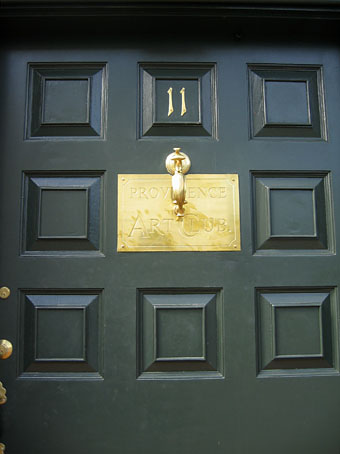
The massive and weighty door of the Art Club.

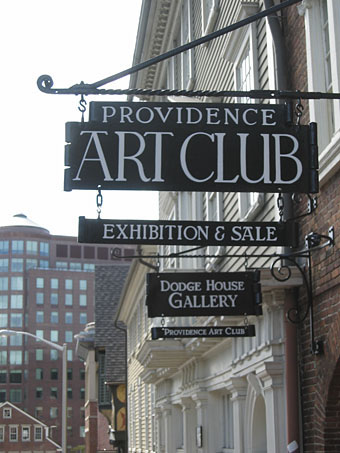
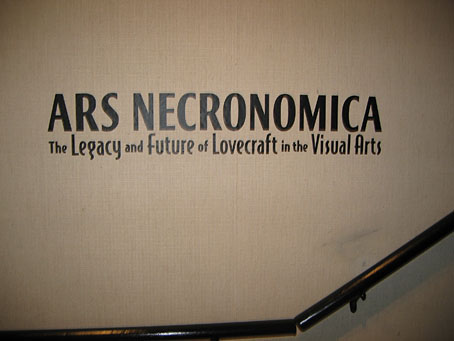
The main reason to be there was for the art exhibition, of course, and for that the venue couldn’t have been better. The Providence Art Club is mentioned in The Call of Cthulhu as a rather staid organisation that disapproves of Henry Anthony Wilcox who works down the street at the Fleur-de-Lys Studios; I spoke to a couple of current Art Club members, and was amused to hear that the establishment still maintains a somewhat conservative position. But the presence of so much bizarre and grotesque art in the gallery was evidence of a loosening of attitudes that Wilcox and Pickman couldn’t have managed in their day. A selection of my photographs follows below; I took over 250 photos but really should have taken more, especially of the buildings. The Providence Art Club has a good collection of photos from the opening night, some of which include me caught uncomfortably in front of a camera lens.
pvd18.jpg

Some acknowledgements: I’ve already thanked Niels-Viggo Hobbs and The joey Zone for inviting me there but I’ll do so again. Big thanks also to Carmen Marusich who spent most of her time behind the counter at Lovecraft Arts & Sciences in the Arcade; to print-wrangler Brian Mullen who very generously spent an afternoon ferrying me around various stores in search of a phone charger before smartly suggesting I try the USB port in the TV at the hotel (something I should have thought of); and to Michael Rose and company at the Providence Art Club for allowing us into their beautiful building. Shouts and thanks to: Sara Bardi, Michael Bukowski, Syl Disjonk, Jason C. Eckhardt, Bob Eggleton, Dave Felton, Stephen Gervais, Mike Knives, Robert H. Knox, Allen Koszowski, Henrik Möller, Mallory O’Meara, Gage Prentiss, Skinner, Jason Thompson, Frank H. Woodward (at last!), Josh Yelle, and all those who bought artwork, offered compliments or came to see the art and the panel discussions.

Finally…Earth! I’ve been listening to the band a great deal this year so I’m predisposed to enjoy any live event, but their performance in the gilded splendour of the Columbia Theatre on Federal Hill really knocked me out. An outstanding set with great sound and great support acts too, especially Elder. All this taking place a couple of streets away from the location of Lovecraft’s Starry Wisdom church; I was in seventh heaven.

And now the photos…
pvd16.jpg

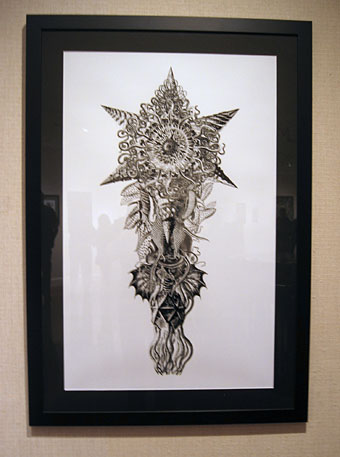
The title page entity from Lovecraft’s Monsters which was named Tentacles for the exhibition.
pvd17.jpg

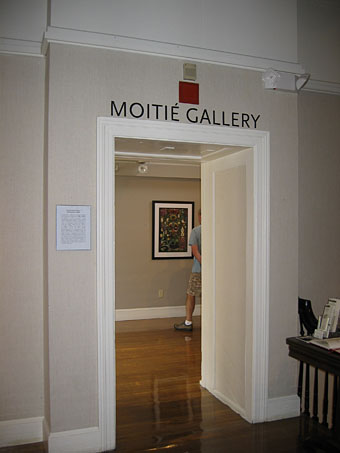
My works were in a gallery room on their own, guarded by the title page thing from Lovecraft’s Monsters.

Continue reading “Dark arts”

Weekend links 272

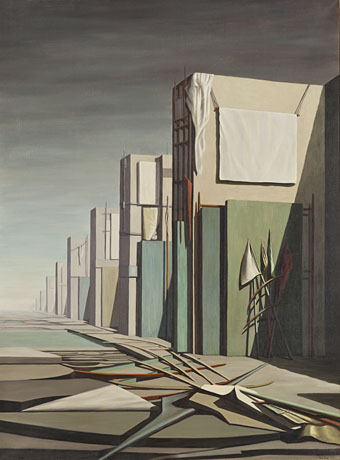
sage.jpg

No Passing (1954) by Kay Sage.

• More Lovecraftiana: She Walks In Shadows, an illustrated all-woman Lovecraftian anthology, will be published in October. Related: “The octopus genome and the evolution of cephalopod neural and morphological novelties“, a study that’s been filtering through the press as “Do octopuses have alien DNA?”

• “The right to ‘subject each others’ fundamental beliefs to criticism’ is the bedrock of an open, diverse society,” says Kenan Malik in his TB Davie Memorial Lecture.

Sunn O))) with Attila Csihar at the Berlin Heimathafen. Related: Here’s what you missed at Sunn O)))’s sold out Berlin gig.

Caillois is fascinated by these “beveled buildings,” truly abundant in the Fifteenth, along with an unusually high incidence of blind walls, false façades, and merely ornamental windows, each beloved of his phantoms. In the parts of the arrondissement developed during the postwar period, Caillois’s attention is drawn instead to the ventilator shafts and drainage grates that dot the streets. These structures, built to clear away rainwater or aerate underground garages, have a secret function, according to him. Noting their uncanny similarity to some of the settings in the Weird Tales of HP Lovecraft, he speculates that they may have been constructed to provide the entry points for an extraterrestrial invasion of our planet.

Ryan Ruby on Roger Callois and the phantoms of the Fifteenth Arrondissement

• “I’m really into big moments,” says Julia Holter whose new album, Have You In My Wilderness, is released next month.

Adrian Utley talks to Peter Zinovieff, co-inventor of the EMS synthesizer. Related: What the Future Sounded Like.

• “Tarkovsky’s Solaris is the anti-2001: A Space Odyssey,” says Marissa Visci.

• Mix of the week: Gizehcast #17 by Rutger Zuydervelt.

Modernist architecture on film.

Thaumaturgy at Tumblr

The Call of Ktulu (1984) by Metallica | Cthulhu Dawn (2000) by Cradle of Filth | Cthulhu: A Cryo Chamber Collaboration (2014) by Various Artists

Weekend links 269

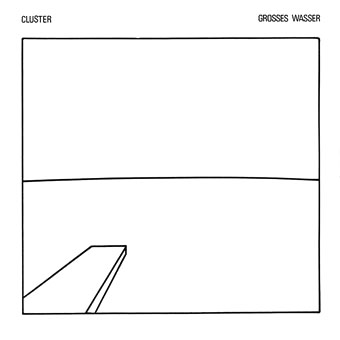
cluster.jpg

Grosses Wasser (1979) by Cluster. Cover art by Dieter Moebius.

• RIP Dieter Moebius: one half of Cluster (with Hans-Joachim Roedelius), one third of Harmonia (with Roedelius and Michael Rother), and collaborator with many other musicians, including Brian Eno and Conny Plank. Geeta Dayal, who interviewed Moebius for Frieze in 2012, chose five favourite recordings. From 2008: Cosmic Outriders: the music of Cluster and Harmonia by Mark Pilkington. At the Free Music Archive: Harmonia playing at ATP, New York in 2008. Live recordings of Cluster in the 1970s have always been scarce but in 1977 they played a droning set at the Metz Science-Fiction Festival, a performance that was broadcast on FM radio (the Eno credit there seems to be an error).

• “I’ve since had the feeling that, if the attacks against The Satanic Verses had taken place today, these people would not have defended me, and would have used the same arguments against me, accusing me of insulting an ethnic and cultural minority.” Salman Rushdie on the fallout from the Charlie Hebdo killings.

• “The effect of these memories is to make you think you know the film better than you do, and wonder what it’s like actually to sit down and watch it.” Michael Wood on rewatching Orson Welles’ Touch of Evil (1958). Related: Tipping My Fedora on the film’s source novel, Badge of Evil (1956).

“To me, it’s simple,” he says. “Fantasy became as bland as everything else in entertainment. To be a bestseller, you’ve got to rub the corners off. The more you can predict the emotional arc of a book, the more successful it will become.

“I do understand that Game of Thrones is different. It has its political dimensions; I’m very fond of the dwarf and I’m very pleased that George [R R Martin], who’s a good friend, has had such a huge success. But ultimately it’s a soap opera. In order to have success on that scale, you have to obey certain rules. I’ve had conversations with fantasy writers who are ambitious for bestseller status and I’ve had to ask them, ‘Yes, but do you want to have to write those sorts of books in order to get there?’”

Michael Moorcock talking to Andrew Harrison about fantasy, science fiction, the past and the present.

• “Architects love Blade Runner, they just go bonkers. When I was working on the film, it was all about, let’s jam together Byzantine and Mayan and Post-Modern and even a little bit of Memphis, just mash it all together.” Designer and visual futurist Syd Mead talking to Patrick Sisson.

• “Lucian of Samosata’s True History reads like a doomed acid trip,” says Cecilia D’Anastasio, who wonders whether or not the book can be regarded as the earliest work of science fiction.

• Mixes of the week: A Tribute to Dieter Moebius by Vegan Logic, and another by Totallyradio.

• The Phantasmagoria of the First Hand-Painted Films by Joshua Yumibe.

Islamic Geometric: calligraphic tessellations by Shakil Akram Khan.

Michael Prodger on The Dangerous Mind of Richard Dadd.

A chronological list of synth scores and soundtracks.

Touch Of Evil (Main Theme) (1958) by Henry Mancini | Badge Of Evil (1982) by Cabaret Voltaire | Touch Of Evil (2009) by Jaga Jazzist