Weekend links 255

farneti.jpg

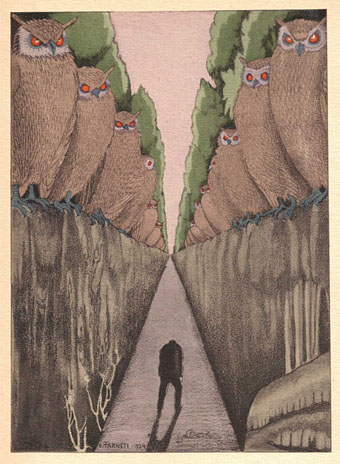
The Owls by Carlo Farneti for a 1935 edition of Les Fleurs du Mal. Via Beautiful Century although the scans probably came originally from 50 Watts.

• “…a project that seemed under a curse comprising greed, peculiar French copyright laws, jealousies and grudges, bad judgment, complicated ownership disagreements, a messy estate, and a list of individuals who believed they had some legal, financial, moral, or artistic right to the film itself.” Josh Karp on the tangled history of The Other Side of the Wind, always the most interesting of Orson Welles’ unfinished feature films.

• Producer Conny Plank is remembered for his work with a host of German artists but he also recorded a session with Duke Ellington and His Orchestra in 1970. Grönland Records is releasing the session in July, and they’ve posted Afrique (take 3 vocal) as a taster.

• “And that’s what a lot of social media by authors is starting to look like, to feel like: being smacked in the face, repeatedly, by hundreds of fish.” Delilah S. Dawson wants authors to leave off the incessant self-promotion.

“In everybody, there is an inner bestiary,” she claimed, and her pictures are overrun with animals and animal-headed creatures; sometimes sinister, sometimes acting as guides to the unconscious, as in The Pomps of the Subsoil (1947). As her interests grew more hermetic her paintings abandoned all trace of the world beyond. If the figures occupy any sort of space it’s rarely more than the planes of a room in muted browns or greys, and in many the surface is overlaid with geometric patterns that seem to imply some mystical framework.

Alice Spawls on the art and life of Leonora Carrington

• “How a pro-domme, a Russian diplomat, US intelligence and Mary Tyler Moore’s landscaper conspired to create a dance classic.” Dave Tompkins on The Dominatrix Sleeps Tonight.

• “Battersea, in fact, is a fairly simple climb, made ready by the builders who are destroying it.” Katherine Rundell on climbing Battersea Power Station at night.

• Mixes of the week: Secret Thirteen Mix 148 by Mlada Fronta, and The Ivy-Strangled Path, Volume V, by David Colohan.

Erté illustrates a gay romance in Lytton Strachey’s Ermyntrude and Esmeralda (1913 but not published until 1969).

• Dangerous Minds looks back at “The most unusual magazine ever published”, Man, Myth & Magic.

David Chase on the writing, directing and editing of the final scene of The Sopranos.

Magic Man (1969) by Caravan | The Myth (1982) by Giorgio Moroder | Magick Power (1987) by Opal
Weekend links 254

scdc.jpg

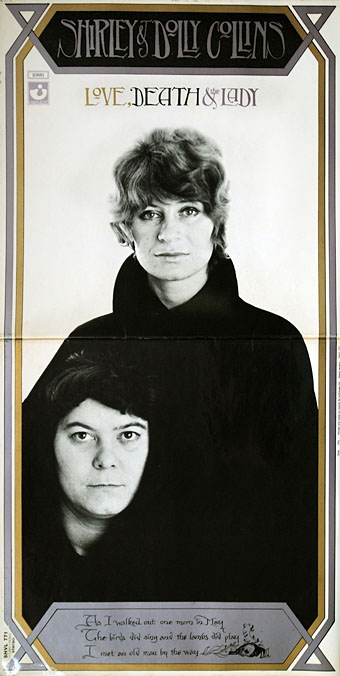
Gatefold sleeve for Love, Death and the Lady (1970) by Shirley & Dolly Collins. Photo by Allan Willmoth. No designer credited.

• “When you look at a lot of modern album covers, the art school obsession with the Helvetica kind of undermines it. So instead of looking at an artefact that comes from another place entirely, you are looking at an artefact that has been caught and tamed and made corporate.” Roger Dean talking to Liv Siddall about cover design in the 1970s.

• Erik Davis talks to Stephen Finley, author of Esotericism in African American Religious Experience, about hoodoo and metaphysical blackness. Related: Sun Ra’s Afrofuturist masterwork, Space Is The Place, has been reissued by Harte Recordings as a limited DVD, CD and hardcover book.

• “…she has managed to unearth a coal-seam of neglected songs and stories, incantations of the working people from across the English-speaking planet with their edge of discord left intact, the harmonies frayed by hard-won experience.” Alan Moore on the great Shirley Collins.

[MR] James’s influence, or his example, has rarely been more strongly with us than now. For there is presently apparent, across what might broadly be called landscape culture, a fascination with these Jamesian ideas of unsettlement and displacement. In music, literature, art, film and photography, as well as in new and hybrid forms and media, the English eerie is on the rise. A loose but substantial body of work is emerging that explores the English landscape in terms of its anomalies rather than its continuities, that is sceptical of comfortable notions of “dwelling” and “belonging”, and of the packagings of the past as “heritage”, and that locates itself within a spectred rather than a sceptred isle.

Such concerns are not new, but there is a distinctive intensity and variety to their contemporary address. This eerie counter-culture—this occulture—is drawing in experimental film-makers, folk singers, folklorists, academics, avant-garde antiquaries, landscape historians, utopians, collectives, mainstreamers and Arch-Droods alike, in a magnificent mash-up of hauntology, geological sentience and political activism. The hedgerows, fields, ruins, hills and saltings of England have been set seething.

Robert Macfarlane on the eerieness of the English countryside

• Lots of mixes to choose from this week: Songs from a Railway Station at Dusk by Abigail Ward; mix series The Ivy-Strangled Path by David Colohan is now up to Volume IV; a trove of occult psychedelia from The Ghost of the Weed Garden.

• “Blood Meridian was released on April 28, 1985 to little initial acclaim, but would later gain recognition as one of the most significant novels of the late 20th century.” Ted Gioia on the rise and fall of the Western.

• From the past week’s zones of research: the Gregory Pendennis Library Of Black Sorcery, and Vault Of Evil: Brit Horror Pulp Plus!

• At Dangerous Minds: Zappa meets claymation in the wonderful VHS rarity The Amazing Mr. Bickford.

Synthesizer manuals at the Internet Archive.

• Pages from The Graphic Canon at Pinterest.

Sabbath, a new song by Jenny Hval

French book covers

The Cruel Mother (1967) by Shirley Collins | The Unquiet Grave (1968) by Shirley Collins | Go From My Window (1970) by Shirley & Dolly Collins

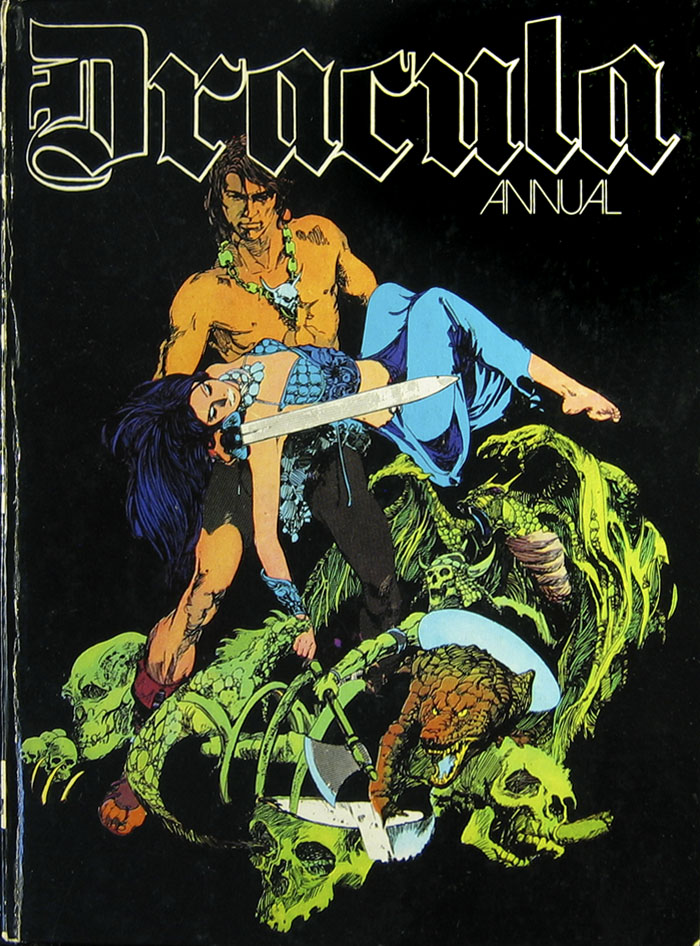
The Dracula Annual

wolff1.jpg

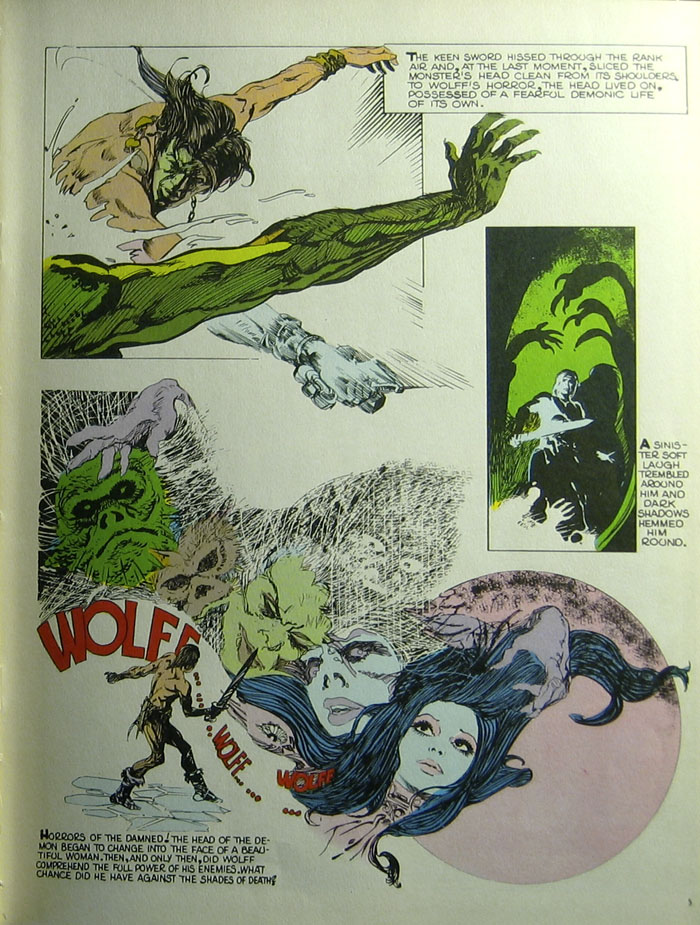
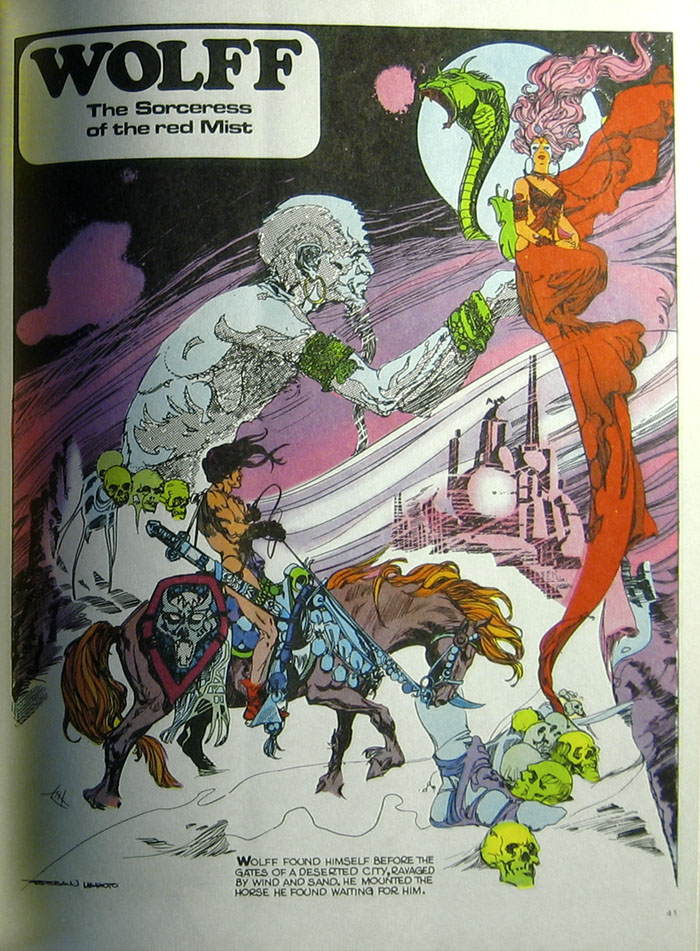
A comment by Modzilla in last month’s post about psychedelic comic book Saga de Xam is responsible for this recent book purchase. Dracula was a full-colour large-format comic book from notorious pulp imprint New English Library (later to be distributors for my colleagues at Savoy Books) that repackaged Spanish horror strips for a British audience. The comic ran for 12 issues in the early 1970s; the pages shown here are from the hardback annual that gathered all the issues into a single volume. I remember this being around in secondhand shops for years but I never paid it any attention at all so the artwork has been a revelation.

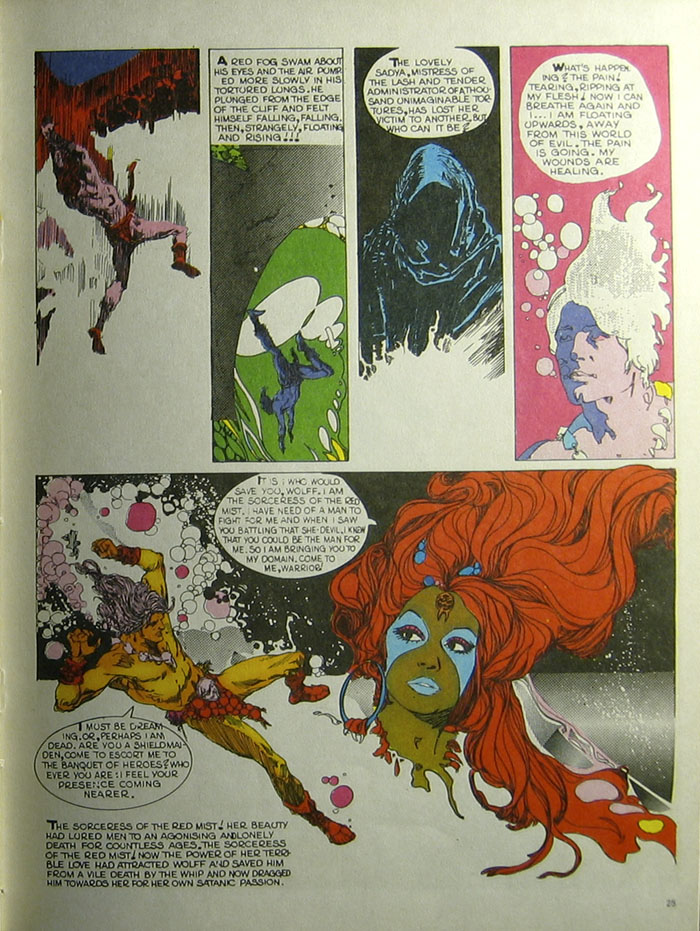
NEL’s Dracula isn’t much of a horror comic, despite its title; Dracula himself only appears in one story, and that’s a jokey throwaway piece. The two main episodic strips are Wolff, a Conan clone searching for his lost wife in a world ravaged by witches, werewolves and other supernatural threats; and Agar-Agar, a deliriously psychedelic picaresque concerning a hyper-sexual “sprite” (or a hippyish young woman with blue hair and magic powers) from the planet Xanadu. Everything in the book is redolent of the early 1970s when strains of psychedelia were still percolating through pop culture. Watered-down psychedelia used to bore me because I wanted the authentic stuff but forty years on this kind of work is much more attractive.

wolff2.jpg

Wolff is the work of Esteban Maroto whose splash pages and inventive layouts give Barry Windsor-Smith’s Conan the Barbarian (which was running at this time) some serious competition. Wolff is very much in the Conan mould—he even shouts “Crom!” at crucial moments—a pawn of supernatural forces he often fails to comprehend. The artwork in Smith’s Conan was often praised for its details and decor but the Art Nouveau influence in Maroto’s work is much more overt. Maroto’s flame-haired witches are like Alphonse Mucha sirens—one panel even borrows from Mucha’s Salammbô—and he’s no slouch with the Frazetta-like demons either. The scripting is perfunctory but I don’t mind that when it turns up pages like these. There’s also a brief nod to Lovecraft when “R’Lyeh” is mentioned.

wolff3.jpg

wolff4.jpg

Continue reading “The Dracula Annual”

Yuggoth details

yuggoth01.jpg

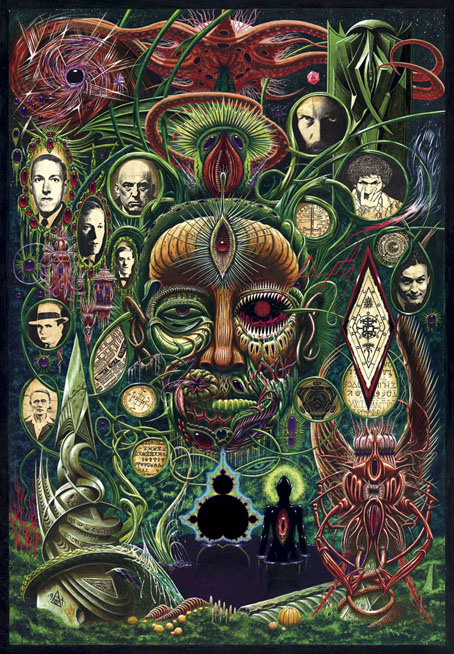
Yuggoth Cultures (1994) by John Coulthart.

Earlier this week I spent a day scanning this painting—which I’m now surprised to find is 21 years old—so I might at last have a good quality digital copy. There’s been a copy on the website for years but that was a print made at a high-street copy shop that did nothing for the detail and range of colour. It’s quite a large piece—49.54 x 71.39 cm (19.5 x 28.1 inches)—done with acrylics on board. Since 2003 the painting has been used (in another poor reproduction) on the cover of The Starry Wisdom, the controversial collection of Lovecraftian fiction from Creation Books. The painting wasn’t originally intended for that collection, however, and doesn’t quite fit since a number of the portraits don’t feature in the book at all.

Yuggoth Cultures would have been an earlier collection of Lovecraftian fiction and non-fiction that Alan Moore had begun writing for Creation in 1993. Alan’s idea was to take Lovecraft’s Fungi from Yuggoth sonnet sequence as the basis for a collection that would explore Lovecraft’s fictional world and also draw together a variety of figures from the same era: fellow writers, occultists like Aleister Crowley and Austin Spare, and Harry Houdini for whom Lovecraft ghost-wrote Imprisoned with the Pharaohs in 1924. Unfortunately the stars were not right on this occasion; Alan took the sole copy of the half-written manuscript to London in order to read selections at an event in Soho but left the papers in a cab. Some pieces survived, having been copied and stored elsewhere—The Courtyard in The Starry Wisdom is one of these—and there was talk for a while of the lost pieces being rewritten but enthusiasm for the project flagged.

yuggoth08.jpg

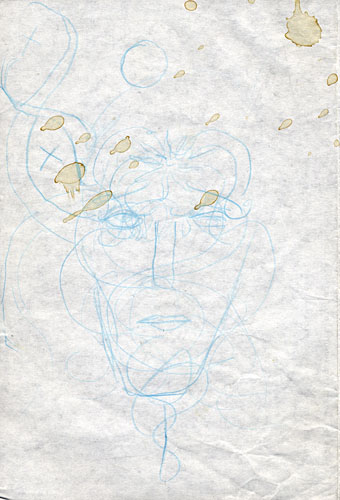
This is Alan’s sketch for the cover, the idea being to have a Lovecraft head made of fungal growths rather like an Arcimboldo painting. The head would be sprouting tendrils whose loops would contain pictures of some of the people featured in the book. Alan’s quick sketch is actually a better approximation of Lovecraft’s strange features than my painted version which isn’t narrow enough. For the record (and because people always ask), the other people on the cover are Alan himself, Austin Osman Spare, Aleister Crowley, Harry Houdini, Robert E Howard (not Al Capone as people often think) and Clark Ashton Smith.

yuggoth09.jpg

yuggoth10.jpg

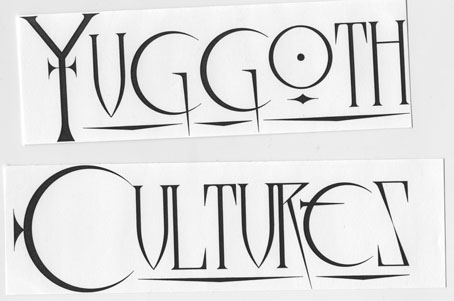
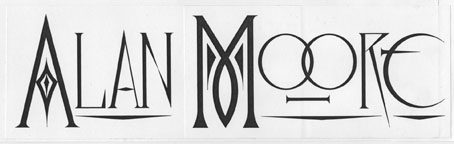
While searching through the archives I discovered these lettering designs although they’re probably not bold enough to read very well on such a busy painting. Before I started using a computer, designs like this had to be drawn at large size then scaled down using a photocopier.

Continue reading “Yuggoth details”

Weekend links 251

quintana.jpg

Beliel (2013) by Dan Quintana.

Guida essenziale all’Italian Occult Psychedelia. Out next month: Nostra Signora Delle Tenebre, a tribute to “movies that…retained a decidedly Italian flavour, a bizarre mix of nasty violence, lurid sexuality and feverish Catholic mysticism, all filtered through a manic obsession with death, blood and the sins of the flesh.” In the meantime, try the Italic Environments mix by Lay Llamas.

• “His work matters more than ever now because it stands in contrast to all the sequels, the comic-book adaptations, that Hollywood makes to sell lunchboxes.” Ryan Gilbey looks at a new documentary about the great Robert Altman.

• Psychedelic Culture at the Crossroads: Erik Davis on the ongoing reappraisal of the value of psychedelic drugs. Related: Dude, You Can Draw Magic Mushrooms With an Oscilloscope.

Like [Ellen Sofie] Lauritzen, what I appreciate about music, writing, and films that vary from dated to downright misogynist is the rawness I see expressed, a sheer energy that can’t toe the line of perfect political obeisance. I join her in hoping that we back down from using “problematic” as a censorious bludgeon against creative achievements, no matter how problematic they are.

Sarah Seltzer on whether feminists can enjoy misogynist art

• Mixes of the week: Roger Eagle’s jukebox selection for Eric’s club, Liverpool; Switched On! Vol. 4 by AnchSounds; T-P-F Mix 3: Bucolic Intrigue Romance by The Pattern Forms.

• At Dangerous Minds: Paul Gallagher on the whimsical anarchism of the White Bicycle revolution.

• Opening the Ghost Box: Dave Thompson on a record label that’s mentioned here more than most.

Abominations Of Yondo (2007), a free album inspired by the weird fiction of Clark Ashton Smith.

• Placards of earthly delight: Isabel Stevens on Vera Chytilová’s film posters.

• I’m an artist to watch according to Nakid Magazine.

Tomb of Insomnia

Death Surf (2012) by Heroin In Tahiti | Voices Call (2015) by Lay Llamas | Averno (2015) by OVO