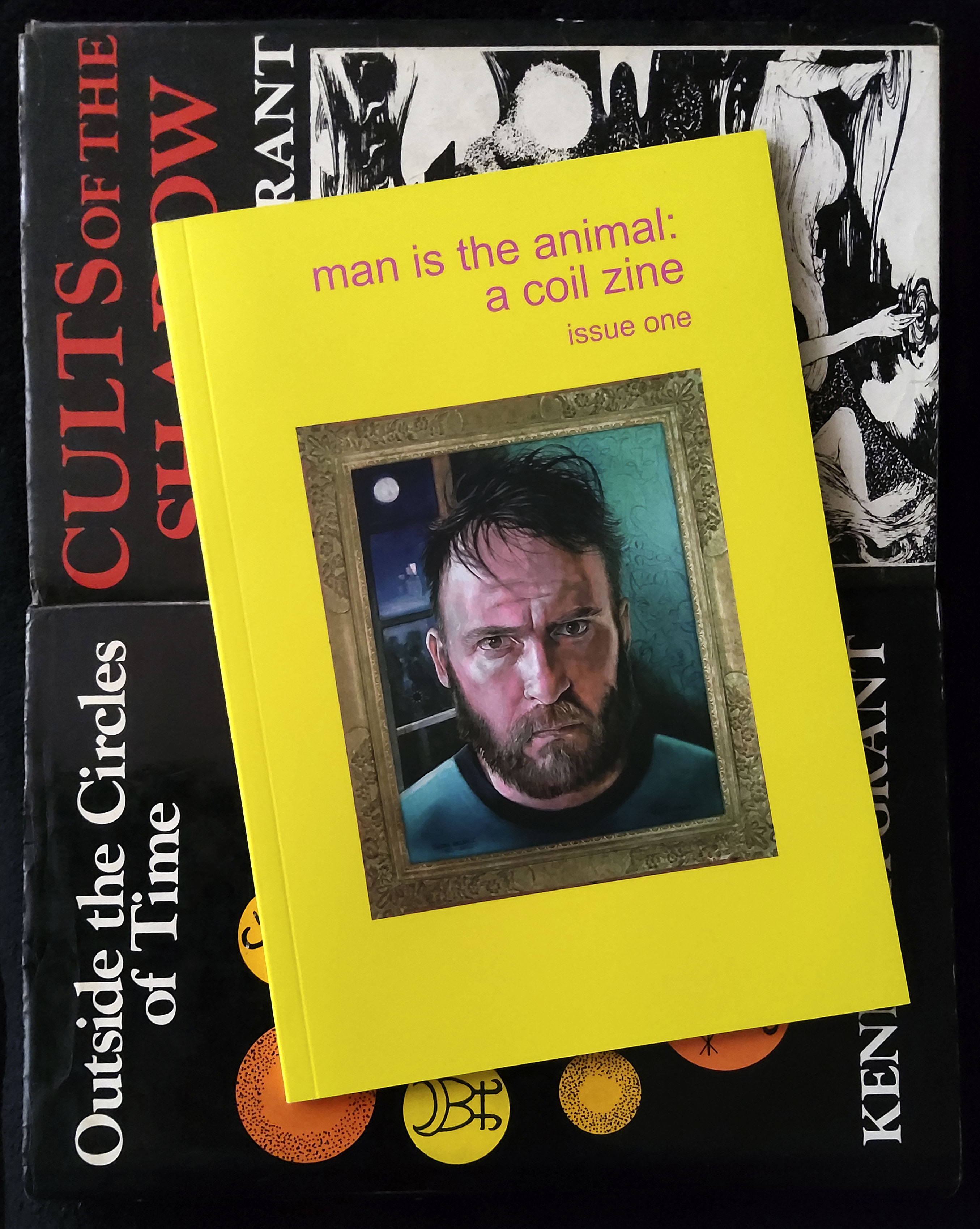
Man is the Animal: A Coil Zine

coil.jpg

Death is centrifugal / Solar and logical / Decadent and symmetrical / Angels are mathematical / Angels are bestial / Man is the animal —Fire Of The Mind by Coil

In the post this week from Temporal Boundary Press, issue 1 of Man is the Animal: A Coil Zine. A timely publication, given the persistent and increasing interest in Coil, and one whose essays are all of a quality belied by the “zine” label which usually suggests something more fannish and trivial. This is a pleasing object even before you look inside, a perfect-bound A5 booklet with full-colour printing throughout, and a cover painting by Val Denham, an artist with Coil associations that reach back through the Some Bizzare period to art for Marc Almond and Throbbing Gristle. Denham also contributes one of the written pieces, Jhonn is Unbalanced, a touching memoir of Geoff Rushton/John (Jhonn) Balance. Among the other entries is a piece by Benjamin Noys, a writer whose previous studies have included an examination of the connections between my own art for the Reverbstorm comic series and the weird fiction of HP Lovecraft. Noys takes a similar approach here, finding reflections of Coil obsessions in the symbolism of alchemical magic and the weird fiction of Arthur Machen.
grant.jpg

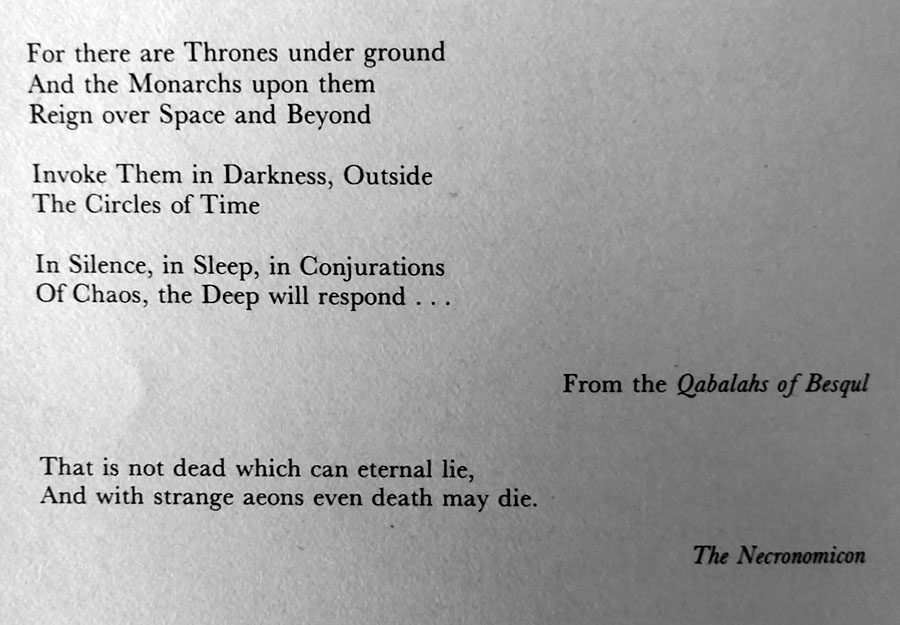
Epigraph from Outside the Circles of Time by Kenneth Grant.

The weird fiction of HP Lovecraft was a Coil obsession, and Lovecraft receives the most attention in a great piece by Andy Sharp which takes its cue from the appearance in Titan Arch of lines from the epigraph for Outside the Circles of Time, an occult study by magus and scholar Kenneth Grant. The latter was another Lovecraft obsessive—no doubt one of the first, given his age—whose books are littered with references to both Lovecraft and Machen. I spotted the Coil/Grant connection many years ago (although quite some time after Love’s Secret Domain was released), and acknowledged the link in two pages in The Haunter of the Dark, one of which reprints Grant’s epigraph, while the other is a picture with the title In Spaces Between, a line from Titan Arch which is also a reference to the Necronomicon extract in The Dunwich Horror: “The Old Ones were, the Old Ones are, and the Old Ones shall be. Not in the spaces we know, but between them, they walk serene and primal, undimensioned and to us unseen.” Sharp does more than merely acknowledge this web of connections, he delves into Grant’s dense treatise in search of further correspondences. I’ve not read Grant’s book for many years but this essay makes me think I ought to look at it again. By coincidence (or is it? etc), both Love’s Secret Domain and Outside the Circles of Time have been reissued this year, the Grant book by Starfire Publishing.

Contents:
The Vision and the Voice: Esoteric Dimensions of Coil’s Vocals by Hayes Hampton
A Hauntology of Coil by Sean Oscar
Are You Loathsome Tonight?: Coil’s Transformations by Benjamin Noys
The Horseman Betrays His Steed by Cormac Pentecost
The Spaces Between: Outside the Circles of Time and Love’s Secret Domain by Andy Sharp
Jhonn is Unbalanced by Val Denham

Previously on { feuilleton }
Dreaming Out of Space: Kenneth Grant on HP Lovecraft
Peter Christopherson Photography & The Art of John Balance Collected
The White People by Arthur Machen
Val Denham album covers
Kenneth Grant, 1924–2011
Peter Christopherson, 1955–2010
The Angelic Conversation

Weekend links 571

valck.jpg

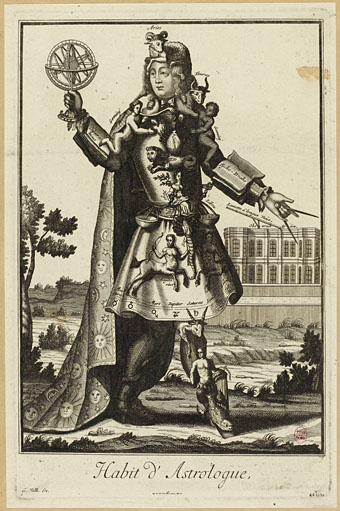
Habit d’Astrologue (c. 1700) by Gerard Valck.

• “The Appointed Cloud begins with the high-pitched, keening sound of many bagpipes noisily playing at once—and then the music slowly coalesces, approaching a peaceful, tranquil hum. This gives way to fast-paced repetitive pulses, reminiscent of the minimalist works of composers such as Terry Riley and Philip Glass. Then the bagpipes join in once more, in a ferocious swarm of energy.” Geeta Dayal on the music of Yoshi Wada.

• “How can we conceive of the time of climate change, the time of planetary death? The House on the Borderland tried to conceive of exactly this a century ago. Yes, the narrator’s acts are fruitless. He gets haplessly carted about the universe to witness the end of time, which never really ends, is always at the edge, nearing an asymptote, on the borderland.” Namwali Serpell journeys through space and time with William Hope Hodgson.

• The Bureau of Lost Culture: DJ Food hosts a podcast discussion with Tony Bennett, founder and publisher of Knockabout Comics.

• Mixes of the week: Isolated Mix 111 (plus interview) by Ian Boddy, and a Wire mix (plus interview) by Teresa Winter.

• Fantastic visions and unknown worlds: Edwin Pouncey on Van Der Graaf Generator’s sleeve art.

• At Spoon & Tamago: Sculptor Kenichi Nakaya reconfigures ubiquitous Japanese rural crafts.

• My Bloody Valentine’s Kevin Shields: “We wanted to sound like a band killing their songs.”

• At Wormwoodiana: More earth mysteries are explored in Northern Earth magazine.

• New music: Black Horses Of The Sun by Dave Bessell.

The Exotica Project: One Hundred Dreamland 45s

• At Dennis Cooper’s: Hans Richter Day.

Mdou Moctar‘s favourite music.

Earth Floor (1985) by Michael Brook | Earth Tribe (1993) by Transglobal Underground | Earth Lights (2012) by Belbury Poly

Weekend links 564

kolbe.jpg

Fantastical Tree (c. 1830) by Carl Wilhelm Kolbe.

• “It’s just a square and a semi-circle at the end of the day.” Pete Adlington navigates the rapids of high-profile cover design for the UK edition of Kazuo Ishiguro’s Klara and The Sun. I’m not always keen on the minimal approach but the Faber edition is a better design than the equally minimal US cover whose circle in a hand makes it look like a reprint of Logan’s Run. Faber also produced a limited edition with the sun circle wrapped onto sprayed page edges.

• “‘With a mysterious smile on her lips,’ writes the Chilean film director Alejandro Jodorowsky, ‘the painter whispered to me, “What you just dictated to me is the secret. As each Arcana is a mirror and not a truth in itself, become what you see in it. That tarot is a chameleon.”‘” The painter referred to is the now-ubiquitous Leonora Carrington whose own Tarot deck is investigated by Rhian Sasseen.

• “‘Horror is an emotion,’ Douglas E. Winter tells us. I would respectfully like to amend that assertion. Horror is a range of emotions. And each of these moods, if they are to be successful, must be cultivated differently.” Brian J. Showers offers his thoughts on horror fiction.

• “You move from awareness of—and preoccupation with—how sounds affect our bodies, into how that might create a web of connection with the external world—with the natural world.” Annea Lockwood talking to Jennifer Lucy Allan about her career as a composer and sound artist.

• Gay cruising and its geography in cinema and documentary, a list of films by Mike Kennedy. Related: Shiv Kotecha on O Fantasma (2000), a film by João Pedro Rodrigues.

• Coming from Strange Attractor in June: Coil: Camera Light Oblivion, a photographic record by Ruth Beyer of the first live performances by Coil from 2000–2002.

• At Wormwoodiana: Mark Valentine on The Star Called Wormwood (1941), a strange novel by Morchard Bishop.

• At Unquiet Things: Ephemeral and Irresistible: The Spectacular Still-life Botanical Drama of Gatya Kelly.

• “Fevers of Curiosity”: Charles Baudelaire and the convalescent flâneur by Matthew Beaumont.

• 1066 and all that: Explore the Bayeux Tapestry online.

• Mix of the week: Secret Thirteen Mix 311 by Arigto.

• New music: Terrain by Portico Quartet.

Fever (1956) by Little Willie John | Fever (1972) by Junior Byles | Fever (1980) The Cramps

Voice of the Fire by Alan Moore

votf1.jpg

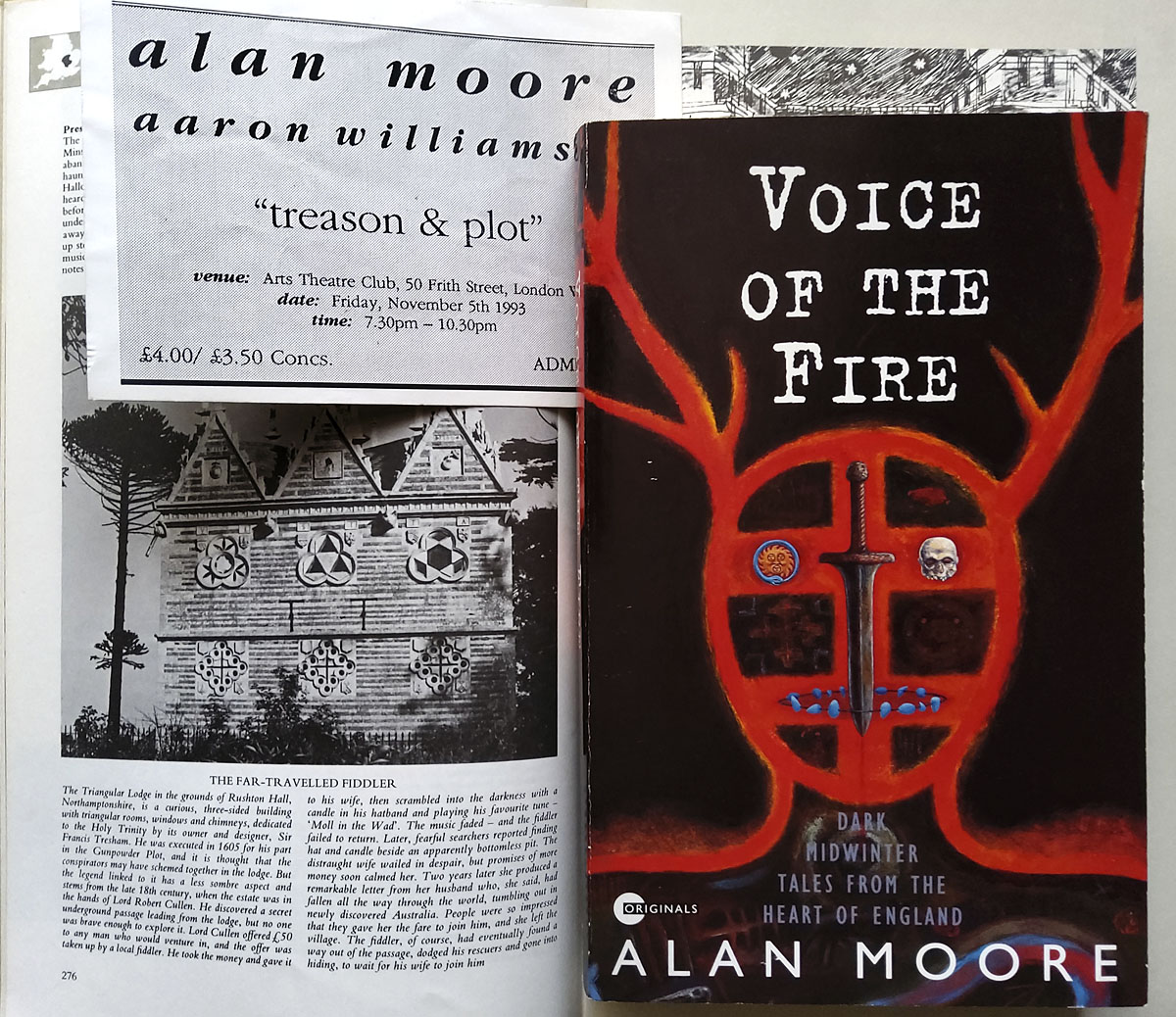
“History is a heat,” says Alan Moore at the end of his first novel, Voice of the Fire, when the author takes centre stage to add his own voice to those of his characters. History is a heat, and fire is its agent, the element that provides a connecting thread between the twelve people whose voices comprise the text of the book. Late last year I was asked to design a new cover for Voice of the Fire which will be published by Knockabout in a 25th anniversary edition later this year. I’d read the book when it was first published, and even saw Alan read some of the opening chapter in 1993 at an event at the Arts Theatre Club in Soho. That event, which took place on November 5th, was titled “Treason and Plot”, and the pages from the work-in-progress novel had been collected from the offices of Gollancz after Alan left the unfinished manuscript of Yuggoth Cultures—which he was supposed to be reading from that evening—in the back of a cab. I was in London that day to talk to Alan about illustrating Yuggoth Cultures, so to find myself illustrating Voice of the Fire many years later feels a little like being caught by one of the acausal connecting threads that he weaves through his novel.

votf3.jpg

The first edition: design by Gary Day-Ellison, illustration by Robert Mason. The photo on the left shows Thomas Tresham’s Triangular Lodge, a folly outside Northampton encoded with references to the Holy Trinity via a profusion of triangles and tripartite details. Tresham’s Lodge is described in the Gunpowder Plot chapter of Alan’s novel; the triangles on my cover may be taken as a reference to this.

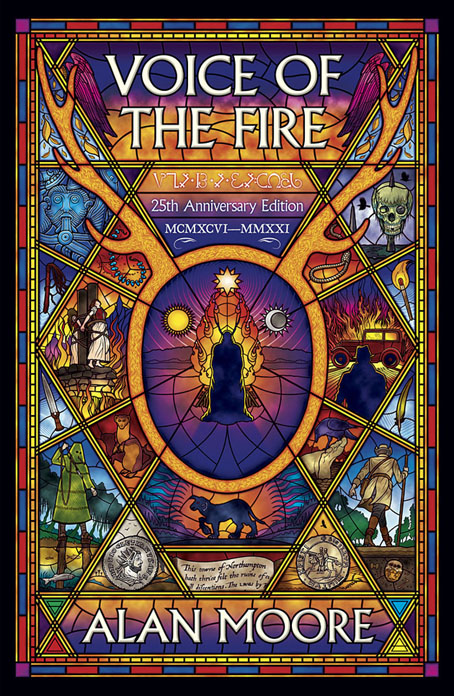
November is the dominant month in Voice of the Fire, and the ritual fires of November 5th are one of many recurrent motifs. The novel’s twelve characters live in Alan’s home town of Northampton at different periods of history, from 4000 BC to 1995, a span of time that charts the town’s foundation and growth, taking in the Viking invasions, the Roman occupation, the Crusades, the treason and plot of Guy Fawkes and his conspirators, witch trials, the poet John Clare, and Alan himself. A lot of history and a wealth of incident to try and symbolise in a cover design. Author and publisher both liked the stylised outline of a horned head that Robert Mason painted on the cover of the first edition, a reference to the opening chapter of the novel in which a Neolithic shaman performs a ritual that marks the land as the site of the future town. I liked the original cover but felt it made the novel seem too much like something by Henry Treece or Alan Garner, with no indication of more recent history. A stained-glass window seemed like a good solution to the problem of how to bring together so many disparate elements into a single design. Stained-glass windows are often things from the distant past still visible in the present day, and they have the additional convenience of being a single container for many small pictorial details.

votf2.jpg

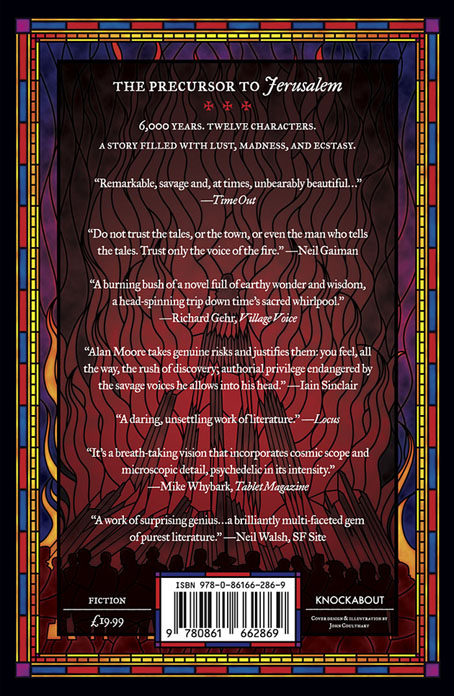
It’s Bonfire Night on the back cover.

My design doesn’t attempt to illustrate all the characters or events from the novel but shows the more salient moments together with smaller details, some of which (the noose, for example) appear in multiple chapters. The horned shaman is at the centre of the design which radiates out from his ritual fire. I avoided making the window design too much like a church window; the book contains many references to churches and Christian history but there’s also a strong pagan element in many of the chapters. Magic, in the occult sense, is a recurrent thread, and Alan’s favourite Elizabethan magus, Dr. John Dee, is present (albeit offstage) in the Angel Language chapter. To acknowledge this I placed an inscription in Enochian—Dee’s “Angel Language”—underneath the title. There’s more magic in the font used for the title and author’s name, Albertus, which was named after Albertus Magnus, a philosopher and theologian often described as an alchemist. The main reason to use Albertus is for its timeless styling and its readability, an important quality for such a busy cover design; the font is a common one on London street signs.

The creature with the floppy ears in the lower centre is another recurrent motif, the sinister “shagfoal”, or Black Dog, whose presence is a sign of the darker energies that seem to thrive in that part of the world. Black Dogs appear in folklore all over Britain but there are few pictorial examples to be found in old texts. I based my hound on the “Straunge and terrible Wunder” depicted in 1577 on the title page of Abraham Fleming’s account of the Black Dog of Bungay. Other details are more obvious for those who read the novel so I won’t spell out everything here. If you haven’t read it then I’d urge you to do so, it’s one of Alan Moore’s major works, and a book I’m hoping might receive more attention than it did in 1996 when Gollancz only saw fit to publish it in paperback. Voice of the Fire will be published by Knockabout in May in paperback and a limited edition hardback which will include a card signed by the author. Top Shelf will be doing something similar for the US but I don’t think they’ve announced any dates or other details as yet. Anyone looking for further information is advised to keep an eye on the Knockabout news page or the publisher’s social media accounts.

Previously on { feuilleton }
The Blake Video
The Cardinal and the Corpse
Mapping the Boroughs
Tresham’s Trinities
The Triangular Lodge again
Art is magic. Magic is art.
Alan Moore: Storyteller
Alan Moore: Tisser l’invisible
Dodgem Logic #4
The Triangular Lodge

Weekend links 559

fukuda.jpg

Cover art by Toshiyuki Fukuda for the Japanese edition of the new novel by Kazuo Ishiguro.

• “The story here is how between 1978 and 1982, this impulse shed its novelty genesis and its spoils were divvied up between gay producers making high-energy soundtracks for carnal abandon, and quiet Hawkwind fans smoking spliffs in Midlands bedrooms.…this excellent compilation offers fresh understandings of a period in sonic history where the future was up for grabs.” Fergal Kinney reviews Do You Have the Force? Jon Savage’s Alternate History of Electronic Music, 1978–82.

DJ Food continues his history of mini CDs with Oranges And Lemons, the 1989 album by XTC which was released in the usual formats together with a limited edition of three small discs in a flip-top box. The cover art by Dave Dragon is a good example of the resurrected groovy look.

• “If Austin Osman Spare, William Burroughs, Mary Butts and Kathy Acker got together for a séance, the transcript could well look like this.”

• How Leonora Carrington used Tarot to reach self-enlightenment: Gabriel Weisz Carrington on his mother’s quest for mythic revelations.

• Mixes of the week: Sounds Unsaid at Dublab with Tarotplane, and To Die & Live In San Veneficio by SeraphicManta.

• At Dennis Cooper’s: 5strings presents…Solve et Coagula: An introduction to Israel Regardie.

• The Joy of Silhouettes: Vyki Hendy chooses favourite shadow-throwing cover designs.

Emily Mortimer on how Lolita escaped obscenity laws and cancel culture.

Freddie deBoer has moved his writing to Substack.

• New music: Wirkung by Arovane.

• Children Of The Sun (1969) by The Misunderstood | Children Of The Sun (1971) by Hawkwind | Children Of The Sun (2010) by The Time And Space Machine