Weekend links 713

hishida.jpg

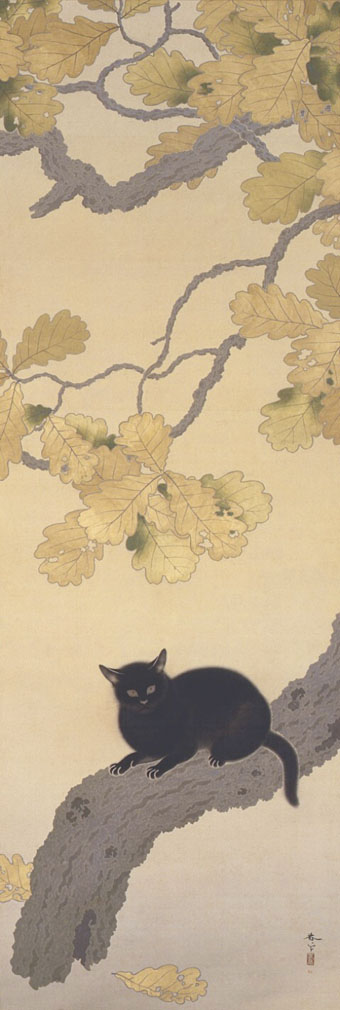
Black Cat (1910) by Shunso Hishida.

• “A duck goes quack quack in English but coin coin in French. In Spanish a dog goes guau-guau, not woof woof, while in Arabic it goes haw haw, and in Mandarin wang-wang. In Japanese cats go nyaa, and bees—having no access to the zz sound—go boon-boon.” Caspar Henderson asks “Could onomatopoeia be the origin of language?”

• Coming soon from MIT Press: Blotter: The Untold Story of an Acid Medium by Erik Davis; “the first comprehensive written account of the history, art, and design of LSD blotter paper, the iconic drug delivery device that will perhaps forever be linked to underground psychedelic culture and contemporary street art.”

• At Aquarium Drunkard: The late Damo Suzuki is remembered with a recording of Can playing at the Volkshalle Wagtzenborn-Steinberg, Giessen, October 22, 1971.

• At Unquiet Things: Another collection of Intermittent Eyeball Fodder. I was sorry to hear from that post that artist Dan Hillier had died recently. RIP.

• At Bandcamp Daily: Mouse On Mars discuss 30 years of dynamic electronic music.

• Old music: Rare Soundtracks & Lost Tapes (1973–1984) by Alain Goraguer.

• At Spoon & Tamago: The imaginary architectures of Minoru Nomata.

• Mix of the week: DreamScenes – February 2024 at Ambientblog.

• At Vinyl Factory: Julia Holter on some of her favourite records.

• At Public Domain Review: Wanda Gág’s Millions of Cats (1928).

• Steven Heller’s Font of the Month is Cuatro.

• A brief history of London’s gas lamps.

• New music: Pithovirii by Aidan Baker.

• Black Cat Bone (2000) by Laika | Black Cat (2005) by Broadcast | Black Cat (2008) by Ladytron

Weekend links 712

abbott.jpg

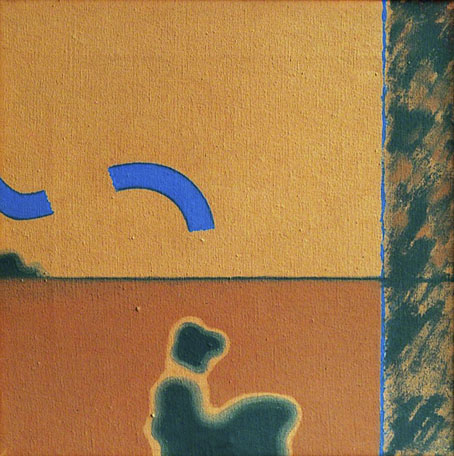
Above and Below (1968) by Wendy Abbott.

• “Thirty-two years after the five Central Asian countries of Uzbekistan, Kazakhstan, Tajikistan, Kyrgyzstan, and Turkmenistan appeared on the world map, little of the region has been portrayed in film. Countries associated with the -stan suffix are perceived as dangerous or sinister.” Komron Ergashev on Central Asia and cinema.

• Old music: Alice Coltrane’s Carnegie Hall concert from 1971 has been available for many years as a high-quality bootleg but never the complete recording. The first official release next month promises to at last present a full performance.

• RIP Damo Suzuki, vocalist for Can during the group’s peak years. The Rockpalast concert from 1970 captured the group in impressive form shortly after Suzuki joined.

• “I’ve always been drawn towards esoteric phenomena: the illogical, the inexpressible, the impossible.” Dorothea Tanning talking to Carlo McCormick in 1990.

• “This film was shot live on the surface of an 8mm² chemical reaction.” As Above by Roman Hill.

• New music: Floating On A Moment by Beth Gibbons, and All Life Long by Kali Malone.

• At Unquiet Things: The art of Kiyoshi Hasegawa.

• Joel Gion’s favourite music.

• Esoteric Circle (1976) by Jan Garbarek | As Above, So Below (1981) by Tom Tom Club | Esoteric Red (1997) by Tao

Weekend links 711

paalen.jpg

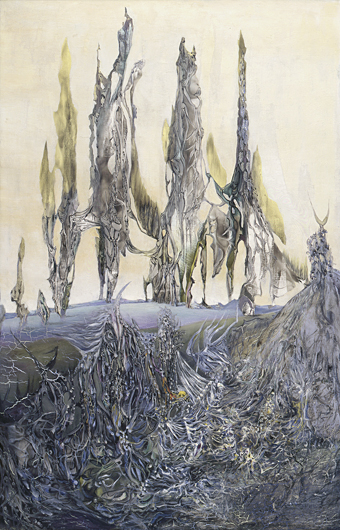
Les Étrangers (1937) by Wolfgang Paalen.

• “I was picturing Monty Python’s spoof Pasolini cricket film The Third Test Match, a man frantically rubbing his groin with a cricket ball.” Paul Gallagher writing about the time that Kenneth Anger wanted to make a film about cricket.

• The week in deserts: This camera is taking a 1,000-year-long exposure photo of Tucson’s desert landscape; Explore the surface of Mars in spectacular 4K resolution.

• At the Wired YT channel: puzzle-box maker Kagen Sound talks about the creation and operation of his amazing boxes.

• RIP Wayne Kramer, the MC5’s other incendiary guitarist. Here they are kicking out the jams on Beat-Club in 1972.

• National Gallery of Ireland acquires Harry Clarke artwork for national collection.

• At Bajo el Signo de Libra: The (mostly homoerotic) Italy photographed by Herbert List.

• New music: Fragmented by Parallel Worlds, and The Crystal Parade by Cate Brooks.

• At Wormwoodiana: Aquarius, Arcania, Arcturus: Exploring New Age shops.

• At Public Domain Review: Early modern blackwork prints.

• Sun In Aquarius (1970) by Pharoah Sanders | Aquarius (1998) by Boards Of Canada | Aquarius (2018) by Beautify Junkyards

Arsenal: Surrealist Subversion

arsenal1.jpg

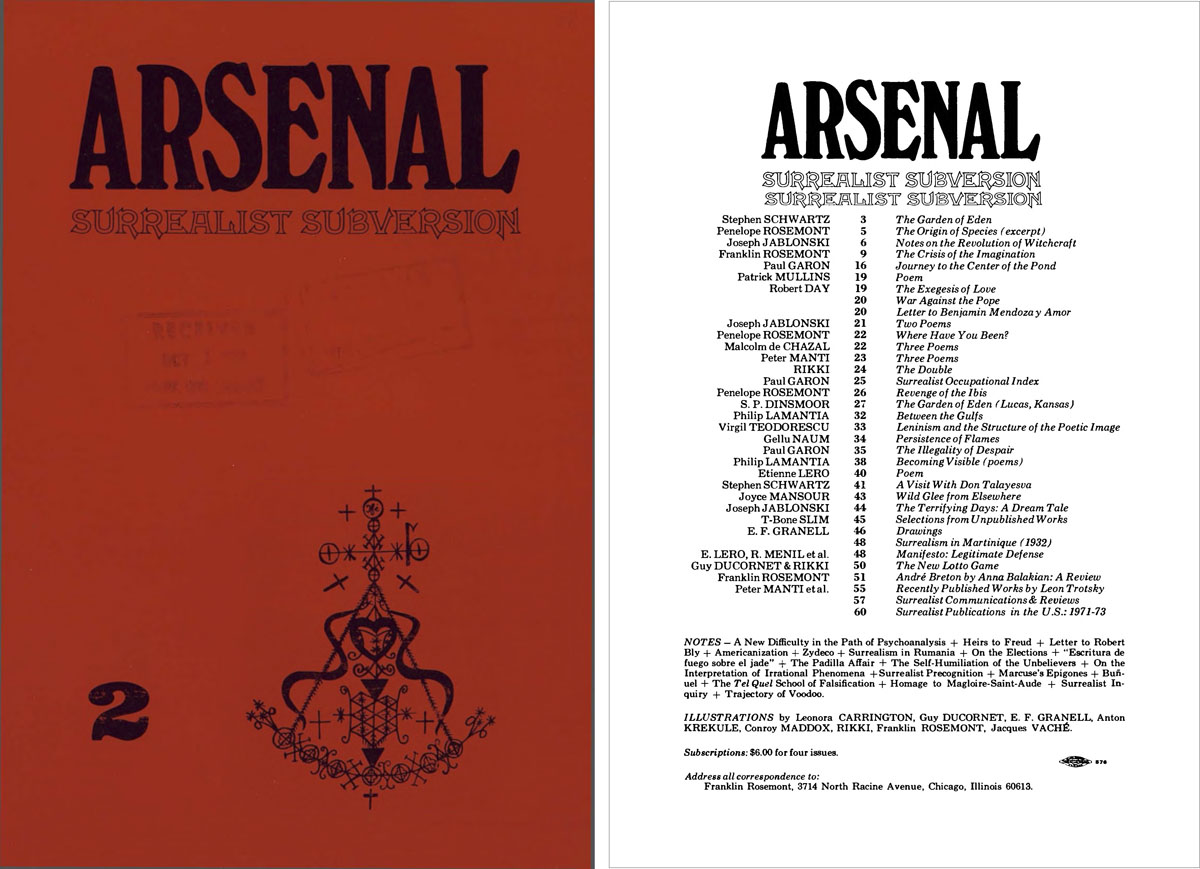
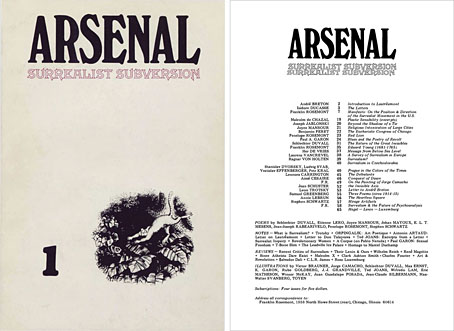
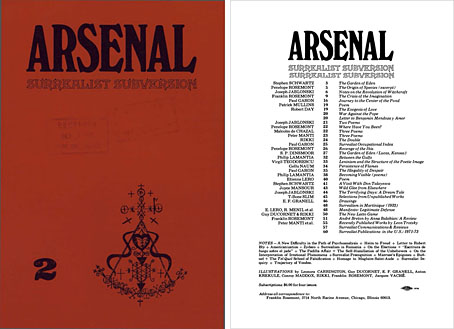
It’s the “S” word again. I said at the beginning of this month that I was looking forward to seeing where this interest led, and here we are. My recent reading has included Penelope Rosemont’s Surrealist Women (1998), a comprehensive study that I’d dipped into in the past but hadn’t gone through properly until now. In the section devoted to activities since the 1960s Rosemont mentions a magazine, Arsenal: Surrealist Subversion, which she produced with her husband, Franklin Rosemont, as part of their work with the Chicago Surrealist Group. Arsenal had more of an erratic schedule than most magazines, managing four issues that appeared in 1970, 1973, 1976 and 1989. I really didn’t expect there to be copies of such an obscure publication available anywhere but, once again, the invaluable Internet Archive has scans of the first three issues.
arsenal2.jpg

Arsenal proves to be a curious mix of the kind of material you’d expect from a Surrealist publication—poetry, essays, drawings, collages, significant quotes—together with chunks of Marxist politics and Freudian business that seem to have strayed in from another magazine. The latter material isn’t so unwarranted, being a reflection of André Breton’s original concerns, but committed Marxists of whatever stripe have never had much time for Surrealist art-creation and game-playing, while Freud himself was nonplussed by Breton’s attempts to interest him in the activities of the Parisian Surrealists. Breton casts a long shadow here; the Rosemonts had met him in Paris in the mid-60s, and many of the articles (also their combative attitudes) have a Bretonian cast.

arsenal3.jpg

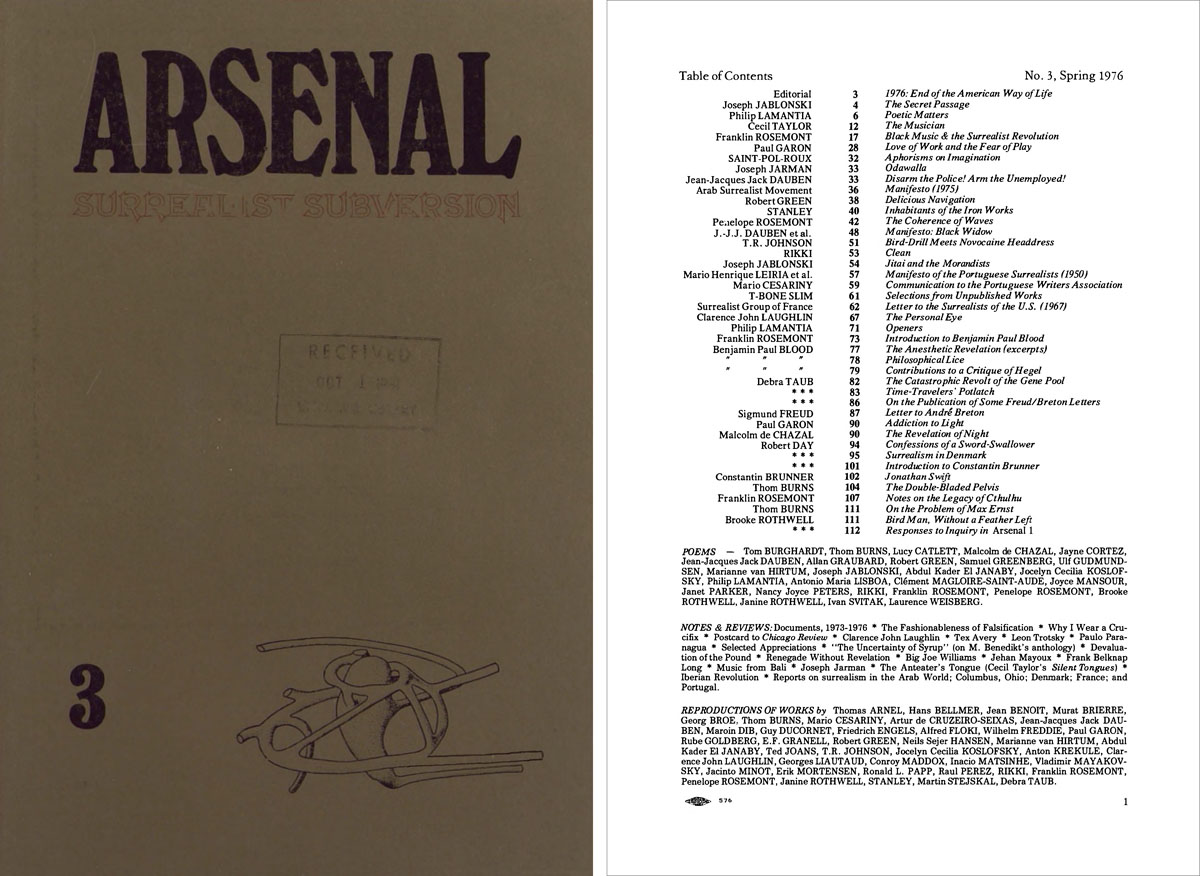
Elsewhere, Arsenal breaks new ground with a Surrealist appraisal of blues musicians, music being a form that Breton and Louis Aragon had dismissed in the 1920s as “too confusing” for incorporation into the Surrealist project. The magazine also reprints a couple of comic strips, including a page of Little Nemo in Slumberland which may be the first acknowledgement from inside Surrealism of Winsor McCay’s dream-worlds as Surrealist precursors. And after posting Breton’s musings about “The Great Transparent Ones” these mysterious beings surface once again. Not only the Great Transparent Ones but also HP Lovecraft’s Great Old Ones in a piece by Franklin Rosemont about the Cthulhu Mythos. Rosemont draws attention to the obvious similarity between the names of Breton and Lovecraft’s beings, while also noting Lovecraft’s prowess as a transcriber of dreams. In doing so he complains about Lovecraft circumscribing his imagination by resorting to the story structures of the pulp magazines. Lovecraft was never a member of any avant-garde literary circle, however, unlike Clark Ashton Smith, who also receives further mention in these pages; if it wasn’t for Weird Tales we never would have heard of HP Lovecraft and there wouldn’t be a Cthulhu Mythos. This fault-picking is typical of many other pieces in the magazine, the book reviews in particular where a kind of petulant bad temper is the predominant tone. You probably can’t expect much else from a magazine that names itself after a store of weapons but the cumulative effect makes it seem that the road to the Marvellous must be paved with razor blades and broken glass. To their credit, the editors did print in the third issue some of the negative reviews they received for the previous two, including the inevitable dismissals from hardline Communists. Despite all this I’d still like to see how things developed (or came to an end) in the fourth and final issue.

• Further reading: I Could Dream In French: An Interview With Penelope Rosemont.

Elsewhere on { feuilleton }
• The Surrealism archive

Previously on { feuilleton }
• First Papers of Surrealism
• The original Cabaret Voltaire
• View: The Modern Magazine

Weekend links 710

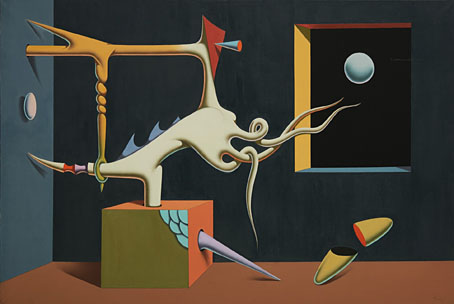
Menace (1974) by Ivan Tovar.

• “I find myself going back to Early Water more and more in recent years. It should be better known.” B. Sirota reviewing the one-off musical collaboration between Michael Hoenig and Manuel Göttsching. (Previously.) It should indeed be better known.

• At Unquiet Things: “Come for the cosmic awe, stay for the skeletons in spacesuits”; S. Elizabeth talks to Adam Rowe about the science-fiction art of the 1970s.

• “The architectural style wars have started all over again.” Owen Hatherley on the unending debate between traditionalists and modernists.

• At Public Domain Review: Clear Shadows (1867), a book of Japanese silhouette portraits by Ochiai Yoshiiku.

• New music: Flux Gourmet Original Motion Picture Soundtrack by Various Artists, and Volta by Loula Yorke.

• Meta machine mantras: Steve Barker on the birth of the Buddha Machine.

• Cosmohedron, a short animated film by Duncan Hatch.

• Mix of the week: isolatedmix 125 by Sa Pa.

• Chelsea Wolfe’s favourite music.

• At Dennis Cooper’s: Mirrorers.

• A Silhouette Of A Man And A Wasp (1995) by Add N To (X) | A Silhouette Approaches (2005) by Robin Guthrie & Harold Budd | Silhouette (2015) by Julia Holter