Weekend links 270

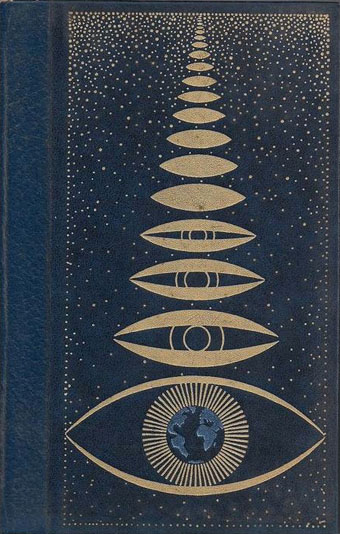
ufo.jpg

Cover design for UFOs and Extra-Terrestrials in History (four vols, 1978) by Yves Naud.

Come To The Sabbath, “a festival of dark arts delving into the influence of Black Magick, Witchcraft, Demonology and Satanism in pop culture”, takes place at Apiary Studios, 458 Hackney Road, London, from Tues 18th–Sun 23rd August.

• “Visitors, if there had ever been any, would have said that the little town of Mansfield was haunted.” Showdown is a previously unpublished short story by Shirley Jackson.

• “A sandbox stealthy immersive sim in a surreal, horror-y world inspired by writers like Burroughs and Ballard…” Alice O’Connor previews the forthcoming computer game, Tangiers.

Sometime in the late 1960s, the artist Robert Smithson took a trip to southwestern Ohio. He saw the Great Serpent Mound there and decided that he would make a great spiral too. […] Because the Great Salt Lake’s levels vary several feet from year to year, and also from season to season, Spiral Jetty is not always visible even if you make the trip to Utah. You could go out to Spiral Jetty and find that the entire earthwork is invisible underwater. When Robert Smithson created this earthwork in 1970, he did not care if it could be easily seen or who owned it. And so, even today, no one knows to whom Spiral Jetty really belongs. To view it requires a pilgrimage.

Stefany Anne Goldberg on earthworks, new and ancient, and the art of disappearance

• “Commercial book cover design is a minor portion of Gorey’s award-winning legacy, but not a lesser art.” Steven Heller on Edward Gorey: cover designer.

• “You are accepted,” he says, “by the genre that can accept you.” Samuel R. Delany talked to Peter Bebergal about being an outsider in the world of science fiction.

A battle of Witts: A brief look at ‘Taboos’ and the work of The Passage. Mark Griffiths on a great, if seldom-remembered, Manchester band.

• “Hispanic photomonteur Josep Renau aimed Technicolor jets of scorn at the mirage of US consumerist culture,” says Rick Poynor.

• Because the internet is really big… Kelli Anderson reworks the Eames’ The Powers of Ten using imagery found via Google searches.

Against Nature is a forthcoming musical adaptation of Huysmans’ À Rebours by Marc Almond, Jeremy Reed and Othon.

“What makes a film noir?” Adam Frost & Melanie Patrick have an infographic for you.

• Mixes of the week: Gizehcast #20 by LCC, and Jenny Hval‘s WEIRD Quietus mix.

• Mysterium Tremendum: Russell Cuzner on The Strange World of Lustmord.

• The charming march of the Penguin Books logo.

Cosey Fanni Tutti: Agent Provocateur

Dark Times (Peel Session) (1980) by The Passage | XOYO (1982) by The Passage | Revelation (1982) by The Passage
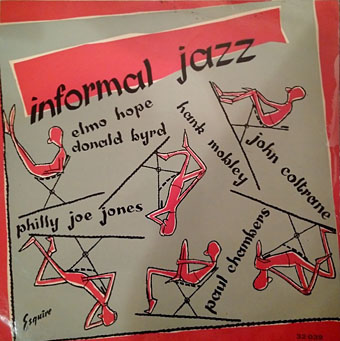
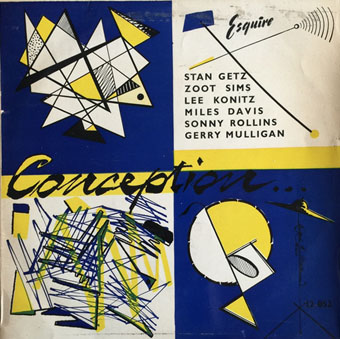
Ralph Steadman record covers

steadman01.jpg

Informal Jazz (1956) by Elmo Hope Sextet.

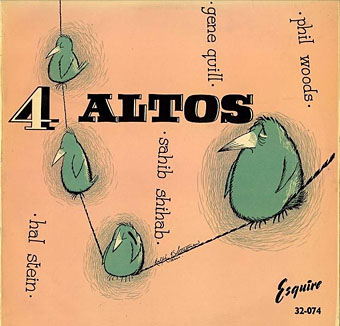
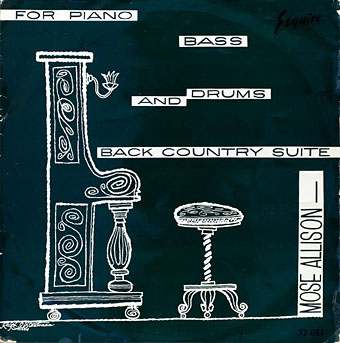
Yesterday’s post made me realise I’d never looked to see how many album covers Ralph Steadman might have designed or illustrated. A quick delve into Discogs revealed the following haul, a couple of which I own on CD. Steadman has worked in a wide range of media but I didn’t know his album work went back into the 1950s. The style of the early sleeves is markedly different to the angry, splattery creations that made his name, and without a signature you’d be unlikely to recognise the artist.

steadman02.jpg

Conception (1956) by Miles Davis, Stan Getz, Gerry Mulligan, Lee Konitz, Sonny Rollins, Zoot Sims.

Artists known for their work outside the music world tend to have pre-existing art used on record sleeves but Steadman is unusual in creating so much cover art afresh. In light of this I’ve omitted the CD insert for a dramatisation of Fear and Loathing in Las Vegas which repeats the drawing familiar from many of the paperback editions.

steadman03.jpg

4 Altos (1957) by Phil Woods, Gene Quill, Sahib Shihab, Hal Stein.

steadman04.jpg

Back Country Suite For Piano, Bass And Drums (1959) by Mose Allison.

Continue reading “Ralph Steadman record covers”

Polaroids

polaroid1.jpg

I was given a Polaroid Instant Camera some years ago, not the cult SX-70, a later model. I still have it somewhere but never used it very much. The film cartridges were still available in shops, but at around £1 a shot Polaroids always seemed like a costly indulgence unless you had some specific use for them which I never did. The photo of Murnau’s Nosferatu was taken from a TV screen, and seems to be the only print I kept.

krims.jpg

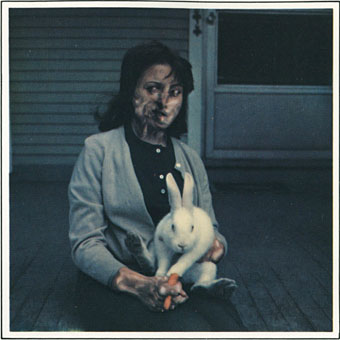
Radiation Victim Holding a Rabbit and Carrot (1974) by Les Krims.

This post was prompted by a search for the Polaroid manipulations made by Les Krims in the 1970s. Krims was one of the first people (the first?) to exploit the potential of the print’s slow processing to create surreal and grotesque images. Krims self-published a collection of these as Fictcryptokrimsographs in 1975. The Francis Bacon-like “radiation victim” is one of the more restrained examples, many of the others being male and female nudes in various stages of mutation.

gabriel1.jpg

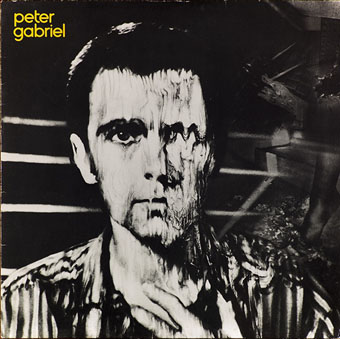
Peter Gabriel (1980).

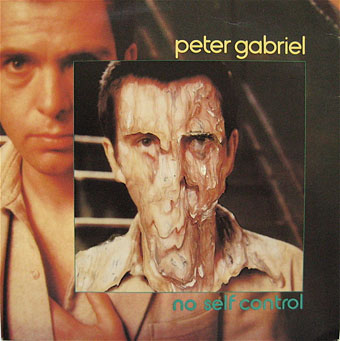
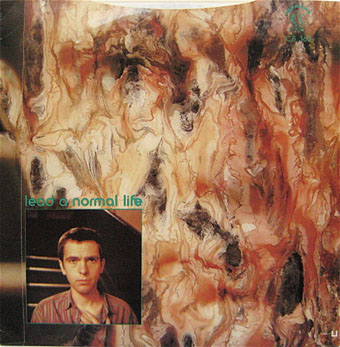
The mutation technique was more famously employed by the Hipgnosis design team and Peter Gabriel for the cover art of Gabriel’s third album. (Americans insist on calling this album “Melt” even though it was never titled as such.) The technique was also used for photos on the inner sleeve and on two of the single releases.

gabriel2.jpg

No Self Control (1980). Front and back sleeve of 7-inch single.

gabriel3.jpg

steadman.jpg

William Burroughs by Ralph Steadman.

Also in 1980, Ralph Steadman says discovered the same technique while on holiday in Turkey. I recall him discussing his own manipulations, which he calls “Paranoids”, on TV around this time. There’s no indication that Steadman was aware of Krims or the Gabriel album but he’s continued to use the technique ever since. The Burroughs portrait was one of a series created in 1995 when Steadman paid a visit to Lawrence, Kansas. There’s film of the meeting here although I’m more interested in the older TV film on the same page which shows Steadman creating a new composite portrait by drawing onto the emulsion.

Previously on { feuilleton }
Portrait

Weekend links 269

cluster.jpg

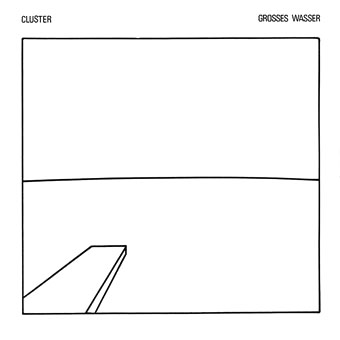
Grosses Wasser (1979) by Cluster. Cover art by Dieter Moebius.

• RIP Dieter Moebius: one half of Cluster (with Hans-Joachim Roedelius), one third of Harmonia (with Roedelius and Michael Rother), and collaborator with many other musicians, including Brian Eno and Conny Plank. Geeta Dayal, who interviewed Moebius for Frieze in 2012, chose five favourite recordings. From 2008: Cosmic Outriders: the music of Cluster and Harmonia by Mark Pilkington. At the Free Music Archive: Harmonia playing at ATP, New York in 2008. Live recordings of Cluster in the 1970s have always been scarce but in 1977 they played a droning set at the Metz Science-Fiction Festival, a performance that was broadcast on FM radio (the Eno credit there seems to be an error).

• “I’ve since had the feeling that, if the attacks against The Satanic Verses had taken place today, these people would not have defended me, and would have used the same arguments against me, accusing me of insulting an ethnic and cultural minority.” Salman Rushdie on the fallout from the Charlie Hebdo killings.

• “The effect of these memories is to make you think you know the film better than you do, and wonder what it’s like actually to sit down and watch it.” Michael Wood on rewatching Orson Welles’ Touch of Evil (1958). Related: Tipping My Fedora on the film’s source novel, Badge of Evil (1956).

“To me, it’s simple,” he says. “Fantasy became as bland as everything else in entertainment. To be a bestseller, you’ve got to rub the corners off. The more you can predict the emotional arc of a book, the more successful it will become.

“I do understand that Game of Thrones is different. It has its political dimensions; I’m very fond of the dwarf and I’m very pleased that George [R R Martin], who’s a good friend, has had such a huge success. But ultimately it’s a soap opera. In order to have success on that scale, you have to obey certain rules. I’ve had conversations with fantasy writers who are ambitious for bestseller status and I’ve had to ask them, ‘Yes, but do you want to have to write those sorts of books in order to get there?’”

Michael Moorcock talking to Andrew Harrison about fantasy, science fiction, the past and the present.

• “Architects love Blade Runner, they just go bonkers. When I was working on the film, it was all about, let’s jam together Byzantine and Mayan and Post-Modern and even a little bit of Memphis, just mash it all together.” Designer and visual futurist Syd Mead talking to Patrick Sisson.

• “Lucian of Samosata’s True History reads like a doomed acid trip,” says Cecilia D’Anastasio, who wonders whether or not the book can be regarded as the earliest work of science fiction.

• Mixes of the week: A Tribute to Dieter Moebius by Vegan Logic, and another by Totallyradio.

• The Phantasmagoria of the First Hand-Painted Films by Joshua Yumibe.

Islamic Geometric: calligraphic tessellations by Shakil Akram Khan.

Michael Prodger on The Dangerous Mind of Richard Dadd.

A chronological list of synth scores and soundtracks.

Touch Of Evil (Main Theme) (1958) by Henry Mancini | Badge Of Evil (1982) by Cabaret Voltaire | Touch Of Evil (2009) by Jaga Jazzist

Out Of Limits

ool01.jpg

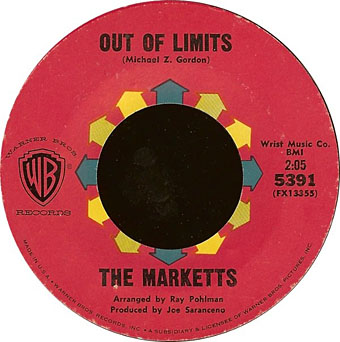
Out Of Limits (1963) by The Marketts.

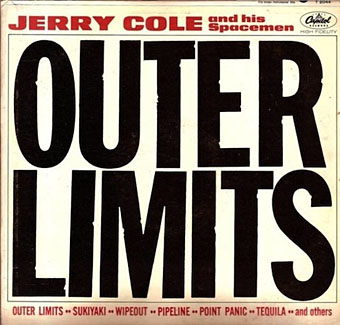
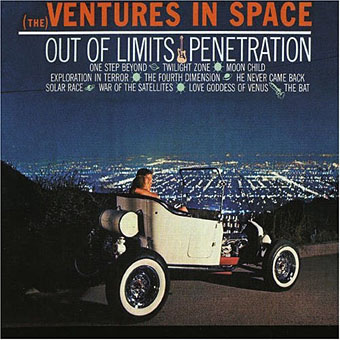
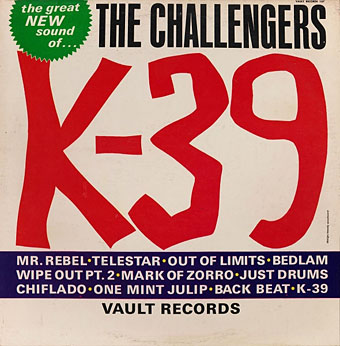
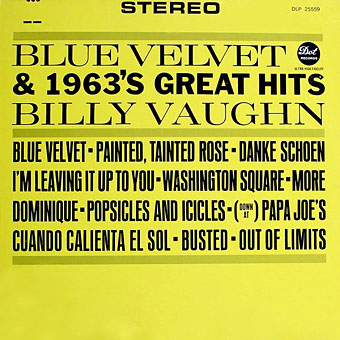
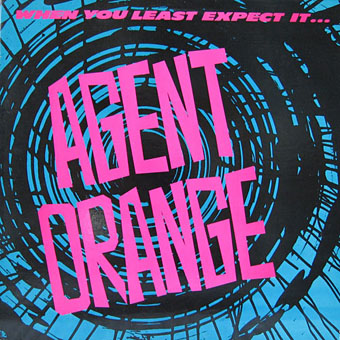
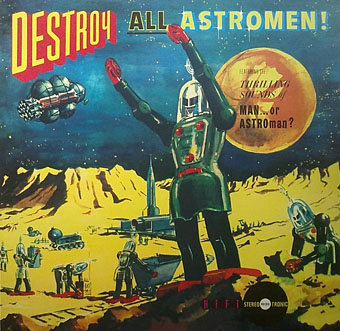
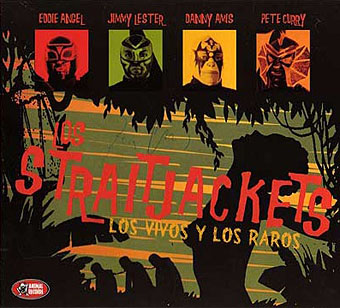
Did you know that Marius Constant, composer of the theme for The Twilight Zone, had a career as a serious composer? I didn’t. I wonder what Constant thought about the reworking of his theme into a surf tune by Michael Z. Gordon and The Marketts in 1963. Gordon’s version was originally titled Outer Limits then changed to Out Of Limits to evade the copyright police. The Marketts’ version will be familiar to anyone who’s watched Pulp Fiction where (as I recall) it’s playing while John Travolta is driving around. But it’s even more familiar to surf obsessives as this small selection of covers shows. There’s more out there (so to speak), and we’ll probably be hearing even more interpretations versions in the future.

ool02.jpg

Outer Limits (1963) by Jerry Cole And His Spacemen.


ool05.jpg

Out Of Limits (1963) by The Ventures.


ool03.jpg

Out Of Limits (1964) by The Challengers.


ool04.jpg

Out Of Limits (1964) by Billy Vaughn.


ool08.jpg

Out Of Limits (1983) by Agent Orange.


ool11.jpg

Out Of Limits (1994) by Man Or Astro-Man?


ool12.jpg

Out Of Limits (2003) by Los Straitjackets.

Previously on { feuilleton }
In The Past
My Surfing Lucifer by Kenneth Anger
A Reverbstorm jukebox