Weekend links 591

entangled.jpg

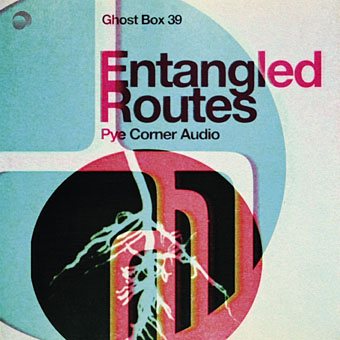
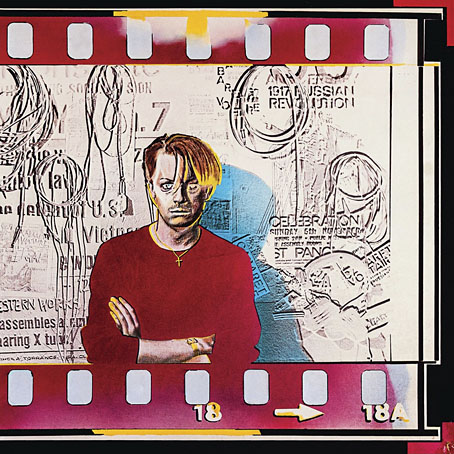
Ghost Box 39. Design, as always, is by Julian House.

Entangled Routes by Pye Corner Audio will be the next album on the Ghost Box label, due for release on 26th November. This will be Pye Corner Audio’s fourth album for Ghost Box, and one which forms the final part of a trilogy of imaginary soundtracks for science-fiction scenarios, “the latest installment of which plays with the idea of mycorrhizal networks and attempts by humans to listen in and communicate”.

• “…for every ten projects I start, nine will probably fall by the way side—they just don’t get made. Nothing happens, you can’t find the tapes, you can’t find the rights holders, the tapes were destroyed, no one’s interested.” Jonny Trunk interviewed at Aquarium Drunkard.

• At Unquiet Things: S. Elizabeth is celebrating the first anniversary of The Art Of The Occult (previously) by giving away a signed copy of her book to one of the commenters on this post.

• “Sand is not only temporary, it is also the most temporised form of matter.” Steven Connor on the dust that measures all our time.

• Mixes of the week: Autumn Hymnal: A Mixtape by Aquarium Drunkard, and In Estonia with Bart de Paepe by David Colohan.

• “Touched by the hand of Ithell: my fascination with a forgotten surrealist.” Stewart Lee on Ithell Colquhoun.

• Skin trade: a playlist of percussion at the outer limits; Valentina Magaletti surveys alternatives to the conventional kit.

• At Wormwoodiana: Mark Valentine reviews The Devil At Saxon Wall by Gladys Mitchell.

• “The Show: Alan Moore brings vaudevillian dazzle to Northampton noir,” says Phil Hoad.

• At Bandcamp: A Guide to the Eclectic Funk Music of Bernie Worrell by John Morrison.

• At Dennis Cooper’s: Spotlight on…Octave Mirbeau The Torture Garden (1899).

• At Spine: Vera Drmanovski on redesigning the novels of Hermann Hesse.

• New music: Music For Psychedelic Therapy by Jon Hopkins.

South To The Dust (1990) by Ginger Baker | Into Dust (1993) by Mazzy Star | Photon Dust (2020) by Pye Corner Audio

Weekend links 590

santesson.jpg

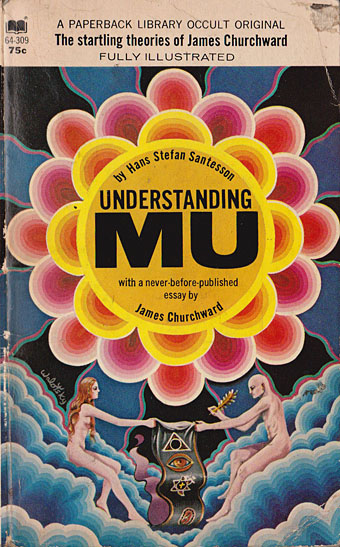
Understanding Mu (1970) by Hans Stefan Santesson. Cover art by Ron Walotsky. Via.

• “I have never believed Chariots of the Gods?—it takes faith, so what I mean is that I’ve never believed in it—but it has still held my affection for decades.” Patrick Allington on ancient aliens, unidentified aerial phenomena, and the unhinged pleasures of speculative nonfiction. I still have a stash of paperbacks in what I call “The Crank Box”, a collection of the more far-out titles that proliferated in the 1970s in the wake of the bestselling (and very egregious) Erich von Däniken. There aren’t many books about ancient astronauts or flying saucers in the box because they were so plentiful, I was always on the lookout for more outlandish volumes: lost continents, yes, but not the all-too-common Atlantis; Lemuria or Mu were more like it. So too with Hollow Earths and mysterious realms as detailed in Shambhala: Oasis of Light by Andrew Tomas, or The Lost World of Agharti: The Mystery of Vril Power by Alec MacLellan. The attraction wasn’t that any of this speculation might be true, more that these books operate as bargain-basement equivalents of the Borges conceit in which metaphysics is regarded as a branch of fantastic literature. Weird fiction by other means.

Collecting these books was a fun thing to do in the 1980s when the crank publications of the previous decade had washed up on the shelves of secondhand bookshops. The shine began to wear off in the 1990s when the emergence of the internet empowered a new breed of hucksters (and worse) pushing all of this stuff as though it was “hidden knowledge”. It’s hard to get excited about a battered paperback brimming with pseudo-science and pseudo-archaeology when similar ideas proliferate on YouTube channels catering to credulous hordes.

• Absolutely elsewhere (and linked here on a regular basis): An archive of the endlessly fascinating Absolute Elsewhere, a website created by the late RT Gault in order to present “a bibliography of visionary, occult, new age, fringe science, strange and even crackpot works published between 1945 and 1988”. The listings are accompanied by an informed, sceptical and often enlightening commentary, and also include a fair amount of weird fiction. Mr Gault had the right attitude.

• New music: Raum by Tangerine Dream, a preview of the new album, Probe 6–8, which will be released next year; new/old music: a reissue of Marine Flowers (Science Fantasy) by Akira Ito.

• “He had been honest about himself, and shockingly honest about his parents, but about his work he had spun me a tale.” Carole Angier on the elusive WG Sebald.

• At The New Criterion: Two stray notes on Moby-Dick by William Logan; on contemporary reviews of Moby-Dick and Melville’s journey on the Acushnet.

• “Perhaps what’s most extraordinary about Kollaps is that it was made at all.” Jeremy Allen on Einstürzende Neubauten’s thrilling debut album.

• At Culture.pl: a podcast about Czech film director Vera Chytilová and her masterpiece of Surrealist anarchy, Daisies.

• At Perfect Sound Forever: Part 2 of a Jon Hassell tribute which talks to friends and musical collaborators.

• At Dennis Cooper’s: Spotlight on…William S. Burroughs The Ticket That Exploded (1962).

• At Wormwoodiana: Mark Valentine unearths a medieval recipe for gingerbread.

• Mix of the week: Death’s Other Dominion by The Ephemeral Man.

MU-UR (2000) by Coil | Mu (2005) by Jah Wobble | Mu 1 (2015) by Acronym

Weekend links 589

mackintosh.jpg

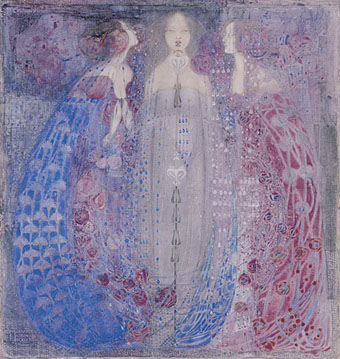
The Three Perfumes (1912) by Margaret Macdonald Mackintosh.

• “…we have empowered this monopoly to strike fear into the hearts of authors. And that may be unprecedented in history. Through our own complicity as consumers, their market share only grows.” Dave Eggers talking to Rachel Krantz about the dominance of Amazon, and his new novel, The Every.

• “People will readily flock to yoga and Pilates classes, but how many show up for soundscape therapy or take a sound-walk?” Bernie Krause on the healing powers of quietude, the Ba’Aka tribe, and Japanese forest bathing.

• “Difficulty is my drug of choice, I guess.” Dennis Cooper (again) talking to Troy James Weaver about his new novel, I Wished.

• At Wormwoodiana: Mark Valentine reviews Shadows of London by Jonathan Wood.

• Robert Fripp’s drive to 1981: Joe Banks on Discipline and the return of King Crimson.

• End times and rapture: Ken Hollings remembers Richard H. Kirk.

• Daniel Spicer on The Strange (Parallel) World of Miles Davis.

• Mix of the week: XLR8R Podcast 715 by Uffe.

• Steven Heller’s font of the month is Oposta.

Perfumed Metal (1981) by Chrome | Ode To Perfume (1982) by Holger Czukay | Perfume (2006) by Sparks

Weekend links 588

br.jpg

Gerry Barney’s logo for British Rail. A page from the British Rail Corporate Identity Manual (1965).

• RIP Russ Kick, writer, editor, and founder of many websites/blogs such as Rare Erotica, Books Are People Too and (notoriously) the several iterations of The Memory Hole, a space dedicated to keeping visible information that successive US governments would have preferred to remain unseen. I’d known Russ remotely for many years, initially as a reviewer of the Savoy comics in Outposts. Savoy Books later helped find him a publisher for Psychotropedia: A Guide to Publications on the Periphery, a wide-ranging overview of alternative/underground print culture in the late 1990s. In 2004 his information activism gave him a fleeting taste of world-wide attention when he forced the Bush administration to make public the photos of flag-draped coffins returning from Iraq. The scandal put his name on the front pages of newspapers that should have been finding those photos for themselves instead of cheerleading the war. A run of books for Disinformation presented his archival researches for the general reader, then in 2012 he edited The Graphic Canon, a massive three-volume collection of comics and illustrations based on classic works of literature. I was among the many contributors to the latter with an adaptation of The Picture of Dorian Gray, and would have worked on the follow-up collection of crime stories if I hadn’t been busy with other things. I had hoped that we might work together again in the future.

• “‘The new mainstream has attempted to erase the innovations of the avant-garde from jazz history,’ the film declares.” Geeta Dayal reviews Fire Music, a documentary about the jazz innovations of the 1960s.

• I don’t have the hardware to play this but Sable is a new computer game from Raw Fury whose design owes much to the desert landscapes seen in comics by Moebius.

• New/old music: Stealing Sheep and The Radiophonic Workshop reimagine the score for René Laloux’s animated science-fiction film La Planète Sauvage.

• At Spine: Savannah Cordova on how to perfect your book cover’s typography. Having recently designed an all-type cover design this is timely.

• Mixes of the week: Isolatedmix 113 by Sunju Hargun, XLR8R Podcast 714 by Soela, and Holograficzne Widmo ze Bart De Paepe by David Colohan.

• “If it ain’t broke, don’t fix it.” Gerry Barney, designer of the British Rail logo, doesn’t like the green reworking of his design.

• Scottish lord goes blood simple: a teaser for The Tragedy of Macbeth by Joel Cohen and some bloke called William Shakespeare.

• “It’s unmanageable.” Ellen Peirson-Hagger on how the vinyl industry reached breaking point.

Macbeth (1973) by John Cale | Rail (1994) by Main | Logotone (2013) by Steve Moore

Richard H. Kirk, 1956–2021

kirk.jpg

Q: Was the initial idea to be a music group?

Richard H. Kirk: I suppose that depends on how you define “music”. No, the initial idea was to be more of a sound group, just putting sounds together like jigsaw pieces. If the result did sound like music then it was purely coincidental.

From Cabaret Voltaire: The Art of the Sixth Sense (1984) by M Fish & D Hallberry

This was a shock, in part because I tend to think of certain artists as perpetually young even when I’ve been following them for decades. In the case of the not-so-young Cabaret Voltaire it was an easy frame of mind to slip into when Kirk and Mallinder were only photographically visible up to about 1990. After this the group resumed their former obscurity, cloaked by abstract images and Designers Republic graphics.

Oddly enough I’d been running through the early Cabs albums only a couple of weeks ago, and wondering how long Kirk was going to keep the revived group going on his own. I suppose this means that Cabaret Voltaire is now definitely finished, in which case it’s a double RIP. And just a few days ago I was reading a Mark Fisher essay on Joy Division, feeling as frustrated as I always do when Curtis and co. are praised for “channelling” (or whatever) the spirit of William Burroughs when nobody would think to connect Burroughs and Joy Division if you changed the title of the song Interzone to something else. Throbbing Gristle were closer to Burroughs personally than were Cabaret Voltaire but the influence on TG only became really overt when Industrial Records released Nothing Here Now But The Recordings, an album of Burroughs’ tape experiments. The Cabs were more important to me as a youthful reader of Burroughs’ novels for seeming to be broadcasting from inside his texts. Their early albums were disturbed and disturbing (a friend once asked me to switch off their music for this very reason), an unwholesome amalgam of dialogue taped from TV and radio, crude electronics, threatening voices, and songs that were warped into strange new shapes. This is entertainment…this is fun… I’m still amazed that their first album included a cover of No Escape, a song by psychedelic group The Seeds, which didn’t sound out of place despite the weirdness surrounding it.
giorno-burroughs-cabs.jpg

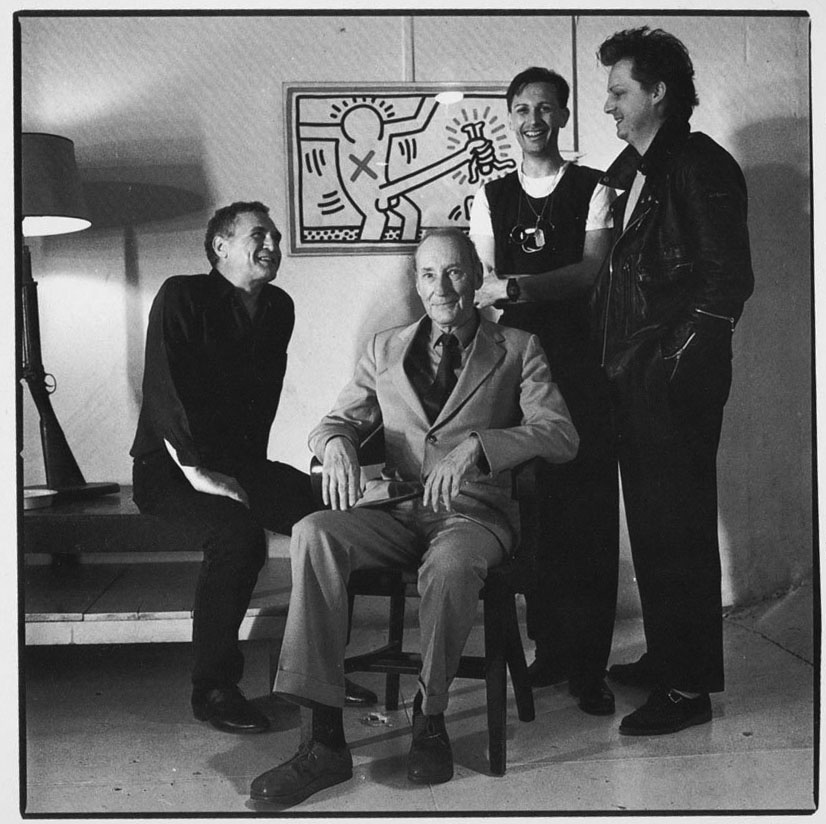
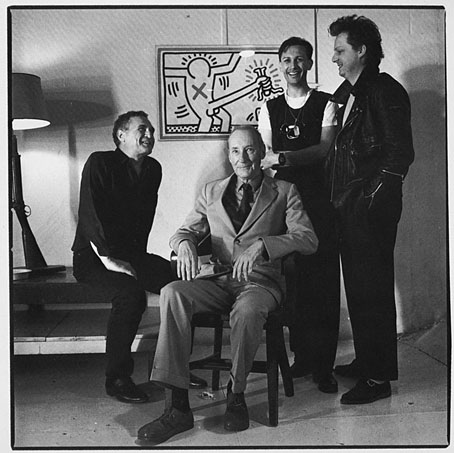
William smiles. Left to right: John Giorno, William Burroughs, Stephen Mallinder, Richard H. Kirk. Photo by Sylvia Plachy from the gatefold interior of A Diamond In The Mouth Of A Corpse (1985), a compilation album released by Giorno Poetry Systems.

Cut-up theory was a constant in the Cabaret Voltaire discography, and in many of Richard Kirk’s solo recordings, with the group starting out as Dada-inspired tape collagists* before they found a way to present their experiments in a musical form. The concept is to the fore in the title of Cabaret Voltaire’s debut album, Mix-Up, and exemplified in the track that opens side two, Photophobia, a reworked version of a Surrealist monologue that dates from the group’s days making recordings in Chris Watson’s attic. Photophobia pulls you into the same queasy dreamspace in which you find yourself when reading Burroughs’ early cut-ups, a catalogue of oneiric splicings—”they’re injecting the rivers with stainless-steel fish…a coelacanth/a body with a shrunken head…”—the phrases being increasingly overwhelmed by rising synthesizer drones and Kirk’s squeaking clarinet. Kirk’s solo debut, Disposable Half-Truths, was a cassette-only release on Industrial Records infused with the Burroughs spirit in both technique and content, offering track titles such as Information Therapy and Insect Friends Of Allah. Cabaret Voltaire continually referred to Burroughs’ speculative essay collection The Electronic Revolution in interviews but it was Kirk who extended the group’s cut-up experiments to film and video. By 1982 they’d accumulated enough of their own video material to release a VHS collection on their own music and video label, Doublevision.

If I’ve concentrated on the early recordings it’s because the post-punk period continues to seem like a miraculous moment, a space of four years when anything was possible musically, a time when Bruce Gilbert and Graham Lewis could record an album as uncompromisingly strange as 3R4 then have it released on 4AD and sold in racks next to albums by label-mates Bauhaus and The Birthday Party. Cabaret Voltaire took advantage of this unique period to warp expectations in their own way, and to extend the boundaries of the possible. Richard H. Kirk’s subsequent career was prolific, releasing a blizzard of albums and singles under a variety of pseudonyms (Discogs lists 42 different Kirk aliases). One of my favourite pieces from his solo recordings is White Darkness from 1993, the last track on a 12-inch single, Digital Lifeforms, credited to Sandoz. There’s a mysterious quality here that I wish he’d explored more often on his later albums instead of letting the rhythms run their course for another seven or eight minutes. The sampled voice maintains a thread of continuity with Kirk’s music before and after, as does the reference to LSD in the Sandoz name, taking us back to Mix-Up and the mescaline experiments described on Heaven And Hell. Psychedelia by other means.

* For a taste of unadorned Cabs-related tape manipulation, see The Men With The Deadly Dreams, a cassette release compiled by Geoff Rushton/John Balance which features contributions from Chris Watson and Richard H. Kirk. Note that the blog post doesn’t give an accurate description of the tape contents.

• At Vinyl Factory: An introduction to Richard H. Kirk in 10 records.
• At The Wire: two interviews with Kirk from the magazine’s archives.

Previously on { feuilleton }
Recoil and Cabaret Voltaire
Pow-Wow by Stephen Mallinder
TV Wipeout revisited
Doublevision Presents Cabaret Voltaire
Just the ticket: Cabaret Voltaire
European Rendezvous by CTI
TV Wipeout
Seven Songs by 23 Skidoo
Elemental 7 by CTI
The Crackdown by Cabaret Voltaire
Neville Brody and Fetish Records