Weekend links 120

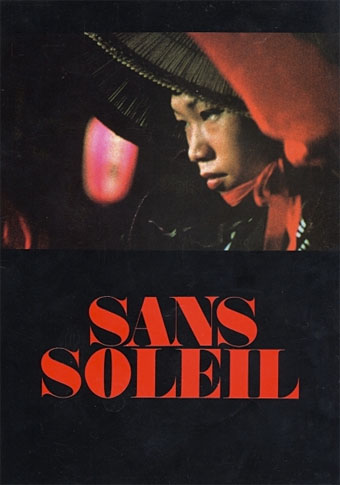
sanssoleil.jpg

• More Nabokov: The University Poem by Vladimir Nabokov, translated by Dmitri Nabokov and read by Ralph Fiennes. And Breitensträter – Paolino, a short story from Nabokov’s Russian period that’s only just been translated into English.

• More LSD: “For decades, the U.S. government banned medical studies of the effects of LSD. But for one longtime, elite researcher, the promise of mind-blowing revelations was just too tempting,” says Tim Doody.

• More Marker: The Guarded Intimacy of Sans soleil by Jonathan Rosenbaum, The Revolutionary Cinema of Chris Marker by Patrick Higgins, and Chris Marker’s Faces by Brian Dillon.

• “A private realm, not easily penetrated, from which emerged music that would give rise to so much of the music we know today.” Guy Horton on Kraftwerk’s Kling Klang studio.

• A narrative from the swamps of Borneo: BLDGBLOG on the mephitic enigma of London’s sewers.

• At Coilhouse: The Incredibly True Adventures of Gerda Wegener and Lili Elbe.

• “What some people call idleness is often the best investment,” says Ed Smith.

• Book cover design: Rick Poynor on Pierre Faucheux and Le Livre de Poche.

• Metaphysical psychedelia: Erik Davis on Rick Griffin: Superstar.

Diamanda Galás discusses her 13 favourite albums.

• Rudy Rucker’s Memories of Kurt Gödel.

• The Men of the Folies Bergère

Olympics or gay porn?

Smoketography

The songs of bowhead whales | Another Moon Song (2009) by Espers | One Thousand Birds (2012) by Six Organs of Admittance.

Weekend links 118

owczarek.jpg

The Garden of Urban Delights (2010) by Marcin Owczarek.

His protagonists are misfits: alienated, implicitly gay, longing for love, frequently hard to be around, always fixated on small pleasures that compensate for an essential feeling of not belonging. […] His patroness Edith Sitwell termed him “that rare being, a born writer.” William Burroughs dedicated The Place of Dead Roads to him, declaring Welch “certainly the writer who most directly influenced my work.” John Waters has called In Youth is Pleasure “so precious, so beyond gay, so deliciously subversive, [it] is enough to make illiteracy a worse social crime than hunger.”

Sadie Stein on Denton Welch, a writer I’m embarrassed about still not having read. Edith Sitwell and William Burroughs had a famously disputatious correspondence in the pages of the TLS over The Naked Lunch. An appreciation of Welch’s work was one of the few things they had in common.

• Don’t mention guitars: Robert Hampson on acousmatic music, the curse of Loop and the rebirth of Main.

• No Straight Lines: A Collection Of Queer Comics part one, part two, part three. A history by Justin Hall.

Pieces Of Gold by The Aikiu: shots from gay porn videos repurposed via some smart editing.

• RIP İlhan Mimaroğlu, electroacoustic composer. Ubuweb has a selection of his recordings.

“A good ground rule for writing in any genre is: start with a form, then undermine its confidence in itself,” he says. “Ask what it’s afraid of, what it’s trying to hide – then write that.” For Harrison, the most satisfying writers are “at odds with their cultural context. They’re trying to fit in and failing, or they’re trying to remove themselves and failing. The attempt to resolve the conflict is an angle – a frame or a context – in itself.”

The Guardian’s A Life in Writing profiles M. John Harrison. His new novel, Empty Space, was published on Thursday. There’s also this recent video interview with Arc magazine.

• Stephen Usery interviews editor Russ Kick about The Graphic Canon: Volume One.

At home with Prince Zaleski, the “most decadent and imperial detective in fiction”.

• A Visit with Magritte: photographs by Duane Michals.

Loitering airships could dispense drones on demand.

• Creating a Forever Object: Ian Schon’s Pen Project.

• A Tumblr for the late, lamented Arthur Magazine.

• “Few cities can boast a railway line for the dead.”

The Lost Tapes by Can: An Oral History.

Space Reflex (1963) by Dick Hyman & Mary Mayo | Space Is Deep (1972) by Hawkwind | Space Is The Place (1973) by Sun Ra | Space Moment (1995) by Stereolab | Space Pong (2006) by T++

Terminus by John Schlesinger

terminus.jpg

Before John Schlesinger made his debut feature, A Kind of Loving (1962), he directed a number of short documentary films. Terminus (1961), a day in the life of the Waterloo railway station in London, is the most notable of these, an award-winning snapshot of a period when Britain’s railways were still nationalised and steam trains were about to vanish from regular service. The film has that crisp, black-and-white photography so typical of the early 1960s, a look which renders close-ups with uncanny fidelity and makes the outmoded fashions—the bowler-hatted men and gloved women—seem all the more curious. A year later Orson Welles was deploying a similar style when photographing the dishevelled splendour of the Gare d’Orsay in Paris for his film of The Trial.

For a different take on London’s railway stations there’s Terminus by analogue electronic outfit Node, a track inspired by concerts they played live at Paddington station in 1995.

Previously on { feuilleton }
Screening Kafka

Weekend links 116

sherer.jpg

Ankle Deep, a pyrograph by Robert Sherer whose work is showcased at The Advocate.

• “Bertrand Russell wrote in 1932, during another period of economic distress, ‘that immense harm is caused by the belief that work is virtuous, and that what needs to be preached in modern industrial societies is quite different from what always has been preached.’ ” From The Devilishness Of Idleness by Alex Gallo-Brown. Related: Owen Hatherley says “It’s the 21st century – why are we working so much?”

Restoring James Joyce’s book of the night: Joyce biographer Gordon Bowker reviews the new edition of Finnegans Wake. Over at the NYRB Michael Chabon has a great piece about his own relationship with Joyce’s novel that manages to make some very un-NYRB references to Cthulhu, the Necronomicon and Michael Moorcock’s Elric. Related: Leopold’s Day, a limited edition (and expensive) map of Dublin using typography to depict the people and places of Bloomsday.

Verbally, it feels as though Burroughs, Joyce and Beckett are text messaging haikus back and forth: ‘beautiful/last/random fragments of poetry/finding syllables,/the waters fall/the waves fall/musical./pencil murmuring’.

James Kidd on A Humument by Tom Phillips.

The Expanding Universe (1980), an album of early computer music by American composer Laurie Spiegel, will be reissued with additional recordings in September.

• A previously unreleased remix by Surgeon of Teenage Lighting by Coil has been made public.

collard.jpg

Small Museum of Nature and Industry (2010) by Susan Collard.

Queer Kids In America, a photo project by M. Sharkey.

Walter Benjamin’s Grave: A Profane Illumination.

The Visual Art and Design of Famous Writers.

Nylon Sculptures by Rosa Verloop.

Froschroom (1994) by Mouse on Mars | Bib (1995) by Mouse on Mars | Cache Coeur Naïf (1997) by Mouse on Mars.

Wilfried Sätty album covers

gandharva.jpg

Gandharva (1971) by Beaver & Krause. Cover art by Sätty, lettering by David Singer.

There aren’t many, unfortunately, and half the ones here have already featured in previous posts, but since I’m often referring people to Sätty’s work it seems worthwhile gathering them together. His album cover art shows he was equally adept at working with colour as with black-and-white, and might have done a lot more in this line had he been given the opportunity. (Sätty’s first book, The Cosmic Bicycle, does include some colour plates.)

The Gandharva album is the oddest in this small collection, one side being a blend of blues, gospel and Beaver & Krause’s Moog doodlings while the other side comprises an improvised Moog-inflected jazz suite recorded live in Grace Cathedral, San Francisco. The setting of the latter is apt since cover artists Sätty and David Singer both came to prominence among San Francisco’s psychedelic poster designers in the late 1960s. Film director Robert Fuest liked Gandharva so much he hired Paul Beaver, Bernie Krause and Gerry Mulligan to play similar music for the soundtrack of The Final Programme.

Of the other albums the Sopwith Camel is obviously closest to Sätty’s familiar style. The covers for George Duke suit the mid-70s trend of jazz/funk albums with “cosmic” sleeve art exemplified by Tadanori Yokoo’s fantastic (in all senses) collage for Agharta by Miles Davis. Documentation of Sätty’s non-book work is still sparse so if anyone knows of any other covers please leave a comment.

Update: Added The Occult Explosion. See this later post.

sopwith.jpg

The Miraculous Hump Returns From The Moon (1973) by Sopwith Camel.

occultsatty.jpg

The Occult Explosion (1973) by Various Artists.

duke2.jpg

Feel (1974) By George Duke.

duke1.jpg

The Aura Will Prevail (1975) by George Duke.

Elsewhere on { feuilleton }
The album covers archive

Previously on { feuilleton }
Nature Boy: Jesper Ryom and Wilfried Sätty
Wilfried Sätty: Artist of the occult
Illustrating Poe #4: Wilfried Sätty