Weekend links 218

white.jpg

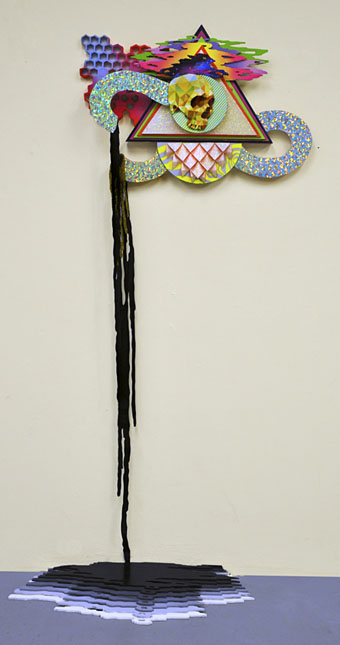
The End of a Thousand Years (2014) by Hilary White. Via Phantasmaphile.

• It’s taken a while to shamble into the world but A Mountain Walked, an anthology of Cthulhu Mythos stories edited by leading Lovecraft scholar ST Joshi, will be published by Centipede Press next month. The publisher’s page for the book shows that my contribution will be facing Joshi’s introduction which is something I wasn’t aware of until this week. It also says the 692-page limited edition is sold out, although book dealers often buy collectible volumes such as this to sell on after adding their own markup. Be warned that it was listed on Amazon at $160 so if there are copies available anywhere they won’t be cheap.

• It’s not such a surprise to hear that magic mushrooms were an inspiration for Frank Herbert’s Dune. David Lynch’s film of Dune receives passing mention in this profile by Jeremy Kay of Lynch and the Twin Peaks film/TV series.

• “Whitechapel station is one of Giambattista Piranesi’s imaginary prisons, colonised by frantic electrical engineers and watched over by CCTV.” Will Wiles on the chaos and tangled energy of modern cities.

The word perfume comes from the French root “fume”—smoke—and where there’s smoke, there’s fire! I think most people are turned on sexually by scents and smells. Certain body odours can be very sexually stimulating. We purposefully chose certain ingredients for my Obscenity perfume that are associated with occult or religious rituals, including vetiver, labdanum, and oud, and others that are considered aphrodisiacal, including patchouli and sandalwood. The point of Obscenity is that there is no conflict between the religious and the sexual, and in fact they should be completely complimentary. The fragrance is meant to stimulate you sexually, but it also literally contains water from Lourdes, so it also has religious notes and perhaps even healing properties!

Bruce LaBruce talks to Kathy Grayson about his new fragrance, Obscenity

The Baffler, “a journal of iconoclastic wit and cultural analysis” relaunches with full access to its archives from 1988 to the present.

Pineal, the new album by Othon, is dark and “properly, brilliantly queer,” says David Peschek.

• At Core77: How to improve the audio quality of vinyl records with wood glue.

• P. Adams Sitney interviews Kenneth Anger on WNYC’s Arts Forum (1972).

• At BibliOdyssey: Le Bestiaire Fabuleux by Jean Lurçat.

• Mix of the week: Secret Thirteen mix 123 by Evol.

Meawbin the Creepy Cat

Perfumed Metal (1981) by Chrome | Fragrance (Ode To Perfume) (1982) by Holger Czukay | The Perfume (2006) by Johnny Klimek, Reinhold Heil, Tom Tykwer
The original Cabaret Voltaire

cv1.jpg

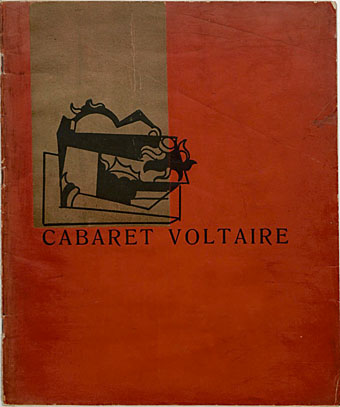
Cabaret Voltaire #1 (1916). Cover by Hans Arp.

Richard H. Kirk’s announcement that he’ll be performing at the Berlin Atonal festival as Cabaret Voltaire caused some raising of eyebrows recently, although if Stephen Mallinder isn’t involved I won’t be getting too excited myself. The last few releases under the Cabaret Voltaire name were credited to Kirk/Mallinder but from Plasticity (1992) on they don’t sound very different to Kirk’s solo releases from the same period. That’s not to say the music suffers but you have to wonder why the group name is being perpetuated if there’s nothing unique attached to it.

cv2.jpg

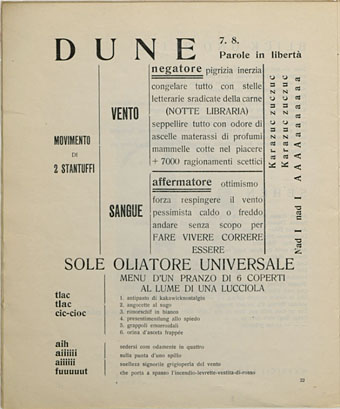
Dune, parole in libertà by Filippo Marinetti.

The group, old or new, will be the first thing that comes to mind for most people when they hear the name Cabaret Voltaire, something that might have surprised Hugo Ball who founded the original Cabaret Voltaire in Zurich almost a century ago. Cabaret Voltaire (the group) named themselves after Ball’s project, their intentions in the mid-1970s being similarly Dadaist. Early Cabs performances were more audience provocations than anything to do with entertainment; the music came later, and only after several years of very uncommercial tape experimentation, some of which can be heard on Methodology ’74–’78: Attic Tapes (2003). Thanks to Switzerland staying out of the war the original Cabaret didn’t get wrecked by bombs or destroyed by the Nazis, and is still active today. Ball also published a Cabaret Voltaire journal, two pages of which can be seen here. If this doesn’t look very dramatic to our eyes it needs to be remembered that everyone who first saw it would have been born in the 19th century so the contents would have seemed a lot more radical. A slim publication but with a formidable list of contributors: Guillaume Apollinaire, Hans Arp, Blaise Cendrars, Wassily Kandinsky, Filippo Marinetti, Amedeo Modigliani, Pablo Picasso, Tristan Tzara and others.

Also at Ubuweb (where else?) there are several recordings of Hugo Ball’s Dada poetry including a recital of Karawane by (of all people) Marie Osmond. Who knew there was a connection between the Osmonds and Cabaret Voltaire?

Previously on { feuilleton }
Cabaret Voltaire on La Edad de Oro, 1983
Doublevision Presents Cabaret Voltaire
Just the ticket: Cabaret Voltaire
TV Wipeout
The Crackdown by Cabaret Voltaire

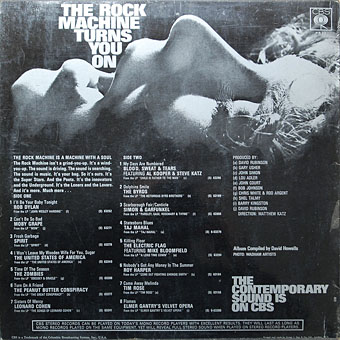
The Rock Machine Turns You On

rockmachine.jpg

Discovered via the latest issue of The Wire magazine in a feature about compilation albums, The Rock Machine Turns You On (1968) was the first budget sampler album. Given the success of this release I’m sure I must have seen it over the years but that cover wasn’t familiar at all. I have to assume that the “Hey, pop kids!” title would have been enough of a turn-off to ensure the fingers kept flipping through the sleeves. Priorities change with the passing of time, however, and my attention was caught by the cover art alone, another example of the engraving-collage style whose evolution I’ve been tracing over the past few years. The only design credit on the sleeve is for the back cover photo by Wadham Artists. The front cover is credited online to Milton Glaser, some of whose album covers have already featured here. He was working for Columbia/CBS in the late 60s so it’s a possibility. If anyone out there has a copy of the vinyl then maybe they can tell me if that’s an artist credit in the lower right of the picture. A CD reissue in 1996 only copied the album credits.

rockmachine2.jpg

As to the music, it’s a pretty good compilation, lots of familiar names together with a track from cult favourites of mine The United States of America whose one and only self-titled album had been released that year. One of the few negatives about the superb United States of America album is the cover design which isn’t bad but does nothing to reflect the extraordinary musical invention within. It’s a shame that whoever designed The Rock Machine… couldn’t have worked on that sleeve as well.

Update: Rick Poynor writes to say that this cover appears in Milton Glaser: Pop, so the Glaser attribution is accurate.

Elsewhere on { feuilleton }
The album covers archive

The art of Fritz Hegenbart, 1864–1943

hegenbart4.jpg

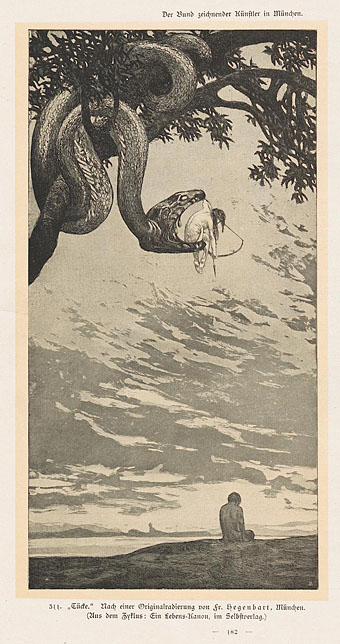
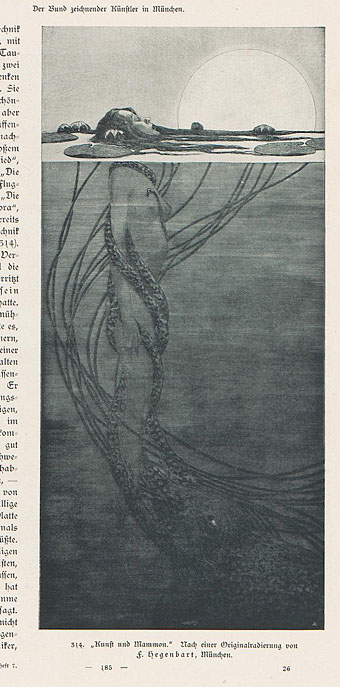
Fritz Hegenbart was an Austrian artist some of whose work has appeared here before in posts about Jugend magazine. Hegenbart provided many illustrations and embellishments for Jugend and other journals circa 1900, the examples here being mostly from a feature in the collected Kunst und Handwerk for 1902/03, a magazine I was rifling through last week. Once you’ve been through Deutsche Kunst und Dekoration and others you find the same contents repeating themselves with slight variations; that’s no surprise when there was only a certain amount of news that any arts magazine could report for a given year.

Hegenbart’s work stands out for conjuring the slightly grotesque allegories I often like to see: The woman aiming an arrow from inside a serpent’s jaws represents Malice, while the woman being dragged under the water by a tentacled monstrosity is Art falling prey to Mammon. An updated version of that picture would have to show Mammon as a bloated and triumphant abomination. Hegenbart seemed to enjoy attaching wings to whatever women he was drawing; further down the page you’ll find a wingless woman being menaced by a particularly dopey-looking dragon.

hegenbart7.jpg

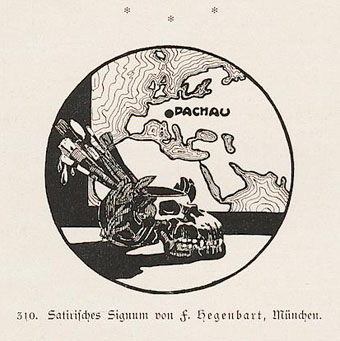
There’s also the curious ink piece below showing the location of the artist’s home in Dachau, Bavaria, and what to our eyes is a supremely inappropriate skull-shaped container for his brushes. The shadow of two world wars always hangs heavily over these magazines (especially in the nationalistic Jugend) but the imagery is seldom as prescient as this.

hegenbart3.jpg

Continue reading “The art of Fritz Hegenbart, 1864–1943”

Weekend links 206

komoda.jpg

Nova Express (2014) by Paul Komoda.

• Last week it was Kraftwerk, this week it’s Can in another astonishing 70-minute TV performance from 1970. For those who know where to look in the torrent world there are copies of these recordings circulating there.

JG Ballard: five years on. Extracts from introductions by John Gray, Hari Kunzru, Robert Macfarlane, Deborah Levy, James Lever, China Miéville and Michel Faber for a new series of Ballard editions.

• Mix of the week: Needle Exchange 147 by Inventions. Also at Self-Titled Mag: Suzanne Ciani on her Buchla beginnings, talking dishwashers, and why no one got electronic music in the ’70s.

• At Dangerous Minds: It’s So Far Out It’s Straight Down, a Granada TV documentary from 1967 featuring Paul McCartney, Allen Ginsberg, International Times, Pink Floyd et al.

The Wonderful World of Witches: Portraits of English Pagans. A photo-special from the 1960s at LIFE. Related: From 1974, the US TV ad for Man, Myth and Magic.

• Suspicious Minds: Adam Curtis on Stephen Knight, Jack the Ripper, squatters, heists, From Hell, and why people no longer trust those in authority.

• Here be men with beards and syntezators: Andy Votel‘s Top 10 Early Patch-Bay Polymaths From Eastern Europe.

The New York Public Library has made 20,000 maps available as free, high-res downloads.

• An oscilloscope video by Vincent Oliver & Steve Bliss for Riff Through The Fog by Clark.

Anne Billson interviewed Alejandro Jodorowsky in 1990.

• At BLDGBLOG: When Hills Hide Arches.

Do gay people still need gay bars?

Pixelord Dreams

I’m So Green (1972) by Can | Nova Feedback (1978) by Chrome | Gay Bar (2003) by Electric Six