Weekend links 443

gorey.jpg

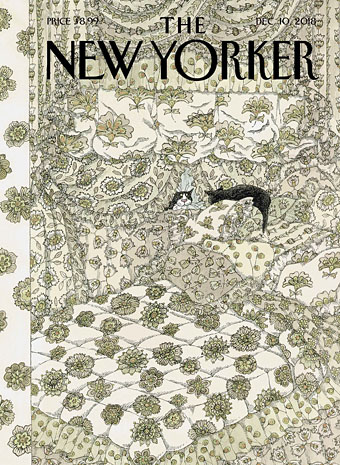
• Yet more Gorey: Mark Dery’s biography of the artist prompted The New Yorker to unearth a piece of cover art that Edward Gorey submitted 25 years ago. In the same magazine Joan Acocella reviews Dery’s book and examines Gorey’s life and art. At Expanding Mind, Erik Davis talks with Mark Dery about Surrealism, the gay voice, Penny Dreadfuls, and the occult and Taoist influences in Gorey’s work.

Moving Through Old Daylight: Mark Fisher, Jim Jupp & Julian House of Ghost Box Recordings, and Iain Sinclair in conversation at the Roundhouse, Camden, London, 5 June 2010. Topics under discussion included Nigel Kneale, TC Lethbridge, John Foxx, BBC Radiophonic Workshop, alchemies of sound, the homogenisation of culture, imagining space and the impersistence of memory.

• “A radical retelling of our relationship with the cosmos, reinventing the history of astronomy as a new form of astrological calendar.” The Space Oracle by Ken Hollings.

There was a deliberate, almost prickly quality to Fisher’s writing and thinking that is rare nowadays, when criticism is more likely to involve open-minded rationalizing than steadfast refusal. He was not one to frolic in ambiguity or irony. “Just because something is current doesn’t mean it is new,” he writes in K-Punk, as he wonders if a time traveller from the nineties would find any contemporary music as radical as post-punk or jungle had once seemed to him. When everything is cheerfully “retro,” Fisher argued, we lose our grasp on history—and, without a sense of why the past happened the way it did, our anything-goes embrace of “happy hybridities” is an empty gesture. “What pop lacks now is the capacity for nihilation, for producing new potentials through the negation of what already exists,” he writes.

Hua Hsu on Mark Fisher’s K-Punk

• At Wormwoodiana: Mark Valentine on The Wind Protect You (1946), a novel by Pat Murphy which Mark describes as a forgotten precursor of Watership Down.

• “At once tiny and huge: what is this feeling we call ‘sublime’?” Sandra Shapshay explores the Romantic aesthetic.

Dennis Cooper‘s favourite fiction, poetry, non-fiction, film, art, and internet of 2018. Thanks again for the link here!

• Mixes of the week: XLR8R Podcast 572 by Nastia, and FACT Mix 683 by Casino Versus Japan.

A Child’s Voice (1978) by David Thomson, an overlooked ghost story starring TP McKenna.

• Jean Cocteau’s Orphée returns from the underworld via BFI blu-ray next month.

Rated SAVX: The Savage Pencil Scratchbook

Orpheus (1967) by The Walker Brothers | Orpheus (1987) by David Sylvian | Overture To Orpheus (2003) by Colin Booth
Weekend links 441

jakuchu.jpg

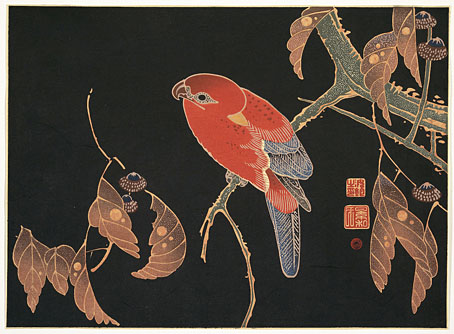
Red Parrot on the Branch of a Tree (c.1771) by Ito Jakuchu.

• Reporter John Stapleton (later a fixture of BBC TV) visits the Portobello Road offices of British underground newspaper Frendz for newsreel service British Pathé. The date says 1969 but it’s probably 1971 since earlier that year the magazine had changed its name from Friends. Among the unidentified interviewees is Rosie Boycott, later the founder of Britain’s first feminist magazine, Spare Rib, and now Baroness Boycott. She may have predicted the former in 1971 but I doubt she would have expected a seat in the House of Lords.

• At Expanding Mind: Erik Davis talks with martial artist and psilocybin explorer Kilindi Iyi about African martial arts, high dose psilocybin work, African-American psychedelia, Dr. Strange, and the metaphysics of darkness.

Bloom, the generative music app by Brian Eno and Peter Chilvers, is given a tenth-anniversary relaunch this month. The new app will also (finally) be available for Android as well as Apple machines.

Early on, I realized my interest in [William] Burroughs’ work was less to do with the cut-up novels and more with the documented research and investigation of the human condition, technology, control, travel, dreams, drug culture, shamanism, and Hassan-I Sabbah. Books like The Job, The Electronic Revolution and especially, The Third Mind with Brion Gysin were particularly important to me. […] As for integrating Burroughs’ work into the music, it’s not about the history of a literary collaboration, but rather the complete fusion in a praxis of two subjectivities that metamorphosize into a third. From this collusion, a new author emerges—an absent third person, invisible and beyond reach, recording the silence.

From 2017: Bill Laswell in a satisfyingly lengthy interview with Anil Prasad

Secret Satan, 2018: being the annual Strange Flowers “round-up of giftable cultural history with which you can unmistakably signal your degenerate cosmopolitan values”.

• Laurie Spiegel’s second album of electronic music, Unseen Worlds, was never given a proper release in 1990. This situation will be rectified in January.

• Mixes of the week: Secret Thirteen Mix 272 by Paulie Jan, and XLR8R Influences Podcast 12 by Ripperton.

• More Gorey: biographer Mark Dery and design historian Steven Heller discuss Edward Gorey’s life and work.

Rumsey Taylor on Roger Excoffon’s Choc, “the mystery font that took over New York”.

• More Nicolas Roeg: David Thompson on one of Britain’s greatest film directors.

John Waters picks his films of the year.

• RIP Bernardo Bertolucci

In Bloom (1991) by Nirvana | Bloom (2001) by Brian Eno & J. Peter Schwalm | Violet Bloom (2010) by John Foxx

Weekend links 431

eckman-lawn.jpg

Postcard collage by Alex Eckman-Lawn.

• “He deserves to be a major figure not only in the history of Japanese music, but in popular music writ large.” Geeta Dayal on Haruomi Hosono, a musician whose solo albums from the 1970s are reissued this month by Light In The Attic.

Erica X Eisen reviews Black Light: Secret Traditions in Art since the 1950s, an exhibition of occult art at the Barcelona Contemporary Culture Centre. Related: Gary Lachman‘s talk from the same exhibition.

• Mixes of the week: Jesús Bacalão’s Light Entertainment Programme 2, Secret Thirteen Mix 265 by Alexander Tucker, and FACT Mix 672 by Rian Treanor.

Whenever horror is criticised, it is criticised for staging a dark carnival of physicality. Perhaps the only sort of media we moralise more than we do horror is that other mainliner of bodily response, pornography.

Horror’s historical ghettoisation has meant that weightier, smarter horror reliably gets labelled as something else. The finest films of our current golden age have been dubbed “elevated horror” and “post-horror”. In literary circles, works of horror seen as sufficiently cerebral get relabelled “Gothic”. It’s certainly true that great horror is always about more than gore. But we should be careful not to gentrify the genre by cleansing it of everything but the philosophy.

MM Owen on the perennial attractions of a perennially despised genre

• “Netflix is a woeful service,” says Jeremy Allen who prefers DVD/Blu-ray to streaming video (as do I). Related: The problem with film aspect ratio on Netflix.

• The Thought Gang album, a Twin Peaks-related collaboration between David Lynch & Angelo Badalamenti from 1993, will be released next month.

Tangerine Dream: Sound From Another World: a TV documentary from 2016. In German but with auto-translated subtitles.

The Thing’s Incredible! The Secret Origins of Weird Tales by John Locke.

Haute Macabre Staff Favorites: Tarot Decks

First Light (1980) by Harold Budd & Brian Eno | Blue Light (1993) by Mazzy Star | Black Light (1994) by Material

The eyes have it

oeil01.jpg

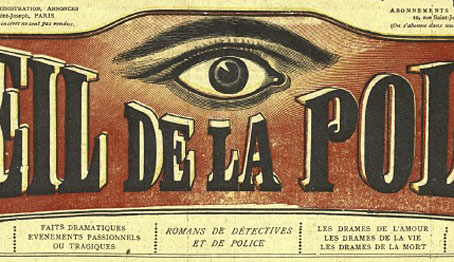
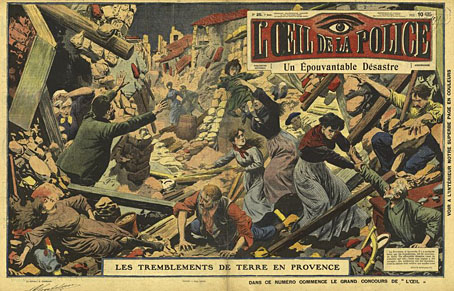
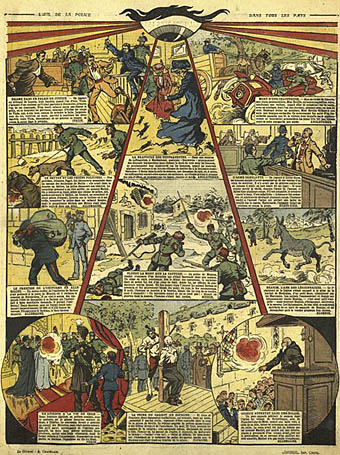
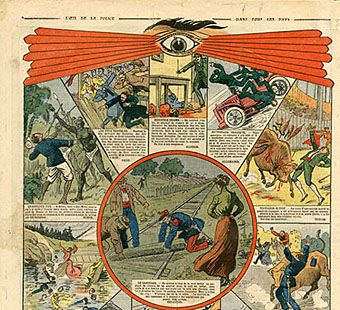
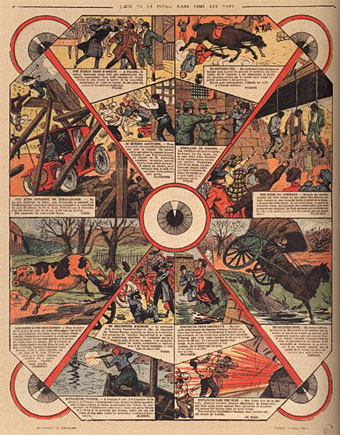
Recent picture research turned up issues of L’Oeil de la Police, a lurid French crime magazine that I hadn’t encountered before. It shouldn’t be too surprising when the nation that gave the world the guillotine and Grand Guignol theatre produces magazines filled with gore, but the amount of red ink in these pages (also applied to gun shots and explosions) is certainly unusual for the time. The covers of Le Petit Journal—which ran concurrently with L’Oeil de la Police—also tended to the lurid and gory but the quality of illustration was better there. L’Oeil de la Police is positively cartoon-like, especially on the back covers of each issue which present their disasters in comic-like pages overseen by the spectral Eye of the Law. This is rather disingenuous when many of the scenes don’t involve law-breaking at all, but are reports of natural disasters and fatal accidents. The samples below show the most bizarre feature of the back pages which is the titular Eye in places becoming anthropomorphised, like an atrocity-viewing precursor of the eyeball heads worn by The Residents.

oeil02.jpg

The L’Oeil de la Police archive at Gallica runs from 1908 to 1914 should you require an antique disaster fix. The archive site has improved in recent years but it can still be awkward (and slow) to use so perseverance is required.

oeil03.jpg

oeil04.jpg

oeil05.jpg

Continue reading “The eyes have it”

Weekend links 412

maroto.jpg

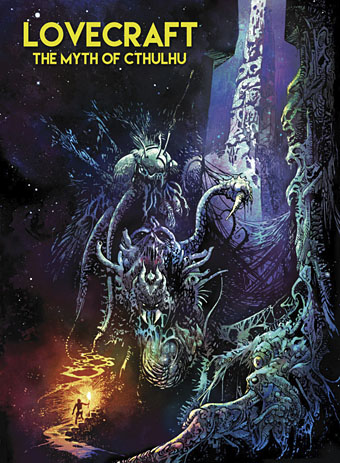
Lovecraft: The Myth of Cthulhu, an English-language edition of three comic-strip adaptations by Esteban Maroto, is now available from IDW.

The Coffin House, a short story by Robert Aickman that’s a taster for the new Aickman collection, Compulsory Games. Anwen Crawford wrote an introduction to Aickman’s world of “strange stories” for The New Yorker. Related: Victoria Nelson, editor of the new collection, chooses ten favourite horror stories.

• German music this week at The Quietus: Sean Kitching talks to Irmin Schmidt about his years with Can; and there’s an extract from Force Majeure, an autobiography by the late Edgar Froese, writing about the early days of Tangerine Dream.

• More German music at Carhartt WIP: a lengthy and revealing interview with guitarist Michael Rother about his time as one half of Neu!. There’s also a bonus Neu!-themed mix (and one of the mixes of the week) by Daniel Miller.

• From October last year, a Stereoklang interview with master synthesist Hideki Matsutake (Logic System, Yellow Magic Orchestra, et al).

• “When did you first get interested in esoteric studies?” Gary Lachman interviewed at The Astral Institute.

• At Sweet Jane: early illustrations by Wojtek Siudmak for Plexus magazine, 1969.

• 87 prints and drawings by MC Escher in zoomable high-resolution.

• Meet the Small Press: James Conway of Rixdorf Editions.

• Mix of the week: Goodbyes & Beginnings by Zach Cowie.

Derek Jarman on the trouble with shopping for clothes.

Person To Person (1981) by Logic System | Plan (1981) by Logic System | Prophet (1981) by Logic System