Lovecraft’s favourite artists revisited

hpl.jpg

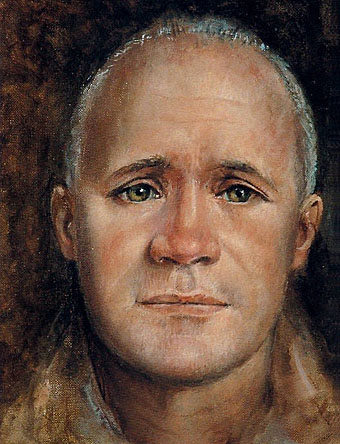
HP Lovecraft (1937) by Virgil Finlay.

I was asked recently to join the bloggers at Tor.com writing about art as it relates to fantasy and science fiction, so for today’s post your attention is directed to this piece, an expanded version of a rather half-hearted list I put together a few years back concerning HP Lovecraft’s favourite artists. Half-hearted or not, people kept linking to that list so it seemed a good idea to make more of it. I’ll be writing these posts a couple of times a month, provided I have the time to do something worthwhile. Watch this space.

Previously on { feuilleton }
The monstrous tome

Weekend links 50

selski1.jpg

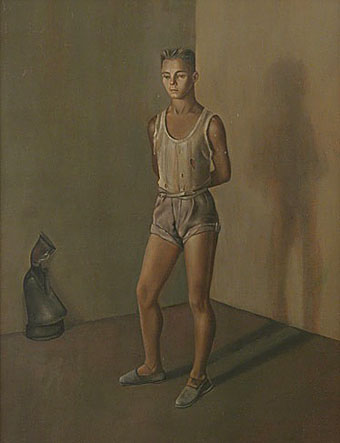
Invisible Light by Margo Selski.

The Glass Garage Fine Art Gallery has an online collection of paintings by Margo Selski, many of which feature her cross-dressing son, Theo. Coilhouse profiled artist and model earlier in the week. Some of these paintings mix oil with beeswax which is something I’ve not come across before.

• The Periwinkle Journal‘s first issue will be available online, free, from March 22nd until mid-June, featuring work by filmmaker and artist Hans Scheirl (Dandy Dust), artwork and collages by Genesis Breyer P-Orridge, a 7-page colour comic by Mavado Charon, artwork by Timothy Cummings, artwork and installations by Cody Chritcheloe/SSION, photos by Megan Mantia, Science-Heroes by Peter Max Lawrence, an illustration portfolio by Diego Gómez, selections from the queer photography pool on Flickr, reviews and other stuff. More later.

• The Quietus wanted to remind us that this year is the 25th anniversary of the NME‘s C86 compilation tape, a collection that sought to capture a moment of ferment but which inadvertently inspired too much dreary sub-Velvet Underground pop. I’d rather celebrate the 30th anniversary of the NME‘s C81 compilation, a far more diverse collection and musically superior. If you want to judge for yourself, both tapes can be downloaded here.

selski2.jpg

Machine in the Garden — Our Island Shall Know Abundance Without End by Margo Selski.

• Rick Poynor continues his exploration of Ballardian graphics with a piece about the paintings of Peter Klasen. Related: Where Will It End? JG Ballard interviewed by V. Vale & introduced by Michael Moorcock (Arthur No. 15/March 2005).

In his autobiography, Miracles of Life, JG Ballard suggested that illustrated versions of The Arabian Nights helped prepare him for surrealism.

Robert Irwin, author of The Arabian Nightmare, on the illustrators of The Arabian Nights.

• Another Coulthart cult movie surfaces, Jerzy Skolimowski’s Deep End (1970), out of circulation for many years but newly restored by the BFI. A re-release is scheduled for May so I’m hoping now that a DVD release will follow soon after.

Thom Ayres’ photostream at Flickr, and more long-exposure photos.

Fuck You, A Magazine of the Arts, number 5, volume 8.

Nicolas Roeg: “I don’t want to be ahead of my time.”

• MetaFilter looks at the films of René Laloux.

• The Eerie covers of Frank Frazetta.

Indie Squid Kid.

Requiem (for String Orchestra) by Toru Takemitsu.

ICA talks archived

ica.jpg

I’ve linked to the British Library’s sound archive before but it was only recently that I had a browse through their collection of talks from the Institute of Contemporary Arts, London. The public discussions cover the period 1981–1994, and while there’s a wide range of contributors the lion’s share of interviewees are writers. Most of the talks run from 60–90 minutes. The following is a selection from some of the contents:

JG Ballard and Matthew Hoffman in conversation, 1984. Ballard discussing his latest novel, Empire of the Sun.

Derek Jarman and Ken Campbell in conversation, 1984. Jarman discussing his autobiography, Dancing Ledge which was also published that year. (A revised edition appeared in 1991.) If Ken Campbell seems an unusual interviewer it should be recalled that he appeared in Jarman’s 1979 film, The Tempest.

Alan Moore and Charles Shaar Murray in conversation, 1987. Mr Moore caught in the year when the world at large became aware of comics in general and his work in particular.

Whose Fantasy? Hosted by Neil Gaiman (uncredited) with M. John Harrison, Terry Pratchett, Geoff Ryman & Diana Wynne Jones, 1988. One of a series of events examining British genre fiction. Neil Gaiman was the host of each discussion but is uncredited on the site for several of the talks. This one concerns fantasy and science fiction.

Whose Fantasy? Hosted by Neil Gaiman (uncredited) with Clive Barker, Ramsey Campbell, Roz Kaveney & Garry Kilworth, 1988. The following day’s discussion was oriented more towards horror.

Laurie Anderson and Sarah Kent in conversation, 1990. Laurie Anderson’s latest album (and one of hers I like a great deal) Strange Angels is discussed.

Weekend links: fifth anniversary edition

demuth.jpg

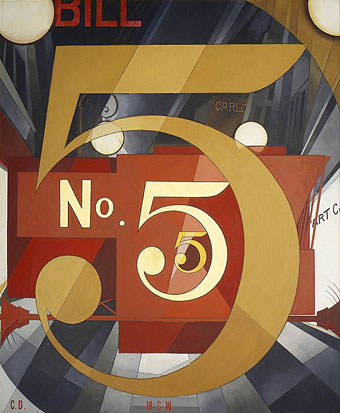
The Figure 5 in Gold (1928) by Charles Demuth.

It’s a little surprising to find I’ve been doing this for five whole years yet here we are. Having seen a number of blogs call it quits at the five-year point I should note that I don’t feel quite that exhausted although maintaining a discipline of daily posting can be a chore at times, especially when you’re pressured by work. On the whole the advantages continue to outweigh the disadvantages. Some of the discoveries here have fed back into things I’ve been working on or opened avenues for future exploration. Researching something for an audience (however slight that audience or the resulting post) encourages you to look more deeply into a given subject; sometimes you learn more as a result and occasionally make surprising discoveries. Obsessions are teased out which might otherwise have lain dormant. Yes, it’s an extra bout of work but I’ve spent much of my life saying to people “if you like that, you may like this”, and that’s all many of these posts are doing.

This year promises to be an interesting one so watch this space. And, as always, thanks for reading!

John x

On to the links…

Cathedral Scan translates the architectural plans of Gothic cathedrals into open-ended musical scores via custom software. There’s more at Blake Carrington‘s website.

Forty-three William Burroughs recordings (tape experiments and readings) at the Ubuweb archives.

• The opening scene of Deadlock (1970), an obscure German film with a theme by the mighty Can.

Strange Lands: A Field-Guide to the Celtic Otherworld, a new book by Andrew L Paciorek.

• The enduring nature of Frankenstein, currently on stage at the National Theatre, London.

shimojo.jpg

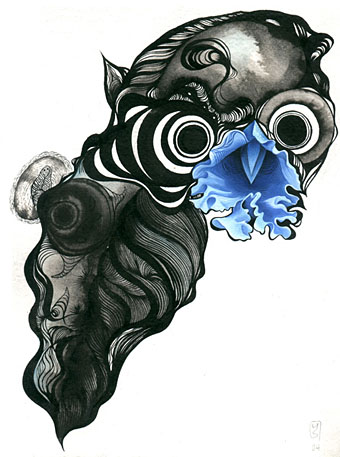
Owl One (2004) by Yuri Shimojo.

¡Activista! by Sonny Smith: Drag Queens, Borders, Rivers, Death and Transformation.

• Estonian sculptor Mati Karmin makes furniture out of Russian anti-submarine mines.

Alan Moore’s contribution to the Save Our Libraries campaign.

• Innsmouth Free Press is raising funds for their running costs.

A history of queer street art (Facebook link, unfortunately).

Illuminated book design for Heston’s Fantastical Feasts.

Physica Sacra, an engraving set at Flickr.

Egypt (1985) by Tuxedomoon | Egyptian Basses (1998) by Coil | Soleil D’Egypte (2001) by Natacha Atlas.

The writhing on the wall

hands9.jpg

Dracula (1992).

This is the closest you’ll get to a guest post here even though it’s been done remotely and I’ve changed things around a little. Following my mention yesterday of the Cocteau-derived lantern-arms in Francis Coppola’s Dracula, Jescie sent me an abandoned blog post which collected similar examples of the arms-through-the-walls motif. I’ve done this kind of thing here in the past so it’s good {feuilleton} material. Almost all these examples are fantasy- and horror-related which isn’t too surprising, and I’m sure there’ll be other examples in films I haven’t seen. If anyone has any suggestions just remember that hands grasping through doors and windows don’t count with this, it’s through the wall or not at all.

hands1.jpg

La Belle et la Bête (1946).

Jean Cocteau sets things off in 1946, a perfect piece of fairytale Surrealism and one of the many memorable aspects of this film.

hands2.jpg

La Belle et la Bête (1946).

Continue reading “The writhing on the wall”