The Court of the Dragon

atget.jpg

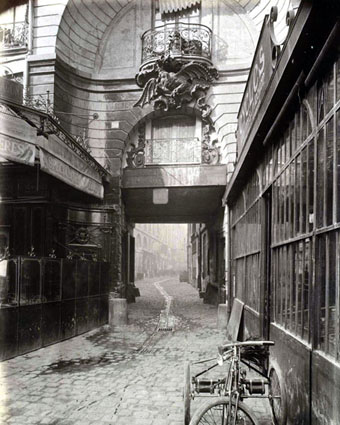
50 Rue de Rennes (1900) by Eugène Atget.

I live in the Court of the Dragon, a narrow passage that leads from the Rue de Rennes to the Rue du Dragon.

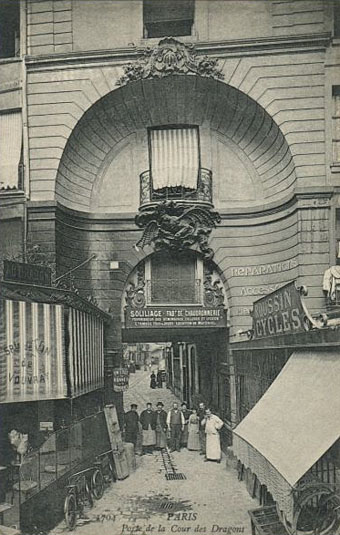
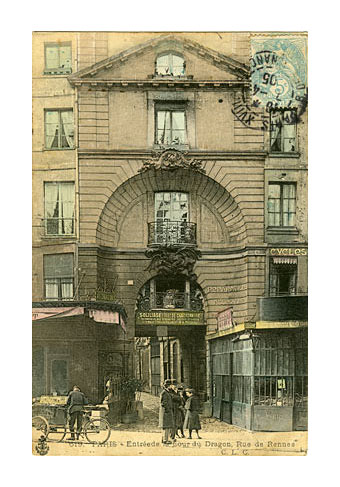
It is an “impasse”; traversable only for foot passengers. Over the entrance on the Rue de Rennes is a balcony, supported by an iron dragon. Within the court tall old houses rise on either side, and close the ends that give on the two streets. Huge gates, swung back during the day into the walls of the deep archways, close this court, after midnight, and one must enter then by ringing at certain small doors on the side. The sunken pavement collects unsavoury pools. Steep stairways pitch down to doors that open on the court. The ground floors are occupied by shops of second-hand dealers, and by iron workers. All day long the place rings with the clink of hammers and the clang of metal bars.

Unsavoury as it is below, there is cheerfulness, and comfort, and hard, honest work above.

Five flights up are the ateliers of architects and painters, and the hiding-places of middle-aged students like myself who want to live alone. When I first came here to live I was young, and not alone.

In the Court of the Dragon (1895) by Robert W. Chambers.

Drawing the King in Yellow for the Karl Edward Wagner story in Lovecraft’s Monsters (see yesterday’s post) sent me back to the Robert W. Chambers story collection where the strange and terrible regent first appears. Despite having written in the past about the covers for Chambers’ book I hadn’t read the stories for some time. Chambers’ blending of Bohemian romance, fantasy, horror, and early science fiction is just the thing to point to when people ask for a definition of weird fiction, writing that comes from a period before the straightjacket of genre definition had fastened itself about imaginative writing.

Chambers’ collection contains ten stories but only the first four are weird tales: The Repairer of Reputations, The Mask, In the Court of the Dragon, and The Yellow Sign. Of the four, In the Court of the Dragon is the weakest, although my re-reading caused some surprise when I realised that the story takes place in a location in Paris which the great photographer of the city, Eugène Atget, had memorably fixed five years after the book was published. Chambers was American but pursued a career as an artist in Paris before he took up writing; the description above can be taken as his own experience of the city.
ruederennes3.jpg

Undated postcards showing wider views.
ruederennes2.jpg

Atget is a photographer whose work I’m always happy to return to, especially his views of the streets and courtyards of a Paris now cleaned and tidied, if not altogether redeveloped. His view of the dragon balcony in the Rue de Rennes features everything I like about his street scenes: an unpeopled vista, weathered cobblestones, curious architectural detail, and the hazy distance of the courtyard itself. Chambers’ story may not communicate quite the same atmosphere but the pair for me are now inextricably linked. This place couldn’t have survived, could it?
ruederennes.jpg

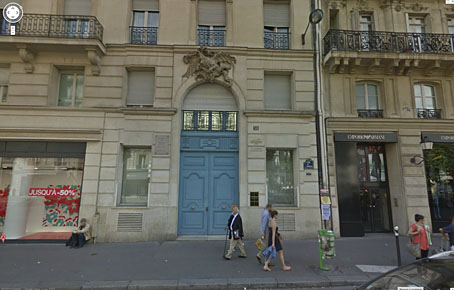
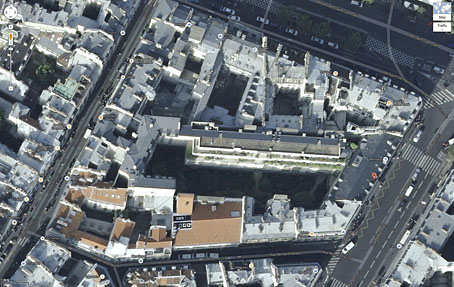
Well, yes and no. The dragon is still there on the wall at 50 Rue de Rennes but the court was apparently redeveloped in the 1950s. Behind those blue doors is a tidy little park for the use of the locals, a common feature in Paris although tourists seldom see more than a glimpse of these places when gates are opened.

dragon.jpg

The satellite view below shows the park, the red A marking the position of the blue doors. Nothing in Paris looks like Atget’s photos any more—that’s a part of their fascination—so these kinds of changes are no surprise. But I’m pleased to discover that the dragon still exists. Next time I’m there I’ll have to pay homage.
court.jpg

ernst.jpg

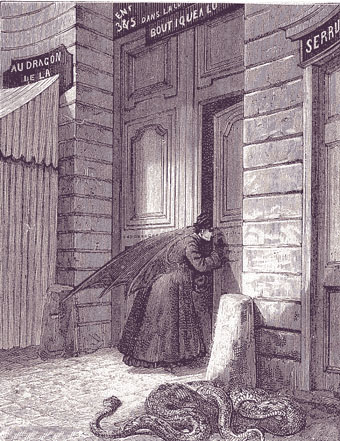
Fourth collage from the La Cour du Dragon chapter of Une Semaine de Bonté (1934) by Max Ernst.

The King in Yellow at the Internet Archive.

Update: Added a couple more pictures.

Update 2: Thanks to Herr Doktor Bimler for reminding me of Ernst’s collage novel, Une Semaine de Bonté, whose second chapter takes its title from the court. Considering this is a favourite book I really ought to have remembered it. Two of the collages show the entrance to the court but the dragon isn’t seen, its presence having been transferred to creatures lurking at the edges of the picture, and the Doré demon wings that many of the characters are sporting.

Update 3: Laurent drew my attention to this post which includes more photos and historical detail. Thanks, Laurent!

Previously on { feuilleton }
Atget’s corners
Rue St. Augustin, then and now
Brion Gysin’s walk, 1966
The King in Yellow

Lovecraft’s Monsters

Lovecraft's Monsters

Graphic for the title page and ends of chapters.

I don’t usually post things so far away from publication, but editor Ellen Datlow put these pictures on her Facebook page a few hours ago so I may as well do the same here.

Back in February I bought a Wacom Intuos drawing tablet, something I’ve been using with regularity for the past few months. The Alas Vegas Tarot cards I designed in the summer were the first major attempt at getting used to working with it; Lovecraft’s Monsters, a forthcoming fiction anthology for Tachyon is the second, and I now feel very comfortable working with it. More than that, I’m increasingly pleased with the way it’s possible to combine the drawing techniques I’ve been using for years with the additional possibilities provided by working in Photoshop. As always, it’s the end result that counts but arriving at an end result can be easy or difficult. Some of these illustrations look no different than they would have done had I used ink on paper but they took half the time to create, a considerable benefit when a deadline is looming.

The stories Ellen Datlow has chosen for this collection all present different aspects of monstrosity seen through the lens of Lovecraft’s fiction and his cosmic menagerie. Some are full-on extensions of the Mythos, others are more allusive; all the pieces bar one have been published before but I’d not read any of them so for me this was fresh material. Having spent the past few years saying I was finished with Lovecraft’s fiction I was excited to be working on this book. The stories are good, and I welcomed the challenge of having to illustrate such a variety of material.

Larger copies of all the pictures can be seen here.

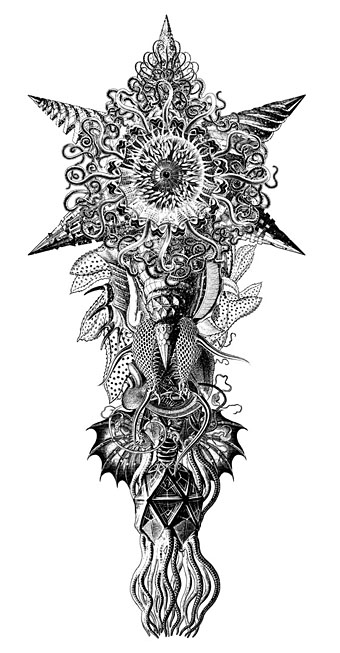
The star-headed thing at the top of this page is another amalgam of elements plundered from Haeckel’s Kunstformen der Natur and other sources. I’ve leaned rather heavily on Haeckel in the past, something I wanted to avoid here; this serves as a kind of visual punctuation separating the stories.

Lovecraft's Monsters

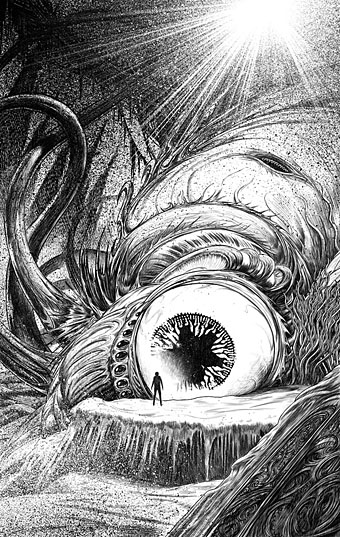
Cthulhu.

The drawing I’ve called Cthulhu is a piece for the introductory pages. Having already produced a lot of Cthulhoid art I didn’t want to repeat myself. The initial idea was of a tiny human figure faced with something enormous and nightmarish; that could be a vast eyeball or it could be a mouth or some other organ/aperture, the vagueness was intentional. Lovecraft continually impresses upon his readers how difficult things are to describe or apprehend but you seldom find this quality in art based upon his stories. Cthulhu especially has devolved into little more than an outsize man-in-a-rubber-suit à la the Creature from the Black Lagoon. In The Call of Cthulhu the figure on the mysterious statuette is described as having a humanoid shape but Lovecraft doesn’t describe the appalling reality in any detail at all. When Cthulhu is struck by a ship at the end of the story it breaks apart and is then seen recombining, the implication being that the creature is corporeally amorphous.

Lovecraft's Monsters

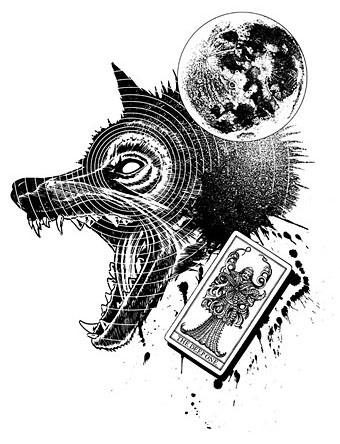
Only the End of the World Again by Neil Gaiman.

Neil Gaiman’s entry concerns a werewolf private detective in Innsmouth. Lovecraft’s decaying fishing village and its inhabitants turn up in several of the stories so care was taken to avoid repetition.

Lovecraft's Monsters

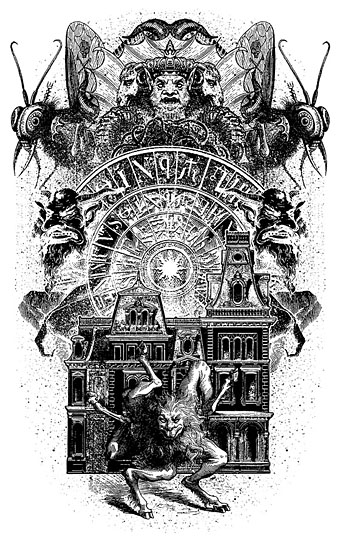
Bulldozer by Laird Barron.

A great story about another detective, a Pinkerton agent this time, hunting his quarry through the Old West. Collin de Plancy’s Dictionnaire Infernal is mentioned so I used some of Louis Breton’s illustrations from the third edition.

Continue reading “Lovecraft’s Monsters”

Weekend links 188

blackwell.jpg

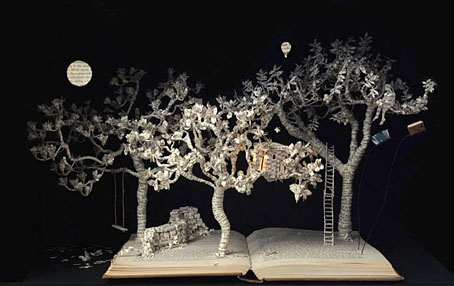
The Baron in the Trees (2011), a book-cut sculpture by Su Blackwell.

Kurt Andersen at Vanity Fair examines the latest claims that Vermeer used a combination of lenses and mirrors to aid the creation of his remarkable paintings. David Hockney caused a considerable fuss in 2006 when he made similar assertions. Andersen recounts how Tim Jenison (who isn’t an artist) decided to test the hypothesis by building a replica of the room from Vermeer’s The Music Lesson (1662–65) which he then painted with the assistance of a lens-and-mirror apparatus. I’m agnostic on this issue, and don’t regard it as a devaluing of the work of Vermeer (or any other artist) if some special apparatus was used to help create the paintings; artists for centuries have been using whatever technology was available.

One point which isn’t mentioned in the article: lens optics were being developed to a high standard in the Netherlands during Vermeer’s time. One of the developers of the microscope, Antonie van Leeuwenhoek, was a contemporary of Vermeer’s in Delft, and is even alleged to be portrayed in some of the artist’s paintings.

• Before Alfred Hitchcock’s film and Daphne Du Maurier’s short story, The Birds was an “eerie yet satirical and rather metaphysical novel” by Frank Baker, inspired in part by Arthur Machen. Michael Dirda reviews a new edition. Related: “The Day of the Claw: A Synoptic Account of Alfred Hitchcock’s The Birds“, an essay by Ken Mogg examining avian menace through the ages.

Kevin Brownlow and Carl Davis on how they brought Abel Gance’s 270-minute silent masterwork, Napoleon (1927), back to the screen.

Finally, he was asked about the growth of surveillance and the militarization of the police.

“The phenomenon itself shouldn’t be surprising—the scale was surprising—but the phenomenon itself is as American as apple pie,” Chomsky said. “You can be confident that any system of power is going to use technology against its enemy: the population. Power systems seek short-term domination and control, not security.”

Matthew Robare on “American Anarchist” Noam Chomsky in (of all places) The American Conservative.

• “Why the hell wouldn’t I?” Evan J. Peterson on reading/performing his poetry in public, and his new book, The Midnight Channel.

The adversaria of Google Books: captured mark of the hand and digitization as rephotography.

• No surprise that the rabies-haunted town of Scarfolk is soon to have its history fixed in print.

Mazzy Star made a rare TV appearance last week, playing a song from their recent album.

The Sorcerer Blog is obsessively devoted to William Friedkin’s cult film.

• Unexpected Artefacts: Pushing the envelope with Bristol’s Emptyset.

• Mix of the week: Secret Thirteen Mix 097 by Lee Gamble.

• At PingMag: Ryokudo—Tokyo’s Green Roads.

Norman Records’ Top 50 albums of 2013.

Birds Of Fire (1973) by Mahavishnu Orchestra | Attack Of The Killer Birds (2006) by Émilie Simon | One Thousand Birds (2012) by Six Organs of Admittance

Weekend links 187

delia.jpg

Delia Derbyshire (2007) by Iker Spozio.

Whatever you think of Doctor Who, Delia Derbyshire’s recording of Ron Grainer’s theme tune is a landmark piece of electronic music. Those glassy electronic tones still sound unique today, not least for their having been created using rudimentary oscillators and much laborious tape editing. In Radiophonic Workshop: the shadowy pioneers of electronic sound, Joe Muggs looks at the history of the BBC’s electronic composers. If you’re a Radiophonic-head then the Alchemists of Sound TV documentary from 2003 is essential viewing.

There’s more (there’s always more): Delia Derbyshire – Sculptress of Sound: part one of a seven-part radio documentary about the great electronic music composer, and Blue Veils and Golden Sands, Martyn Wade’s radio play about Delia. Related: Delia-Derbyshire.org, Delia Derbyshire: An audiological chronology and A History of the Doctor Who theme. And don’t miss: Silence Is Requested In The Ultimate Abyss (1969) by Welfare State and White Noise, an incredible slice of electro-psychedelia from the John Peel Presents Top Gear album.

• “Why don’t books for grown-ups have illustrations any more?” asks Christopher Howse. Some of them do, this past week I’ve been finishing a new series of illustrations for a story anthology.

• From 2006: Ian Penman on cigarettes, espionage, and the masterful (and superior) television adaptation of Tinker, Tailor, Soldier, Spy.

It was Malcolm [McLaren] who suggested that the main characters be a boy who looks like a girl who looks like a boy and vice versa. What was strange was that, actually, in 1985 this was nobody’s vision of the fashion industry. Since then, fashion and fascism have crept closer: you’ve got John Galliano doing his promotional bits for the Third Reich, you’ve got Alexander McQueen killing himself, you’ve got Versace and that horrible, violent stalker coming for him. Since it was written, almost all of it has come true apart from the nuclear winter, but I think we’re working on that. The actual society that the story happens in is much more like the society we have now than culture was in 1985.

Alan Moore on Fashion Beast, Situationism, and why he hates superheroes.

• KW Jeter talks about his latest novel, Fiendish Schemes, and the “cultural juggernaut” that is steampunk.

• Grit and Social Dynamics in Smoke Ghost: Elwin Cotman on the weird fiction of Fritz Leiber.

The Secret Lives of the Vatican’s Gay Cardinals, Monks, and Other Clergy Members.

Don Cherry & Organic Music Theatre, live in the RAI TV studios, 1976.

• Otherworldly Art and Photography: Mlle Ghoul finds the best things.

• From 1998: Rahma Khazam on composer Bernard Parmegiani.

• Mix of the week: Marshland: The Mix by Hackneymarshman.

• “Let’s colonize the clouds of Venus,” says Ian Steadman.

J. Hoberman on David Cronenberg’s Visual Shock.

The Delian Mode (1968) by Delia Derbyshire | Tom Baker (1981) by The Human League | Doctor Who? (1984) by Doctor Pablo & The Dub Syndicate

Schalcken’s paintings

schalcken3.jpg

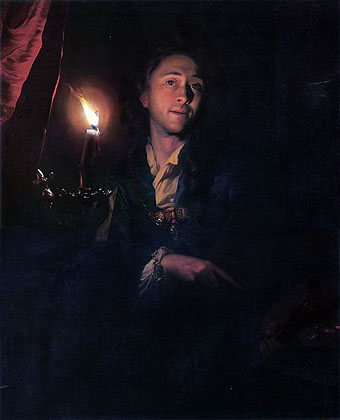
Self Portrait by Candlelight (1695).

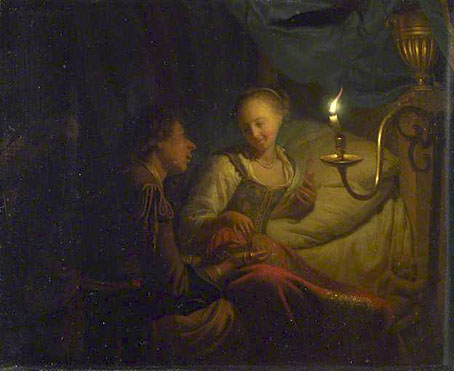
One additional pleasure of Le Fanu’s story and Leslie Megahey’s film is the way they draw attention to the work of an artist who might otherwise have remained overshadowed by his more famous contemporaries. Ever since seeing the meticulous chiaroscuro of Joseph Wright’s An Experiment on a Bird in an Air Pump (1768) I’ve been fascinated by paintings which feature a single artificial light source. Candlelit pictures are a particular fascination since these aren’t easy to paint even today when you can photograph the required scene beforehand. How much more difficult would it be painting a candlelit scene by candlelight alone? Works of this nature demonstrate an artist’s fascination with limited sources of light but also serve as displays of expertise, as did so much Dutch painting of Schalcken’s time with its emphasis on photo-realist representation.

schalcken5.jpg

Self Portrait (no date).

This small selection of paintings by Godfried Schalcken (1643–1706) shows some of the pictures that appear in Megahey’s film, or which we see being posed or replicated. At the end I’ve included Schalcken’s own take on the Salomé story which means his work can now be ushered into the Salomé archive. More of Schalcken’s work may be seen at Wikimedia Commons and the BBC’s Your Paintings site. One significant picture is unavailable: the painting which Le Fanu describes at the opening of his story. In his interview about the making of the film Megahey says that they searched the entire catalogue of Schalcken paintings but were unable to find a single picture that matches the one described in Le Fanu’s story. The painting seen in the film (which is perfectly rendered in Schalcken’s style) was created especially for the production.

schalcken6.jpg

A Candlelight Scene: A Man offering a Gold Chain and Coins to a Girl seated on a Bed (c. 1665–70).

Continue reading “Schalcken’s paintings”