Weekend links 241

clerc.jpg

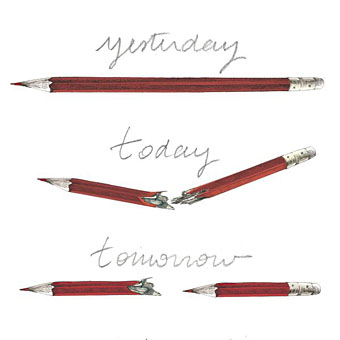
A drawing by Lucille Clerc.

• The usual imbalance of heat versus light this week but Kenan Malik and Teju Cole had some worthwhile things to say. Related: Atlantic illustrators respond to the events of Wednesday. And some history: covers of Charlie Hebdo‘s parent magazine, Hara-Kiri, whose legacy of bad taste and confrontation was overlooked in the rush to express disapproval.

• At The Quietus: Virginie Sélavy, Mark Pilkington and Stephen Thrower of the Miskatonic Institute talk to Mat Colegate about horror old and new. There’s more horror cinema in Mat Colegate’s interview with animator Carla MacKinnon.

• Mixes of the week: Sleepwalkers of the Montgomery Canal by The Geography Trip, and Secret Thirteen Mix 142 by Helena Hauff.

• Jazz legend Julian Priester reflects on his fusion classic Love, Love, Sun Ra, Herbie Hancock, and a lot more.

• “No gays, no blacks, no fat people”: Ryan Gilbey on how film advertising continues to betray filmmakers.

Paul Gorman on the drumheads that Barney Bubbles painted for Hawkwind’s Simon King in 1972.

Massive: Gay Erotic Manga and the Men Who Make It, edited by Anne Ishii & Graham Kolbeins.

NASA’s exoplanet travel bureau wants you to pack your bags.

• The New Humanist on imagining a world without work.

• At Strange Flowers: 15 books for 2015.

Ghosts in the TV

Prologue/Love, Love (1974) by Julian Priester | The Jewel in the Lotus (1974) by Bennie Maupin | Rima (1975) by The Headhunters

Weekend links 240

wiley.jpg

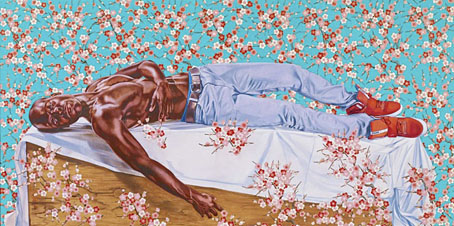
The Death of Chatterton (2014) by Kehinde Wiley.

• Mixes of the week (and the week before that): The Conjurer’s Hexmas: Second Rite by SeraphicManta; Secret Thirteen Mix 140 by Deaf Center; Best of 2014: A Highly Opinionated Mix by Robin The Fog.

• Never mind Music for Airports, how about Music for Neurosurgery? The Tegos Tapes Edits are extracts from “12 hours of unheard Vangelis music soundtracking films of various surgical operations”.

• “It was one of the first magazines that, with science-fiction and comics together, proposed comics for adults.” Aug Stone on 40 years of publisher Les Humanoïdes Associés and Métal Hurlant.

• Zinesters Do It on the Photocopier: Stephanie Schroeder on the Queer Zine Archive Project. Related: Holy Titclamps by Larry-bob Roberts.

A Year In The Country reached the end of its 365 posts. The archive is well worth a browse.

• “These people love to collect radioactive glass. Are they nuts?” asks Ben Marks.

• Think before you share: 86 viral images from 2014 that were totally fake.

• The Anti-Tolkien: Peter Bebergal on Michael Moorcock.

• Extracts from Alan Bennett‘s diary for 2014.

John Cage 4’33” Autotune

Alpha (1976) by Vangelis | Reve (1979) by Vangelis | L’Enfant (1979) by Vangelis

The Importance of Being Oscar

macliammoir1.jpg

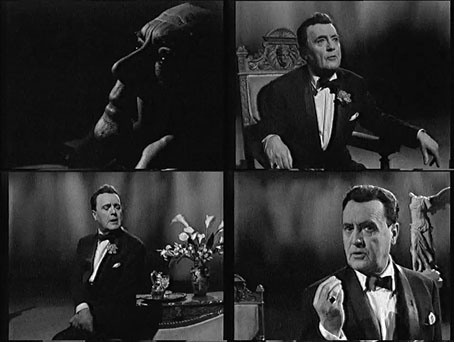
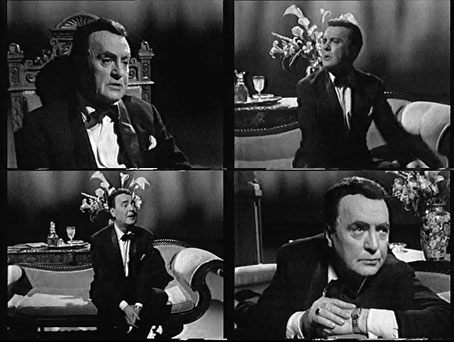
Picking up where we left off, I was thrilled to find that Micheál MacLiammóir’s one-man dramatised biography of Oscar Wilde had finally made it to YouTube. The Importance of Being Oscar was MacLiammóir’s 100-minute magnum opus, an acclaimed condensation of Wilde’s life and work first performed at the Gate Theatre, Dublin, in 1960. Hilton Edwards produced for partner MacLiammóir who subsequently took his show around the world, including performances on Broadway.

MacLiammóir’s monologue interleaves sketches of Wilde’s life with substantial extracts from the major works—An Ideal Husband, The Picture of Dorian Gray, The Importance of Being Earnest, De Profundis, and The Ballad of Reading Gaol—with the actor/writer often taking two roles in the same scene. The readings are deeply felt; this would have been a very personal project, not only for its subject being a fellow Irishman and playwright but also for MacLiammóir and Edwards’ status as gay men in Ireland at a time when they could never be open about their private lives. (Or openly secretive: Barbara Leaming’s biography of Orson Welles makes it clear that iniquitous laws did nothing to stifle the pair in their pursuit of other men.) Accounts of Wilde’s post-trial life are inevitably sombre but MacLiammóir notes that even prison couldn’t suppress Wilde’s sense of humour. A literary conversation with one of the warders is recounted, along with the famous barb thrown at Marie Corelli: “Now don’t think I’ve anything against her moral character, but from the way she writes she ought to be in here.” If MacLiammóir’s performance seems a little overwrought in the television studio it would have appeared less so on the stage.

macliammoir2.jpg

The BBC filmed The Importance of Being Oscar in the mid-60s, and I think that recording may be the one linked here, a version I recall being shown during an evening of Wilde-related TV in the late 1980s. Prior to this MacLiammóir had played Wilde himself for a televised dramatisation of the courtroom appearances broadcast by the BBC in 1960. This was a key year for reappraisals of Wilde’s reputation which also saw the cinema release of Oscar Wilde (with Robert Morley) and The Trials of Oscar Wilde (with Peter Finch). The latter is the superior film and performance even if Finch looks nothing like Wilde. Public attitudes were changing but all the films and TV plays at this time remained evasive about the precise nature of Wilde’s infractions. The Importance of Being Oscar follows this pattern with a fade to black after Wilde’s arrest; the second act opens with MacLiammóir as the judge passing sentence on Wilde and procurer Alfred Taylor. Circumspection doesn’t detract from the power of the monologue which has been revived in recent years, most notably by Simon Callow, another great Wilde enthusiast and also the biographer of MacLiammóir’s young protégé, Orson Welles.

Now that MacLiammóir’s monologue has resurfaced I’ll be hoping someone uploads John Hawkesworth’s Oscar (1985), a three-part television biography with Michael Gambon playing Wilde.

Elsewhere on { feuilleton }
The Oscar Wilde archive

Gay slang from the 1970s

gay1.jpg

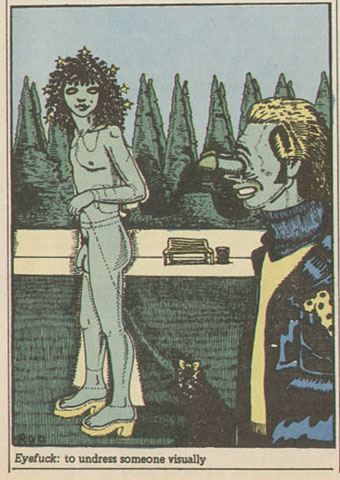
While browsing recently through the available back issues of Oz magazine I noticed a guide to gay slang that I didn’t recall seeing before. The underground magazines and newspapers of the 60s and 70s were a lot more tolerant of the nascent gay rights movement than their “straight” (ie: non-freak) counterparts. Oz magazine published pieces about gay rights, notably so in issue 23 which ran an extract from The Homosexual Handbook (1969) by Angelo d’Arcangelo among a couple of other features; the UK’s first gay magazine, Jeremy, advertised regularly in Oz and IT; later issues of Oz carried ads for another gay mag, Follow Up, and there’s a letter in one issue from a gay freak complaining about the state of the few gay pubs in London where the clientele was apparently not freaky enough. (His solution was to try and persuade them all to drop acid.) Arguments which still circulate today, between those who want to assimilate and those who prefer to remain separate from general society, go back a long way.

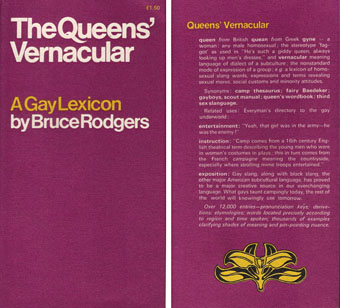
The gay slang guide was extracted from The Queens’ Vernacular: A Gay Lexicon by Bruce Rodgers (1942–2009), published in the US by Straight Arrow Books in 1972. Straight Arrow was affiliated with Rolling Stone magazine, later publishing two volumes of Wilfried Sätty’s art, and Kenneth Anger’s Hollywood Babylon. Rodgers’ book was reissued in 1979 as Gay Talk: A (Sometimes Outrageous) Dictionary of Gay Slang (Formerly entitled The Queens’ Vernacular) but has been out-of-print ever since, unsurprisingly since so much of it is now completely outmoded. That doesn’t make the content uninteresting, however. The phraseology may be ribald, obscene and offensive (misogynist, especially) but the book has been described as “the first serious dictionary of gay slang and the definitive gay American jargon resource”. Rodgers was a serious researcher with an interest in all forms of slang. Just as the Dictionary of the Vulgar Tongue (1811) by Francis Grose gives a more-or-less unmediated insight into the lives of the working and criminal classes of 18th-century London, so Rodgers’ dictionary tells us something about the way gay people, especially gay men in the US, were talking to each other for much of the 20th century. What’s striking now about this truncated list is the degree to which so much of the language is obsolete—nobody under the age of 60 would use the term “queen” with such frequency—while the wider acceptance of porn has made once-esoteric terms like “golden shower” much more common. Notable by its absence is “queer” as a purely positive description (not reclaimed until the 1980s), and no mention of “twink” (which goes back to the early 60s) or “bear” (another term from the 80s).

There’s a tendency when looking at lists such as this to imagine a group of people using most of the terms all the time, but as with any form of slang this would be unlikely. The same goes for Polari or the handkerchief codes of the 1970s. As you’d expect from a document that’s 42 years old, some of the language that Rodgers collected tramples over many current sensitivities.

gay2.jpg

Illustration by Rod Beddall.

THE QUEEN’S VERNACULAR, Oz 46, Jan–Feb 1973

Gay slang has been coined and used by those within the gay subculture who themselves feel the most oppressed—the flagrant wrist benders, the screaming queens, the men who look like women, the women who don’t shave their moustaches.

It is a form of social protest, aimed at the establishment; it is also self-protective and self-defeating. Gay militants would like to see it go, and argue rightly that gay jargon is yet another link in the chain which holds the homosexual enslaved and oppressed—yet its widespread use and complex vocabulary indicate that gay liberation has still along battle in front of it. The selections which follow are taken from a Straight Arrow publication, The Queens’ Vernacular by Bruce Rodgers. The words are mostly American. Even the classic English phrase, “queer basher” is not included.

* * *

advertising 1. to dress in a sexually provocative manner. Gay maxim: “It pays to advertise.” 2. (camp) to pluck and then paint the eyebrows.

army style (mid ’60s) beating the cocksucker after the act.

bumping pussies the embarrassment of two homosexual men who find themselves too passive, active, or in other ways too similar to create a sexual situation. “He thought you and I were carrying on together—what would we do, bump pussies?”

cash-ass (from cautious) cynically applied to hustler who feigns coyness until assured of material gain. “He’s not shy, he’s cash-ash. Mention money and watch his cheeks light up.”

catalogue queen homosexual who collects physique magazines for masturbation purposes.

cheesy having the foreskin lined with smegma. Stale and musky smelling. “The sailor was so cheesy that I felt like asking him where be hid his crackers.”

chic the latest craze. Cruising the busy streets after the bars close is chic. Getting invited to an orgy is chic. Sucking men off in a public lavatory is not chic. Wearing pearls with grey flannel is not chic either, unless one is serving tea in a closet.

Continue reading “Gay slang from the 1970s”
New blade

katana.jpg

The Men with swords thread has been rather moribund of late but I did manage to make at post at the beginning of the year. This new addition, a suggestion by Clive (thanks, Clive!), was irresistible so it can help see the year out. Don’t ask why there’s a katana on the bed, I doubt we’ll ever know. I did try to find the source of the photo; Google Images traces it back to a Tumblr that’s now deleted so the identities of photographer and model remain a mystery.

Elsewhere on { feuilleton }
The men with swords archive