Arrow by The Irrepressibles

arrow.jpg

I’ve kept wondering when we’d hear more from The Irrepressibles following the release of their wonderful Mirror Mirror album. Here at last is a new song, Arrow, from a forthcoming album, Nude. Lyrical allusions to Saint Sebastian accompany two naked guys wrestling until…well, go and see. (Thanks to Thom for the tip!)

Directed & choreographed by Jamie McDermott
Camera Person: Kate Perring
Filmed at Studio 7, Alston Works, London.

Previously on { feuilleton }
Los Bikers by Dënver
The Lady Is Dead and The Irrepressibles

Weekend links 111

thefox.jpg

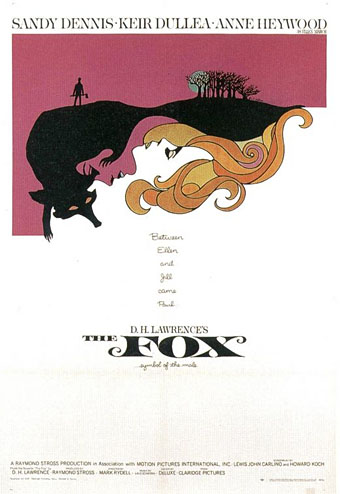
The Fox (1968). Design by Bill Gold, art by Leo & Diane Dillon.

Mark Rydell’s The Fox may be regarded unfavourably now for its retrograde idea of a lesbian relationship but that’s still a great poster by the Dillons. Equally retrograde (well it was 1957) is Anders als du und ich, a film about wayward German youth directed by ex-Nazi propagandist Veit Harlan:

Klaus is a young man in post-war Berlin. He is drawn to his friend Manfred and, under the encouragement of their acquaintance, Dr. Winkler, explores the underground world of gay clubs and electronic music. His family begins to learn of his other life and do everything they can to set him straight.

A saving grace is the conspicuous deployment of Oskar Sala’s Trautonium. They’re deviants—of course they like weird electronic music! Sala’s instrument was his own invention which means it has a unique pre-Moog sound, famously used by Alfred Hitchcock in the score for The Birds. YouTube has a collection of the electronica moments from Anders als du und ich. Wait for the wrestling scene…

Netherwood: Last Resort of Aleister Crowley by A Gentleman of Hastings. Related: Jimmy Page’s Lucifer Rising sessions part 1 and part 2.

• “This coming 16 June, [BBC] Radio 4 will be a wall-to-wall Joycefest, kicking off at 9am and running until midnight.”

A World Where Architecture is the Driving Force Behind Society, Core77 on the Cités Obscures of François Schuiten.

• At The Hooded Utilitarian an examination of the thorny problem of adapting Lovecraft for the comics medium.

• Plates from La Plante et ses Applications Ornementales (1897–1900) by Eugene Grasset.

• Coilhouse found a rough copy of Todd Haynes’ Superstar: The Karen Carpenter Story.

Three Quick Ways to Introduce Yourself to the Work of Harlan Ellison.

Daniel Buren’s Monumenta 2012 at the Grand Palais, Paris.

Our Sorrows, a new video from Julia Holter.

I, Cyclops: Monocularity in a 3-D World.

JG Ballard: The Concordance.

• RIP Pete Cosey.

• Pete Cosey with Miles Davis et al, November 1973: Ife | Turnaroundphrase

Jacques d’Adelswärd-Fersen revisited

fersen1.jpg

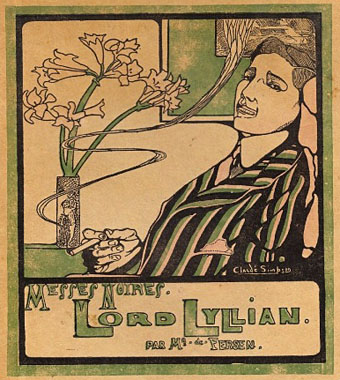
Messes Noires. Lord Lyllian (1905).

An email earlier this week from French bookdealer Chez les libraires associés contained a link to an online catalogue of books by or related to that disreputable Uranian Jacques d’Adelswärd-Fersen, the subject of this earlier post. The catalogue describes the poet as “l’Oscar Wilde français” which isn’t strictly true since Wilde had (and has) a far higher literary reputation. And when it came to homosexual scandal Fersen didn’t suffer anything like Wilde’s appalling treatment, he simply decamped (so to speak) to Capri with his boyfriend, Nino Cesarini. The latter is the subject of another document linked in the same email, Nino et son jumeau, an investigation (in French) concerning “Faces and legends of the friend of Jacques d’Adelswärd-Fersen. What is known of the appearance of Nino, are there pictures of him by von Gloeden, von Plüschow or Vincenzo Galdi?” A number of the pictures in question show Nino and others in various states of undress so those wishing to view the pages will need to be registered at Issuu first.

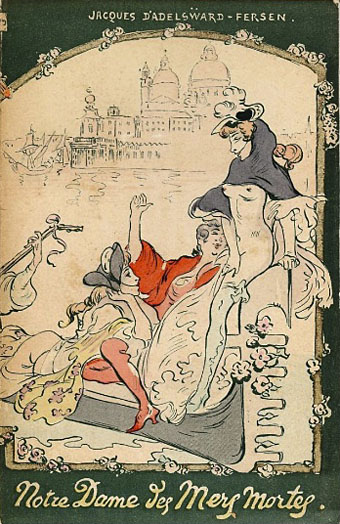
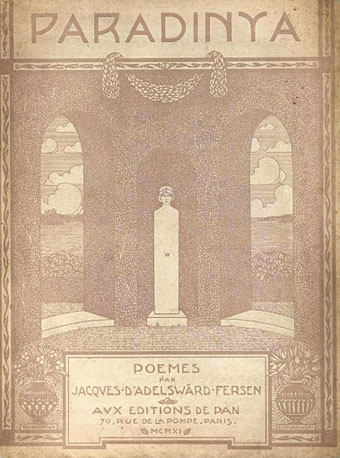
A couple more covers from the catalogue follow. All these publications are rare and correspondingly expensive but I still find it fascinating seeing any of this material at all when it’s been proscribed and ignored for so long. While we’re on the subject, I’ve only just noticed that Fersen’s Le Baiser de Narcisse (with illustrations by Ernest Brisset) can be viewed complete at Gallica.

fersen2.jpg

Notre-Dame des mers mortes (1902).

fersen3.jpg

Paradinya (1911).

Elsewhere on { feuilleton }
The gay artists archive

Previously on { feuilleton }
Le Baiser de Narcisse

Weekend links 110

janke.jpg

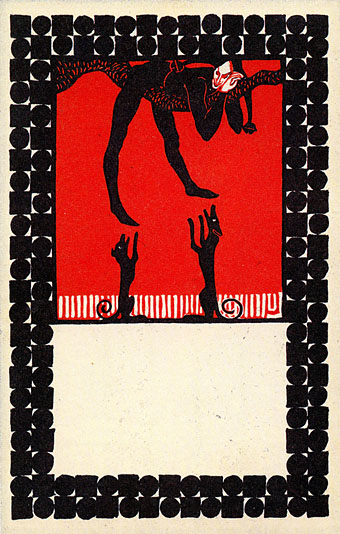
Til Eulenspiegel by Urban Janke. From Twenty Postcards of the Wiener Werkstätte at 50 Watts.

Rorschach Audio by Joe Banks is “essential reading for everyone interested in air-traffic control, anechoic chambers, artificial oxygen carriers, audio art, bell-ringing, cocktail parties, cognitive science, communications interference, compost, the death penalty, Electronic Voice Phenomena, evangelism, evolutionary biology, experimental music, ghosts, the historiography of art, illusions of sound and illusions of language, lip-reading jokes, nuclear blast craters, predictive texting, singing hair, sonic archives, sound design, steam trains, tinnitus, the Turing Test, Victorian blood painting, visual depth and space perception, ultrasonic visual music, ventriloquism, voices and warehouse fires and robberies.”

• “Freud did not understand female sexuality. Klimt did. Klimt’s women please themselves. The realization that women have an independent sexual life was an insight in art.” Eric Kandel discusses his new study The Age of Insight: The Quest to Understand the Unconscious in Art, Mind, and Brain, from Vienna 1900 to the Present.

• Three new books already mentioned here receive further attention: Stan Persky on Christopher Bram’s Eminent Outlaws : The Gay Writers Who Changed America. | Matthew Aquilone on Paul Russell’s The Unreal Life of Sergey Nabokov. | Karin L. Kross on the new translation of the Strugatsky’s Roadside Picnic.

The creative writing moment/movement baffles me and it intrigues me. What does it signify, all this creative longing? And why through language? Specifically fiction, poetry, memoir? […] The crazy part of it is that we are breeding professional, competent, homogenised writers who will go on to teach writing that is professional, competent and homogenised. The intriguing part of it is whether this movement towards creativity and self-expression is really the start of a kind of Occupy – that it could be dangerous and confrontational, not homogenised at all.

Dangerous? But then they won’t get published and win awards and get film deals and… Jeanette Winterson prepares to teach creative writing at Manchester University.

The Underground New York Public Library is a visual library featuring the Reading-Riders of the NYC subways.

Hob by No Man: “Constructed from soundtrack noises from both version of Quatermass and the Pit.”

Stephen Thrower talks about his soundtrack music for The Erotic Films of Peter De Rome.

John Waters surprises everyone by hitchhiking across the US.

• Sounds & the City: An interview with Julia Holter.

The Dead Dream of the Dirigible.

Meditation (1979) by Edward Artemyev.

Weekend links 108

newyorker.jpg

Bob Staake’s cover illustration acknowledges President Obama’s statement last week in favour of gay marriages.

• Related to the above: Gay rights in the US, state by state, an infographic and a useful riposte to people like Orson Scott Card (yes, him again) who claim that gay Americans are equal in everything but the right to marry. On the same theme, “Now Obama’s come out on same-sex marriage, maybe so will I,” says Edmund White (yes, him again), and Eric Berkowitz, author of Sex & Punishment: 4,000 Years of Judging Desire, who writes that “In the period up to roughly the thirteenth century, male bonding ceremonies were performed in churches all over the Mediterranean.”

• The fifth edition of A Humument by Tom Phillips will be published soon by Thames & Hudson. The Tom Phillips website has just been relaunched in a form which now incorporates the notes I made in December about Phillips’ album cover designs.

• The Greenfriars are encouraging people to follow their example and get involved with their local communities (the habits are optional). Kudos for the choice of a Dürer knot.

The action centres on the arrival of a man who may or may not be a prophet, or the devil, or just a violent con-man, in a rotting, rain-drenched Hungarian hamlet. This is the “estate”, apparently some sort of failed collective, where all hope has been lost and all the buildings are falling down. It is inhabited by a cast of semi-crazed inadequates: desperate peasants cack-handedly trying to rip each other off while ogling each other’s wives; a “perpetually drunk” doctor obsessively watching his neighbours; young women trying to sell themselves in a ruined mill; a disabled girl ineptly attempting to kill her cat.

Sátántango by László Krasznahorkai is published in a new translation by George Szirtes

• The Quietus interviewed Kevin Shields following the long-awaited reissue of the My Bloody Valentine catalogue.

• The first volume of Russ Kick’s Graphic Canon (to which I’m a contributor) has been sighted in the wild.

Rise of the Living Type: Stylised 17th century floriated letterforms & grotesque mask sprinkles.

Ed Jansen’s Camera Obscura III, a tour of museums, galleries and venues, 2009–2011.

• io9 reports on the new translation of Roadside Picnic by Arkady & Boris Strugatsky.

Shanghai Expression: Graphic Design in China in the 1920s and 30s.

Liberty Realm, a monograph of drawings by Catharyne Ward.

• 100 mins of Adrian Sherwood‘s best dub productions.

Strange Flowers checked into the Chelsea Hotel.

Chelsea Girls (1967) by Nico | Chelsea Morning (1968) by Fairport Convention | Chelsea Hotel #2, Rufus Wainwright sings Leonard Cohen.