Weekend links 366

kashiki.jpg

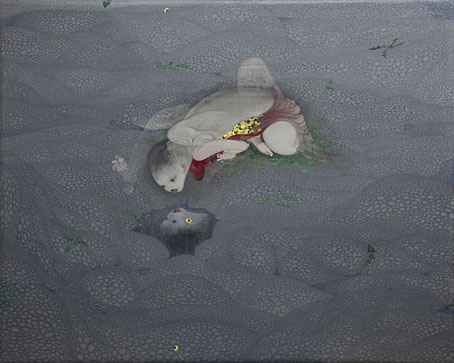
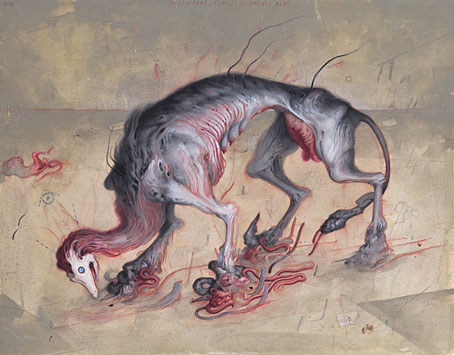
Dandelion (2009) by Tomoko Kashiki.

• “Standard Ebooks takes ebooks from sources like Project Gutenberg, formats and typesets them using a carefully designed and professional-grade style guide, lightly modernizes them, fully proofreads and corrects them, and then builds them to take advantage of state-of-the-art ereader and browser technology.”

Obscenity and the Arts, a previously unpublished essay by Anthony Burgess, will appear in book form later this year via Pariah Press.

• Mixes of the week: VF Mix 97: Talk Talk by The Last Dinosaur, and Secret Thirteen Mix 225 by Janek Schaefer.

Rub any two writers together and similarities will show. No two writers, however different, are completely different. Here’s a crucial instance: Lovecraft and Ballard both put architecture at the heart of their fiction, even though neither had the slightest formal training in the subject. And it is via this interest that the two intersect in an unexpected way. They are connected, through time and space, by that most humble of architectural events: the corner, the junction between two walls. What Lovecraft and Ballard did was to make the corner into a place of nightmares — and in doing so, they reveal its secret history.

Will Wiles in a long and rewarding essay, The Corner of Lovecraft and Ballard

• Dungeons Deep, Forests Dark – A beginner’s guide to Dungeon Synth by Daniel Pietersen.

Alex Ross on Joséphin Péladan, the Symbolists and the occult roots of Modernism.

• Cooling the Tube: engineering heat out of the [London] Underground by IanVisits.

Caroline on the mysteries of Pye Corner: Flames, poltergeists and bodysnatchers.

• The Saint of Sin City – Tony Kail Visits Las Vegas’ Santuario de la Santa Muerte.

• Photographs of Art Nouveau architecture by Keiichi Tahara.

• A stream of the new Porter Ricks album, Anguilla Electrica.

Jasper Sharp on 100 years of Japanese animation.

• At Dennis Cooper’s: 197 clocks.

On The Corner [Take 4] (1972) by Miles Davis | Corner Crew Dub (1976) by Augustus Pablo | Empty Avenues And Dark Corners (Pye Corner Audio Mix) (2013) by John Foxx and the Belbury Circle

Weekend links 363

sommers.jpg

The Constant Drumbeat of Terrible News (no date) by Allison Sommers.

• Nadia Khomami on Gay UK: Love, Law and Liberty, an exhibition at the British Library. Related: Simon McCallum‘s potted history of LGB characters on British screens. Elsewhere: writer and philanthropist Chuck Forester on gay sex in the 1970s.

The Panic Fables: Mystic Teachings and Initiatory Tales by Alejandro Jodorowsky. Finally available in English, a collection of all the comic strips written and illustrated by Jodorowsky when he was living in Mexico in the 1960s.

• A trailer for the restored print of The Fabulous Baron Munchausen (1961) by Karel Zeman. Related: collage designs by Graphic Manipulator for a Japanese collection of Zeman’s films.

• “Whether divining ancient wisdoms or elevating the art of cold reading, Tarot is a form of therapy, much like psychoanalysis,” says James McConnachie.

James Reith on “the Icelandic publisher that only prints books during a full moon – then burns them”.

• Mixes of the week: Wire 400 Mix #6 by Emptyset, and Secret Thirteen Mix 223 by Constantine.

• Mud And Flame: Penda’s Fen re-examined by Matthew Harle and James Machin.

Tilda Swinton in a Leonora Carrington-inspired fashion shoot for i-D magazine.

• At Dennis Cooper’s: Spotlight on William Burroughs’ The Wild Boys.

Applied Ballardianism: A Theory of Nothing by Simon Sellars.

• At Dangerous Minds: The Dark Rift by Jim Jarmusch’s Sqürl.

French Underground Rock: 1967–1980; a Discogs list.

Suzanne Ciani‘s favourite albums.

Infinite artwork: Untitled, 2017

Rip, Rig And Panic (1965) by The Roland Kirk Quartet | Panic (1984) by Coil | Flash Of Panic (1994) by Axiom Ambient

The mystery of trams

quays-black.jpg

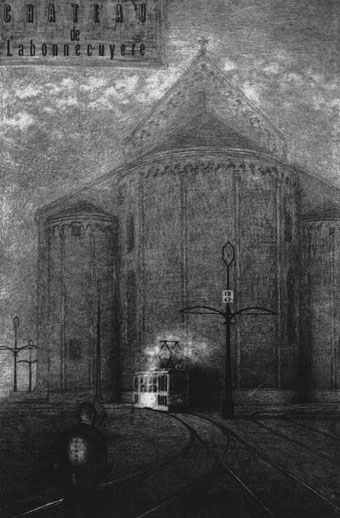
Chateau de Labonnecuyere (c. 1970s) by The Brothers Quay.

Trams are a recurrent feature in the early drawings of the Brothers Quay, and they’ve also appeared in the Quays’ earliest animated films and in some of their designs for the stage. I respond to this fetishisation on the deepest level having been born and raised on the Fylde coast of Lancashire, an area which was for many years the only place in Britain that kept its tramways after the rest of the country had given over the streets to buses and cars. Trams are so ingrained in my consciousness that I still dream about the trams of my childhood, many of which were rattling, streamlined things dating back to the 1930s. Manchester was tramless when I arrived in the city in 1982 but a few years later the council embarked on an ambitious and far-sighted scheme to return trams to the city’s streets. The first routes opened in 1991, and the network has been evolving ever since, pushing out of the centre along disused rail lines.
delvaux1.jpg

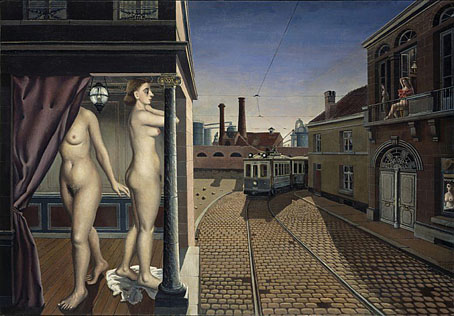
La Rue du Tramway (1938–1939) by Paul Delvaux.

The Quays aren’t alone in being attracted to this form of public transport. Trams haunt a certain type of oneiric European imagination, and I often wonder where the attraction lies. I think it’s something to do with their small scale and the way they remain bounded within the cities they serve. Trains have a romance and mythology of their own but are wide-ranging and far more common, as are buses whose presence on a city street is a reminder that the tram can be replaced. The Quays are Europhiles so they no doubt see the trams of the Continent as another feature of European city life that’s more arresting to American eyes. This post gathers some of the Quays’ uses together with other notable (and favourite) examples.
delvaux2.jpg

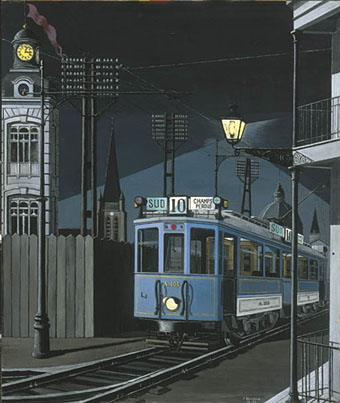
Tram nocturne (1950) by Paul Delvaux.

Several of the examples listed here are Belgian which either means that trams exercise the Belgian imagination more than that of other nations, or I happen to pay more attention to Belgian art. (Probably a little of both.) Paul Delvaux put trams into several paintings but seems to have been the only Surrealist to do so.
tram1.jpg

tram2.jpg

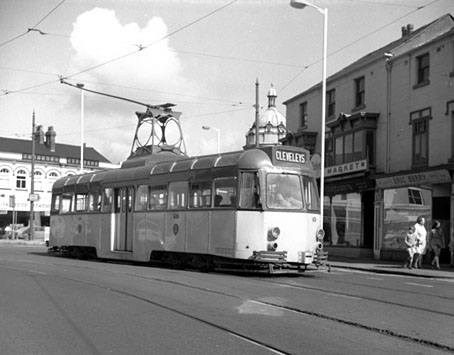
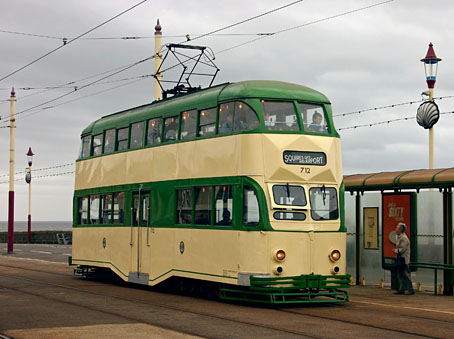
The trams that haunt my imagination are the cream-and-green vehicles that trundled for decades up and down the Fylde coast between Blackpool and Fleetwood. These machines used to run along the line at the end of the street I grew up in so there’s never been a day I can remember when I wasn’t aware of the tram—and of these vehicles in particular—as a viable mode of public transport. Looking at the websites of tram enthusiasts reveals the different names for each generation of Blackpool trams; so I now know that the bow-ended ones (which I always liked) are known as Brush Railcoaches, while the double-deckers are known as Balloons. None of these names were ever used by locals.
schuiten.jpg

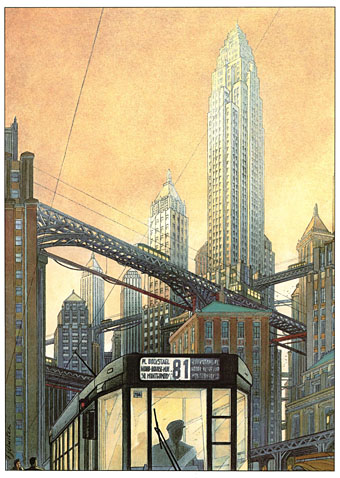
Back to Belgium, and the comics and illustrations drawn by the marvellous François Schuiten are filled with trams. I’ve written at length about the Obscure World mythos of Schuiten and Peeters so rather than repeat myself I’ll point to the mystery of Tram 81, a recurrent and unexplained presence in Schuiten’s work.
nocturna1.jpg

Nocturna Artificiala.

nocturna2.jpg

Nocturna Artificiala.

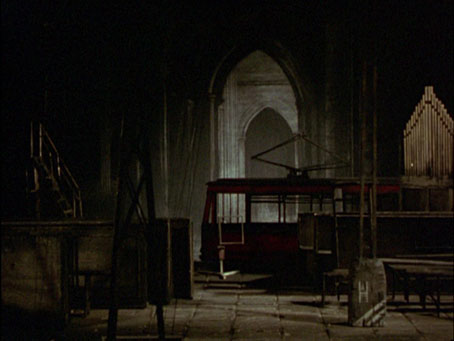
Trams for the Brothers Quay are the small European variety rather than the streetcars seen in some American cities. One of the brothers’ Black Drawings, Chateau de Labonnecuyere, features a pantographed vehicle that glides through their later animated films. The first of these, Nocturna Artificiala (1979), is a wordless masque involving the yearning relationship between the solitary puppet character and an empty, nocturnal tram. The film is an animated extension of Chateau de Labonnecuyere which not only features the drawing itself but also includes a unique moment where the tram glides through the vast cathedral seen in the background.
janacek1.jpg

Leos Janacek: Intimate Excursions.

janacek2.jpg

Leos Janacek: Intimate Excursions.

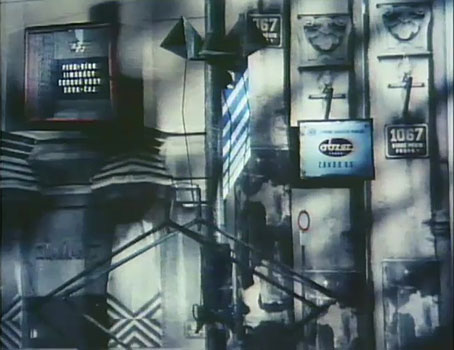
The power-line supports seen in Chateau de Labonnecuyere are a recurrent motif in the Quays’ works. They appear together with the Nocturna Artificiala tram in Leos Janacek: Intimate Excursions (1983), and may be glimpsed among the faded detritus in Street of Crocodiles (1986).
avalon1.jpg

Avalon.

avalon2.jpg

Avalon.

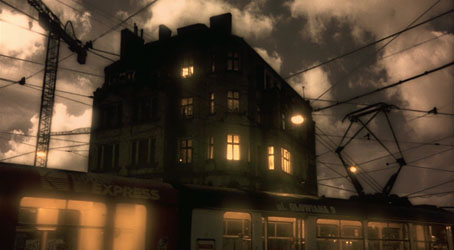
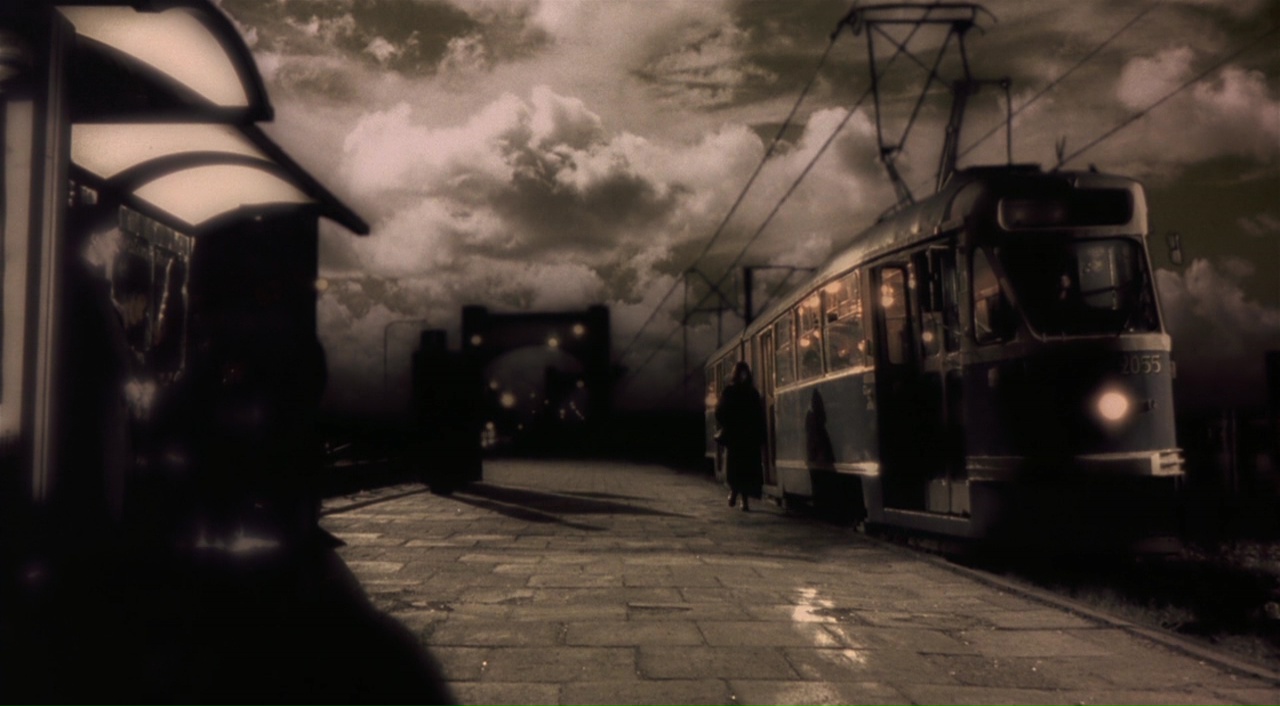
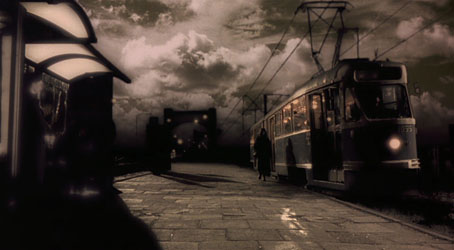
I don’t know what the Quays would make of the science-fiction scenario of Mamoru Oshii’s Avalon (2001) but the recurrent scenes of a nocturnal tram journey would probably appeal, especially since the tram in question is a Polish one. Mamoru Oshii is the director of many SF-oriented animations, not least The Ghost in the Shell (1995). Avalon was a surprise when it appeared (and then seemed to vanish all-too-quickly): a live-action drama concerning the players of a virtual reality game which can have lethal consequences for the contestants. The film was made in Poland with a Polish cast, and the scenes are heavily processed throughout, with everything given a sepia wash. Coming after The Matrix, Dark City et al, the virtual reality aspect wasn’t so much of a surprise but I loved the juxtaposition of a futuristic story in a run-down European setting. And the trams, of course. The dream-like atmosphere of the film’s mundane scenes brings everything back to Delvaux and his tram nocturnes.

I was going to add Tramway (1966) to this list, a short student film directed by Krzysztof Kieslowski, but it’s not especially mysterious. It’s worth a look if you like Kieslowski, however, and may be watched here. If anyone has suggestions for other mysterious trams then please leave a comment.

Elsewhere on { feuilleton }
The Quay Brothers archive

Previously on { feuilleton }
Paul Delvaux: The Sleepwalker of Saint-Idesbald

More Quays: Slow Time—Tempus Fugit

slow1.jpg

This short video—officially released to YouTube by the makers of Leffe, a Belgian beer—is two films in one: Slow Time is a brief portrait of the Brothers Quay by Gary Tarn, more fleeting even than Christopher Nolan’s film; Tempus Fugit is an ad by the Quays for Leffe beer that’s more typical than many of their earlier commissions from the commercial world. The portrait is one of six promotional pieces that Leffe have made about artists. Belgian beer seems a fitting product for the Quays when you know that the production company they formed with Keith Griffiths in 1979, Koninck, took its name from a Belgian beer mat.

slow2.jpg

slow3.jpg

Tempus Fugit.

Elsewhere on { feuilleton }
The Quay Brothers archive

Inner Sanctums—Quay Brothers: The Collected Animated Films 1979–2013

quays.jpg

In previous posts about the Quay Brothers’ films I’ve expressed a hope that we might see a new collection from the BFI that gathers together more of their recent works. That’s what we have now in a 2-disc Blu-ray set that will be released in the UK on 10th October.

quay.jpg

Quay (2015) directed by Christopher Nolan.

The new collection repeats the contents of the earlier BFI DVD set, The Short Films 1979–2003, while adding some of their recent commissions including Maska (2010), Through the Weeping Glass (2011), and Unmistaken Hands: Ex Voto F.H. (2013). Among the extras there’s a short portrait of the brothers, Quay (2015), directed by Christopher Nolan. This shows the Quays at work in their Southwark studio where they discuss the technical details of animation and puppet-making a little more than I’ve seen in other interviews. Nolan’s film is both beguiling and frustrating, the latter for being so inexplicably short. When I first saw Quay announced I thought it might be a feature-length documentary rather than a fleeting glimpse; the Quays have been interviewed regularly over the past few years so they’re not exactly unforthcoming. I’m hoping now that Nolan’s public enthusiasm for the brothers might at least help them to make another feature, a decade having elapsed since The Piano Tuner of Earthquakes (2005).

street1.jpg

Street of Crocodiles (1986).

As to the films, seeing them in high-definition is certainly a plus although the earliest ones were all made in 16mm so they don’t gain a great deal. Street of Crocodiles, however, looks superb, and I found myself noticing details that I’d earlier missed despite numerous viewings. I’m disappointed that two early shorts, Igor: The Paris Years (1982) and Leoš Janáček: Intimate Excursions (1983), remain unreleased due to apparent problems with music copyrights. (See this post for YouTube links.) Also uncollected are their other music videos apart from the two produced for His Name Is Alive, together with a handful of other short pieces. (See this post for further links.)

street2.jpg

Street of Crocodiles (1986).

Of the longer films on the second disc, Maska has become a favourite, with its combination of a baroque science-fiction scenario (from Stanisław Lem) and a score by Penderecki. Through the Weeping Glass, a 30-minute documentary about the medical oddities housed in the Mütter Museum in the Quays’ home city of Philadelphia, is a kind of companion piece to The Phantom Museum (2003), a similar study of the Wellcome Collection in London. This is the first film the Europhile Quays have made in the US, and comes with a short documentary showing them at work on the film, and an interview about the production. I’m still getting used to their shift to digital video—I miss the grain and texture of their films—but since I’ve been working digitally myself for many years now I can’t complain if others choose to do the same.

maska1.jpg

The preview discs of the new collection came without the booklet which will be present in the package. This will include an updated Quays Dictionary by Michael Brooke (as featured in the previous BFI collection), and the 2012 “interview” by the deceased calligrapher Heinrich Holzmüller, On Deciphering the Pharmacist’s Prescription for Lip-Reading Puppets. The latter appeared in the catalogue for the Quays’ MoMA exhibition where it was printed at an eye-straining point size. I’m hoping the BFI version will be an improvement.

The Films
Nocturna Artificialia (1979)
The Cabinet of Jan Švankmajer (1984)
This Unnameable Little Broom (1985)
Street of Crocodiles (1986)
Rehearsals for Extinct Anatomies (1988)
Stille Nacht I: Dramolet (1988)
Ex-Voto (1989)
The Comb (1990)
Anamorphosis (1991)
The Calligrapher (Parts I, II, III) (1991)
Stille Nacht II: Are We Still Married? (1992)
Stille Nacht III: Tales from Vienna Woods (1993)
Stille Nacht IV: Can’t Go Wrong Without You (1994)
In Absentia (2000)
The Phantom Museum (2003)
Songs for Dead Children (2003)
Eurydice, She So Beloved (2007)
Alice in Not so Wonderland (2007)
Kinoteka Ident (2008)
Inventorium of Traces (2009)
Wonderwood for Comme des Garçons (2010)
Maska (2010)
Through the Weeping Glass (2011)
Unmistaken Hands: Ex Voto F.H. (2013)

Special features
Introduction by the Quay Brothers (2006, 20 mins)
Quay (2015, 8 mins): a film by Christopher Nolan
Quay Brothers audio commentaries for This Unnameable Little Broom, Street of Crocodiles, Stille Nacht I-III and In Absentia
The Falls [excerpt] (1980, 5 mins)
BFI Distribution ident (1991, 30 secs)
The Summit (1995, 12 mins)
No Bones About It: Quay Brothers (2010, 12 mins)
Behind the Scenes with the Quay Brothers (2013, 31 mins)
Unmistaken Hands: Ex Voto F.H. trailer (2 mins)

Elsewhere on { feuilleton }
The Quay Brothers archive