The writhing on the wall

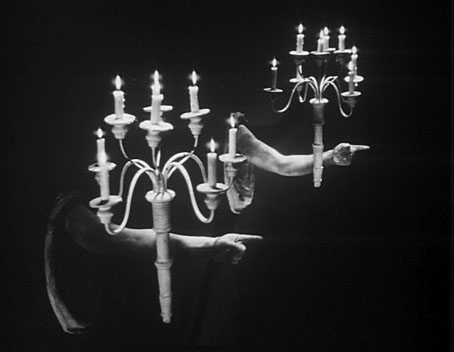
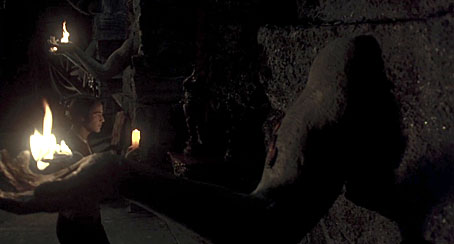
hands9.jpg

Dracula (1992).

This is the closest you’ll get to a guest post here even though it’s been done remotely and I’ve changed things around a little. Following my mention yesterday of the Cocteau-derived lantern-arms in Francis Coppola’s Dracula, Jescie sent me an abandoned blog post which collected similar examples of the arms-through-the-walls motif. I’ve done this kind of thing here in the past so it’s good {feuilleton} material. Almost all these examples are fantasy- and horror-related which isn’t too surprising, and I’m sure there’ll be other examples in films I haven’t seen. If anyone has any suggestions just remember that hands grasping through doors and windows don’t count with this, it’s through the wall or not at all.

hands1.jpg

La Belle et la Bête (1946).

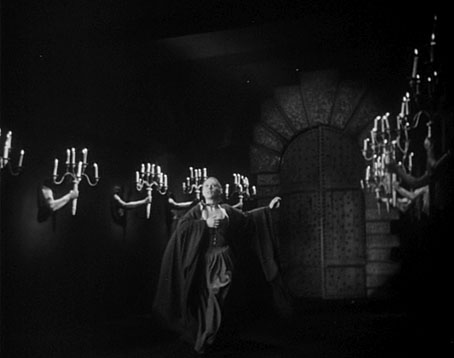
Jean Cocteau sets things off in 1946, a perfect piece of fairytale Surrealism and one of the many memorable aspects of this film.

hands2.jpg

La Belle et la Bête (1946).

Continue reading “The writhing on the wall”

Weekend links 46

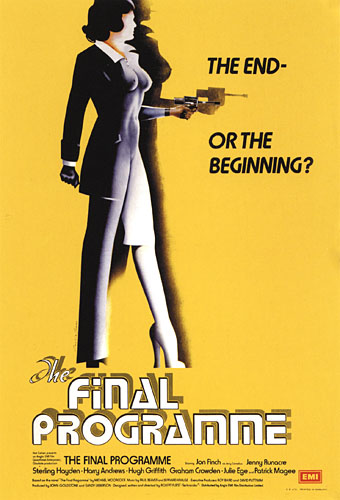
finalprogramme.jpg

The Final Programme (1973). Philip Castle’s poster art implied the androgynous finale of Moorcock’s novel which the film itself evaded.

They were musty-smelling 10p messages from the futuristic past, complete with cover designs (and content) that were unlike anything I’d seen before. I’m fairly certain that this was how I first came across Michael Moorcock, in an early-70s Mayflower paperback, with a psychedelic cover by Bob Haberfield.

(…)

Moorcock steered New Worlds towards a set of concerns that chimed with the times; this was the period ruled by Marshal McLuhan and RD Laing, and the exploration of “inner space” seemed just as interesting as the “outer space” of satellites and moonshots. This turn was controversial, not just with die-hard pulp fans, but, surprisingly, with people such as the pop artist Richard Hamilton, another denizen of the London scene. “He thought we were turning science fiction into something namby-pamby, losing its roots,” Moorcock says. “He wanted explosions and spaceships and robots.”

When Hari Kunzru met Michael Moorcock, a major feature on a great writer and cultural catalyst. Kunzru posted the full transcript of their conversation here. Jovike’s Moorcock Flickr set has many of the lurid Mayflower covers.

• Moorcock is among the contributors to the forthcoming Thackery T. Lambshead Cabinet of Curiositities. io9 posted a list of contents (and one of my pics) while co-editor Jeff VanderMeer added some detail.

• So long to The White Stripes whose dissolution was announced earlier in the week. We know they’ll be back one day. Jay Babcock gave them their first major interview for the LA Weekly in 2000 which he’s reposted here.

Mister Blues (1962) by Lasry-Baschet aka Structures Sonores, a rare 7″ single showcasing the unique glass-and-metal sounds of the Cristal Baschet. Young Teddy Lasry on clarinet was playing in prog-jazz outfit Magma a few years later. Related: John Payne on Magma and The Mars Volta.

Here’s one thing that changed me: a close reading of Flannery O’Connor’s Mysteries and Manners. In it, she says that, “it is the business of fiction to embody mystery through manners,” manners being those concrete details — depictions of the real — in story. “Mystery through manners…” I had never heard a modern author seeking deep metaphysical mystery through realism before. Well, sure, Robert Musil, Bruno Schulz, Robert Walser, and a handful of other personal faves. By deep mystery I mean, mystery about our relationship with the planet, not anthropocentric mystery. I get sick of thinking about humans quickly, as we only constitute about 1% of what’s happening in our universe, if that much, and it was refreshing to me to hear O’Connor critiquing Henry James’ idea that modern people should aspire to know nothing of mystery, to be completely rooted in humanity. That notion makes me feel like hurling myself off a cliff. In her opinion, great literature seeks to embrace and express mystery through its mimicry of actual mannerisms. Mystery — fantasy — through the real. And with that, the borders between fantasy and realism were completely transgressed in my brain. Suddenly, I saw them as two good means to the same end. This made me excited to write real human situations again.

Trinie Dalton is interviewed here.

• And speaking of mystery through the real, there’s London Intrusion, a sequence of metropolitan adumbrations by China Miéville. Am I the only person to spot an intrusion of a different kind in the presence there of one of Eugène Atget’s Parisian views? There’s a doorway to Viriconium in that curious wedge of buildings but nobody can tell you where.

Rupert Murdoch—A Portrait of Satan. Adam Curtis on top form looking at the Dirty Digger’s career and a reminder of why some of us have always called one of his rags The Scum. A key point for me: Murdoch’s insecure railing against “elites”, a favourite term of aspersion on his Fox News network.

• Rick Poynor asks What Does JG Ballard Look Like? Related: “…only two people in Bucharest are going to read this.” Eduardo Paolozzi in conversation with JG Ballard and Frank Whitford, 1971.

How many days does Bill Murray’s character really spend reliving Groundhog Day?

• Silent Porn Star explores The Translucent Beauty of Androgyny.

Ballets Russes brought back to life on film, and also here.

Dewanatron Electronic Music Instruments.

RIP Tura Satana. Remember her this way.

Warm Leatherette (1978) by The Normal | Warm Leatherette (1982) by Grace Jones | Warm Leatherette (1998) by Chicks On Speed.

The art of Robert Lawson, 1892–1957

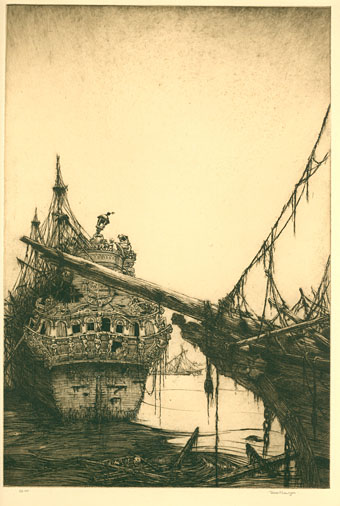
lawson1.jpg

Sargasso Sea (no date).

Did I say Sargasso Sea? Blame William Hope Hodgson some of whose sea stories I was re-reading over the weekend. An idle search for Sargasso images turned up this tremendous etching by American author and illustrator Robert Lawson, part of a collection of equally fine work at the Florida State University. There’s little information about this picture, unfortunately, it’s a numbered print so it’s most likely a one-off piece but it would make an ideal cover illustration for a Hodgson collection. It hadn’t occurred to me before but the rambling third film in the Pirates of the Caribbean series might have been improved if they’d made use of the old Sargasso-as-oceanic-graveyard legend, it’s just the place you’d expect to find Davy Jones and his piscine crew.

Bud Plant has more about Robert Lawson’s career and examples of his book illustrations.

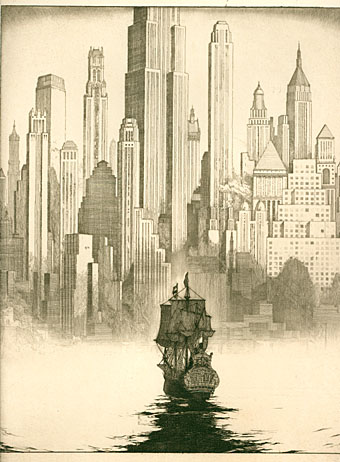
lawson2.jpg

Untitled (CityShip) – Manhattan (no date).

Elsewhere on { feuilleton }
The etching and engraving archive
The illustrators archive

Previously on { feuilleton }
Coming soon: Sea Monsters and Cannibals!
Druillet meets Hodgson
Davy Jones

The art of Carel Willink, 1900–1983

willink1.jpg

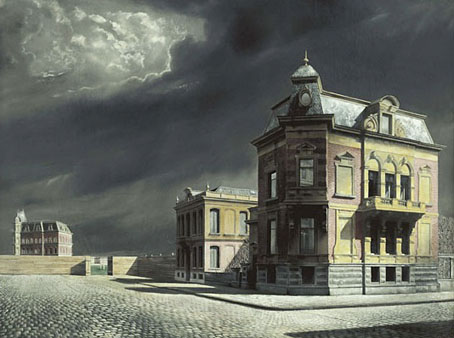
Townscape (1934).

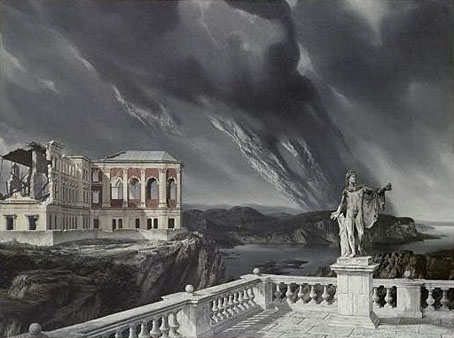
Carel Willink was a Dutch painter whose self-described brand of “imaginary realism” conjured in its early years a collection of views of desolate plazas, empty lanes and abandoned ruins over which smoke or cloud hangs like an ominous portent. The works of Giorgio de Chirico and Paul Delvaux come to mind when looking at these pictures although Willink’s work has enough unique qualities to stand apart from his more famous contemporaries. I’m also reminded a little of Spanish artist Arnau Alemany who has a similar predilection for isolated architecture.

willink2.jpg

Chateau in Spain (1939).

There’s an official Willink website here, while further paintings can be seen at this Flickr set and also at Ten Dreams.

Elsewhere on { feuilleton }
The fantastic art archive

Previously on { feuilleton }
Bruges-la-Morte
Taxandria, or Raoul Servais meets Paul Delvaux
The art of Arnau Alemany

The Colmore Fatagravures

colmore1.jpg

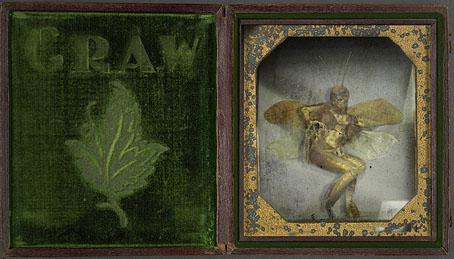
Golden Fairy Specimen.

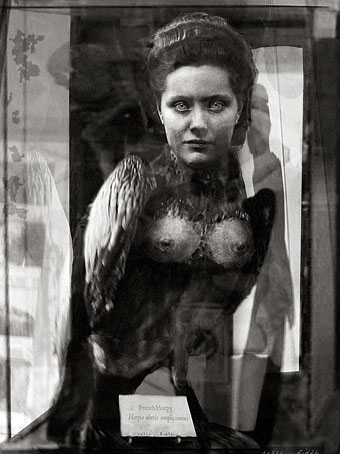
These have already been featured on many other sites but that shouldn’t exclude their presence here. The Wunderkammer concept seems to be a recurrent fascination on the web—see here and here and here, for example—possibly because the nature of the medium lends itself to the accumulation of curiosities. It’s a small step from collecting genuine curios to inventing those the world stubbornly refuses to provide, that’s what we see happening here and also at some of the earlier posts below. About the Colmore Fatagravures we’re told:

A Scottish adventurer, inventor, and photographer named Neville Colmore claimed to have constructed a device capable of “…parting the veil of Faery…”. The device, which he called the “Spectobarathrum”, produced beautiful photo graphic plates he called “fatagravures”, through a now lost process. The original “Spectobarathrum” along with all of the images he claimed to have made were believed destroyed in a fire. (More.)

colmore2.jpg

French Harpy of Questionable Provenance.

In a similar vein, I’ve already mentioned that I’ve done some design and illustration for the Thackery T. Lambshead Cabinet of Curiosities, the sequel to the Lambshead Disease Guide which is forthcoming from HarperCollins. The new book is edited by Ann & Jeff VanderMeer and publication has been announced for June. Jeff unveiled the near-final cover design just before Christmas (not my work, I should note) and a preview of some of the contents, including one of my interior pages. More about this closer to publication.

Previously on { feuilleton }
The specimens of Alex CF
Walmor Corrêa’s Memento Mori
Harpya by Raoul Servais
The art of Ron Pippin
Custom creatures
Jan Švankmajer: The Complete Short Films
Cryptozoology
The Museum of Fantastic Specimens