Tomorrow Never Knows

beatles.jpg

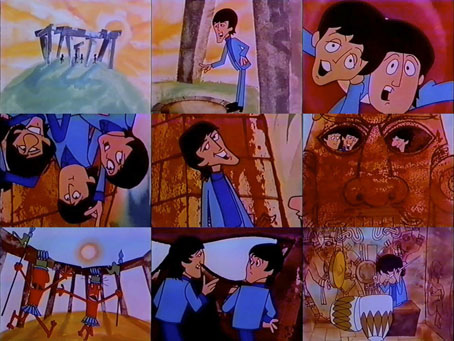
Episode 38 of The Beatles (1967).

The Beatles’ Yellow Submarine was released on Blu-ray earlier this month. The quality is as good as you’d expect, it looks and sounds fantastic with the songs really benefitting from their remixes and high-definition audio. The film atoned for Al Brodax and George Dunning’s earlier role as producers of the lamentable The Beatles animated TV series which ran for 39 episodes from 1965 to 1967. The series as a whole may be cheap and nasty but the penultimate number is notable for being the only one featuring two of John Lennon’s songs inspired by his acid trips: Tomorrow Never Knows and She Said, She Said. These tiny eruptions of psychedelic culture into children’s film and television have always fascinated me, and this is one example I’d missed until now. No wonder it had to end, the Fab Four were getting far too weird. Okay kids, sing along now: “I know what it’s like to be dead…”

Previously on { feuilleton }
• The Dukes declare it’s 25 O’Clock!
• Yellow Submarine comic books
• A splendid time is guaranteed for all
• Heinz Edelmann
• Please Mr. Postman
• All you need is…

Weekend links 113

leonard.jpg

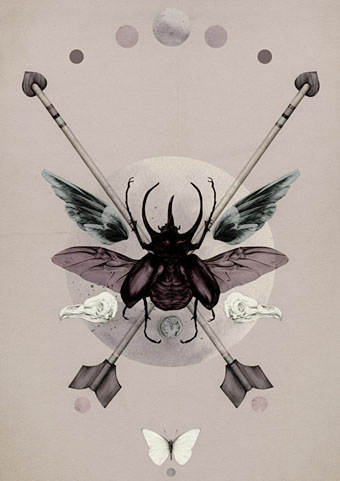
Wunderkammer (2011) by Emma Leonard.

As someone who was eight years old at the time of the Apollo moon landing, I remember calculating that I would be thirty-nine in the magic year 2000 and wondering what the world would be like. Did I expect I would be living in such a world of wonders? Of course. Everyone did. Do I feel cheated now? It seemed unlikely that I’d live to see all the things I was reading about in science fiction, but it never occurred to me that I wouldn’t see any of them.

A quote from Of Flying Cars and the Declining Rate of Profit, an essay by David Graeber. Related: Another World: David Graeber interviewed by Michelle Kuo at Artforum.

• Constellation, a series of portraits by Kumi Yamashita: “This body of work consists of three simple materials that, when combined, produce the portraits: a wooden panel painted a solid white, thousands of small galvanized nails, and a single, unbroken, common sewing thread.”

• Nicole Rudick at The Paris Review on the history of psychedelic art. Related: The psychedelic art and design of Keiichi Tanaami. Also Manifesting the Mind: Footprints of the Shaman, a two-hour documentary about psychedelic drugs.

• Already mentioned here, The Lost Tapes, a 3-CD collection of previously unreleased recording by the mighty Can, is out on Monday. There’s a preview of ten of the tracks here.

• “I can’t think of anybody who would have a good word to say for centipedes…” Duncan Fallowell (a Can associate for many years) interviewed William Burroughs in 1982.

• Herb Lubalin: American Graphic Designer and the Herb Lubalin Study Center’s Flickr sets.

• Strange Flowers goes to the movies with everyone’s favourite Bavarian king, Ludwig II.

• The Sphinx’s Riddle: The Art of Leonor Fini at the Weinstein Gallery, San Francisco.

• More Teutonica: A Spacemusic Primer by Dave Maier.

• Van Dyke Parks: return of a musical maverick.

• Forty Posters for Forty Years at Pentagram.

• Donovan’s Colours (1968) by Van Dyke Parks | Sailin’ Shoes (1972) by Van Dyke Parks | Clang Of The Yankee Reaper (1975) by Van Dyke Parks.

Weekend links 109

magritte.jpg

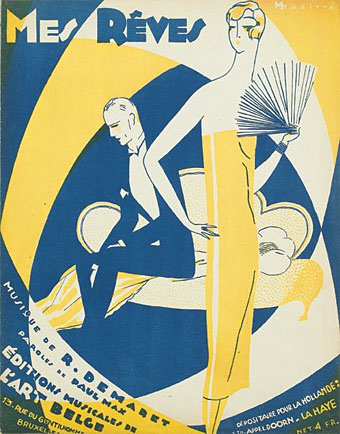
Dreams before Surrealism: a sheet music cover from 1926 by René Magritte.

• The week in music: Listen to compositions by Annea Lockwood. | At the Free Music Archive: Uncomfortable Music, a tribute to David Lynch’s Eraserhead (and, it should be said, to Alan Splet’s unique soundtrack). | Alan Licht plays a track from Trout Mask Replica then loops some Donna Summer and improvises guitar noise over it. | Music Experiments with Terror: The Spooky Isles presents Joseph Stannard‘s list of recent eldritch sounds from British musicians.

Great art, or, let’s just say, more modestly, original art is never created in the safe middle ground, but always at the edge. Originality is dangerous. It challenges, questions, overturns assumptions, unsettles moral codes, disrespects sacred cows or other such entities. It can be shocking, or ugly, or, to use the catch-all term so beloved of the tabloid press, controversial. And if we believe in liberty, if we want the air we breathe to remain plentiful and breathable, this is the art whose right to exist we must not only defend, but celebrate. Art is not entertainment. At its very best, it’s a revolution.

Salman Rushdie on the censorship of art

• All Diamond, No Rough” says the School Library Journal about the first volume of The Graphic Canon. Volume two should be out in August.

• Scientific American asks: Do Psychedelics Expand the Mind by Reducing Brain Activity?

• From 2010: A Dandy in Aspic – A letter from Derek Marlowe.

• Tom Phillips and A Humument: how a novel became an oracle.

• Timeline Maps at the David Rumsey Map Collection.

• Happy 50th birthday, A Clockwork Orange.

• Jim Dandy (1956) by LaVern Baker | Larks’ Tongues in Aspic, part one (1972) by King Crimson, live on Beat Club.

Gerald Scarfe’s Long Drawn-Out Trip

scarfe.jpg

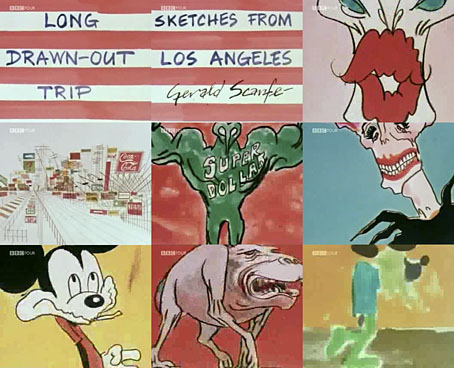
Yet more animation. Long Drawn-Out Trip was Gerald Scarfe‘s first foray into the medium, produced in 1972 at the request of the BBC who sent the artist to Los Angeles to try out the new De Joux animation system. The process needed only six or eight drawings per second of film thus reducing the usual amount of labour. Scarfe says in the first book collection of his work, Gerald Scarfe (1982), that the 16-minute film was still very labour intensive.

The subject of Long Drawn-Out Trip is Los Angeles and America itself, the concerns being the same ones that Ralph Steadman was depicting the same year in his illustrations for Hunter S. Thompson’s Fear and Loathing on the Campaign Trail ’72: venality, violence, vulgarity and the omnipresent spectre of Richard Nixon, a president who had the good fortune to be drawn many times by two of Britain’s greatest living satirists although he wouldn’t have thanked them for it. In Scarfe’s film we also find Mickey Mouse being reduced to his constituent lines and colours after smoking a joint. In the 1980s Scarfe regularly drew Ronald Reagan wearing the famous mouse ears, something that nearly got him fired from his post at the Sunday Times after Rupert Murdoch saw one of the cartoons. Long Drawn-Out Trip had a more favourable effect when it was seen by Roger Waters who asked Scarfe to create some animations for Pink Floyd’s Wish You Were Here tour. The animated sequences for The Wall have their origin in this short film. Watch it here.

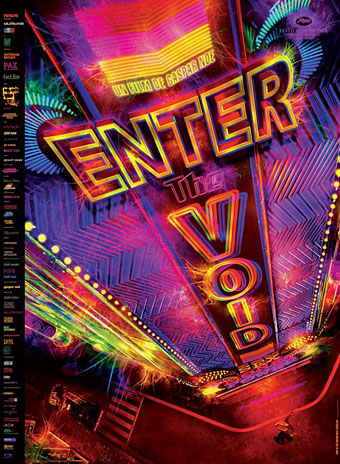
Enter the Void

etv01.jpg

It’s taken me a while to see this but the long search for a genuinely psychedelic feature film is over. That’s genuinely psychedelic not in the debased sense of a handful of garish or trippy visuals, but in the full-spectrum expanded-consciousness sense for which Humphrey Osmond invented the term in 1956:

I have tried to find an appropriate name for the agents [psilocybin, mescaline, LSD, etc] under discussion: a name that will include the concepts of enriching the mind and enlarging the vision. My choice, because it is clear, euphonious, and uncontaminated by other associations, is psychedelic, mind-manifesting.

Other films have given us flashes of this kind of unfiltered experience—Chas’s mushroom trip in Performance (1970), for example—or attempted to relay LSD states through Hollywood conventions: The Trip (1967) and Altered States (1980). Then there are inadvertently psychedelic moments such as the Star Gate sequence in 2001: A Space Odyssey (1968). Some of the most successful works from a psychedelic perspective have almost always been abstract, micro-budget films such as those made by James Whitney, Jordan Belson, Ira Cohen and others. But until very recently no-one had attempted to combine the narrative-free intensity of abstract cinema with a film narrative that would warrant placing psychedelic experience at the heart of the story. I was hoping A Scanner Darkly (2006) might do it but, good as it was, it didn’t really get there. Gaspar Noé’s Enter the Void is the film that gets everything right.
etv02.jpg

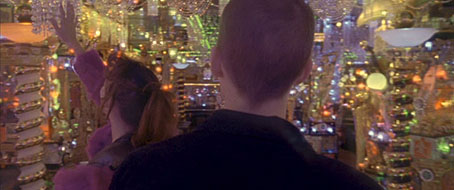
Linda and Oscar.

The narrative is a simple one (Noé calls his story a “psychedelic melodrama”): Oscar, a young American drug-dealer living in Tokyo smokes DMT, trips out for a while then goes to exchange some goods with a customer in a small club called The Void. While there he’s shot and killed in a police raid. His disembodied consciousness leaves his body, and for the next two hours wanders the streets and buildings following his beloved sister, Linda, and his friends while they cope with the aftermath. Later on he starts to re-experience memorable (and traumatic) moments from his life. The Big Signifying Text in all of this is introduced in the opening scene: The Tibetan Book of the Dead. Oscar hasn’t read much of it so his friend Alex quickly relates (for the benefit of the audience) the book’s description of what happens to the soul between the time of death and rebirth into a fresh human body. A few minutes later we’re with Oscar experiencing this very process in dizzying, miraculously-filmed detail. Flicking through my own copy of The Tibetan Book of the Dead (OUP, 1960) one paragraph in the introduction had particular relevance:

The deceased human being becomes the sole spectator of a marvellous panorama of hallucinatory visions; each seed of thought in his consciousness-content karmically revives; and he, like a wonder-struck child watching moving pictures cast upon a screen, looks on, unaware, unless previously an adept in yoga, of the non-reality of what he sees dawn and set.

WY Evans-Wentz

etv07.jpg

This is your brain on drugs: the DMT trip.

Continue reading “Enter the Void”