Shin-Bijutsukai

shinbijutsukai01.jpg

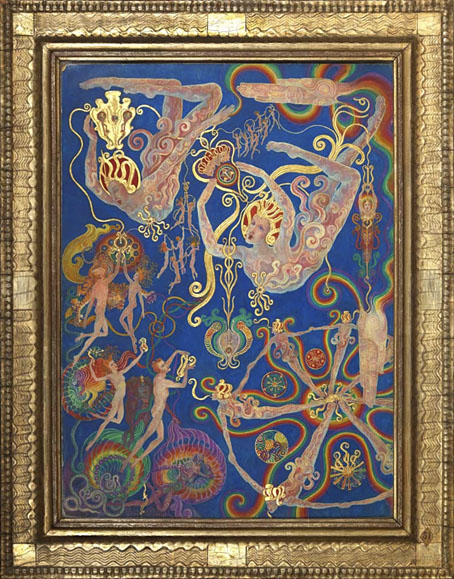
If you’ve spent a great deal of time looking at European design publications from before or after 1900 you may experience a shock of surprise when you encounter a Japanese publication from the same period. Shin-Bijutsukai (“New Oceans of Art”) was a Japanese magazine published in monthly issues from 1902 to 1906. At first glance it looks like an equivalent of European design samplers such as Dekorative Vorbilder or Documents d’atelier: Art décoratif moderne, another collection of colour plates with little or no accompanying text. Many of the samples, however, are the kinds of designs you wouldn’t see in Europe for another 20 years, or even 50 years in some cases. The book linked here seems to contain a complete run of the magazine, and is part of the Smithsonian collection at the Internet Archive, a holding I still haven’t explored very thoroughly. A task for the future.

shinbijutsukai02.jpg

shinbijutsukai03.jpg

shinbijutsukai04.jpg

shinbijutsukai05.jpg

Continue reading “Shin-Bijutsukai”

Weekend links 805

strausfeld.jpg

A poster by Peter Strausfeld for a 1966 screening of Alphaville and La Jetée.

• At Bandcamp Daily: “Caroline True obsesses over compilations so you don’t have to,” says Erick Bradshaw. I recommend CTR’s compilations.

• At The Wire: Read an extract from Music Stones: The Rediscovery Of Ringing Rock by Mike Adcock.

• At Colossal: Pastoral landscapes brim with patterns in luminous paintings by David Brian Smith.

One of the markers that sets Mamoru Oshii apart from his peers is his willingness to allow place to speak for itself. From the seasonality captured in his works, like the first two Patlabor films, to the otherworldly environments of Ghost In The Shell 2: Innocence (all projects in which Ogura was also involved heavily) and even the fantasy scapes of his Angel’s Egg, Oshii’s attention to place, and allowing it to be a player in the story, gives as much voice to world building, as he does to characterisation. This attentiveness and patience for place, allows us to settle deeply inside a worldview that is often simultaneously familiar but unerringly alien.

Lawrence English talks to art director Hiromasa Ogura and composer Kenji Kawai about their work on Oshii’s Ghost in the Shell

• At the BFI: Leigh Singer suggests where to begin with the films of Lucile Hadžihalilović.

• Necromodernist Architectures in Contemporary Writing: an essay by David Vichnar.

• New music: Hydrology by Loula York; Love Letters Via Echelon by Nerthus.

• There’s more Intermittent Eyeball Fodder at Unquiet Things.

• The Strange World of…Early Cabaret Voltaire.

• Winners of the Drone Photo Awards 2025.

Lautréamont’s Apocrypha

Drone Um Futurisma (1992) by Cusp | ABoneCroneDrone 1 (1996) by Sheila Chandra | Suspicious Drone (2009) by Demdike Stare

Weekend links 803

USA-ad.jpg

Ad for The United States Of America from Helix magazine, 1968.

• American composer Joseph Byrd died this week but I’ve yet to see a proper obituary anywhere. He may not have been a popular artist but he was significant for the one-off album produced in 1968 by his short-lived psychedelic group, The United States Of America. Their self-titled album has been a favourite of mine since it was reissued in the 1980s, one of the few American albums of the period that tried to learn from, and even go beyond, the studio experimentation of Sgt Pepper. The United States Of America didn’t have the resources of the Beatles and Abbey Road but they did have Byrd’s arrangements, together with an energetic rhythm section, an electric violin, a ring modulator, some crude synthesizer components, the voice of Dorothy Moskowitz, and a collection of songs with lyrics that ranged from druggy poetry to barbed portrayals of the nation’s sexual neuroses. The album became an important one for British groups in the 1990s who were looking for inspiration in the wilder margins of psychedelia, especially Stereolab, Portishead (Half Day Closing is a deliberate pastiche), and Broadcast. Byrd did much more than this, of course, and his follow-up release, The American Metaphysical Circus by Joe Byrd And The Field Hippies, has its moments even though it doesn’t reach the heights of its predecessor. Byrd spoke about this period of his career with It’s Psychedelic Baby Magazine in 2013.

• At BBC Future: “The most desolate place in the world”: The sea of ice that inspired Frankenstein. Richard Fisher examines the history of the Mer de Glace in fact and fiction with a piece that includes one of my Frankenstein illustrations. The latter are still in print via the deluxe edition from Union Square.

• A Year In The Country looks at a rare book in which Alan Garner’s children describe the making of The Owl Service TV serial.

• The final installment of Smoky Man’s exploration of The Bumper Book of Magic has been posted (in Italian) at (quasi).

• At Public Domain Review: Perverse, Grotesque, Sensuous, Inimitable: A Selection of Works by Aubrey Beardsley.

• At Colossal: Ceramics mimic cardboard in Jacques Monneraud’s trompe-l’œil ode to Giorgio Morandi.

• At the Daily Heller: The “narrative abstraction” of Roy Kuhlman‘s cover designs for Grove Press.

• New music: Elemental Studies by Various Artists; and Gleann Ciùin by Claire M. Singer.

• Steven Heller’s font of the month is Archive Matrix.

Sensual Hallucinations (1970) by Les Baxter | The Garden Of Earthly Delights (United States Of America cover) (1982) by Snakefinger | Perversion (1992) by Stereolab

Weekend links 801

waterhouse.jpg

The Magic Circle (1886) by John William Waterhouse.

The Moon and Serpent Bumper Book of Magic has just been published in France by Editions Delcourt. A preview here shows how carefully they’ve managed to translate and reletter my page designs.

• Among the new titles at Standard Ebooks, the home of free, high-quality, public-domain texts: Algernon Blackwood’s stories of John Silence, occult detective.

• Relevant to some of my recent reading: The Necronomicon Wars, an examination of the many attempts to give life to HP Lovecraft’s fictional grimoire.

Altered States is tremendously exciting to watch—and not only during its psychedelic interludes when goat Jesus is being crucified and writhing red figures are toppling, Hieronymus Bosch–like, into hell and abstract splotches give the impression of cells endlessly dividing or murky membranes dissolving and beautiful women stare into Magritte skies and waves of lava crash as though the molten core of humanity itself were erupting. Even in its quieter moments, it is a beautiful film, with Hurt’s every appearance shot by cinematographer Jordan Cronenweth to emphasize his character’s alien otherworldliness.

Jessica Kiang explores the creation of Ken Russell’s flawed but fascinating psychedelic feature, Altered States

• A new catalogue of lots at another After Dark: Gay Art and Culture online auction. Homoerotic art, photos, historic porn. etc.

Tarot decks through the ages: a video showing some of the cards from Victoria and Albert Museum’s collection.

• More psychedelia: Neuroscientist Grigori Guitchounts asks “What is your brain doing on psychedelics?”

• At the Daily Heller: Ryan Hughes has published a weighty collection of his typeface designs.

• Old music: Caged (25th Anniversary Edition) by Ian Boddy & Chris Carter.

• At the BFI: Rory Doherty selects 10 great Technicolor melodramas.

• At Dennis Cooper’s: The Old School Horrors of Terence Fisher.

Photographs from the 2025 Wildlife Photographer of the Year.

Ambientblog celebrates 20 years of existence.

• RIP Dave Ball.

Necronomicon (1970) by Les Baxter | Liriïk Necronomicus Kahnt (1975) by Magma | Necronomicon–The Magus (2004) by John Zorn

Ambagious Tactics

cards1.jpg

Ambagious Tactics is a box containing 120 small white cards, most of which show a short aphorism, suggestion or piece of advice for the creatively-minded. A few cards at the end of the box feature line drawings instead of words; there are also three blank cards for the user’s own contributions. Anyone familiar with  Brian Eno and Peter Schmidt’s Oblique Strategies will recognise the form: “over one hundred worthwhile dilemmas” which artists, writers (and anyone else) can use as a prompt to jolt a creative endeavour away from familiar ruts or to provide a solution to an impasse or problem.

cards2.jpg

The first deck of Oblique Strategies was published in an edition of 500 copies 50 years ago which makes Ambagious Tactics an anniversary celebration as well as “An Oblique Tribute Act—A choir of over 100 versatile enigmas”. The main difference between the Strategies and the tributes is that the Strategies were mostly the work of Eno and Schmidt, although I think Eno says somewhere that the pair asked friends and colleagues for contributions. For the tributes Alistair Fruish has collected a single suggestion from many different people, myself included:

Some of these creatives are connected to Eno and Schmidt, and some are folk who regularly used Oblique Strategies, others are members of Arts Labs around the country, and some people were asked for the hell of it.

I’m very familiar with Oblique Strategies, mostly via their recent manifestations as online editions or freeware applications. The only physical deck I’ve seen is Alan Moore’s heavily-used first edition, and Alan happens to be one of the contributors to this deck.

cards4.jpg

My own contribution may seem a little glib or obvious at first: when you’re creating something you’re invariably on the lookout for things you don’t like. The question is intended to have a wider reach than this, and refers to something Jon Hassell used to talk about with regard to his own creations: the question of what you really like in a fundamental sense, and how this can be distilled into your own creative activities. Asking yourself what you really like helps you avoid falling into the slipstream of prevailing trends (unless that’s what you really like…), or doing something solely to fulfil other people’s expectations. Hassell couldn’t be involved with the project so this was my attempt to bring some of his own thinking to the tribute act. My original idea—”Do the washing up”—was one I had to reject after I confirmed that it’s one of the suggestions you’ll find in Oblique Strategies. (It’s one I recommend all the same. Try it.)

cards3.jpg

Ambagious Tactics has been published by the Northampton ArtsLab and Alan Moore’s Mad Love imprint. I don’t know how much you might have to pay if you want a set of the cards but there’s an email address on this page for those requiring further details.

Before I started writing this post I thought I’d see what random suggestion the Oblique Strategies application on my phone might have to offer. The advice is suitably oblique and rather fitting as well:

Revaluation (a warm feeling)

Previously on { feuilleton }
Jon Hassell, 1937–2021
Imaginary Landscapes: A film on Brian Eno