Diaghilev’s World of Art

miriskusstva1.jpg

Cover by Evgeny Lanceray for Prospectus of the Magazine, 1901.

Previous posts here have concerned fin de siècle art magazines like The Savoy, Pan and Jugend; yesterday we had Sergei Diaghilev so it seems fitting to mention Diaghilev’s own magazine, Mir Iskusstva (World of Art), founded in 1899 with similar intentions to the European magazines which were highlighting developments in art beyond the academic sphere. Mir Iskusstva was also the name of the Russian art group who used the magazine as their forum, and a number of the artists involved in the movement, notably Léon Bakst, Ivan Bilibin and Nicholas Roerich, went on to work for Diaghilev at the Ballets Russes.

miriskusstva2.jpg

Cover by Léon Bakst for Mir iskusstva #8 (1902).

I find this later development especially fascinating since it positions the magazine as a precursor to the groundbreaking works which followed rather than being—as so many periodicals were and still are—a publication which had its moment of glory then faded from view. Of the works shown here, Vrubel’s Symbolist Demon, one of several painted by the artist, was featured in a 1903 edition of the magazine, whilst the Bakst painting, depicting the destruction of Atlantis, shows a Symbolist side to an artist who later became far better known for his Ballets Russes costume designs.

vrubel.jpg

Demon (1902) by Mikhail Vrubel.

Unlike the other magazines mentioned above, I’ve yet to come across a cache of whole editions of Mir Iskusstva (and I’m still waiting for Ver Sacrum to turn up somewhere). This page has an overview of the Russian art movement and its journal, while this page has a selection of works by the artists involved. For more of Vrubel’s work, Wikimedia Commons has the best collection of the artist’s paintings and sculpture.

bakst.jpg

Terror Antiquus (1908) by Léon Bakst.

Previously on { feuilleton }
Diaghilev and the Ballets Russes
Pamela Colman Smith’s Russian Ballet
The art of Ivan Bilibin, 1876–1942
Magic carpet ride
Le Sacre du Printemps
Images of Nijinsky

Diaghilev and the Ballets Russes

diaghilev1.jpg

Ida Rubinstein as Zobeide and Vaslav Nijinsky as the Golden Slave in Schéhérazade (1913) by George Barbier.

Another great exhibition at the V&A, London, Diaghilev and the Ballets Russes gathers a wealth of costumes, stage designs, photographs and ephemera—including some of Stravinsky’s manuscripts—to present a history of the legendary ballet company and their visionary impresario. For those who can’t get to London the museum website shows some of the items which will be on display, and there’s also a blog about the installing of the exhibition. The enormous frontcloth from 1924 based on Picasso’s Two Women Running on the Beach received a flurry of attention in the press here but my own attention was caught by the picture of Natalia Goncharova‘s even more enormous backcloth for The Firebird. The exhibition runs to January 9, 2011.

diaghilev2.jpg

Cover of Le Théatre showing Tamara Karsavina in costume as the Firebird, May 1911.

While we’re on the subject, a new biography of the impresario, Diaghilev: A Life by Sjeng Scheijen, was reviewed last week in the New York Times:

Diaghilev loved beautiful young men, and at a time when the fashion in ballet was to exchange patronage for sex, his company provided a bounty. Scheijen dexterously plays his sources against one another to examine the erotic and professional dynamics between Diaghilev and his stars.

For a fictional (and necessarily heterosexual) account of those erotic and professional dynamics, I recommend Michael Powell & Emeric Pressburger’s The Red Shoes (1948) which not only has a central character based on Diaghilev but includes among the cast of real dancers Léonide Massine, dancer and principal choreographer of the Ballets Russes from 1915 to 1921.

See also:
Russian Ballet History | An archive and documentary site.

Previously on { feuilleton }
Pamela Colman Smith’s Russian Ballet
The art of Ivan Bilibin, 1876–1942
Jack Cardiff, 1914–2009
Magic carpet ride
Le Sacre du Printemps
Images of Nijinsky

Steampunk overloaded!

infernal.jpg

Yes, it’s the “S” word again, and if there was any doubt that this has been the Year of Steampunk here at Coulthart Towers, look at these recent works. And this is by no means everything I’ve been doing in this area, there’ll be further announcements later on.

The covers for KW Jeter’s novels are a pair of reprintings from UK publisher Angry Robot whose books will shortly be available in the US and Canada. Jeter is now famous—infamous, perhaps—for having given the word “steampunk” to the world in the early 1980s. This was intended as a jest after he and a couple of other writers (including a favourite of mine, Tim Powers) had written a number of science fiction novels set in the 19th century; like many light-hearted neologisms, it gained a life of its own. Angry Robot are reissuing two of these early works as a result of the ongoing steampunk explosion.

morlock.jpg

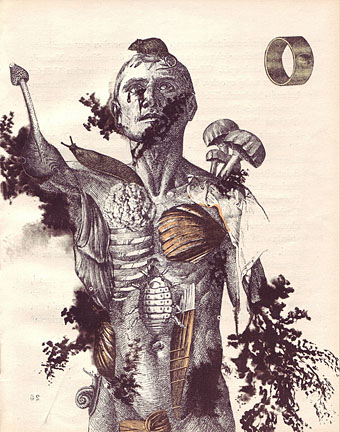
Morlock Night (1979) is a pulpy affair which sees the Morlocks from HG Wells’ The Time Machine using the Time Traveller’s vehicle to return to Victorian London and wreak no end of havoc. Infernal Devices (1987) is a rather more substantial confection involving a great deal of clockwork mechanisms (for once the clock parts are justified!), automata, fish people, and a device capable of destroying the earth. I’ve been producing a lot of engraving collage à la Ernst and Sätty recently but the technique seemed especially appropriate here as a means of illustrating works which themselves are collages of Victorian motifs.

zeppelins.jpg

Meanwhile, over at Tachyon Publications, there’s this cover for another Victorian adventure, two in fact, from master beserker Joe R Lansdale. Flaming Zeppelins combines a pair of comic adventures, Zeppelins West (2001) and Flaming London (2006), which feature a host of notable figures including Mark Twain, Annie Oakley, Buffalo Bill Cody…and a talking seal. Publication date is November 1st.

steampunk.jpg

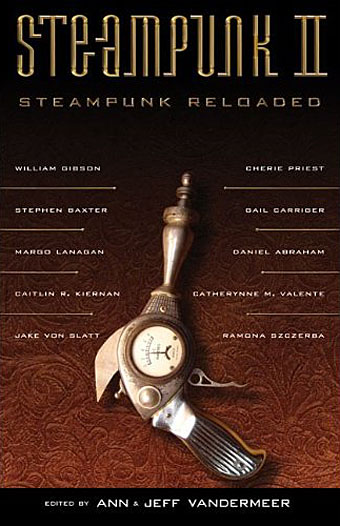
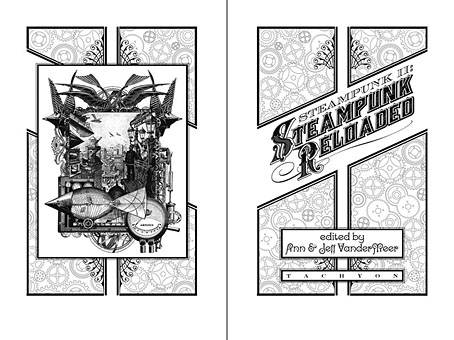
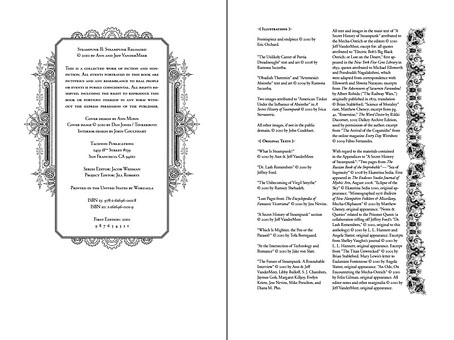
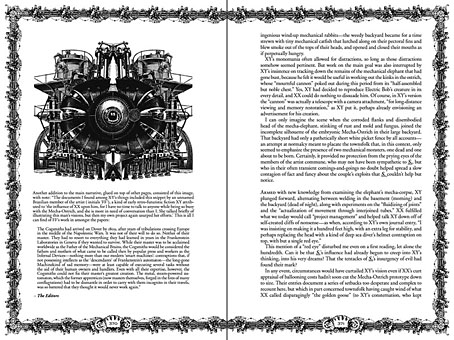
Then from Tachyon in mid-November there’ll be Steampunk II: Steampunk Reloaded, a 430-page anthology edited by Ann & Jeff VanderMeer which includes fiction and non-fiction from William Gibson, Caitlín R Kiernan, Jeffrey Ford, Cherie Priest, and many others. Also a comic strip, copious illustrations and a very full-on interior design from yours truly of which I’ll only show you the above page for the time being. Yes, that’s a mechanical ostrich but if you want to know what it’s doing there you’ll have to read the book. More about this later. And more later about The Steampunk Bible to which I’m also a contributor, a glossy, full-colour guide to the entire sub-culture which will be published next year by Abrams. By the time that appears I’ll probably be sick of the sight of clockwork parts, dirigibles, florid typefaces and Victorian decoration; I’ll be needing a good dose of Helvetica and Josef Müller-Brockmann minimalism to calm down.

Previously on { feuilleton }
Skeleton clocks
Vickers Airship Catalogue
The Air Ship
Dirigibles
More Steampunk and the Crawling Chaos
La route d’Armilia by Schuiten & Peeters
The art of François Schuiten
Steampunk Redux
Steampunk framed
Steampunk Horror Shortcuts
The Airship Destroyer
Zeppelin vs. Pterodactyls

Der Eigene: Kultur und Homosexualität

eigene1.jpg

Der Eigene, collected edition, 1906. Design credited to Adolf Brand.

The subtitle is from an article (see below); Der Eigene, the world’s first homosexual periodical was devoted to an ideal of “masculine culture” which looked to Ancient Greece for a model of same-sex relationships. Adolf Brand (“Editor, photographer, poet, polemicist, activist, anarchist, enfant terrible“) founded Der Eigene in Berlin 1896, and to give some idea of how advanced the Germans were in these matters, consider that not only was this a year after Oscar Wilde had been imprisoned in Britain but that Brand’s publication was only the first of several journals advocating gay rights at a time when homosexual acts were still illegal in Germany. The radicalism fell short of including women, unfortunately; like many Grecophile pioneers of the time, Brand’s world had no place for females. All this activity was part of a peculiar ferment in Germany around 1900 which saw the rise of many small groups devoted to naturism, Theosophy, occultism in general, and various pagan revivals. There were also plenty of fiercely nationalist factions, of course, and these took a dim view of Brand’s outspoken homo-anarchism. When the nationalists later turned into the Nazis they destroyed Germany’s nascent gay culture.

eigene3.jpg

Morgendämmerung (Dawn) by Sascha Schneider, 1897. This drawing also appeared in Jugend magazine the same year.

The pictures here are from sets at Wikimedia Commons where the section devoted to the magazine has finally been amended with some higher-resolution copies. It’s a shame there isn’t more to see given that Der Eigene ran until 1932. I’ll be hoping for further works to come to light as the digitisation of rare publications gathers pace.

eigene2.jpg

Der Eigene, November, 1920.

Elsewhere on { feuilleton }
The gay artists archive

Previously on { feuilleton }
Sanctuarium Artis Elisarion
Jugend Magazine revisited
The art of Sascha Schneider, 1870–1927
Hadrian and Greek love

Weekend links 30

woody.jpg

Did someone say “woody”? Plenty more toy antics at TheOneCam.

• And yet more Haeckelisms: Praying in Haeckel’s Garden, recent works by artist Mary O’Malley.

Seasons of the Peacock, the perennial showoff as depicted by a handful of Art Nouveau artists. A couple of examples there I hadn’t seen before.

• Dorian Cope presents On This Deity, “Commemorating culture heroes and excavating world events.”

• At long last, Fantagraphics will be publishing Ah Pook is Here, the comic strip collaboration between William Burroughs and artist Malcolm McNeill. Something to look forward to for next year. Related: Malcolm McNeill’s website.

David Lynch Dark Splendor: “Der große Filmemacher David Lynch als Fotograf, Maler, Zeichner und Grafiker.”

More on the forthcoming album from Brian Eno, Leo Abrahams and Jon Hopkins. With this degree of hype the end result is going to be a disappointment.

Book design by Richard Hollis, including John Berger’s essential Ways of Seeing.

A fistful of Vignellis: the work of Lella and Massimo Vignelli celebrated.

• Berni Wrightson’s Frankenstein at Golden Age Comic Book Stories.

Jimi Hendrix, Philip José Farmer reader.

Imagerie du Chemin de Fer.

El UFO Cayó (2005) by Ry Cooder.