The Trials of Oz

oztrial.jpg

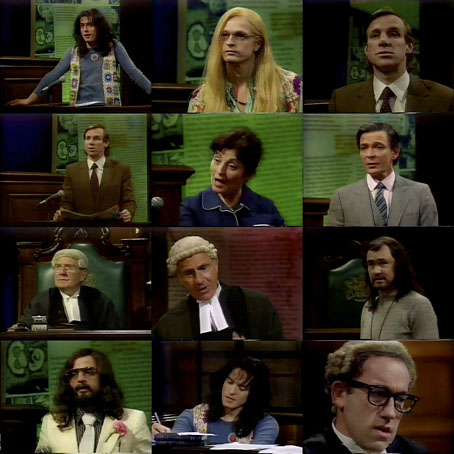
If it’s a surprise to see Cockney geezer Phil Daniels masquerading as the erudite (and non-Cockney) Thomas De Quincey in The Art of Tripping, it’s even more of a surprise to see Hugh Grant in wig and hippy gear as Richard Neville in this 1991 dramatisation of the obscenity trial against Neville’s Oz magazine. Grant wasn’t exactly unknown when this was made but it was prior to Four Weddings and a Funeral so the casting didn’t seem very notable at the time.

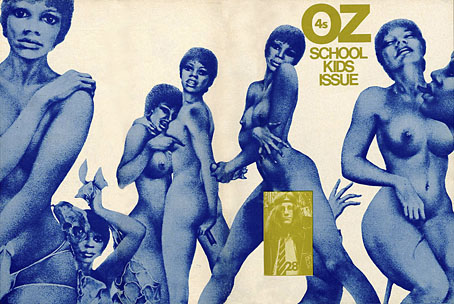
The play was written by Geoffrey Robertson QC from the trial transcripts to coincide with the 20th anniversary of a long and very public trial. Robertson in 1971 was an assistant to John Mortimer, the magazine’s lawyer, so the reconstruction may be taken to be an accurate one. In addition to Grant as Neville, Simon Callow plays Mortimer, Nigel Hawthorne is prosecutor Brian Leary, and Leslie Phillips is Judge Michael Argyle. Among the witnesses there’s Alfred Molina as George Melly (yet again; see yesterday’s post), and Nigel Planer as DJ John Peel, both of whom were called to testify that the notorious “School Kids” issue of Oz wasn’t an obscene publication. The trial, like the earlier drug busts against the Rolling Stones, was as much about the State trying to clobber a bunch of anarchist upstarts as anything that involved the pros and cons of antiquated laws. The three defendants—Neville, Felix Dennis and Jim Anderson—were also accused of “conspiring to corrupt public morals”; the obscenity issue was merely a pretext for getting the longhairs into the dock.
oz28.jpg

Oz 28 (1970). Art by Raymond Bertrand.

This isn’t a lavish production—it’s stylised to the extent that the public gallery is made up of cardboard figures—but it’s good to know that there’s a (rough) copy out there after my tape of the original broadcast developed a fault. (Update: It’s now on YouTube.) Not available, unfortunately, is the live studio discussion that followed in which Jonathan Dimbleby spoke to Geoffrey Robertson, Germaine Greer and others about the trial. The discussion featured a delicious moment when Dimbleby referred to Greer’s feminist issue (no. 29) as “C-Power Oz“. “Come on, Jonathan,” said Greer, “it was Cunt Power Oz!” Dimbleby then spluttered “Anyone can say ‘Cunt Power Oz‘…” and hastily moved on the discussion. (Update: The studio discussion is also on YouTube!)

A year after his TV appearance Geoffrey Robertson was in Manchester Crown Court appealing an earlier ruling of obscenity against David Britton’s Lord Horror (1990) novel. I was in the public gallery on that occasion, and it was an education seeing how little had changed since the Oz trial, with a similarly Philistine and deeply ignorant judge presiding. Robertson overturned the ruling against the novel but a ruling against one of Savoy’s Meng & Ecker comics was upheld. In 1995 we were back in court attempting to argue for a jury trial against further rulings of obscenity, this time against one of my own comics, Hard Core Horror 5. (That issue is now the opening section of the Reverbstorm book.) We failed that time thanks to a magistrate who was even less inclined to listen to any argument.

The Oz trial may seem quaint and farcical today but the issues remain pertinent: some forms of art will always be in conflict with laws that are out-of-date, badly written or maliciously applied. And once you’re standing in a courtroom your opinion about the situation is of no consequence; you’re at the mercy of the people who make the rules.

Previously on { feuilleton }
Martin Sharp, 1942–2013
Raymond Bertrand paintings
Raymond Bertrand’s science fiction covers
The art of Bertrand
Oz magazine, 1967–73

Weekend links 194

roberts.jpg

Untitled glass sculpture by Richard Roberts.

Lord Horror: Reverbstorm, my collaboration with David Britton, makes The Quietus list of Literary Highlights of 2013. At the same site there’s Russell Cuzner talking to English Heretic. “His methodology takes in magick, psychogeography and horror film geekdom, along with firm roots in Britain’s industrial music culture of the early 1980s, to form potent, novel topographies of an otherwise unconnected world of occultists and psychopaths.”

• A slew of London links this week: Geoff Manaugh on how the capital was redesigned to survive wartime blackouts, a piece which inadvertently explains why you see so much black-and-white street furniture in post-war films | Bob Mazzer’s photos of the London Underground in the 1970s and 1980s | Philipp Ebeling’s photos of the capital and its inhabitants today.

• “Science has become an international bully. Nowhere is its bullying more outrageous than in its assault on the phenomenon known as subjectivity.” David Gelernter on “The Closing of the Scientific Mind”. Related: “When Science Becomes Scientism” by Stanislav Grof.

• My favourite book about Orson Welles is This is Orson Welles (1992), a collection of Peter Bogdanovich’s interviews with Welles edited by Jonathan Rosenbaum. Bogdanovich’s interview tapes can now be heard at the Internet Archive.

• Brian Dillon on Dada collagist Hannah Höch who he calls “art’s original punk”, and Sean O’Hagan talking to another collage artist, Linder Sterling, who says “Lady Gaga didn’t acknowledge I wore a meat dress first”.

• One Hundred Years Of Weird Fear: Daniel José Older on HP Lovecraft’s literature of genealogical terror. More fear (and Lovecraft): Will Wiles on the growth of Creepypasta.

The Last Alan Moore Interview? A lengthy discussion with Pádraig Ó Méalóid. Shunning interviews hasn’t done Cormac McCarthy any harm so if I was Alan I wouldn’t worry.

• And speaking of Cormac McCarthy, the headline of the week: “Cormac McCarthy’s ex-wife busted after pulling gun from vagina during alien argument“.

• Where the bodies are buried: Mick Brown presents a potted biography of Kenneth Anger who offers a few reluctant quotes.

• A short animation for gore-obsessed kids: Pingu’s The Thing by Lee Hardcastle.

Helen Yentus designs a 3D-printed slipcase for a novel by Chang-rae Lee.

Ralph Steadman‘s illustrations for Alice’s Adventures in Wonderland.

• Mix of the week: Secret Thirteen Mix 103 by Lustmord.

Collage art at Pinterest.

No Escape (1966) by The Seeds | Pushin’ Too Hard (1966) by The Seeds | No Escape (1979) by Cabaret Voltaire | Pushin’ Too Hard (1982) by Paul Parker

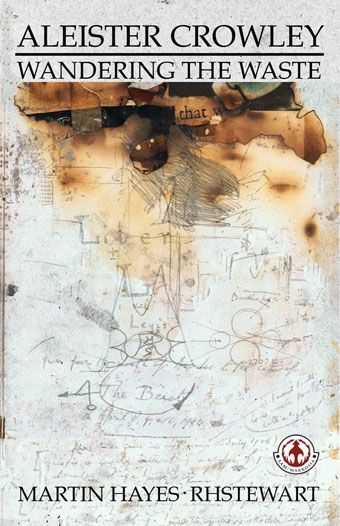
Aleister Crowley: Wandering The Waste

crowley1.jpg

I mentioned this graphic biography of Aleister Crowley earlier in the year but pressure of work has meant it’s taken me all this time to finally read it. Aleister Crowley: Wandering The Waste is written by Martin Hayes and illustrated by RH Stewart. The title alludes to Alastor, or The Spirit of Solitude, a Shelley poem concerning an itinerant poet with whom Crowley often identified.

Crowley isn’t a stranger to the comics world but this book is the first I’ve encountered that devotes itself to the facts of the man’s life rather than using his notorious persona as a general purpose scare figure. Crowley’s life was nothing if not eventful: in addition to the numerous rituals and magickal exploits, he was also a serious mountaineer, and something of a globetrotter before his inheritance ran out; he wrote novels, memoirs, several volumes of poetry, even more volumes of occult philosophy, and was a world-class drug-taker and libertine in an age when sexual escapades of the mildest sort could provoke the deepest outrage.

Given all of this you’d expect somebody to have tried to film his life by now, but doing so presents a number of problems. Period biopics are by their nature very expensive which is why they tend to take the least controversial figures for their subjects. Crowley isn’t only controversial, his life’s work remains esoteric and difficult for a general audience; you’d have to work hard to dispel Devil Rides Out clichés for people who’ve never opened an occult book. There’s no life without the magick, however, so you’re unlikely to get either trying to follow the costume-drama route. In the past I’ve thought that a better solution would be to adopt the jigsaw approach used in François Girard’s Thirty Two Short Films About Glenn Gould (1993); significant moments could be dramatised as they are in the Gould film while other sections could be more graphical, abstract or theoretical.

crowley2.jpg

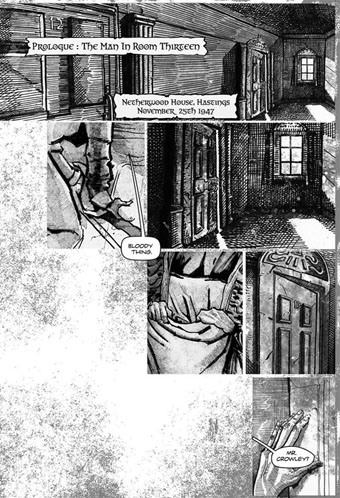
Hayes and Stewart’s book goes for the traditional biopic approach (albeit with some deviations), there being no reason not to when you have an unlimited budget. It’s 1947, and Crowley in his Hastings nursing home remembers his life for a young visitor, delivering a narrative that ranges across seventy years, and which acknowledges the more scandalous moments whilst also repudiating some of the rumours. Hayes backs up his facts with copious endnotes, some of which offer more detail about disputed incidents. Alan Moore and Eddie Campbell’s From Hell is the obvious progenitor here; both books show the strength of comics in being able to deliver historical material in a visual form without having to worry about the constraints of cinema.

Stewart’s artwork is from the sketchy, collaged Sienkiewicz/McKean school of comic art. In some scenes I would have preferred more visual detail but then having drawn historical comics myself I know how difficult it can be having to research the appearance of every last piece of clothing or furniture. (The lettering is also afflicted with a few typos.) Some of the scenes away from 1947 are delivered in a fragmented, hallucinatory style in which occult figures and symbols are confused with Crowley’s memories. The technique enables many years to be covered without padding the book to doorstop size while also keeping the magick as a continual background presence. It’s quite a change to have the aged Crowley as the focus for once, a dishevelled magus rather than the usual libidinous firebrand. After so much turmoil, there’s always a sombre atmosphere around the Great Beast’s less-than-beastly final days, although they were considerably more peaceful than those of some of his wives and associates. Whatever regrets or disappointments Crowley may have felt, his books are still in print, and we’re still talking about him.

The Atlantis Bookshop in London has been showing some of Stewart’s artwork throughout this month. I’ve always liked the way the Atlantis doubles as a mini-gallery, I saw some Austin Spare drawings there a few years ago; it’s a good venue, and the ideal place to view this work. The exhibition will run to December 24th.

Previously on { feuilleton }
Brush of Baphomet by Kenneth Anger
Rex Ingram’s The Magician
The Mysteries of Myra
Aleister Crowley on vinyl

Raphaël Freida’s Torture Garden

freida1.jpg

The guarded, the cautious, the small-scale, the modest, the well-crafted—such books may be rewarded (in our own time, at the national level), but they are rarely preserved. They are not preserved because guardedness, caution, smallness, modesty, and craft can be replaced in any given generation. What is irreplaceable is excess: Of verbal kinesis, religious intensity, intellectual voracity.

Amit Majmudar on Entertainment and Excess: The Great Literary Audiences.

Amit Majmudar is talking about literature and posterity but his argument can be applied to other forms of art. I find the thesis a persuasive one, especially where novels are concerned, for the way it accounts for those works that manage to survive even when they offend the principles of craft and taste by which most novels are judged and criticised. No one would ever claim William Hope Hodgson as a great prose stylist but the excesses of his imagination have ensured that his work remains in print a century after it was first published, while hundreds of “finer” contemporary writers are completely forgotten.

freida2.jpg

Octave Mirbeau’s The Torture Garden (1899) is excessive enough to have ensured that if the author’s other works are reprinted at all it’s because they follow in The Torture Garden‘s wake of notoriety. The moral purpose behind Mirbeau’s scenes of lingering death may have been overwhelmed by its reputation as a classic of erotic sadism, but we’re a long way from 50 Shades of Grey as is evident from these etchings by French artist Raphaël Freida (1877–1942). Given the content it’s surprising to find an illustrated edition at all, Freida’s volume being a limited one published in 1927. The book contained 11 illustrations of which 7 are shown here from two different sources. The impaled figure in the second plate was a surprise since it seems to have been borrowed by Philippe Druillet for one of his pages in his bande dessinée album Yragaël (1974). (See below.) Druillet, like Freida, is an artist whose work is sufficiently excessive to prove attractive to future generations of comic readers and art enthusiasts.

freida3.jpg

Continue reading “Raphaël Freida’s Torture Garden”

Weekend links 187

delia.jpg

Delia Derbyshire (2007) by Iker Spozio.

Whatever you think of Doctor Who, Delia Derbyshire’s recording of Ron Grainer’s theme tune is a landmark piece of electronic music. Those glassy electronic tones still sound unique today, not least for their having been created using rudimentary oscillators and much laborious tape editing. In Radiophonic Workshop: the shadowy pioneers of electronic sound, Joe Muggs looks at the history of the BBC’s electronic composers. If you’re a Radiophonic-head then the Alchemists of Sound TV documentary from 2003 is essential viewing.

There’s more (there’s always more): Delia Derbyshire – Sculptress of Sound: part one of a seven-part radio documentary about the great electronic music composer, and Blue Veils and Golden Sands, Martyn Wade’s radio play about Delia. Related: Delia-Derbyshire.org, Delia Derbyshire: An audiological chronology and A History of the Doctor Who theme. And don’t miss: Silence Is Requested In The Ultimate Abyss (1969) by Welfare State and White Noise, an incredible slice of electro-psychedelia from the John Peel Presents Top Gear album.

• “Why don’t books for grown-ups have illustrations any more?” asks Christopher Howse. Some of them do, this past week I’ve been finishing a new series of illustrations for a story anthology.

• From 2006: Ian Penman on cigarettes, espionage, and the masterful (and superior) television adaptation of Tinker, Tailor, Soldier, Spy.

It was Malcolm [McLaren] who suggested that the main characters be a boy who looks like a girl who looks like a boy and vice versa. What was strange was that, actually, in 1985 this was nobody’s vision of the fashion industry. Since then, fashion and fascism have crept closer: you’ve got John Galliano doing his promotional bits for the Third Reich, you’ve got Alexander McQueen killing himself, you’ve got Versace and that horrible, violent stalker coming for him. Since it was written, almost all of it has come true apart from the nuclear winter, but I think we’re working on that. The actual society that the story happens in is much more like the society we have now than culture was in 1985.

Alan Moore on Fashion Beast, Situationism, and why he hates superheroes.

• KW Jeter talks about his latest novel, Fiendish Schemes, and the “cultural juggernaut” that is steampunk.

• Grit and Social Dynamics in Smoke Ghost: Elwin Cotman on the weird fiction of Fritz Leiber.

The Secret Lives of the Vatican’s Gay Cardinals, Monks, and Other Clergy Members.

Don Cherry & Organic Music Theatre, live in the RAI TV studios, 1976.

• Otherworldly Art and Photography: Mlle Ghoul finds the best things.

• From 1998: Rahma Khazam on composer Bernard Parmegiani.

• Mix of the week: Marshland: The Mix by Hackneymarshman.

• “Let’s colonize the clouds of Venus,” says Ian Steadman.

J. Hoberman on David Cronenberg’s Visual Shock.

The Delian Mode (1968) by Delia Derbyshire | Tom Baker (1981) by The Human League | Doctor Who? (1984) by Doctor Pablo & The Dub Syndicate