Kenneth Grant, 1924–2011

grant.jpg

Kenneth Grant by Austin Spare (c. 1951).

Kenneth Grant, writer and occultist, died last month but the event was only announced this week. He’ll be remembered for the nine fascinating occult treatises he wrote from 1972 to 2002, and for continuing the work of Aleister Crowley as head of the Ordo Templi Orientis, a position which became fraught in later years as various occult factions disputed his authority. Having collected occult books for much of the 1980s I find his name calls out from the shelves more than many other writers; as well as authoring his own works he edited all the major Crowley texts with Crowley’s executor John Symonds, presenting them in authoritative editions for a new readership.

Grant proved a very loyal champion of people he admired, significantly so in the case of Austin Osman Spare whose work he collected, exhibited and republished from the 1950s on. It was Grant’s position as one of the many advisors for Man, Myth & Magic in 1970 which resulted in the part-work encyclopedia using one of Spare’s stunning drawings as the cover picture for its first issue. That effort alone gave Spare an audience far beyond anything he received during his lifetime, and Grant ensured the magazine featured Spare’s work in subsequent issues. Grant’s occult works made liberal use of unique illustrations by his wife, Steffi Grant, Austin Spare and others. The books were singular enough even without their pages of curious artwork, a beguiling and sometimes incoherent blend of western occult tradition, tantric sex magick and hints of cosmic horror which were nevertheless always well-written, annotated and crammed with technical detail. Alan Moore in 2002 examined the experience of an immersion in Grant’s mythos with a wonderful review he called “Beyond our Ken“. He notes there the influence of HP Lovecraft, another of the visionary figures who Grant championed throughout his life.
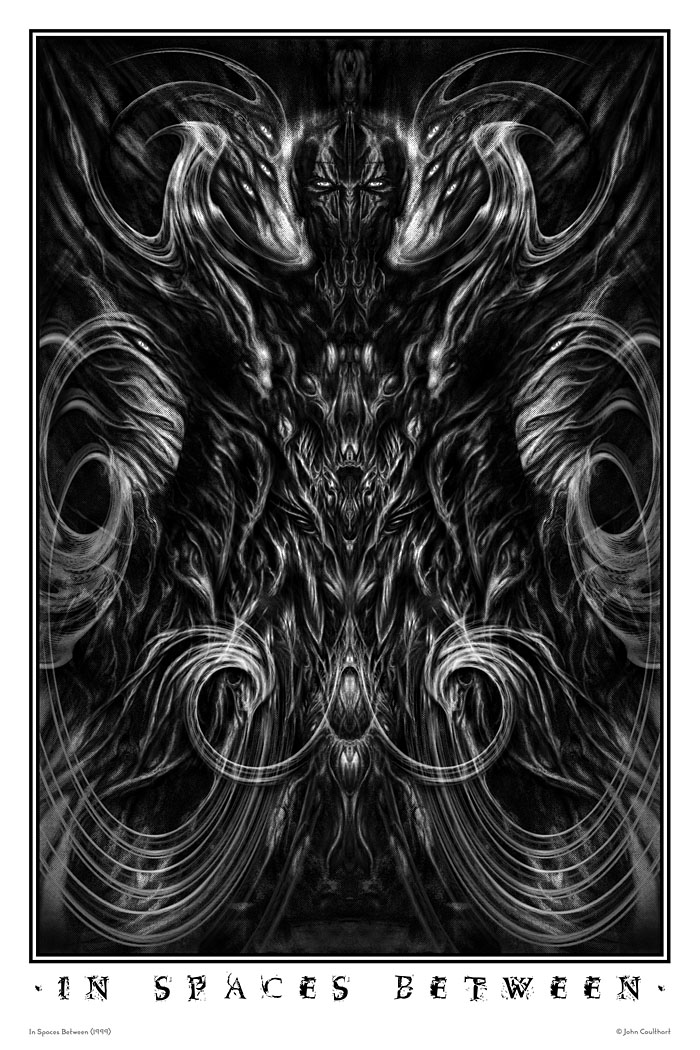
between.jpg

In Spaces Between from The Great Old Ones (1999).

And speaking of Lovecraft, I’ve often wondered whether Kenneth Grant ever saw a copy of my Haunter of the Dark collection. For the opening of the Great Old Ones Kabbalah sequence which Alan Moore and I created for the book I added an extra piece of art entitled In Spaces Between, a reference to Coil via an epigraph from Grant’s Outside the Circles of Time (1980) which I borrowed for the facing page:

For there are Thrones under ground
And the Monarchs upon them
Reign over Space and Beyond

Invoke Them in Darkness, Outside
The Circles of Time

In Silence, in Sleep, in Conjurations
Of Chaos, the Deep will respond…

Coil aficionados will recognise those words as the origin of some lines from Titan Arch (1991):

There are Thrones under ground
And Monarchs upon them
They walk serene
In spaces between

Grant followed his epigraph with another quote, from Lovecraft’s Necronomicon.

In addition to Alan Moore’s Grant review, Fulgur have a detailed Kenneth Grant bibliography on their pages. They were also the publishers in 1998 of Zos Speaks! Encounters with Austin Osman Spare by Kenneth and Steffi Grant, a memoir and celebration of Spare’s work which revealed this trio of remote astral voyagers to be human beings after all. The book is currently out of print but it’s essential for anyone interested in Austin Spare or, for that matter, Mr and Mrs Grant.

Previously on { feuilleton }
New Austin Spare grimoires
Austin Spare absinthe
Aleister Crowley on vinyl
Austin Spare’s Behind the Veil
Austin Osman Spare

The art of Robert Lawson, 1892–1957

lawson1.jpg

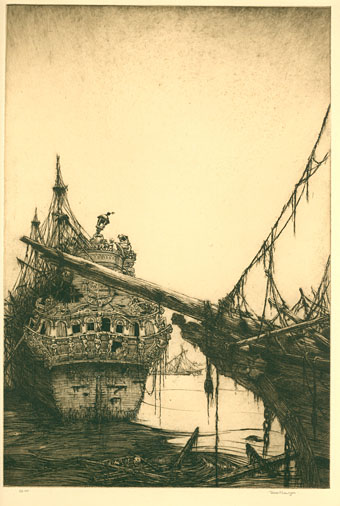
Sargasso Sea (no date).

Did I say Sargasso Sea? Blame William Hope Hodgson some of whose sea stories I was re-reading over the weekend. An idle search for Sargasso images turned up this tremendous etching by American author and illustrator Robert Lawson, part of a collection of equally fine work at the Florida State University. There’s little information about this picture, unfortunately, it’s a numbered print so it’s most likely a one-off piece but it would make an ideal cover illustration for a Hodgson collection. It hadn’t occurred to me before but the rambling third film in the Pirates of the Caribbean series might have been improved if they’d made use of the old Sargasso-as-oceanic-graveyard legend, it’s just the place you’d expect to find Davy Jones and his piscine crew.

Bud Plant has more about Robert Lawson’s career and examples of his book illustrations.

lawson2.jpg

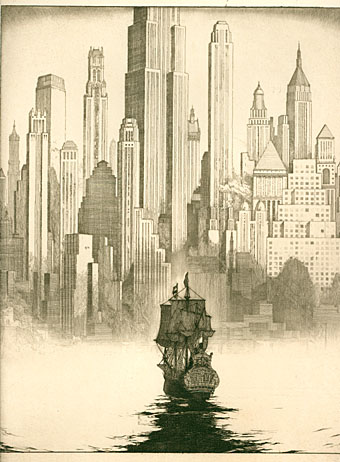
Untitled (CityShip) – Manhattan (no date).

Elsewhere on { feuilleton }
The etching and engraving archive
The illustrators archive

Previously on { feuilleton }
Coming soon: Sea Monsters and Cannibals!
Druillet meets Hodgson
Davy Jones

CthulhuPress

keepcalmcthulhu2.jpg

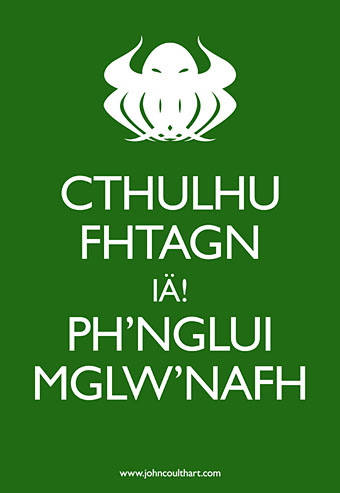
The Twitter consensus yesterday was that CafePress products based on this design were required so here they are. As usual I never know what people want from CafePress so I tend to throw the design on their entire range so long as it fits the requisite size and shape. This piece works better than most since it’s simple and direct, my more detailed and pictorial creations look better as prints. I keep feeling that someone must have made a design like this already, these variations on the “Keep Calm” poster have proliferated so much, but searching didn’t reveal anything so… The web address doesn’t appear on the CafePress things, that’s just for the images posted here if and when they drift into Tumblr’s Sargasso Sea of uncredited pictures.

coc.jpg

The Call of Cthulhu (1987–88).

While we’re on the subject of everyone’s favourite Great Old One, I may as well take the opportunity to remind those interested that these earlier renderings are also available as various CafePress products. The Call of Cthulhu piece above is the opening page of my comic strip adaptation of the story as seen in The Starry Wisdom anthology from Creation Books and my Haunter of the Dark collection.

cthulhu.jpg

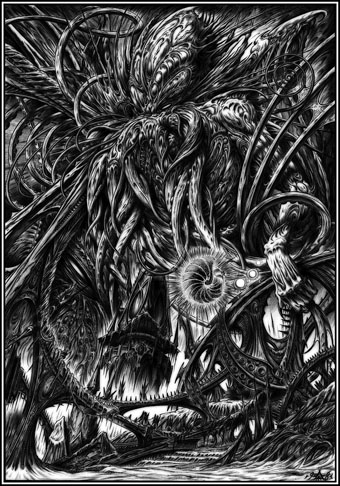
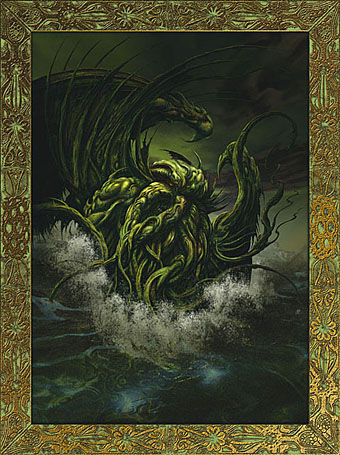
Cthulhu from The Great Old Ones (1999).

The Great Old Ones drawing was one of the plates from the series of the same name I produced with Alan Moore for the Haunter book. And Cthulhu Rising is the cover of that volume, of course, seen here with its Haeckel-derived frame. The Great Old Ones Cthulhu was drawn with a Biro pen then tweaked slightly in Photoshop. I don’t think I’ve ever posted a large version of it so here it is.

cthulhu2004.jpg

Cthulhu Rising (2004).

Elsewhere on { feuilleton }
The Lovecraft archive

Weekend links 45

sa4.jpg

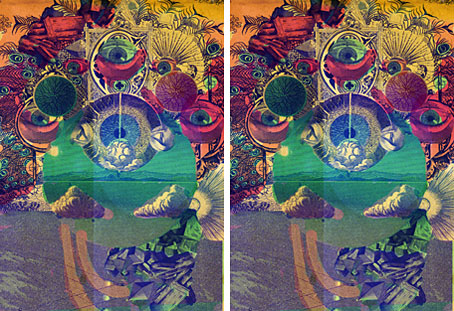
That essential journal of esoteric culture, Strange Attractor, announced a fourth number this week sporting a psychedelic cover which may be the work of Julian House (no credit is given on the SA site). As to the contents:

From Haiti and Hong Kong to the fourth dimension and beyond: discover the secrets of madness in animals; voodoo soul and dub music; ancient peacock deities; Chinese poisoning cults; the history of spider silk weaving; heathen mugwort magic; sentient lightning; Jesuit conspiracy theories; junkie explorers; Dali’s Atlantis; the resurgence of Pan (in London’s Crouch End); anarchist pirates on Madagascar; an ancient Greek Rip Van Winkle; French anatomical waxworks; Arthur Machen’s forgotten tales and Alan Moore’s unpublished John Dee opera.

Further details and the means to order a copy can be found here.

• Resonance FM’s Weird Tales For Winter has returned beginning with a presentation of The Gateway of the Monster, one of the better Carnaki tales by William Hope Hodgson. The story is read by Moon Wiring Club‘s Ian Hodgson (no relation) and the musical atmospheres are provided by The Advisory Circle. I ought to have posted this news yesterday since you’ll have missed the broadcasting of the first half but the second half will go out at midnight (UK time) on Monday. Details here, and the next release on the Café Kaput label in February will be the soundtrack, Music for Thomas Carnaki (Radiophonic Themes & Abstracts).

keepcalmcthulhu2.jpg

• The Keep Calm and Carry On Image Generator lets you work your own variations on the ubiquitous poster. It wouldn’t work for me, however, so I rolled up my sleeves and made my own. This may be good as a CafePress design, yes?

Interplay is an album by John Foxx and The Maths due to be released on March 21st. As with last year’s collection of Foxx instrumental pieces, DNA, the package design is by Jonathan Barnbrook. John Foxx first came to prominence as the lead singer in Ultravox (do I need to say “of course”? Okay…“of course”) and Ultravox’s debut album was part-produced by Brian Eno. It’s been painfully obvious recently (and it pains me to say it) that Foxx’s DNA was a far more accomplished and engaging work than Eno’s recent collection of over-hyped instrumentals. Related: Barnbrook Design’s albums of 2010.

Word Horde 2.0, “a substantial archive of manuscript material, correspondence, and books and printed matter, mostly signed” from the William Burroughs archives can be yours for $260,000. Related: William Burroughs’ Wild Boys photos. Also: Rudy Rucker on David Cronenberg’s Naked Lunch.

• “Nabokov described how ‘a modern taxonomist straddling a Wellsian time machine with the purpose of exploring the Cenozoic era’ would encounter the following series of events in the evolution of these butterflies…” The Royal Society confirms that a contentious theory of Vladimir Nabokov’s concerning the descent of butterfly populations was accurate.

• The work of Gérald Bertot aka Thomas Owen, a Belgian author of weird fiction, is explored at A Journey Round My Skull.

The Other Side of the Wind, Orson Welles’ unfinished film from 1972, may finally be given a release.

• Jon Savage celebrates Roy Harper and his extraordinary Stormcock album.

Philip Pullman wants the Tory philistines to leave our libraries alone.

• Rick Poynor takes a dérive through the arcades of Paris.

Space music new and old.

Young Savage (1977) by Ultravox | Clicktrack (2010) by John Foxx & Jonathan Barnbrook.

Deutsche Kunst und Dekoration #5

dkd05-01.jpg

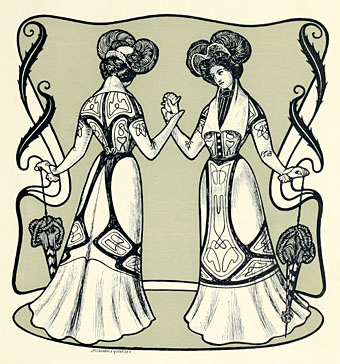
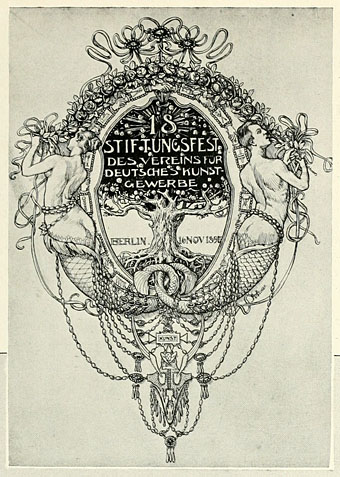
Continuing the delve into back numbers of Deutsche Kunst und Dekoration, the German periodical of art and decoration. Volume 5 covers the period from October 1899 to March 1900, and the Art Nouveau style is in full flower at this point, as it was across most of Europe. This is also the place at which the journal becomes so laden with impressive design work that it’s impossible to easily do justice to over 300 pages of contents. Anyone wanting to see more is encouraged to download the whole thing as either page scans or a PDF. As before I’ve tended to concentrate on the graphic material but this issue also features more lavish interior designs, a range of jewellery, and ponderous monumental architecture including proposals for some of Germany’s many Bismarck Towers. Examples follow below. There’ll be more DK&D next week when we take a trip to the Exposition Universelle in Paris.

dkd05-02.jpg

Sascha Schneider was Karl May’s favourite illustrator and one of the few openly gay artists in Germany at the time. He’s represented here with a small feature on his paintings among which there’s this depiction of a team of strapping oarsmen.

dkd05-03.jpg

Continue reading “Deutsche Kunst und Dekoration #5”