The City of the Singing Flame

cas1.jpg

Wonder Stories, July 1931. Illustration by Frank R. Paul.

Looking over Bruce Pennington’s artwork this week sent me back to some of my Clark Ashton Smith paperbacks, many of which sport Pennington covers. One of my favourite Smith stories, The City of the Singing Flame, is also one of his finest pieces, and a story that Harlan Ellison has often referred to as his favourite work of imaginative fiction.
cas2.jpg

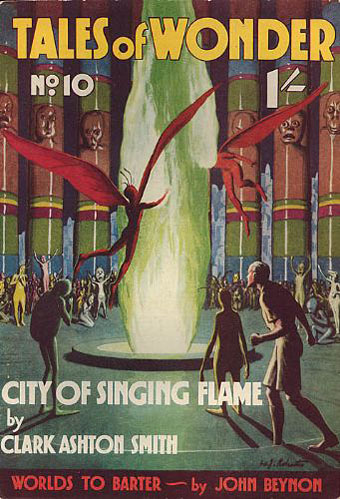
Tales of Wonder, Spring 1940. Illustration by WJ Roberts.

The story as it’s known today was originally a shorter piece, The City of the Singing Flame, followed by a sequel, Beyond the Singing Flame; both stories were published in Wonder Stories magazine in July and November of 1931, then as one in Arkham House’s CAS collection Out of Space and Time in 1942. The two-in-one story is now the definitive version.

Smith’s tale concerns the discovery of a dimensional portal somewhere in the Sierras. Beyond this there lies a path leading through an otherworldly landscape to a colossal city peopled by a race of mute giants. A temple at the heart of the city protects the prodigious green flame of the title, an eerie and alluring presence whose siren call draws creatures from adjacent worlds who prostrate themselves before the flame before immolating themselves in its fire. A narrator, Philip Hastane, give us details of diary entries from a friend who discovered the portal, and who subsequently has to decide whether to resist the lure of the mysterious flame or follow the other creatures into the fire. More than this would be unfair to divulge if you’ve never read Smith’s remarkable piece of fiction.
Continue reading “The City of the Singing Flame”

The fantastic and apocalyptic art of Bruce Pennington

pennington-pastel.jpg

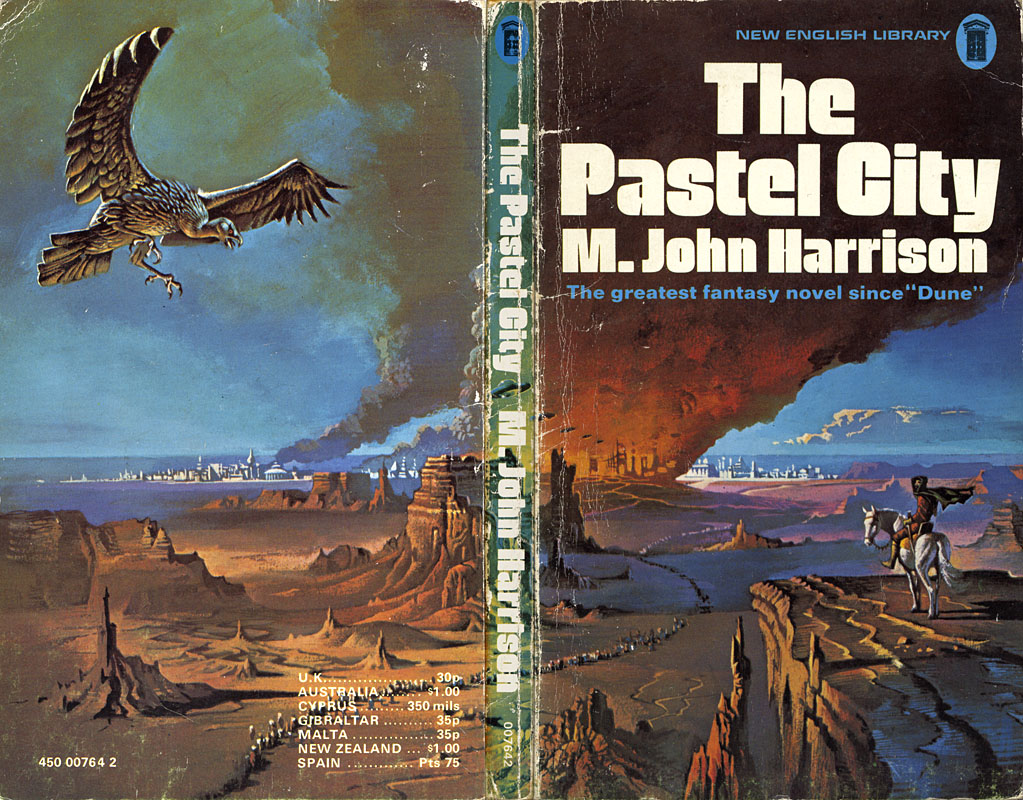
The Pastel City (1971), the first in M. John Harrison’s peerless series of Viriconium books.

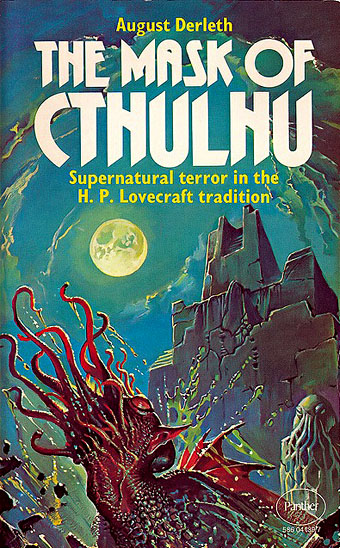
Today’s post is another guest entry over at Tor.com. I’d been intending on writing something about Bruce Pennington‘s art for some time, having already covered the work of Ian Miller, my other favourite genre cover artist of the 1970s. (By coincidence both artists have illustrated the work of M. John Harrison and HP Lovecraft.) My hand was forced this month by the news of the first ever exhibition of Pennington’s paintings which is being held at Britain’s foremost occult book emporium, the Atlantis Bookshop in Museum Street, London. There’s a catalogue of the works on display here, many of which will be for sale. If I had the cash I’d consider buying one, Pennington’s work made a big impression on my imagination when I was reading many of the titles he’d illustrated for the first time. His art was unique for me in its occasionally Surrealist overtones, and as a cover artist he was unusual in working across a range of genres. Like Frank Frazetta his imagination and technique were able to suggest a great deal with a minimum of brush strokes.

pennington-cthulhu.jpg

The Mask of Cthulhu (1976).

This post can be taken as an appendix to the Tor one which I didn’t want to overburden with pictures. The Derleth cover is purloined from Jovike’s excellent Flickr collection which includes several Pennington covers. Below are some pages from Pennington’s first book, Eschatus, a large-format collection of paintings interpreting the prophecies of Nostradamus as an apocalyptic science fiction narrative taking place in the 24th century.

Pennington has many examples of his work on his website, and there’s also a feature about his paintings in this month’s Fortean Times. The Atlantis exhibition runs to August 27th.

pennington-eschatus1.jpg

Eschatus (1976).

Continue reading “The fantastic and apocalyptic art of Bruce Pennington”

Weekend links 69

evans.jpg

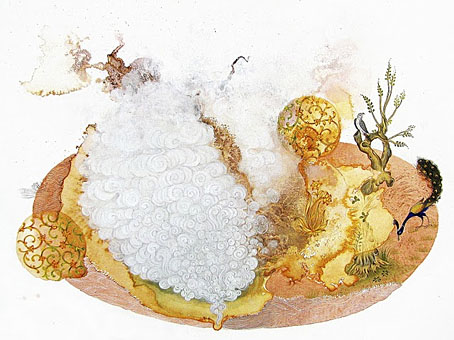
Peacock Apocalypse (detail) by Julie Evans in collaboration with Ajay Sharma.

Here at { feuilleton }, home of the curly bracket affectation, your correspondent is still surprised to find his postings the subject of a critique by Rick Poynor in the latest edition of Eye magazine, the international review of graphic design. I haven’t seen a print copy yet but you can read Mr Poynor’s appraisal here. Meanwhile, over at Design Observer this week there’s another Poynor piece about the collage illustrations of Andrzej Klimowski.

Alan Moore (yes, him again) discusses the moment when the League of Extraordinary Gentlemen gets all swinging and psychedelic. And Iain Sinclair (yes, him again) is still doing the interview rounds promoting his current book, Ghost Milk.

Ayin Acla, a short film by Anna Thew with a soundtrack by Cyclobe. The most recent Cyclobe album, Wounded Galaxies Tap at the Window, was previously vinyl-only but is now available on CD.

• Bones and beads and other things in Wren Britton’s Pure Vile clothing and accessories. Related: Patrick Veillet’s wearable bone sculptures.

Lambshead Cabinet of Curiosities Q&A: Ann & Jeff VanderMeer answer questions about their latest anthology at Fangoria.

• Being a lifelong introvert, I’m sympathetic to Four Ways Technology Can Enable Your Inner Introvert by Philip Bump.

• In an all-too-rare meeting of minds and talents, Roy Harper talks to Joanna Newsom.

Jon Macy’s Teleny and Camille is reviewed at Lambda Literary.

• Author Carol Birch tells us how best to read Finnegans Wake.

Joel Pirela’s Design Classics posters.

Each And Every Word Must Die (1999) by Cyclobe | Brightness Falls From The Air (2001) by Cyclobe | Indulge Yourselves With Our Delicious Monster (2006) by Cyclobe

The angels in their anguish

chj4.jpg

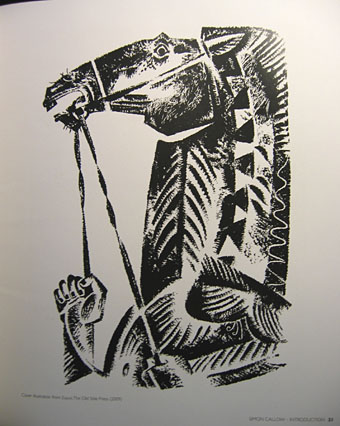
Equus (2009).

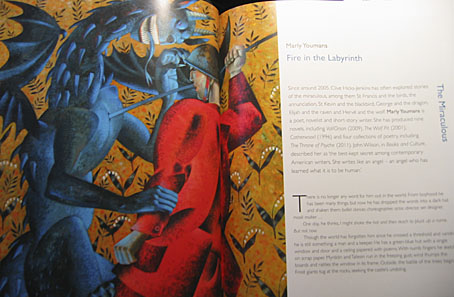
As an addendum to the earlier post about the Clive Hicks-Jenkins retrospective currently running at the National Library of Wales, Aberystwyth, here’s a brief look at the artist’s monograph which turned up in the post this week. Having seen much of this work only in Clive’s blog posts (many of which were day-to-day recordings of work in progress) it’s a real pleasure to see them at larger size in high-quality print. In addition to familiar works there are many sketches and smaller pieces interleaved with the text, and unlike many monographs this isn’t the work of a single author but features appreciations from Simon Callow, Damian Walford Davies, Andrew Green, Rex Harley, Kathe Koja, Anita Mills, Montserrat Prat, Jacqueline Thalmann and Marly Youmans, as well as notes and comments by the artist.

chj5.jpg

Battle Ground (2007).

Andrew Wakelin has done a great job with the book’s design, the use of Gill Sans throughout feels just right. As mentioned before, the publisher is Lund Humphries, and they have a discount for orders made through their website. A few more page samples follow.

Continue reading “The angels in their anguish”

John Dee’s Monas Hieroglyphica

monas1.jpg

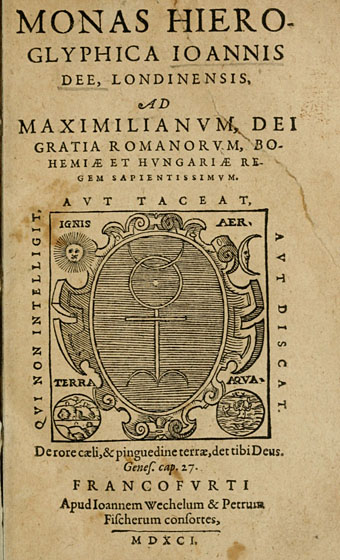
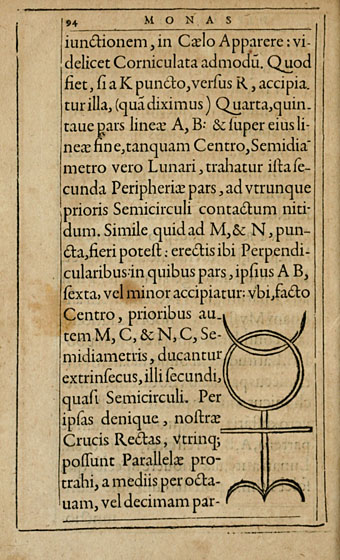
I swear I didn’t go hunting for this. Among the various library collections at the Internet Archive one can find The Getty Alchemy Collection, a substantial gathering of very old alchemical texts scanned in a variety of formats. John Dee’s Monas Hieroglyphica caught my eye during a random search, a third edition of his treatise from 1564 in which he describes his Monas Hieroglyphica, a glyph designed to combine symbols of the Sun, the Moon, the Elements and Fire in a single figure.

monas2.jpg

The glyph also intentionally resembles a human form, and Dee relates its individual parts to various astrological and chemical symbols. I’ve mentioned before that Dee scholar Derek Jarman deliberately based Prospero on John Dee in his 1979 film of The Tempest, giving the magus a scrying wand shaped to resemble the Monas Hieroglyphica.

monas3.jpg

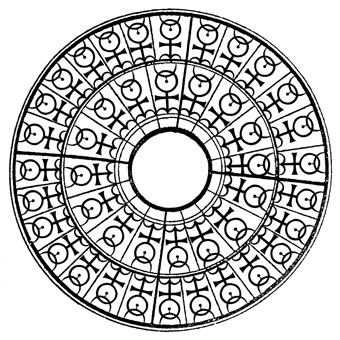
I produced my own variations on the glyph in 2009 when working on the cover of Jeff VanderMeer’s novel, Finch. The symbol recurs in Jeff’s fictional city of Ambergris and I seem to recall there being some discussion about including this doorway design somewhere in the book. In the end it was incorporated into the cover design in a rather subtle fashion. I think this is the first time the design alone has appeared in public.

The Internet Archive has a few other Dee-related items, including Lists of manuscripts formerly owned by Dr. John Dee; with preface and identifications (1921), a 500-page book by antiquarian and ghost story writer MR James.

Previously on { feuilleton }
Mister Jarman, Mister Moore and Doctor Dee
Alchemically Yours
Laurie Lipton’s Splendor Solis
The Arms of the Art
Splendor Solis
Amphitheatrum Sapientiae Aeternae
The Tempest illustrated
Cabala, Speculum Artis Et Naturae In Alchymia
Digital alchemy
Designs on Doctor Dee