Weekend links 85

farmanfarmaian.jpg

Group I (Convertible Series, 2010) by Monir Farmanfarmaian.

The four albums recorded by Bruce Gilbert and Graham Lewis under the name Dome are being reissued by Editions Mego together with Gilbert & Lewis’s Yclept album. I always preferred Gilbert & Lewis in their Dome incarnation (and Colin Newman solo) to the punk and post-punk stylings of their former band, Wire. Dome were (among other things) eccentric, awkward, noisy, hypnotic and experimental. Their recordings seemed to go largely unnoticed in the early 1980s so it’s good to see them being reissued.

A Children’s Treasury of American Cops Brutally Attacking Citizens: “…it takes quite a lot of tax money to keep a bunch of vicious thugs overfed and dressed like junior Darth Vaders with their portable hard-ons, on the off-chance some college kids might one day peacefully sit outside to protest this nation’s revolting descent.”

• “Stevenson, as has been said, was disarmingly candid about the material he borrowed for Treasure Island. One name, however, is missing from the extensive catalogue of self-confessed ‘plagiarisms’.” John Sutherland at the TLS.

• “Messiaen’s advice was revelatory. ‘You have the good fortune of being an architect and having studied special mathematics’, he told Xenakis. ‘Take advantage of these things. Do them in your music.'”

• “They always said punk was an influence. Tracey Emin, Damien Hirst, what a load of old shit that was. It’s Thatcherite art care of Saatchi & Saatchi.” And don’t ask Jamie Reid about the Sex Pistols.

Dennis Cooper is interviewed at Lambda Literary. I was surprised last week to find my recent post about William Burroughs’ The Wild Boys linked on a feature about the novel at Cooper’s blog.

Cosmic Geometry: The art of Monir Farmanfarmaian at The Paris Review. Related: Monir Farmanfarmaian at the Haines Gallery, San Francisco.

• Paleolithic phallic art suggests that many early European men scarred, pierced and tattooed their penises.

FACT mix 301 is a selection of dub tracks, dubstep pieces and Middle Eastern songs compiled by Kahn.

Who left a tree, then a coffin in the library?

The Little Journal of Rejections (1896).

Clive finished another painting.

The Great Salt Desert of Iran.

Keep Drawing.

• Troisième (1980) by Colin Newman | And Then… (1980) by Dome | The Red Tent pts I & II (1980) by Dome) | Jasz (1981) by Dome.
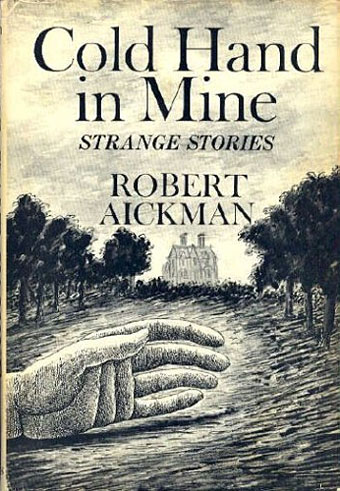
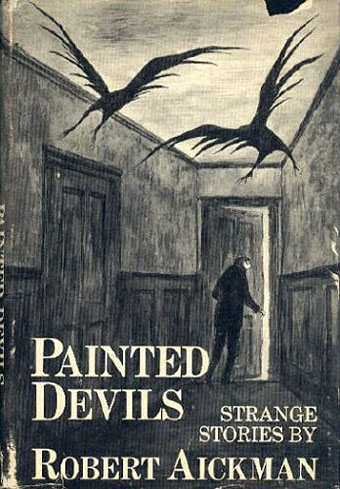
Edward Gorey book covers

gorey1.jpg

Scribner’s edition (USA, 1978).

I’m still working through the Robert Aickman stories so curiosity had me looking up the covers of his first editions. Edward Gorey was a fitting choice as artist for Aickman’s fifth story collection, Cold Hand in Mine, and it’s interesting seeing his work labelled on both these books as “strange stories”; paperbacks tended to brand his fiction as horror which isn’t always accurate. We’re back with that term “weird” again: reading Aickman today is like finding the quotidian Britishness of Alan Bennett darkening into the inexplicable nightmares of David Lynch. Gorey’s gloomy renderings suit these atmospheres a lot better than later attempts to package Aickman’s books so it’s a shame he wasn’t allowed to illustrate more of them. Cold Hand in Mine has recently been republished by Faber, together with two more collections of Aickman’s stories.

gorey2.jpg

Scribner’s edition (USA, 1979).

Edward Gorey illustrated and designed many book covers, not all of them horror or ghost stories. This Flickr set has some of the more notable examples which includes Cold Hand in Mine. Also a flaming spider… There are more covers at Gorey Books where I was surprised to find he’d produced a cover for A Room in Chelsea Square, an early novel of gay life in London by Michael Nelson that was originally published anonymously to spare the author the attentions of intolerant authorities. Gorey’s drawing is like something Philippe Jullian might have done had he been a more careful draughtsman.

• See also: Edward Gorey’s Elephant House for more covers and Gorey ephemera.

Elsewhere on { feuilleton }
The book covers archive
The illustrators archive

Previously on { feuilleton }
Weird Fiction Review

Weekend links 84

enok.jpg

Regeneration (2011) by Toshiyuki Enoki. Via.

HIDE/SEEK: Difference and Desire in American Portraiture, the art exhibition that caused such a fuss last year at the Smithsonian Institution, opens at the Brooklyn Museum, NYC, on November 18th. Among the events associated with the show is a screening of James Bidgood’s lusciously erotic Pink Narcissus. David Wojnarowicz’s video piece, A Fire in My Belly, is still a part of the exhibition so the New York Daily News reached for the outrage stick to prod some reaction from people who’d never heard of the artist or his work before. Will history repeat itself? Does the Pope shit in the woods? Watch this space…

Magic is not simply a matter of the occult arts, but a whole way of thinking, of dreaming the impossible. As such it has tremendous force in opening the mind to new realms of achievement: imagination precedes the fact. It used to be associated with wisdom, understanding the powers of nature, and with technical ingenuity that could let men do things they had never dreamed of before. The supreme fiction of this magical thinking is The Arabian Nights, with its flying carpets, hidden treasure and sudden revelations…

Marina Warner, whose new book, Stranger Magic: Charmed States and the Arabian Nights, is reviewed here and here.

• Those Americans who adore big business but loathe the idea of gay marriage will be dizzy with cognitive dissonance at the news that 70 major US companies—including CBS, Google, Microsoft and Starbucks—have signed a statement saying the Defense of Marriage Act (DOMA) is bad for business. Mark Morford at SFGate says this now means that real homophobes don’t Google.

Divining with shadows and dreams, tears and blood: S. Elizabeth talks to JL Schnabel of BloodMilk about her “supernatural jewels for surrealist darlings“.

Earth: Inferno (2003), a short film by Mor Navón & Julián Moguillansky based on the book by Austin Osman Spare. Via form is void.

finlay.jpg

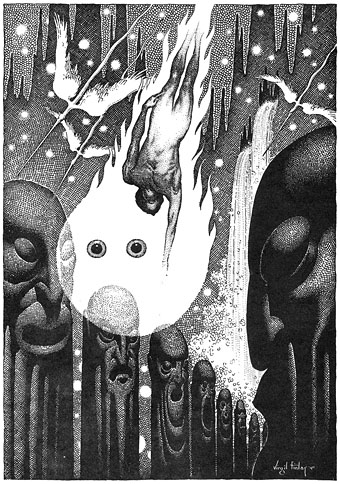
Illustration by Virgil Finlay for A. Merritt’s The Face in the Abyss. From a 1942 Finlay portfolio at Golden Age Comic Book Stories.

The Mute Synth as created by Dirty Electronics & designed by Adrian Shaughnessy.

Phil Baker reviews two new Aleister Crowley biographies at the TLS.

A Brief Rant on the Future of Interaction Design

The Most Amazing Room In Queens, NYC.

Brian Eno on composers as gardeners.

Alan Turing is Alan Garner’s hero.

• Paintings by Guy Denning.

Static (1998) by Redshift | The Owl Service (2000) by Pram | Lover’s Ghost (2010) by The Owl Service.

Pádraig Ó Méalóid talks to Steve Moore

somnium.jpg

Author Steve Moore discusses Somnium, his occult novel for which I provided a cover illustration, with Pádraig Ó Méalóid at the Forbidden Planet site. In addition to examining his comics work and long friendship with Alan Moore, Steve also tells us something about his novel and his lunar obsession:

Without giving away too much of the plot, it’s a historical fantasy about a young man called Kit Morley in 1803 who, fleeing an impossible romance, arrives at an inn on Shooters Hill, where he’s intent on writing a story set in Elizabethan times, titled Somnium, which means ‘a dream’. In that story, a courtier named Sir Endimion Lee arrives on Shooters Hill and finds a lunar dream-palace called Somnium, where he encounters someone who appears to be a moon-goddess. Then there are various other stories embedded within these, set at various times, written in various styles and providing a number of layers, while Morley himself starts to question the nature of the world he’s living in. So it’s a fantasy, but a long way away from the sort of Tolkien-type adventure that a lot of people think of as fantasy.

As to what it’s about … myth (particularly that of the moon-goddess Selene and her mortal lover Endymion) and dream and the fluid nature of reality … lost love and redemption … the psychogeography and psychohistory of Shooters Hill, where I’ve lived all my life … about writing, and real and imaginary books … and goddesses, and Romantic Idealism. It’s poetic, and it’s very, very pagan …

Somnium, as mentioned before, is available direct from that splendid cabinet of curiosities, Strange Attractor.

Previously on { feuilleton }
Somnium by Steve Moore

Weekend links 83

hackett.jpg

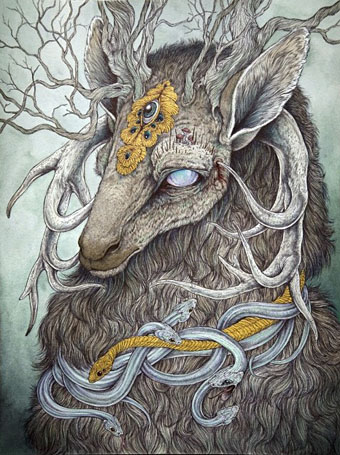
In Memory by Caitlin Hackett who describes her astonishing drawings as “contemporary mythology”.

• David Lynch’s solo album, Crazy Clown Time has just been released so The Guardian last Friday let the artist/director/musician edit their G2 supplement. Xan Brooks tried to get Lynch to open up about his inspirations while elsewhere Lynch had a chat with ZZ Top’s Billy Gibbons. Of more interest to me was news that some of the deleted sequences from Blue Velvet have been discovered. I’ve known about these for years from a feature in Video Watchdog magazine but never thought we might get to see them. Related: a mixtape by David Lynch & musical collaborator/engineer ‘Big’ Dean Hurley.

• “Book jackets these days, for reasons I won’t unpack, seem to revel, overtly, in wit, conceptual deviousness, unusual clever or droll juxtapositions – we, as a professional community, seem to have elevated the visual bon mot above all other virtues.” Peter Mendelsund in a great post about certain problems in book design, starting with the very problematic question of what to do with Nabokov’s Lolita. Related: Covering Lolita, a gallery of covers through the ages which run the gamut of bad decisions.

• “For his sins Pinocchio is not only hanged but robbed, kidnapped, stabbed, whipped, starved, jailed, punched in the head, and has his legs burned off.” Nathaniel Rich goes back to Carlo Collodi’s original Pinocchio. Disney it ain’t.

wolpe.jpg

Some of Berthold Wolpe’s Faber cover designs are now available as prints from wire-frame whose Pelham/Ballard prints were mentioned here recently. Related (and worth another visit): Faber 20th century classics at Flickr.

Technical Vocabularies – Games for May, a small collection of poems by Alan Moore & Steve Moore, is now online with authorial permission. Alan’s Beardsley pastiche on the cover is a bonus.

• Cabaret Voltaire’s Richard H. Kirk says the group’s Virgin albums will be reissued next year by Mute. A new edition of The Crackdown? Yes, please.

• “Homo Riot can only think of six or seven street artists in the world who regularly feature gay themes in their work, and he knows all of them.”

Rub Out The Words: Letters from William Burroughs and Philip K. Dick on the language virus theory of William Burroughs.

L’exilé de Capri: the connections between Jacques d’Adelswärd-Fersen and Roger Peyrefitte explored at Strange Flowers.

• Flying cars and monorails: Soviet Russia in the 1960s also had a Gerry Anderson view of the future.

Are You An Anarchist? The Answer May Surprise You.

Baby’s On Fire (1973) by Brian Eno | Baby’s On Fire (live, 1974) by Eno & The Winkies | Baby’s On Fire (live, 1976) by 801 | Baby’s On Fire (1998) by The Venus In Furs.