Harry Clarke’s Fairy Tales of Charles Perrault

clarke01.jpg

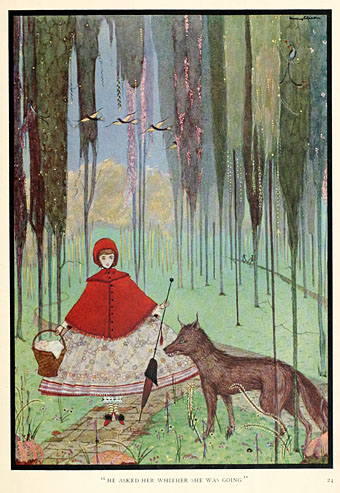
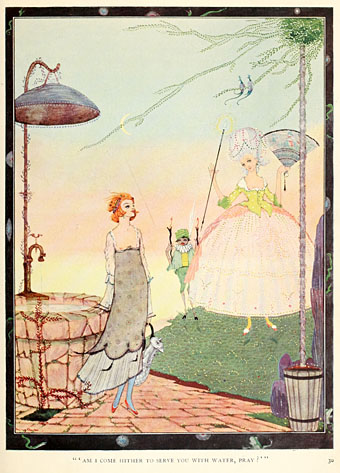
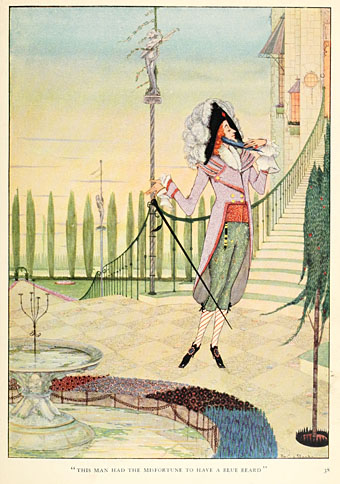
After posting John Austen’s Perrault illustrations I intended to follow-up with other versions but work has been non-stop lately so it’s taken most of this month to do so. Harry Clarke’s edition of Perrault was published in 1922, and while it’s not exactly unfamiliar its one of his illustrated editions that gets overshadowed by the grotesque masterpieces of Faust and Edgar Allan Poe. This is Clarke employing his most delicate Beardsley-like style, the only hint of anything unwholesome being the animated black pudding that fixes itself to a woman’s nose in The Ridiculous Wishes. Bluebeard, by contrast, seems a delightful fellow despite his unfortunate wife-killing propensities.

I’ve only included the colour plates here but the copy at the Internet Archive contains many full-page black-and-white drawings along with vignettes. The plate showing Cinderella and the Prince has been stolen from their edition so I’ve added a scan from my own copy of the book.

clarke02.jpg

clarke03.jpg

Continue reading “Harry Clarke’s Fairy Tales of Charles Perrault”

Weekend links 247

buratti.jpg

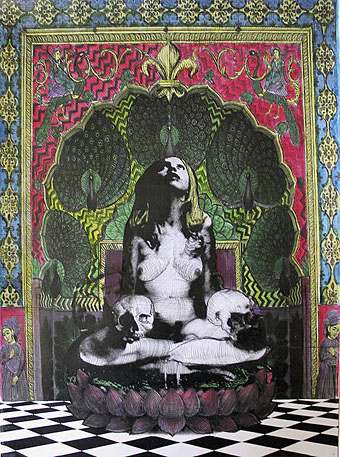
Encounter with the Priestess by Robert Buratti.

• “We were gothy, we loved the New York thing and people like Suicide, Dave loved Throbbing Gristle, we both loved the Sheffield bands…we loved the darkness to that kind of electro.” Marc Almond talking to Simon Price. Also at The Quietus, Cat’s Eyes choose their favourite soundtracks.

• “When he reveals that all he wants is to deliver a breakfast sandwich, the enigma of his desire is not so much dispelled as redoubled—why on earth would anyone want to do that?” Adam Kotsko on the unheimlich nature of old Burger King ads.

• “…commercial design is full of politics, to be a commercial designer is a political decision.” Jonathan Barnbrook talking to Katrina Schollenberger.

You need to know who Billy Wilder was. You need to know the names of people who are no longer alive. Because it’s very important—it’s what our history is made of. You need to see the movies the way they were—with the racism, the violence, and the censorship. All the things that let you see what the movie past had been so you understand where we are! But really nobody’s interested in that right now. Their interests are so bifurcated.

Joe Dante discussing film production past and present with Michael Sragow.

• From 1983: The Encyclopedia of Ecstasy, Vol. 1, a publication which creator Alistair Livingston describes as a “psychedelic goth punk fanzine”.

• Mixes of the week: No One’s There, a collection of post-punk electronica by Abigail Ward, and Secret Thirteen Mix 146 by Te/DIS.

• Frans Masereel’s My Book of Hours is “a crucial example of the power of stories without words,” says Stefany Anne Golberg.

Miles Davis and band in concert, 18th August, 1970. Pro-shot, 45 minutes.

• Lots of good reading and cultural connections at Celluloid Wicker Man.

A world map of micro-nations

Tokyo in dense fog

Tainted Love/Where Did Our Love Go? (1981) by Soft Cell | Tainted Love (1985) by Coil | Titan Arch (1991) by Coil with Marc Almond

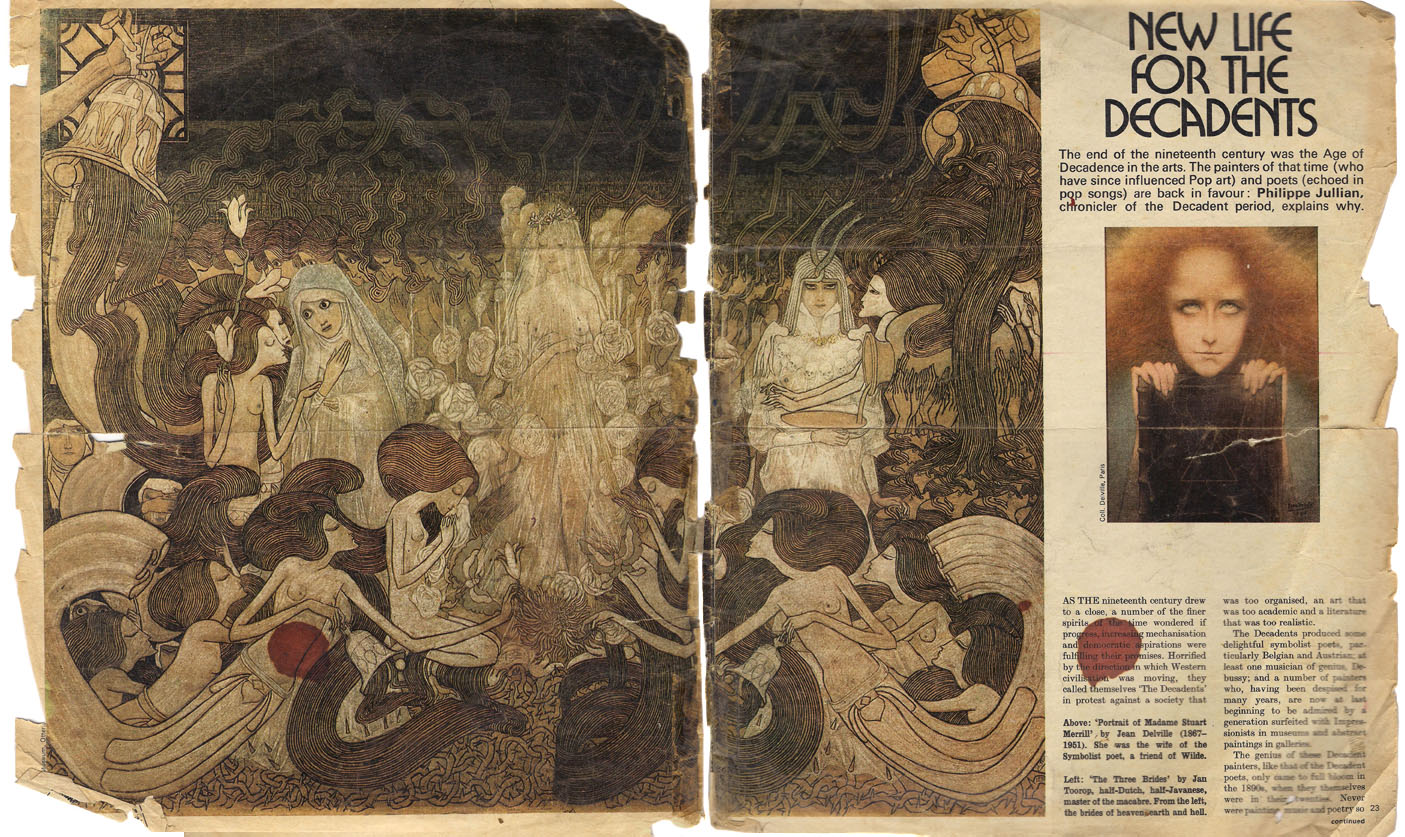
New Life for the Decadents by Philippe Jullian

jullian1.jpg

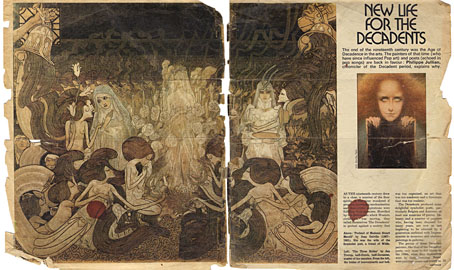
This essay by cult writer Philippe Jullian appeared in an edition of the Observer colour supplement in 1971, shortly after Jullian’s chef d’oeuvre, Dreamers of Decadence, had been published in Britain. Esthètes et Magiciens (1969), as Jullian’s study was titled in France, was instrumental in raising the profile of the many Symbolist artists whose work had been either disparaged or ignored since the First World War. A year after the Observer piece, the Hayward Gallery in London staged a major exhibition of Symbolist art with an emphasis on the paintings of Gustave Moreau; Jullian alludes to the exhibition in his article, and also wrote the foreword to the catalogue. His Observer article is necessarily shorter and less detailed than his introductory essay, emphasising the reader-friendly “Decadence” over the more evasive “Symbolist”. But as a primer to a mysterious and neglected area of art the piece would have served its purpose for a general reader.

Many thanks to Nick for the recommendation, and to Alistair who went to the trouble of providing high-res scans that I could run through the OCR. The translators of the article, Francis King and John Haylock, had previously translated Jullian’s biography of Robert de Montesquiou.

*

New Life for the Decadents

The end of the nineteenth century was the Age of Decadence in the arts. The painters of that time (who have since influenced Pop art) and poets (echoed in pop songs) are back in favour: Philippe Jullian, chronicler of the Decadent period, explains why.

AS THE nineteenth century drew to a close, a number of the finer spirits of the time wondered if progress, increasing mechanisation and democratic aspirations were fulfilling their promises. Horrified by the direction in which Western civilisation was moving, they called themselves “The Decadents” in protest against a society that was too organised, an art that was too academic and a literature that was too realistic.

The Decadents produced some delightful symbolist poets, particularly Belgian and Austrian; at least one musician of genius, Debussy; and a number of painters who, having been despised for many years, are now at last beginning to be admired by a generation surfeited with Impressionists in museums and abstract paintings in galleries.

The genius of these Decadent painters, like that of the Decadent poets, only came to full bloom in the 1890s, when they themselves were in their twenties. Never were painting, music and poetry so close to one another. The gods of the Decadents were primarily Wagner and Baudelaire, then Swinburne and Poe. The Decadent movement, so active all over Europe, turned towards two great sources of inspiration: the Pre-Raphaelites, and a French painter whose glory was for a while eclipsed by the Impressionists but who is now once again accorded his place among the great—Gustave Moreau.

The women whom the Decadents loved and of whom they dreamt resembled the women created 30 years previously by Rossetti, Burne-Jones and Moreau.

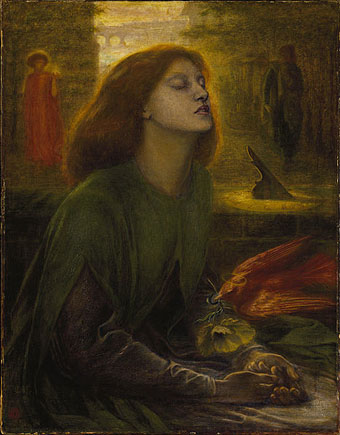
Nothing could be more naturalistic than the artistic style elaborated by the Pre-Raphaelites in the middle of the nineteenth century. Dante Gabriel Rossetti’s model, inspiration, mistress and finally wife was the sweet and sad Elizabeth Siddal, on whom so many fin-de-siècle ladies had to model themselves on the Continent as did all the aesthetic ladies of England in the 1880s. She posed for Rossetti as Beatrix and as the Belle Dame sans Merci.

She was a rare spirit, about whom everything was nebulous and evanescent: the thick, wild hair; the tunic of a simplicity to challenge the elaboration of the crinolines then in vogue; the frail hands burdened with lilies; the gaze turned towards eternity. She also posed, fully dressed and lying in a bath, her hair outspread around her bloodless face, as Ophelia for another Pre-Raphaelite, Millais. Elizabeth died of pulmonary tuberculosis in 1862.

A macabre episode, which might have been imagined by Poe, was the exhumation of a sheaf of Rossetti’s poems that had been buried in Elizabeth Siddal’s coffin. When this symbol of the New Woman died, the grief-stricken poet had insisted on placing the poems inspired by her under her long hair before the coffin was sealed.
jullian4.jpg

Beata Beatrix (1864–1870) by Dante Gabriel Rossetti.

Continue reading “New Life for the Decadents by Philippe Jullian”
Weekend links 246

ngai.jpg

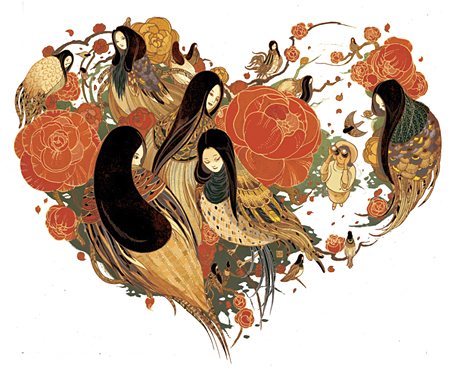
Love Hunter by Victo Ngai.

• “The strangeness of the lyric style, the misuse of words and awkward phraseology that have been criticized even by Poe’s fervent admirers, are here taken as virtues, heightening as they do, a given poem’s conscious and calculated formalism.” Marjorie Perloff reviews The Poet Edgar Allan Poe: Alien Angel by Jerome McGann.

• Mix of the week: Secret Thirteen Mix by Jeremy Kolosine. Starting with Michael Rother is apt when I’ve spent the past week in a Cluster/Harmonia/Kraftwerk/La Düsseldorf/Neu!/Rother loop.

• Court records “suggest that the supposedly prudish Victorians had a far more relaxed attitude to sex between men than their 1960s counterparts”. Historian Jeff Evans has the data.

• “Part of HP Lovecraft’s acknowledged debt to Machen also lies in hearing without seeing.” London Sound Survey on Arthur Machen’s “sounds from beyond the veil”.

• “…pity the designer who has to enact the stage direction that instructs rats to carry away a character’s feet.” Andrew Dickson on the extreme theatre of Sarah Kane.

• Psychedelic collage artist Wilfried Sätty receives a mention in Carey Dunne‘s piece about how LSD helped shape California’s ecstatic design legacy.

• More psychedelia: The Psychedelic Sex Book by Eric Gotland & Paul Krassner, edited by Dian Hanson.

• At Dangerous Minds: Robert Fripp demonstrates Frippertronics on The Midnight Special, 1979.

• Dreams from a Glass House: artist Josiah McElheny on the glass architecture of Paul Scheerbart.

• Director Peter Strickland on six films that fed into The Duke of Burgundy.

Vintage trade card designs

The Zero Of The Signified (1980) by Robert Fripp | Heptaparaparshinokh (1981) by Robert Fripp & The League of Gentlemen | 1984 (1981) by Robert Fripp

A Q&A with artist Mel Odom

odom1.jpg

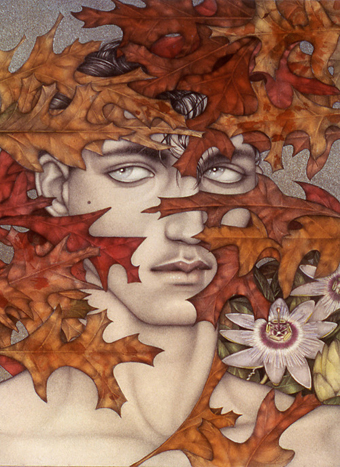
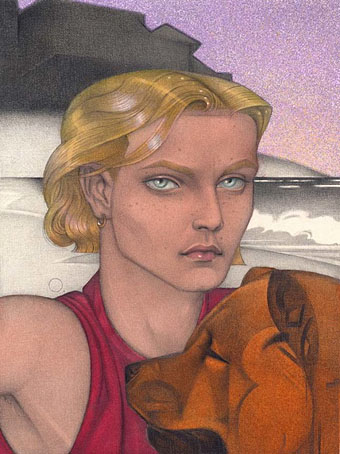
First Eyes (1982).

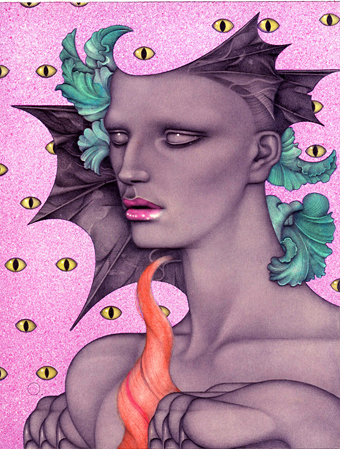
I’ve emphasised the artist label to distinguish this Mel Odom from the very prolific writer of the same name. The artist received a fleeting mention here in the Gay artists archive but for many years he’s been a highly regarded book and magazine illustrator, with a Gold Medal from the American Society of Illustrators among his accolades. (By coincidence, one of his covers was for an Ellen Datlow horror collection, and I happen to be illustrating a new Ellen Datlow collection of horror stories this week.) More recently Odom has gained a very different audience for his doll designs which are mentioned in passing below. I’m grateful again to John Wisniewski for offering me this piece. Thanks to John and to Mel, more of whose gorgeous art can be seen at his website.

*

John Wisniewski: When did you begin drawing and painting?

Mel Odom: I’ve been drawing since I was about 4 years old and painting since my early teens. I have scribbles in an early picture book of mine that I’m sure were my first attempts at drawing.

JW: Whom are some of your favorite artists?

MO: I like so many different artists. The Pre-Raphelites were a huge influence on me as well as artists like Edward Hopper and Georgia O’Keefe. Aubrey Beardsley has been an early and constant favorite of mine. Representational art moves me more than the abstract for the most part. Disney animation also shaped what I still think of as being beautiful.

odom2.jpg

JW: Have you had any exhibitions? If so, what was the reaction to your work?

MO: I’ve really never had a one-man exhibition. When I was illustrating I was too busy to bother and illustration was not considered gallery worthy. Then when I quit illustrating to create Gene [Marshall] there was simply no time to even consider it. I’ve been in tons of group shows where the reaction has been everything from adoring to dismissive. I’ve been working on a series of oil paintings towards a show.

JW: Your work is easily recognizable to those in the art world, Mel. Did you expect this to happen, when you began?

MO: When I started out I knew my drawings didn’t look like anyone else’s, but it wasn’t a conscious ploy for recognition. I devised my style by the process of elimination. I knew what I didn’t want them to look like. I just drew with a vision that made me need to see what the drawing looked like completed. My drawings were always based on a very personal sense of beauty.

odom3.jpg

Hello, I Lied (1997).

Continue reading “A Q&A with artist Mel Odom”