Weekend links 240

wiley.jpg

The Death of Chatterton (2014) by Kehinde Wiley.

• Mixes of the week (and the week before that): The Conjurer’s Hexmas: Second Rite by SeraphicManta; Secret Thirteen Mix 140 by Deaf Center; Best of 2014: A Highly Opinionated Mix by Robin The Fog.

• Never mind Music for Airports, how about Music for Neurosurgery? The Tegos Tapes Edits are extracts from “12 hours of unheard Vangelis music soundtracking films of various surgical operations”.

• “It was one of the first magazines that, with science-fiction and comics together, proposed comics for adults.” Aug Stone on 40 years of publisher Les Humanoïdes Associés and Métal Hurlant.

• Zinesters Do It on the Photocopier: Stephanie Schroeder on the Queer Zine Archive Project. Related: Holy Titclamps by Larry-bob Roberts.

A Year In The Country reached the end of its 365 posts. The archive is well worth a browse.

• “These people love to collect radioactive glass. Are they nuts?” asks Ben Marks.

• Think before you share: 86 viral images from 2014 that were totally fake.

• The Anti-Tolkien: Peter Bebergal on Michael Moorcock.

• Extracts from Alan Bennett‘s diary for 2014.

John Cage 4’33” Autotune

Alpha (1976) by Vangelis | Reve (1979) by Vangelis | L’Enfant (1979) by Vangelis

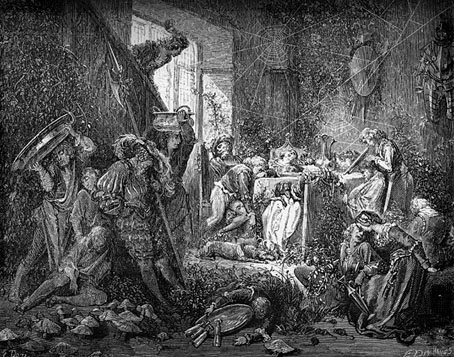
William Heath Robinson’s Rabelais

rabelais00.jpg

Ending the year with some Heath Robinson illustrations I’d not seen before, probably because their grotesque qualities set them apart from the rest of his whimsical drawings and fairy tale illustrations. Illustrated editions of Rabelais are rare owing to the coarse and scatological nature of the novels. Gustave Doré‘s robust and bloodthirsty character made him a good match for the material but it’s a surprise to find a generally light-hearted illustrator like Heath Robinson tackling the same stories.

rabelais01.jpg

Robinson’s illustrations were for a two-volume set published in 1904 (see here and here), and are suitably dark with plenty of solid blacks and heavy cross-hatching. Some of the drawings are so different to the artist’s usual work they could be taken at first glance for pieces by Sidney Sime or Mervyn Peake. More typical are the numerous vignettes that appear at the ends of chapters. The examples here are from Google scans at the Internet Archive but some of the original drawings may be seen in better quality (and purchased if you have the money) at the Chris Beetles gallery.

rabelais02.jpg

rabelais03.jpg

Continue reading “William Heath Robinson’s Rabelais”

The Talking Thrush and Other Tales of India

thrush01.jpg

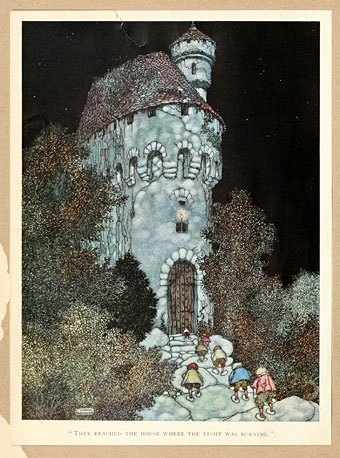
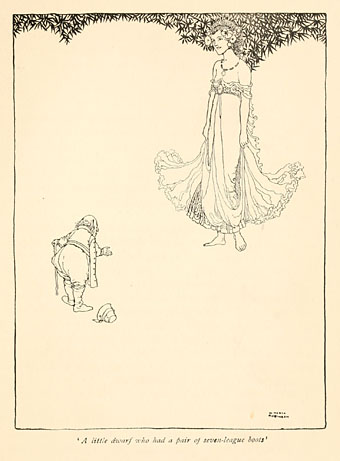
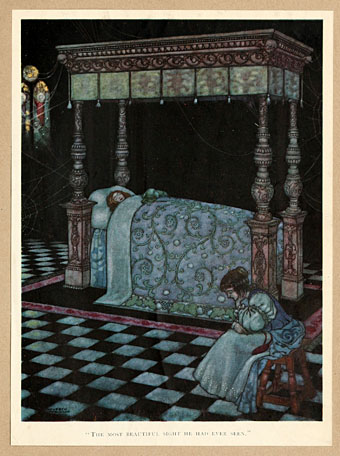
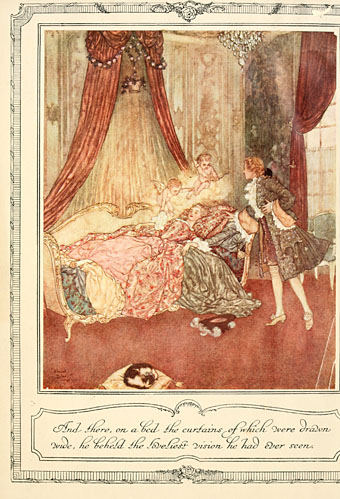
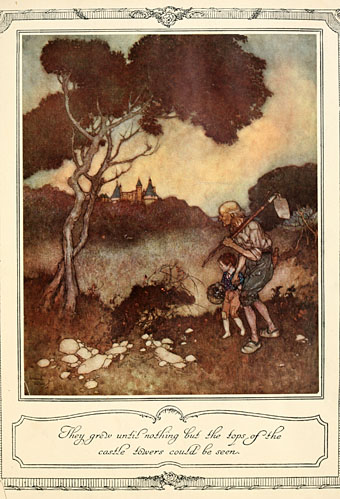
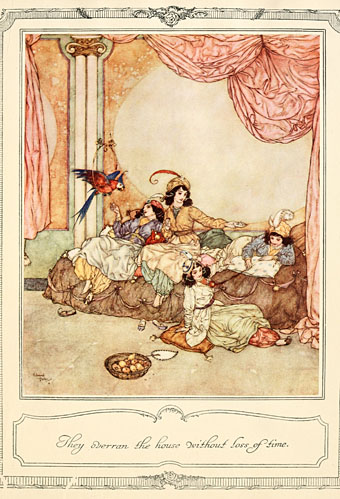
British illustrator William Heath Robinson died in 1944 which means that 2015 will see his own books fall into the public domain in many countries. The books he produced during and after the First World War established his reputation as a creator of impromptu contraptions, to such a degree that the term “Heath Robinson” has the same currency in Britain as “Rube Goldberg” does in the US when describing an improbable mechanical device. Robinson’s whimsical drawings have always been his most popular works but I favour his earlier illustrations, especially his illustrated Poe and A Midsummer Night’s Dream.

thrush02.jpg

The Talking Thrush and Other Tales of India by William Crooke and William Henry Denham was first published in 1899; the version linked here is a reprint from 1922. The fin de siècle is evident in the Art Nouveau styling of some of the borders, the kind of detailing that Heath’s brother, Charles Robinson, often deployed. Heath’s later illustrations dropped the decoration to concentrate on human figures, caricature and the positive use of white space.

thrush03.jpg

Continue reading “The Talking Thrush and Other Tales of India”

The Importance of Being Oscar

macliammoir1.jpg

Picking up where we left off, I was thrilled to find that Micheál MacLiammóir’s one-man dramatised biography of Oscar Wilde had finally made it to YouTube. The Importance of Being Oscar was MacLiammóir’s 100-minute magnum opus, an acclaimed condensation of Wilde’s life and work first performed at the Gate Theatre, Dublin, in 1960. Hilton Edwards produced for partner MacLiammóir who subsequently took his show around the world, including performances on Broadway.

MacLiammóir’s monologue interleaves sketches of Wilde’s life with substantial extracts from the major works—An Ideal Husband, The Picture of Dorian Gray, The Importance of Being Earnest, De Profundis, and The Ballad of Reading Gaol—with the actor/writer often taking two roles in the same scene. The readings are deeply felt; this would have been a very personal project, not only for its subject being a fellow Irishman and playwright but also for MacLiammóir and Edwards’ status as gay men in Ireland at a time when they could never be open about their private lives. (Or openly secretive: Barbara Leaming’s biography of Orson Welles makes it clear that iniquitous laws did nothing to stifle the pair in their pursuit of other men.) Accounts of Wilde’s post-trial life are inevitably sombre but MacLiammóir notes that even prison couldn’t suppress Wilde’s sense of humour. A literary conversation with one of the warders is recounted, along with the famous barb thrown at Marie Corelli: “Now don’t think I’ve anything against her moral character, but from the way she writes she ought to be in here.” If MacLiammóir’s performance seems a little overwrought in the television studio it would have appeared less so on the stage.

macliammoir2.jpg

The BBC filmed The Importance of Being Oscar in the mid-60s, and I think that recording may be the one linked here, a version I recall being shown during an evening of Wilde-related TV in the late 1980s. Prior to this MacLiammóir had played Wilde himself for a televised dramatisation of the courtroom appearances broadcast by the BBC in 1960. This was a key year for reappraisals of Wilde’s reputation which also saw the cinema release of Oscar Wilde (with Robert Morley) and The Trials of Oscar Wilde (with Peter Finch). The latter is the superior film and performance even if Finch looks nothing like Wilde. Public attitudes were changing but all the films and TV plays at this time remained evasive about the precise nature of Wilde’s infractions. The Importance of Being Oscar follows this pattern with a fade to black after Wilde’s arrest; the second act opens with MacLiammóir as the judge passing sentence on Wilde and procurer Alfred Taylor. Circumspection doesn’t detract from the power of the monologue which has been revived in recent years, most notably by Simon Callow, another great Wilde enthusiast and also the biographer of MacLiammóir’s young protégé, Orson Welles.

Now that MacLiammóir’s monologue has resurfaced I’ll be hoping someone uploads John Hawkesworth’s Oscar (1985), a three-part television biography with Michael Gambon playing Wilde.

Elsewhere on { feuilleton }
The Oscar Wilde archive

Weekend links 239

crystal.jpg

The Crystal Gazer (or The Magic Crystal, 1904) by Gertrude Käsebier.

• “I had to resort to extreme violence”: how Hipgnosis revolutionised the album sleeve. Aubrey Powell, last surviving member of the design team, talks to Joe Muggs.

• Mixes of the week: Radio Belbury: Programme 14; The Conjurer’s Hexmas by SeraphicManta; Secret Mix 139 by A Closer Listen.

• Social progress, high-speed transport and electricity everywhere: Iwan Rhys Morus on how the Victorians invented the future.

• At Cinephilia & Beyond: “The most complete investigation into the origins and making of Citizen Kane.”

Poor Souls’ Light: seven curious tales for the end of the year, and a dedication to Robert Aickman.

• Music and the Occult: Stuart Maconie and Rob Young spend an hour in the magick circle.

Alejandro Jodorowsky and Iain Sinclair in conversation at the British Library, July 2014.

• From 1972: An unpublished Victor Moscoso interview by Patrick Rosenkranz.

The Spooky Story Behind Hollywood’s Favourite Mansion.

The Lost World of British Tape Recording Clubs.

• 2014 was a year of outrage.

Wyrd Daze issue 11

Inspirograph

• Pepper-Tree (1984) by Cocteau Twins | Otterley (1984) by Cocteau Twins | Aikea-Guinea (1985) by Cocteau Twins