New things for June

mindscape.jpg

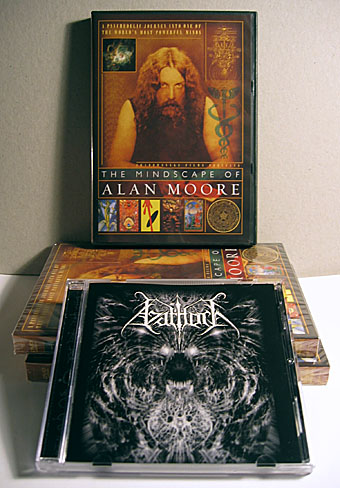
New and not-so-new work-related arrivals include The Mindscape of Alan Moore DVD which finally arrived after the usual postal delays caused by bank holidays and other trivia. Those interested can order this from the Shadowsnake Films site.

And copies of the CD from metal band Azathoth turned up a few weeks ago but I’d neglected to mention this. My sole involvement was letting them use my Azathoth portrait from The Haunter of the Dark for the cover but they’ve done a nice job with the rest of the design. Their insectile name/logo fits very well with the picture.

New things for April

Several disparate pieces of news worth mentioning recently, so here they are gathered together.

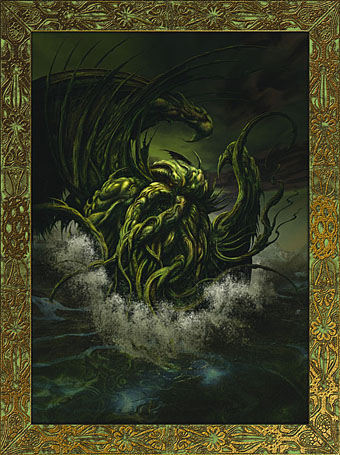
• Some of my Lovecraft art is to be featured in a lavish limited edition volume from Centipede Press.
cthulhu2004.jpg

Artists Inspired by HP Lovecraft
Centipede Press is now accepting pre-orders.
A unique art book available in a cloth slipcase edition and leather deluxe edition.

• Cloth edition in slipcase—2,000 copies—400 pages, four color, sewn with cloth covers, enclosed in a cloth covered slipcase. Front cover image, black embossing, two ribbon markers, fold-outs, detail views.

• The first 300 orders will receive a numbered copy with a special slipcase and a hardcover folder with an extensive suite of unbound illustrations. $395 postpaid.

• Leather edition in traycase—50 copies—400 pages, four color, sewn with full leather binding, enclosed in a giant size traycase. Front cover image debossed on front, two ribbon markers, fold-outs, detail views, signed by most living contributors. $2,000 postpaid.

This huge tome features over forty artists including JK Potter, HR Giger, Raymond Bayless, Ian Miller, Virgil Finlay, Lee Brown Coye, Rowena Morrill, Bob Eggleton, Allen Koszowski, Mike Mignola, Howard V Brown, Michael Whelan, Tim White, John Coulthart, John Holmes, Harry O Morris, Murray Tinkelman, Gabriel, Don Punchatz, Helmut Wenske, John Stewart, and dozens of others.

The field has never seen an art book like this—indeed, it is an art anthology unlike anything ever published before. Many of these works have never before seen publication. Many are printed as special multi-page fold-outs, and several have detail views. The book is filled with four color artwork throughout, all of it printed full page on rich black backgrounds. A special thumbnail gallery allows you to overview the entire contents of this 400-page book at a glance, with notations on artist, work title, publication information, size, and location, when known.

HP Lovecraft fans will simply have to have this book. Because of its sheer size and scope, this book will never be reprinted and will sell out very quickly. Twenty years down the road people will be paying huge prices for this book because of its scope and the quality of reproductions. This is the HP Lovecraft fan’s dream come true. Don’t miss it!

Yes, it is indeed expensive but this is a book for serious collectors.

Bryan Talbot‘s new book, Alice in Sunderland, is finally out. Read a review of it here.

Arthur Magazine is being summoned back from Avalon, which is excellent news. To celebrate, Jay Babcock has posted Alan Moore‘s history of pornography in its entirety here.

heads.jpg

left to right: Donald Cammell, Dennis Hopper, Alejandro Jodorowsky & Kenneth Anger.

One of my favourite photographs of all time shows four directors at the Cannes Film Festival in 1971, all dolled up in their wildest afghan-and-ascot, hairy-hippy finery, and all of them on the cusp of what should have been majestic, transformative, transgressive careers in cinema that by and large never came to fruition. It was not to be—if only it had been.

John Patterson tell you why we need Jodorowsky as much as we ever did.

Update: And while we’re at it, Eddie Campbell also has a new book out, The Black Diamond Detective Agency. Great playbill cover design.
Cubist Cthulhu

cubist_cthulhu.jpg

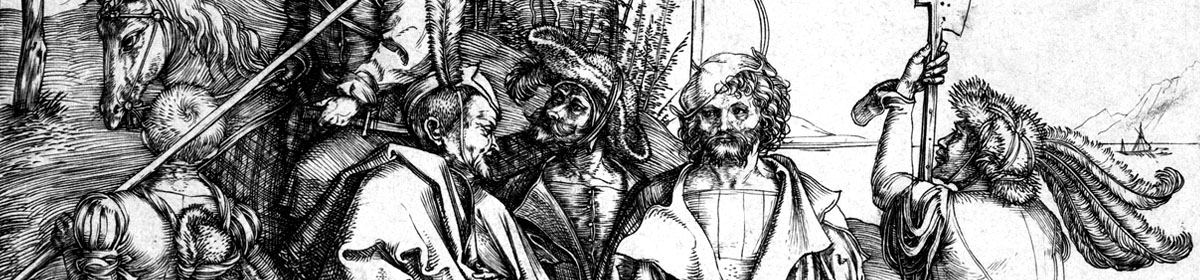
Well maybe it isn’t, but the phrase occurred to me a few days ago so I thought I’d try some sketching and see what emerged. In one interpretation of The Call of Cthulhu it’s conceivable that Lovecraft intended his abomination to look like this, given the description of R’lyeh in the story:

Without knowing what Futurism is like, Johansen achieved something very close to it when he spoke of the city; for instead of describing any definite structure or building, he dwells only on broad impressions of vast angles and stone surfaces—surfaces too great to belong to anything right or proper for this earth, and impious with horrible images and hieroglyphs. I mention his talk about angles because it suggests something Wilcox had told me of his awful dreams. He said that the geometry of the dream-place he saw was abnormal, non-Euclidean, and loathsomely redolent of spheres and dimensions apart from ours. Now an unlettered seaman felt the same thing whilst gazing at the terrible reality.

An alien monstrosity might be even more terrifying if it didn’t resemble anything organic or remotely earthly. For a more traditional impression of the Spawn from the Stars, my drawing from The Great Old Ones can be found here.

Elsewhere on { feuilleton }
The Lovecraft archive

Revenant volumes: Bob Haberfield, New Worlds and others

moorcock_citadel.jpg

The Singing Citadel (1970).

Michael Moorcock’s Elric books are being prepared for republication by Del Rey in the US next year. I’ve assisted with some minor parts of this preparation, including sourcing pictures from Savoy’s edition of Monsieur Zenith the Albino. (Anthony Skene’s albino anti-hero is a precursor of Moorcock’s albino anti-hero.)

Discussion of the Elric books with Dave at Savoy prompted my excavation of this battered Mayflower paperback from the retired book boxes. This slim volume collected four fantasy stories: the title piece (possibly the first Elric story I read), Master of Chaos, The Greater Conqueror and To Rescue Tanelorn…. I’d forgotten about the garishly strange cover, one of many that Bob Haberfield produced for Moorcock’s books during the 1970s. Haberfield is one of a number of cover artists from that period who worked in the field for a few years before moving on or vanishing entirely. The swirling clouds derived from Tibetan Buddhist art identify this as one of his even without the credit on the back; later pictures were heavily indebted to Eastern religious art and while technically more controlled they lack this cover’s berserk intensity. Haberfield’s site has a small gallery of his splendid paintings, including a rare horror work, his wonderfully eerie cover for Dagon by HP Lovecraft.

Searching for more Haberfield covers turned up these two examples, both part of the SciFi Books Flickr pool, a cornucopia of pictures by vanished illustrators. Browsing that lot is like being back inside the In Book Exchange, Blackpool, circa 1977. The digitisation of the past continues apace at the Old-Timey Paperback Book Covers pool and the Pulp Fiction pool. Don’t go to these pages if you’re supposed to be doing something else, it’s easy to find yourself saying “just one more” an hour later.

new_worlds.jpg

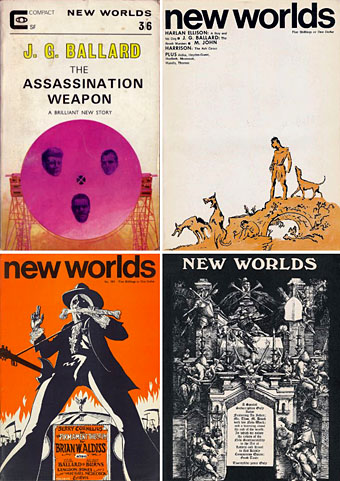
And in other Moorcock-related news, Jay alerts me today to the existence of an archive of New Worlds covers, something I’d been hoping to see for a long time. New Worlds was one of the most important magazines of the 1960s, mutating under Moorcock’s editorship from a regular science fiction title to a hothouse of literary daring and experiment. As with so many things in that decade, the peak period was from about 1966–1970 when the magazine showcased outstanding work from Moorcock himself, JG Ballard, Brian Aldiss, Harlan Ellison, Samuel Delany, M John Harrison, Norman Spinrad and a host of others. For a time it seemed that a despised genre might be turning away from rockets and robots to follow paths laid down by William Burroughs, Salvador Dalí, Jorge Luis Borges and other visionaries. We know now that Star Wars, Larry Niven and the rest swept away those hopes but you can at least go and see covers that pointed to a future (and futures) the world rejected.

Elsewhere on { feuilleton }
The book covers archive
The illustrators archive

Previously on { feuilleton }
Barney Bubbles: artist and designer
100 Years of Magazine Covers
It’s a pulp, pulp, pulp world