More Things to Come

things01.jpg

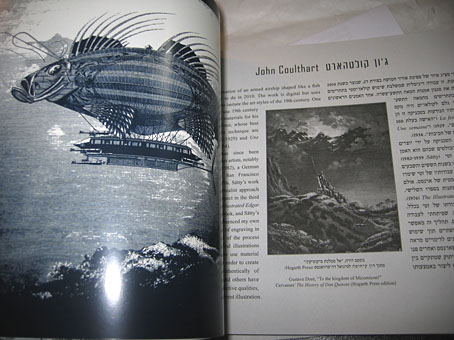
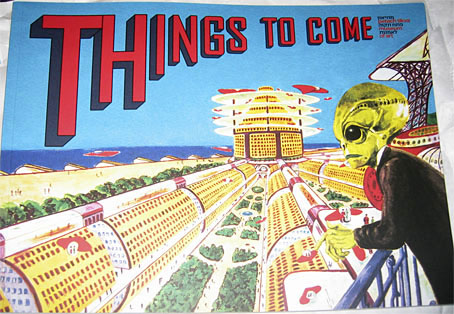
The organisers of the Things to Come exhibition at the Petach Tikva Museum of Art, Israel, sent me their photos of the show earlier this week. As with the other recent exhibitions that I haven’t managed to attend it’s good to see how everything looks in situ, and also see some of the other exhibits.

things02.jpg

The art pieces are all related to science fiction old and new, with my airship illustration (as seen in The Steampunk Bible) and a couple of other works representing the old (or new-as-old) side of things. I’m not used to seeing my work enlarged to such a huge size so this was a treat. The only larger reproductions have been a window display for one of the Cradle of Filth album covers which filled a whole window of Tower Records, London, in 2001, and stage backdrops for Cradle of Filth and Melechesh. I can’t identify any of the other exhibits until the catalogue arrives but I really like the iridescent metal construction that’s lying on the gallery floor. All the photos are by Elad Sarig, and are shown courtesy of the Petach Tikva Museum of Art. My thanks again to Doreet LeVitte Harten for selecting my work, and to Avshalom Suliman for dealing with the printing and other details.

things14.jpg

Continue reading “More Things to Come”

Weekend links 309

witch.jpg

From What is a Witch, “an illuminated manifesto on witchcraft” by Pam Grossman and Tin Can Forest.

• “The other strand of influence for me from dance music was a production house called Savoy in Manchester, England. They were a super underground publishing house that printed cartoons and comic books, and they also released a series of underground dance records. And they were always being shut down by the police and all their stuff was being confiscated, because it was considered ‘anti-society’ in England.” Anohni giving a shout to my colleagues at Savoy Books in a new interview.

Belladonna of Sadness (1973), a feature-length animated film by Eiichi Yamamoto, has been restored, and is being given a premier release in the US. There’s a review here and a trailer here. No news as yet of a UK release but Finders Keepers has the soundtrack album.

Alejandro Jodorowsky talks to Daniel Kalder about his new novel, Albina and the Dog-Men, while Jodorowsky’s comic-book collaborator, Ladrönn, talks to Smoky Man about their new graphic novel, The Sons of El Topo.

Pretty little watercolours these are not. Made by bulldozers and dynamite instead of a paintbrush and easel, the works—often sited on baking sandscapes—fuse minimalism and modern industrial aesthetics to evoke the otherworldly structures of ancient civilisations, from Stonehenge to Mayan temples and the Egyptian pyramids.

Alex Needham on America’s land artists. A few years ago I tracked down some of the structures he describes using Google Maps.

• In every dream home a heartache: High Rise director Ben Wheatley on adapting Ballard, practical special effects and ’70s parenting.

Tom Phillips: From Prequel To Sequel, an exhibition of pages from A Humument at Shandy Hall Gallery.

• From fresh food to magic mushrooms: Michael Pollan probes the medicinal uses of psychedelic drugs.

• “Let’s not forget graphic design is an artistic discipline,” says Jonathan Barnbrook.

Supervert discusses censorship and related matters at SomethingDark.

• “I’ve sung gospel music when in great despair,” says Diamanda Galás.

• Mix of the week: FACT Mix 550 by James K.

Boy Club is a new gay magazine.

Gospel Trane (1968) by Alice Coltrane | The Gospel Comes To New Guinea (1981) by 23 Skidoo | Gospel Train (1990) by African Head Charge

Weekend links 307

chew.jpg

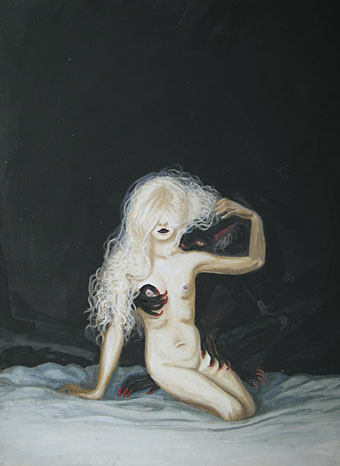
Demon (2014) from the Witch Series by Camille Chew.

• Released next month, Machines Of Desire is the first album of new music by Peter Baumann since Strangers In The Night in 1983. Baumann’s first two solo albums, Romance 76 (1976) and Trans Harmonic Nights (1979), are exceptional works of analogue electronica that frequently outmatch his former colleagues in Tangerine Dream. Both albums have been unavailable for over 20 years so it’s good to know that Cherry Red are reissuing them at the end of May (see here and here).

• RIP Jenny Diski whose death from cancer wasn’t a surprise when she’d been writing about her condition for many months. Linked here in 2013 was this pre-diagnosis meditation on death that takes in Nabokov, Beckett and Francis Bacon (philosopher, not artist). “Jenny offered a living example of how, sometimes, compassion can be born of misanthropy,” says Justin EH Smith. The LRB’s archive of Diski writings is currently free to all.

Murder by Remote Control, a graphic novel by artist Paul Kirchner and writer Janwillem van de Wetering that “resembles a Raymond Chandler-esque noir ‘whodunnit,’ viewed through the psychotropic lens of filmmaker Alejandro Jodorowsky”.

Inspired by Gore Vidal’s 1968 satirical novel, Myra Breckinridge which was denounced as obscene by conservatives, [Boyd] McDonald embarked on a radically, offensive publication, one that avoided the sexless influence of middle class gay mores that sought to whitewash the homosexual experience in order to present a more palatable image of assimilated gays to the general society. This political strategy was successful in achieving gay marriage and more tolerance, but, in the opinion of McDonald, came at a cost. Straight to Hell was in fact the first queer zine. Utilizing erotic photos, interviews and news, McDonald saw it as a “newsletter for us,” the small group of deviates who were its earliest subscribers.

Walter Holland reviewing True Homosexual Experiences: Boyd McDonald and Straight to Hell by William E. Jones

• “HP Lovecraft’s…fascination with all things tentacular and aquatic is unmistakably imprinted on Evolution“, a new film by Lucile Hadžihalilović. Watch the trailer.

• At Dangerous Minds: Broken, the notorious Nine Inch Nails video collection with “snuff movie” interludes by Peter Christopherson, is available online (again).

BEAK> (Geoff Barrow & Billy Fuller) make “claustrophobic, hypnotic music, drawing…on krautrock, post-punk and Interstellar-Overdrive psychedelia”.

• Mixes of the week: Bacchus Beltane 3 : The Age of Abrasax by The Ephemeral Man, and Secret Thirteen Mix 183 by December.

Tease by Jan Rattia, photographs of male strippers on display at ClampArt, NYC.

Wu Zei (2010), a sea-monster sculpture by Huang Yong Ping.

• “I was born weird,” says Robert Crumb.

Sacred Revelation by Susanna

Broken Head (1978) by Eno, Moebius & Roedelius | Broken Horse (1984) by Rain Parade | Broken Harbours (Part 1) (2001) by Stars Of The Lid

In Germany before the war

1: Fritz Haarmann (1879–1925)

hanover.jpg

Arrow shows Haarmann’s attic residence in Rote Reihe, Hanover.

Haarmann was one of several serial murderers haunting Weimar Germany, variously nicknamed “the Butcher of Hanover”, “the Vampire of Hanover”, “the Wolf Man”, etc. for his sexual assault, murder and dismemberment of at least 24 boys and young men between 1918 and 1924. Haarmann also sold meat on the black market which led to rumours that some of the mince and other produce he sold was human flesh.

2: M (1931), a film by Fritz Lang.

m-poster.jpg

Thea von Harbou’s script for M is based in part on the Haarmann case although Lang’s child-killer is shown preying on girls rather than boys. Peter Lorre is superb in his first major role as the murderer, while Lang’s use of the new sound technology is remarkably inventive when compared to his stagey contemporaries in Hollywood.

3: M (1953), a film by Joseph Losey.

m-1951.jpg

Lang’s masterwork reworked as a Los Angeles film noir by Joseph Losey before McCarthyism sent him to Europe. This is one noir I still haven’t seen even though a major sequence takes place in that cult location, the Bradbury Building.

Continue reading “In Germany before the war”

Weekend links 297

floridxfauna.jpg

Crimson Metallic Emergent Skull Crystal Pendant by Kristen Phillips aka Floridxfauna.

The Noise-Arch Backup at the Internet Archive is 30GB of mp3s from noise-arch.net, a collection of cassette-based releases and artwork: “material represented includes tape experimentation, industrial, avant-garde, indy, rock, diy, subvertainment and auto-hypnotic materials…” 30GB is an intimidatingly large amount of material so it’s better to browse The Noise-Arch Archive, a selection of 468 releases.

• The week in erotica: Claire Voon on Ancient Erotic Dreams and Explicit Scenes in the New York Public Library Collection; Melanie Porter on Great Grandporn: Hardcore Pornography of the Silent Era; Cathy Camper on The Comics of Dale Lazarov: Illustrated Explorations of Sexual Inventiveness.

Void Beats/Invocation Trex by Cavern of Anti-Matter (Holger Zapf, Joe Dilworth & Tim Gane) was released this week. The opening number is Tardis Cymbals. Tom Furse condensed the 73-minute album into a 17-minute mini-mix.

Indeed, if you had to “place” ­Williams—put him alongside writers with whom he had something in common—it would be with the mystical autodidacts, the backstreet Rosicrucians more than with the pipe-smoking, tweedy Inklings. To that extent, the only unsatisfactory thing about Grevel Lindop’s book is its title. True, Williams went to Oxford when war broke out and became friends with the famous circle around C. S. Lewis. But he was not an Inkling in spirit. He was not at home in Oxford, and his arrival, far from consolidating the Inklings, actually broke them up by bewitching Lewis, and making Lewis neglect the central friendship of his life, that with ­Tolkien. Another scholar of Old English literature, C. L. Wrenn, said that meeting Williams made you realize why inquisitors thought they had the right to burn people. Tolkien agreed: “Williams is eminently combustible.”

Certainly, Williams’s books had an influence on the Inklings. Lindop is right to say that the central plotline of Many Dimensions suggests the story of The Lord of the Rings. In the Williams novel, it is a stone of great power, rather than a ring, but it has the same effect on those who bear it: They become its possession, not its possessor.

AN Wilson reviews Charles Williams: The Third Inkling by Grevel Lindop

• Russ Fischer recommends five films by Andrzej Żuławski (RIP). Possession (1981) is still the easiest to find, and a good place to start. I enthused about On The Silver Globe (1977–87) last year.

England’s Hidden Reverse: A Secret History of the Esoteric Underground by David Keenan has been published in a revised and expanded edition by Strange Attractor.

The Preservation Man (1962): Artist and collector Bruce Lacey (RIP) filmed by Ken Russell for the BBC’s Monitor.

Barry Adamson: “I’ve been called the outsider’s outsider”.

• At Dangerous Minds: Six degrees of Marty Feldman.

• Mix of the week: FACT mix 536 by Not Waving.

• The Alan Clarke page at the BFI shop.

Umberto Eco (RIP): Porta Ludovica

Possessions (1980) by The Residents | Possessed (1992) by The Balanescu Quartet | Possessed (2001) by Sussan Deyhim & Shirin Neshat