Weekend links 606

smith.jpg

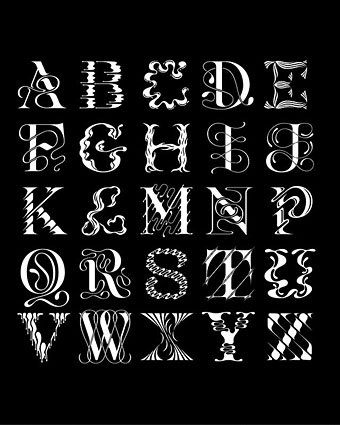
An alphabet by Tina Smith.

• Coming in March from Warp records: reissues of three Broadcast releases that were previously only available in limited quantities, Microtronics, Volumes 1 & 2, and Mother Is The Milky Way. The latter is an EP which makes a perfect companion to Witch Cults Of The Radio Age, and while its reissue means I’ll no longer be able to brag about owning one of the rare originals it really ought to have been more widely available. In addition, Warp will be releasing the group’s first live album, BBC Maida Vale Sessions, a collection of performances for radio. All these releases are packaged in new cover designs by Julian House.

• “Nature Boy was the conduit through which vegetarian ideals, nonconformism and notions of living in harmony with nature began to filter into US culture.” Jon Savage on the exotic world of Eden Ahbez.

• At Dennis Cooper’s: Two booklets of Austin Osman Spare: Earth: Inferno (1905), The Book of Pleasure (Self-Love) (1913).

Joyce refused to fix the meaning of the words on the page and left the reader to fend for themselves. So the content may not be actually shocking, but the book feels exciting—as though it might turn shocking any second. Anything might stir in the body or consciousness of a character, in the body or consciousness of the reader. My mother was right to consider it a dangerous text. The thing the censors worried about were the uncensored workings of their own minds.

More than any other book, Ulysses is about what happens in the reader’s head. The style obliges us to choose a meaning, it is designed to make us feel uncertain. This makes it a profoundly democratic work. Ulysses is a living, shifting, deeply humane text that is also very funny. It makes the world bigger.

Anne Enright on Ulysses at 100

• At Aquarium Drunkard: occult scholar Mitch Horowitz on the Transmissions podcast.

• 5th Dimension: DJ Food examines a piece of psychedelic Op-art by Michael English.

• New music: Möbius by Jonathan Fitoussi/Clemens Hourrière.

• At Spoon & Tamago: Hiraku Suzuki’s Constellations.

• The month in type at I Love Typography.

Wyrd Daze Six Star.

Nature Boy (1975) by Big Star | Nature Boy (1980) by Manu Dibango | Nature Boy (1999) by Jon Hassell
The art of Pinckney Marcius-Simons, 1867–1909

marcius-simons13.jpg

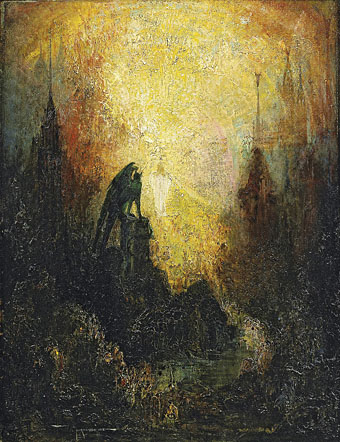
Vision of the Demon.

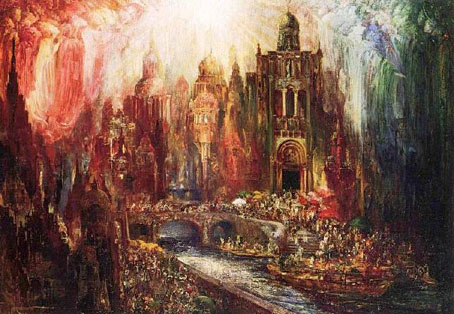
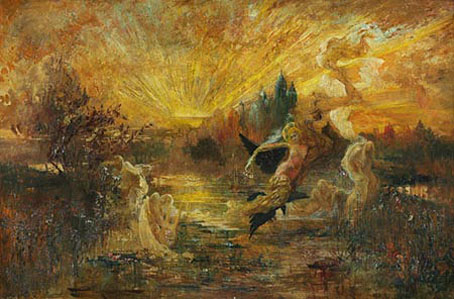
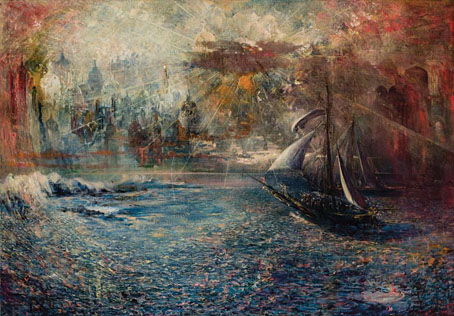
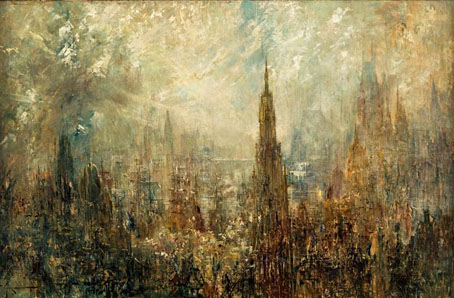
The Symbolist movement in painting never really took hold in America the way it did in Europe so it’s a surprise to find a new name to add to the very small list of American Symbolists. Pinckney Marcius-Simons painted his share of 19th-century genre pictures but these give way in his later career to canvases that show a distinct Gustave Moreau influence, or perhaps Turner in those nebulous volumes of illuminated vapour. Marcius-Simons was born in New York but lived in Europe for most of his life; he studied in Paris so he would have been able to see Moreau’s work first-hand. A few of his later pictures are rather vague fantasies but his real obsession was with Wagner’s operas, and he spent the last few years of his life working as a set designer at Bayreuth while also creating a series of paintings intended to illustrate the entire run of Wagner’s Ring Cycle. His most remarkable creation isn’t a canvas, however, but a French edition of A Midsummer Night’s Dream which he painted over entirely, even decorating the binding. I’m surprised again that such a unique work isn’t more widely known. Happily the entire book is available online at the Folger Shakespeare Library.

All the usual caveats apply here with regard to the accuracy of titles and dates. There’s even some dispute about the artist’s birth year which is occasionally given as 1865. Most of these pictures have been found on auction sites where larger reproductions may be seen.

marcius-simons03.jpg

Port City.

marcius-simons04.jpg

marcius-simons05.jpg

Sunrise.

marcius-simons12.jpg

The City of Dreams.

Continue reading “The art of Pinckney Marcius-Simons, 1867–1909”

02022

parrish.jpg

Daybreak (1922) by Maxfield Parrish.

Happy new year. 02022? Read this.

dechirico.jpg

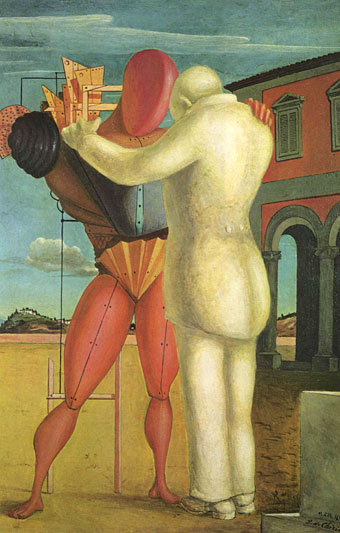
The Prodigal Son (1922) by Giorgio de Chirico.

delaunay.jpg

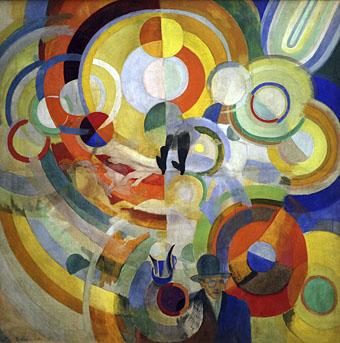
Carousel of Pigs (1922) by Robert Delaunay.

klee.jpg

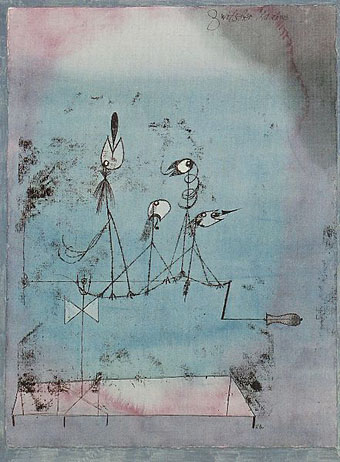
Twittering Machine (1922) by Paul Klee.

moholy-nagy.jpg

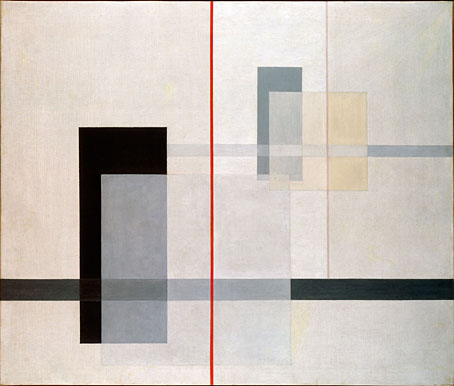
K VII (1922) by László Moholy-Nagy.

Continue reading “02022”

Weekend links 596

hoshiyama.jpg

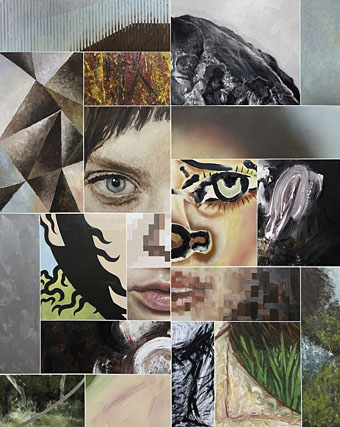
Jam III (2021) by Kotaro Hoshiyama.

• “Powell and Pressburger are peerless in realizing what Orson Welles would term plotless scenes—extra bits that ostensibly do not advance the story, but are a story unto themselves, and aggregate such that they’re vital to how we understand the characters who are living the story.” Colin Fleming says thanks for the Archers.

• A short promo for The Incal: The Movie. Hmm, okay. A film that adapted all 300 pages of the original story without changing anything or trying to explain away the weirdness would be worth seeing. But I doubt that’s what this will be. Read the book.

• “If a single word distills the New Wave aesthetic, it’s plastic…ironically flaunted artificiality became a leitmotif of the era.” Simon Reynolds reviews Reversing Into the Future: New Wave Graphics 1977–1990 by Andrew Krivine.

• Mixes of the week: a mix by Princess Diana Of Wales (not that one) for The Wire, and At The Outer Marker Part I, a Grateful Dead Twilight Zone mix by David Colohan.

The Bloomingdale Story: read the never-before published Patricia Highsmith draft that would become Carol (aka The Price of Salt).

• At Spoon & Tamago: Multiple panels form collaged portraits painted by Kotaro Hoshiyama.

• New music: Pyroclasts F (excerpt) by Sunn O))), and Loop return with Halo.

• At Dennis Cooper’s: William E. Jones Day.

Plastic Bamboo (1978) by Ryuichi Sakamoto | Barock-Plastik (2000) by Stereolab | Black Plastic (2002) by Ladytron

The Purloined Eidolon

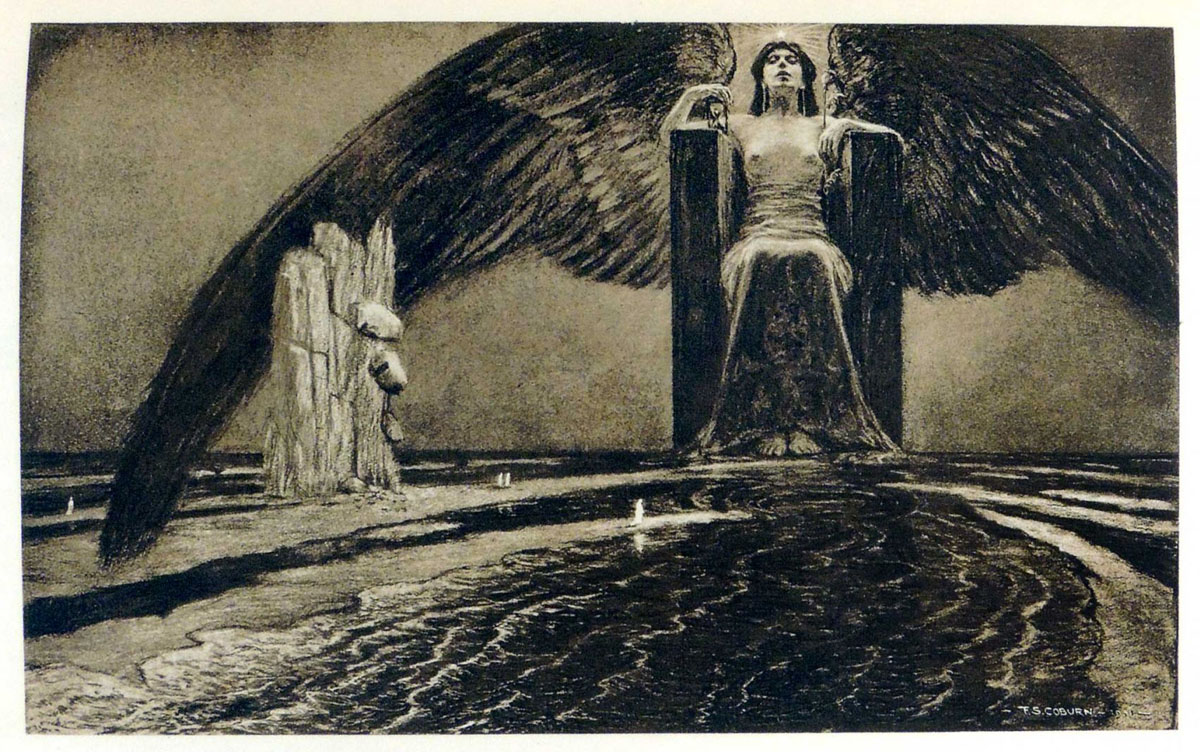
coburn.jpg

Dreamland by Frederick Simpson Coburn.

By a route obscure and lonely,
Haunted by ill angels only,
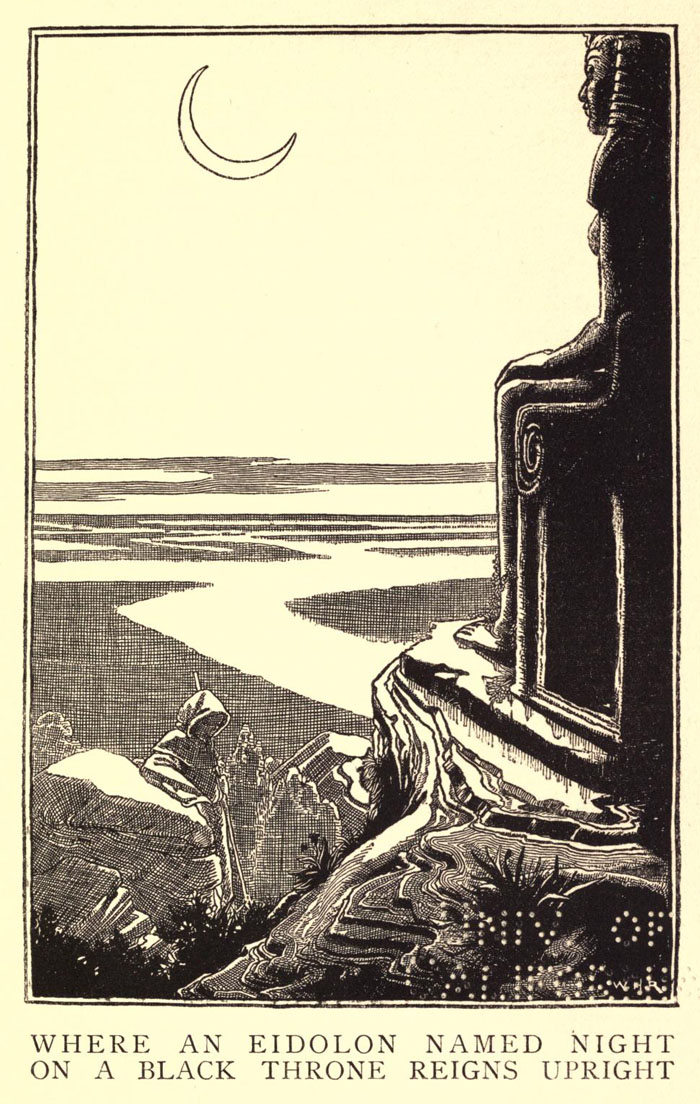
Where an Eidolon, named NIGHT,
On a black throne reigns upright,
I have reached these lands but newly
From an ultimate dim Thule—
From a wild weird clime that lieth, sublime,
Out of SPACE—Out of TIME.

Dreamland by Edgar Allan Poe

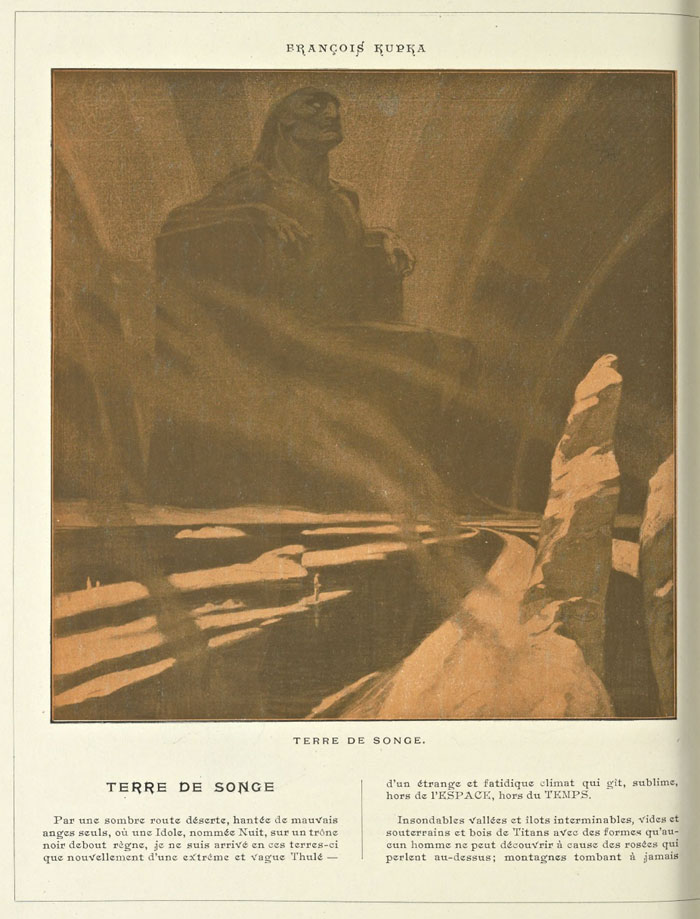
There’s always more Poe. Frederick Simpson Coburn was a Canadian artist who illustrated a 10-volume set of Edgar Allan Poe’s complete works in 1902, the collection being edited by Charles F. Richardson, and published in special editions with Poe-esque names such as “Arnheim” and “Eldorado”. Coburn was more of a painter than an illustrator so his full-page pieces tend to be stolidly professional in a manner that doesn’t really suit Poe’s fervid imagination. One exception is his illustration for Dreamland (aka Dream-Land) which would be more impressive if it hadn’t been so heavily “inspired” by a similar picture, The Black Idol or Resistance by František Kupka. Kupka’s picture dates from 1903 so it might seem at first that any suggestion of creative purloining should be dismissed (or even reversed) unless you know that The Black Idol was a slightly reworked version of a similar piece which appeared in a French magazine, Cocorico, in December 1900.

kupka.jpg

The suspicion of appropriation is reinforced if you also know that Kupka’s earlier work was one of two Poe-derived pieces published in the same magazine, and was itself an illustration for Dreamland, with the first few lines of the poem in the Mallarmé translation being printed underneath the drawing. Coburn grew up in Quebec and moved to Paris in 1896 to study art; he was still there in 1900. Circumstantial evidence this may be but we don’t need the services of Auguste Dupin to suppose that Coburn might have remembered an illustration from a French magazine when the Poe commission arrived a year or so later.

robinson.jpg

I’m not here to cast aspersions, the pressure of deadlines compelled me to swipe a chunk of Gustave Doré when I illustrated Poe myself a few years ago. I enjoy finding minor artistic connections like these, and the links between Coburn and Kupka are obscure enough that they probably haven’t been remarked on very much or even noticed until now. While we’re on the subject of dark eidolons, Dreamland was illustrated by William Heath Robinson in his own Poe edition in 1900. Robinson isn’t as sublimely grandiose as Kupka and Coburn but he also portrays Night as a literal figure. See the rest of his book here.

Previously on { feuilleton }
Martin van Maële’s illustrated Poe
Narraciones extraordinarias by Edgar Allan Poe
Fritz Eichenberg’s illustrated Poe
The Pendulum, the Pit and Hope
Hugo Steiner-Prag’s illustrated Poe
Burt Shonberg’s Poe paintings
Illustrating Poe #5: Among the others
Illustrating Poe #4: Wilfried Sätty
Illustrating Poe #3: Harry Clarke
Illustrating Poe #2: William Heath Robinson
Illustrating Poe #1: Aubrey Beardsley
Poe at 200
The Tell-Tale Heart from UPA
William Heath Robinson’s illustrated Poe