Magritte: The False Mirror

magritte2.jpg

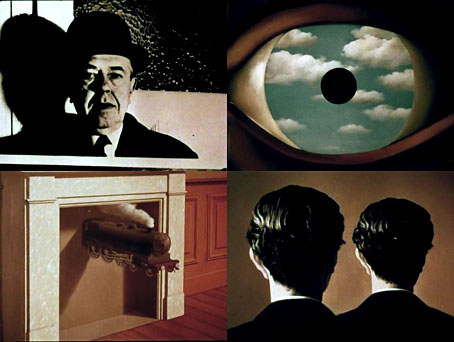
Another short film about René Magritte’s paintings, The False Mirror was made three years after the artist’s death in 1970, a time when his work had started to receive widespread international attention. Prior to the 1960s Magritte wasn’t exactly unknown but it wasn’t until the arrival of Pop Art that his paintings began to be reappraised. The production credits for The False Mirror are surprising for such a short piece, the film being directed by art critic David Sylvester (whose book of interviews with Francis Bacon is essential), and photographed by Bruce Beresford, later to become a well-regarded film director. Among the voices reading from the artist’s statements is ELT Mesens, another Belgian artist and friend of Magritte’s whose presence in the later incarnation of the British Surrealist Group gave that small society some authentic gravitas. (George Melly talks about Mesens and the British Surrealists in this film.) The commentary runs over familiar ground: descriptions of the artist’s childhood encounter with a painter in a cemetery (also referred to in Magritte, ou la lecon de chose), and the details of his mother’s suicide (dramatised in David Wheatley’s film). I’d been wondering recently what Magritte might have made of the increasingly excessive prices being paid for his artworks. One of the comments here provides a possible answer when he says he’d be happy if people destroyed his paintings.

Previously on { feuilleton }
Magritte, ou la lecon de chose
René Magritte album covers
Monsieur René Magritte, a film by Adrian Maben
George Melly’s Memoirs of a Self-Confessed Surrealist
The Secret Life of Edward James
René Magritte by David Wheatley

Magritte, ou la lecon de chose

magritte.jpg

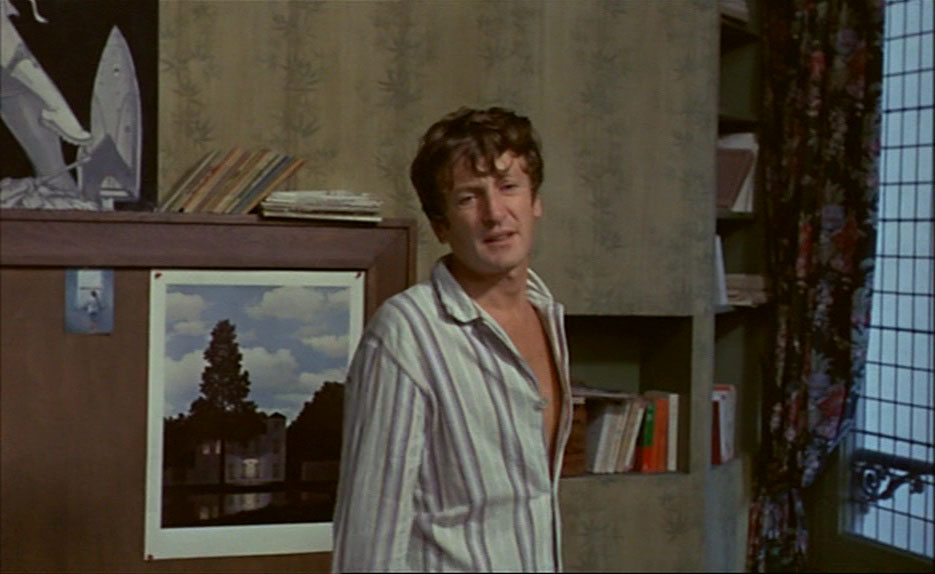
Good to find this one at last with English subtitles. Magritte, ou la lecon de chose is a short study of René Magritte’s paintings made in 1960 by Luc De Hersch. The title translates as “Magritte, or The Object Lesson”, and the film is of note for a few brief scenes in which the artist becomes a performer in order to communicate something of his aesthetic philosophy. We’re also shown a scene of Magritte and friends choosing a title for one of his paintings, while a voiceover provides further explication of the Magrittian view of reality. Given the access the director had to the artist, the film is frustratingly short but it serves as a reminder that there was a time when Magritte’s paintings seemed much more mysterious than they do today.

Previously on { feuilleton }
René Magritte album covers
Monsieur René Magritte, a film by Adrian Maben
George Melly’s Memoirs of a Self-Confessed Surrealist
The Secret Life of Edward James
René Magritte by David Wheatley

Weekend links 634

chaffee.jpg

Cover for Amazing Stories, October 1992, by Douglas Chaffee. A delightfully strange painting that suggests a no doubt unintentional homoerotic scenario when divorced from its original context. Via.

• “The most curious aspect of Buckminster Fuller’s arc is that he became a counterculture icon while entrenched in the very things that betrayed its spirit.” Pradeep Niroula on Buckminster Fuller (again) whose self-importance is deflated in a new biography, Inventor of the Future: The Visionary Life of Buckminster Fuller by Alec Nevala-Lee.

• “I love both King Diamond and Weird Al. Lana del Rey and Anna von Hausswolff. Golden age illustrations of elegantly levitating fairies in a lush vibrant summer garden and the gothic charcoal rendering of melancholy moth singed by a candle’s flame.” S. Elizabeth talking to Luna Luna Magazine about inspirations and The Art of Darkness.

• “I’m writing this from my office which has a record player, currently about eight thousand records, and just one CD.” Vinyl-head Jonny Trunk talking to Norman Records about the finding and releasing of rare music.

A painter’s brilliant achievements, the unique traits of his particular style, rest on an abiding substratum of coordinated specialized crafts, a body of knowledge and practice safeguarded by a tradition upheld by the guilds. Beneath the glimmer and foreground of art history, like a powerful underground river, flow the patterns of training and production developed in the crafts. Art history is centred on individual talents romantically bringing forth their creations on their own, out of nothing. Craft is collective and anonymous. Someone had to weave the pieces of cloth that form the giant canvas of Las Meninas. Someone had to sew them together so that the stitching would show as little as possible. Someone had to cut and to assemble the struts for its support and then nail to them a canvas which in fact is not of the highest quality. It seems that Velázquez enjoyed the roughness of a surface that favoured his subtle veils and ambiguities. The loose manner of painting developed in Venice is linked to the quality of the pigments that could be purchased there, as well as to the oil medium and the thick, porous quality of a cloth that allowed subtle veils and ambiguities that are impossible to achieve on the surface of a wood panel.

Antonio Muñoz Molina on the materiality of painting, and its highest expression in the art of Diego Velázquez

• The films of Japanese director Kinuyo Tanaka are criminally overlooked, says James Balmont.

Winners of the Nature TTL Photographer of the Year 2022.

• From 2012: The Disappeared by Salman Rushdie.

• At Dennis Cooper’s: Standish Lawder Day.

• New music: Octopus by Sunfear.

Come Sta, La Luna (1974) by Can | Fontana Di Luna (1978) by Michael Rother | La Luna En Tu Mirada (2003) by Ry Cooder & Manuel Galbán

Weekend links 632

klee.jpg

Der Goldfisch (1925) by Paul Klee.

• At Wormwoodiana: Mark Valentine compiles a list of finest quality old English yarns. I’m currently working my way through The Count of Monte Cristo, a novel which is a yarn-and-a-half, so I appreciate this one.

• Mixes of the week: Salve Mix for Art of Beatz by The Ephemeral Man, and Mwandishi: Wandering Spirit Songs from Aquarium Drunkard.

• Coming in October from Strange Attractor: Death Lines: Walking London’s Horror History by Lauren Jane Barnett.

• At Dangerous Minds: A teaser for Lost Futures: A Film About Mark Fisher with music by Mark Stewart.

• New music: Niemandsland by Pyrolator, and Full Circle by The Advisory Circle.

• At Spoon & Tamago: Obsessive painter of goldfish, Riusuke Fukahori.

• Old music: Silberland: Kosmische Musik Vol 1 (1972-1986).

• At Dennis Cooper’s: Gig #103: Judy Nylon.

• RIP David Warner.

Future Days (1973) by Can | Future Ghosts (1982) by Chrome | Failed Future (2011) by Master Musicians Of Bukkake

Goodfellow and Borges

goodfellow1.jpg

Last week’s story search had me looking through this handful of Penguin volumes again, all of which have cover illustrations by Peter Goodfellow. These were the first Borges books I bought, beginning with the Labyrinths collection in 1985. The Book of Sand is two volumes in one—The Book of Sand and a late poetry collection, The Gold of the Tigers—with cover art suitable for both. I used to think that the covers of the other books were pastiching or quoting well-known artists but now I’m not so sure. Two of them definitely are quotes or pastiches: The Book of Imaginary Beings is a play on the weird growths you find in Hieronymus Bosch, while Doctor Brodie‘s contemplative skeleton is from the famous anatomical engravings in De Humani Corporis Fabrica by Andreas Vesalius, with some Chinese or Japanese landscape details added to the background.

goodfellow2.jpg

Two positive artistic references suggested that the other covers might follow suit, so I used to take the Labyrinths cover as a vague reference to the anomalies that Salvador Dalí would situate in his desert vistas, while A Universal History of Infamy was de Chirico, perhaps, although this no longer seems certain at all. Those columns look like Bernini’s double colonnade from Saint Peter’s Square in Rome, not a Turin arcade, and the picture lacks the disjunctive perspectives you find in de Chirico’s “Metaphysical” paintings. The pastiche thesis is further diluted when you discover that Goodfellow had been quoting from Bosch as far back as his cover for Ursula Le Guin’s Rocannon’s World in 1972, while he borrowed another skeleton from Vesalius for Structures by JE Gordon. Sometimes you can reach too far for meaningful connections.

goodfellow3.jpg

The Bosch-like cover does seem to have had an enduring influence, however. When Penguin published the Collected Fictions in the UK in 1999 they used a detail from Bosch’s Garden of Earthly Delights for the artwork. Bosch details turned up on a later edition of A Universal History of Infamy, and have subsequently appeared on a series of Turkish Borges editions. Not a bad choice for a writer whose fictions offer universes of possibility.

goodfellow4.jpg

goodfellow5.jpg

Elsewhere on { feuilleton }
The book covers archive
The illustrators archive

Previously on { feuilleton }
The Rejected Sorcerer
The Immortal by Jorge Luis Borges
Borges on Ulysses
Borges in the firing line
La Bibliothèque de Babel
Borges and the cats
Invasion, a film by Hugo Santiago
Spiderweb, a film by Paul Miller
The Library of Babel by Érik Desmazières
Books Borges never wrote
Borges and I
Borges documentary
Borges in Performance