Weekend links 643

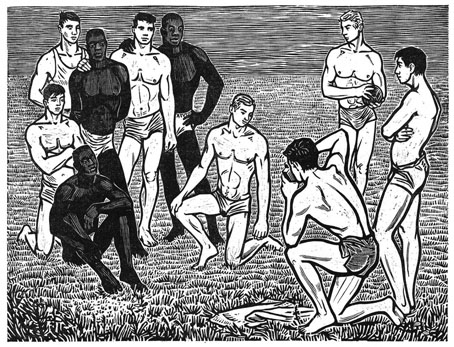
wittdorf.jpg

Freundschaftsfoto (1964) by Jürgen Wittdorf.

• “It’s truly astonishing how Laswell collided with vastly divergent musicians and genres while somehow still representing complementary musical spheres.” Yes, indeed. Mixes of the week: Bill Laswell Research Institute: Vol I & II, two 90-minute collections at Aquarium Drunkard dedicated to the career of the indefatigable musician/producer/catalyst.

• “These pieces are created using custom developed software and laser specialised machines resulting in highly detailed laser cut works on layered paper with some works comprising over a thousand individual parts.” Works in paper at Studio Ibbini.

• “The visual history of polyhedra is littered with false starts, poignant failures, and allegories unable to convey the weight of their subject matter.” Noam Andrews explores the history of rendering polyhedral objects in art.

• “When it came to homosexuality, the east was as bourgeois as the west.” Homoerotic art from the communist era by Jürgen Wittdorf (1932–2018) receives a reappraisal.

• More MR James: All of James’ ghost stories in a single volume at Standard Ebooks, the home of free, high-quality, public-domain texts.

• More mixes: A mix for The Wire by NikNak, and XLR8R Podcast 769 by The Sun Ra Arkestra.

• At Spoon & Tamago: Tracing the history of railways in Japan through art.

• At Dennis Cooper’s: Marie Menken Day.

Angeline Morrison‘s favourite albums.

Ghost Train (1961) by Virgil Holmes | Ghost Train (1961) by Electro-Tones | Ghost Train (1962) by The Partners

Weekend links 639

alphaville.jpg

Japanese poster for Alphaville (1965).

Peter Bogdanovich: I think we’d better have your thoughts on Godard.

Orson Welles: Well, since you’re so very firm about it. He’s the definitive influence if not really the first film artist of this last decade, and his gifts as a director are enormous. I just can’t take him very seriously as a thinker—and that’s where we seem to differ, because he does. His message is what he cares about these days, and, like most movie messages, it could be written on the head of a pin. But what’s so admirable about him is his marvellous contempt for the machinery of movies and even movies themselves—a kind of anarchistic, nihilistic contempt for the medium—which, when he’s at his best and most vigorous, is very exciting.

• RIP JLG. I was watching Alphaville again just two weeks ago after a DVD turned up in the local charity shop. Still the only Godard film I like 100% but “liking” seems beside the point. His influence today is everywhere, so fully absorbed into the language of cinema that people barely notice it.

• “The things that cause my gaze to linger are usually the portraits or landscapes that spark a feeling of unease, disquiet and discomfort. A shadow amongst the summer trees, a lurking silhouette reflected in a perfect blue iris, a vibrant flower in the early stages of decay.” S. Elizabeth talking to Beautiful Bizarre about her new book, The Art of Darkness: A Treasury of the Morbid, Melancholic and Macabre.

• Allow John Waters (again) to dictate your film viewing with a Letterboxd list of his favourite films, based on comments in his writings and interviews. On the subject of Godard, Waters’ Crackpot book contains a whole chapter about Hail Mary.

• Astor’s Electrical Future: Iwan Rhys Morus explores a vision of the year 2000 recounted in A Journey in Other Worlds (1894), a “scientific romance” by John Jacob Astor IV, with illustrations by Daniel Carter Beard.

• Strange Attractor has announced a Kickstarter campaign to fund the publication of an Austin Osman Spare Tarot deck.

• At Wormwoodiana: The Parrot, the Unicorn and the Golden Dragon: Some 17th Century Booksellers’ Signs.

• At Bandcamp: Andy Thomas on Chris Watson‘s post-Cabaret Voltaire career in nature recordings.

• A new outlet for cinematic obscurities: Radiance Films.

Alphaville (1978) by Klaus Schulze | Alphaville (1979) by The Monochrome Set | Alphaville (1999) by Scanner

Leslie Megahey, 1944–2022

megahey.jpg

TV producer & film director Leslie Megahey died at the end of August but the news has taken a while to filter through to these pages where his BBC TV productions have been the subject of several posts. My recurrent comments about his work were effusive enough for him to send me a handwritten note of thanks a few years ago, plus a promotional card for one of the films in the Artists and Models series. If more of his productions had been available online or on disc I would have written something about them as well, but old television, especially the documentary variety, remains persistently inaccessible to future audiences.

There are biographical details in the link above so what follows is a list of the Megahey productions that, for this viewer at least, made his name one to look out for in the TV listings. Some of these are on YouTube, a couple are available on disc, while the rest have yet to resurface anywhere. Everything here is highly recommended…if you can find it.

Omnibus: All Clouds are Clocks (1976/1991): An hour-long interview with composer György Ligeti. I caught this one on its updated rebroadcast in 1991 when Megahey revisited Ligeti to see what directions his career had taken over the past 15 years. Currently unavailable.

Schalcken the Painter (1979): Another Omnibus film, and a ghost story (after Sheridan Le Fanu) that’s as good as any of the BBC’s MR James adaptations. Released on (Region B) blu-ray & (Region 2) DVD by the BFI.

Arena: The Orson Welles Story (1982): A two-part interview (165 minutes in total) which caught Welles in a rare mood when he was happy to talk at length about his career. The TV equivalent of the huge book of Peter Bogdanovich conversations. Part One | Part Two

Artists and Models (1986): Three drama/documentaries about French painters: David, Ingres and Géricault.

Cariani and the Courtesans (1987): Another historical drama about an artist, Giovanni Cariani (c. 1490–1547). Very much in the mould of Schalcken the Painter but without the supernatural element. Currently unavailable.

Duke Bluebeard’s Castle (1988): The best film version of Bartók’s opera. The Region 1 DVD by Kultur seems to be deleted but is worth seeking out for having removable subtitles. There’s a copy at YouTube.

The Complete Citizen Kane (1991): A 90-minute documentary about Welles’ film using extracts from the Arena interviews and the Megahey produced TV series The RKO Story, plus new material. No longer on YouTube (or anywhere else) due to a copyright complaint. This is why I’m always saying you should download these things as soon as you find them.

The Hour of the Pig (1993): A feature film about a medieval animal trial, this one was hacked around by Miramax then released in the US as The Advocate where it flopped. The hard-to-find UK version turned up on YouTube a few days ago.

Previously on { feuilleton }
Men and Wild Horses: Théodore Géricault
The Complete Citizen Kane
Schalcken the Painter revisited
Le Grande Macabre
Leslie Megahey’s Bluebeard

Weekend links 638

feherlofia.jpg

• After writing about Hungarian animator Marcell Jankovics back in January, I left a comment expressing the hope that Arrow or Eureka might give us a Region B blu-ray of Son of the White Mare (aka Fehérlófia), Jankovics’s “psychedelic” animated feature from 1982. Fast-forward nine months to Eureka’s announcement that they’ll be doing exactly this in November. Watch the trailer. The release will include some of the director’s short films plus his first feature, Johnny Corncob (1973), a historical tale presented in the “groovy” style (previously) popularised by Yellow Submarine. If idle wishes can be granted so easily then I’ll hope again that Eureka might do the same for René Laloux’s second and third animated features, the Moebius-designed Time Masters (1982) (made in the same studio as Son of the White Mare) and the Caza-designed Gandahar (1987). Fingers crossed.

• “I don’t think anybody copies me, but Harmony Korine, Todd Solondz, Bruno Dumont, Gaspar Noé, I like those kinds of directors. They’re sometimes not funny at all. They’re very serious and eerily melodramatic. I just like movies that surprise me.” John Waters (yet again) talking to Conor Williams about films, writing and a prayer for Pasolini.

• “There is something profoundly haunting about a master artist’s last painting left unfinished upon its easel…” Kevin Dann on The Mermaid (1910) by Howard Pyle.

• At Bandcamp: Navigating the Nurse With Wound List: A Gateway to Far-Flung Sounds.

• “Juicy With Meaning”: Alex Denney chooses five essential films by David Cronenberg.

• Mix of the week: Discovering 1970s jazz fusion with Kerri Chandler.

• Coming soon from Strange Attractor: Purgatory by Ken Hollings.

• Steven Heller’s font(s) of the month: Farandole & Lustik.

Dennis Cooper’s favourite albums.

• RIP Peter Straub.

White Horses (1968) by Jacky | Five White Horses (1968) by Sun Dragon | Ride A White Horse (2006) by Goldfrapp

Art on film: Je t’aime, Je t’aime

resnais1.jpg

Design by René Ferracci.

Continuing an occasional series about artworks in feature films with a return to Alain Resnais. This one is less substantial than the Providence post, but 2022 happens to be the director’s centenary year, and this particular film, like Providence, is worthy of greater attention.

Last Year at Marienbad is occasionally proposed as science fiction of a very rarified sort (JG Ballard thought it was) but there’s no question about the SF credentials of Je t’aime, Je t’aime (1968), a drama that uses time travel to explore a troubled romantic relationship. Claude Ridder (Claude Rich), an unattached, suicidal man, is persuaded by scientists to assist with a potentially hazardous experiment. He agrees to a one-minute excursion into his past but the experiment doesn’t work as intended, causing him to be caught between the present—in which he can’t escape from a womb-like time machine—and his recent past, in which he relives brief moments without any awareness during the return period of their being a part of the experiment. The flashbacks that comprise most of the film’s running time show us a random sequence of the events leading to Claude’s suicide attempt, the end result of his relationship with his terminally ill partner, Catrine (Olga Georges-Picot).

resnais2.jpg

The time machine.

Despite the presence of a time machine and a script by Jacques Sternberg, a Belgian science-fiction writer, Resnais was adamant that Je t’aime, Je t’aime wasn’t a science-fiction film. This is the kind of comment guaranteed to annoy the more zealous SF reader but it’s true in the sense that the film isn’t about time travel or time machines per se; the temporal experiment is a device to allow the non-linear exploration of a human drama that’s the real concern of director and writer. Previous Resnais films had dealt with remembrance of one sort or another, often using flash cuts to juxtapose different moments or scenes remembered or imagined. Je t’aime, Je t’aime pushes these techniques to an extreme, showing us every facet of the Claude/Catrine relationship, from initial meeting to tragic end. The narrative fragmentation isn’t so surprising today but it was a radical step in 1968, one that proved commercially unsuccessful.

In addition to having a Belgian writer, Je t’aime, Je t’aime is mostly set in Brussels, so the art this time is a famous Belgian painting, one of the many versions of The Empire of Light by René Magritte, which appears in the scenes in Claude’s apartment.

resnais3.jpg

In other hands this might be an incidental decoration but, as Providence demonstrates, Resnais was a director who enjoyed significant details, even if the signification isn’t always obvious. The Magritte painting serves two functions: its slow migration from one side of Claude’s apartment to the other (and the appearance of other pictures around it) shows the passage of time from one flashback to the next.

Continue reading “Art on film: Je t’aime, Je t’aime”