Repin and Ljuba

repin.jpg

Sadko in the Underwater Kingdom (1876).

This painting by Russian artist Ilya Yefimovich Repin (1844–1930) is included in one of my Symbolist art books despite its pre-dating the Symbolist period and there being little else in the artist’s career which might suit the label. It’s a curious picture, however, illustrating a medieval folk tale and depicting the moment when the Sadko of the title is forced by the Sea Tsar to choose a wife from a line of aquatic maidens. It was art historian Philippe Jullian who had me returning to Repin, and the reminder gives me an excuse to post something by Serbian Surrealist Ljuba (aka Ljuba Popovic) whose colours, fauna and metamorphic female figures are a match for Repin’s sirens. Last time I looked for Ljuba pictures there were few available, a situation which has now been remedied by blogs such as this one.

ljuba.jpg

Lot and Lotus (1972).

Previously on { feuilleton }
The art of Ivan Bilibin, 1876–1942
Magic carpet ride
Short films by Walerian Borowczyk
The art of Ljuba Popovic

Weekend links 11

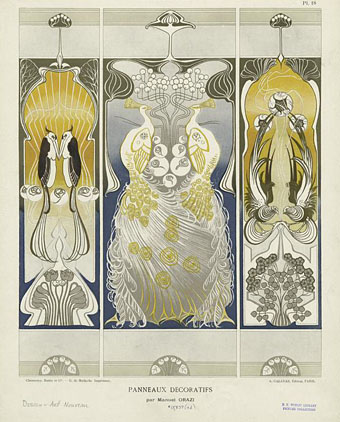
orazi4.jpg

Panneaux decoratifs (1900) by Manuel Orazi at NYPL.

Ghostsigns: “a collaborative national effort to photograph, research and archive the remaining examples of hand painted wall advertising in the UK and Ireland.”

• Golden Age Comic Book Stories posts some Alphonse Mucha.

Voyage Fantastique – An illustrated guide to the body and mind at A Journey Round My Skull.

The gallery of the International Exhibition of Calligraphy.

Trevor Wayne Pin-Up Show, a new photo collection of the tattooed Mr Wayne which includes photos and a foreword by Clive Barker.

Phallophonies, a gallery exploring the penis in religious art. Related: “Churchgoers are outraged over a crucifix in a Catholic church that they say shows an image of genitalia on Jesus.”

Hollingsville: “Expect live and unscripted wanderings around voodoo science parks, examinations of cities as battle suits and thoughts on pods, capsules and world expos.”

Phantom Circuit #33 is a Ghost Box special featuring an interview with Jim Jupp (Belbury Poly) and Julian House (The Focus Group). Related: Ghost Box films at YouTube.

Eldritchtronica and Wyrd Bliss, a mixtape by Simon Reynolds.

• Avant garde music and cinema meet at The Sound of Eye.

• Make your own newspaper with Newspaper Club.

Drawdio: A pencil that lets you draw music.

Yoko Ono collects rare books.

KittehRoulette.

• Song of the week: The Four Horsemen (1972) by Aphrodite’s Child.

The recurrent pose 33

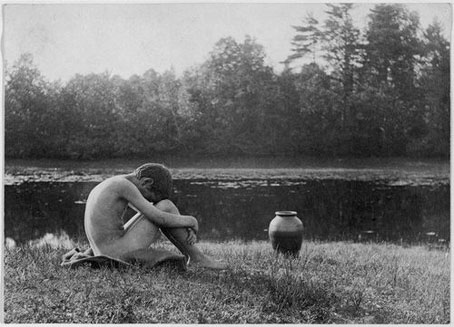
day.jpg

A double helping of that pose today. The photo above was a tip from commenter Jeremiah Q. Oxterwhiff and is credited on its Tumblr source as being by gay photographer Fred Holland Day (1864–1933). I can’t definitely confirm this but I’m fairly sure I’ve seen it credited to Day before. It’s also the case that another of the photographer’s pictures used the same pose and happens to be part of the first post in this series.

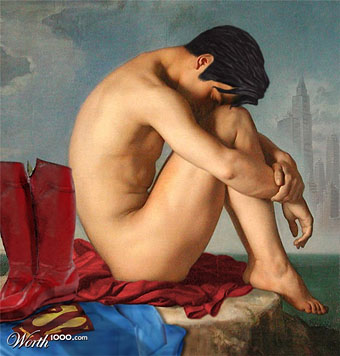
superman-flandrin.jpg

This depiction of Superman’s day off is by Worth1000 contributor jbuck43701 and was another tip from Evan Peterson. Thanks Evan!

Elsewhere on { feuilleton }
The recurrent pose archive

Previously on { feuilleton }
Fred Holland Day

Dorothea Tanning: Early Designs for the Stage

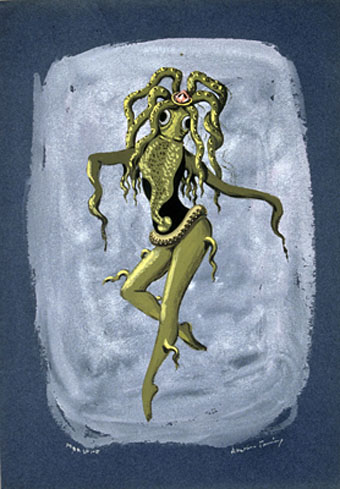
tanning1.jpg

Monstre from The Witch (1950).

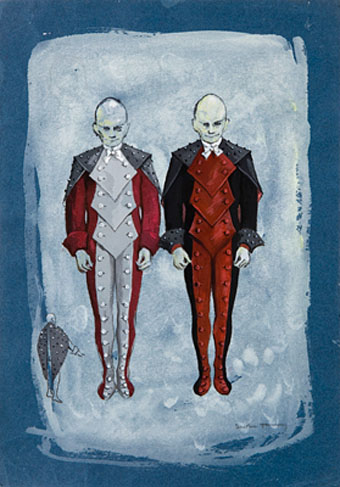
If this squid-headed costume design by Surrealist artist Dorothea Tanning isn’t a unique creation in the history of ballet then I’d like to know what challenges it. These paintings form part of an exhibition of Tanning’s designs for ballet companies which go on display at The Drawing Center, New York from April 23–July 23, 2010. The press release mentions her collaborations as being with George Balanchine but The Witch was choreographed by John Cranko after a score by Maurice Ravel.

Dating from 1945–1953, the designs will be shown together for the first time, and will be accompanied by archival photographs and ephemera related to the staged productions.  This series explores the dynamic intersections of dance, performance, visual art, and costume, while drawing important parallels to Tanning’s early discoveries in both painting and sculpture. (More.)

tanning2.jpg

The Butlers from The Witch (1950).

Via BibliOdyssey.

Previously on { feuilleton }
Angels of Anarchy: Women Artists and Surrealism
Surrealist women

Robert Anning Bell’s Tempest

bell1.jpg

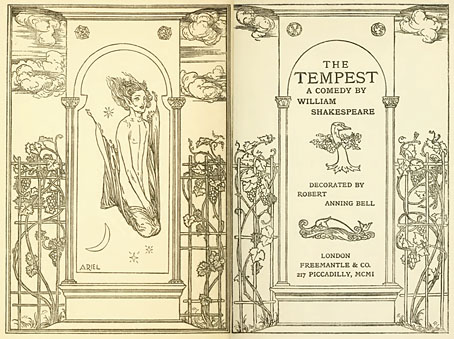
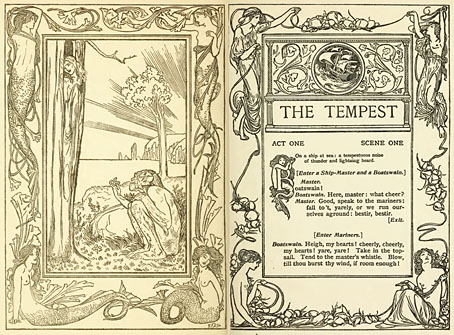
British artist and designer Robert Anning Bell (1863–1933) illustrates Shakespeare in this 1901 edition at the Internet Archive and the work seemed to give him an excuse to embellish many of the pages with writhing mer-folk. His adaptation isn’t as striking as William Heath Robinson’s Midsummer Night’s Dream from 1914 but then few books are. In style Bell is closer to his contemporary Charles Ricketts with very open line work and no heavy black areas. Ricketts produced his own version of Ariel’s Song to Ferdinand for The Magazine of Art in 1895 but doesn’t seem to have illustrated much more of The Tempest as far as I’m aware, although his Vale Press did issue an edition of Shakespeare’s complete works. It hadn’t occurred to me before how few illustrated editions there are of The Tempest; this seems surprising given the fantastic nature of the story. It might be that illustrated plays have never sold so well despite there having been a number of illustrated Midsummer Night’s Dreams. I’d love to have seen Harry Clarke tackling Ariel and Caliban.

bell2.jpg

bell4.jpg

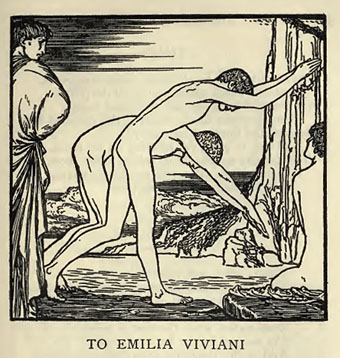
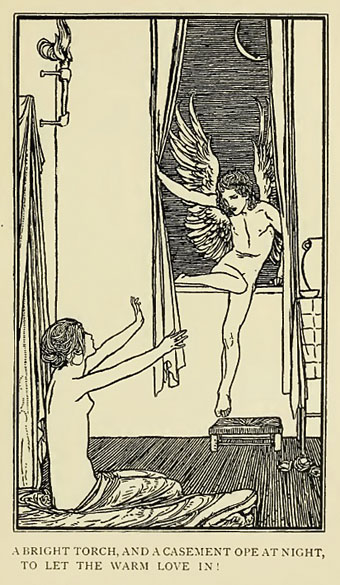
Also at the Internet Archive is a 1902 edition of Shelley’s poems illustrated by Bell (above) and an 1897 edition of Keats in the same series (below). Great poetry doesn’t necessarily lend itself to illustration so it’s no surprise that these books are less interesting than the Shakespeare.

bell3.jpg

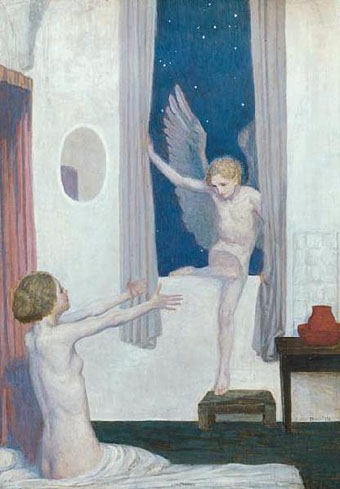
Bell later reworked his illustration for Keats’s Ode to Psyche as a painting which he called Cupid’s Visit. I much prefer the drawing to the painting.

bell5.jpg

Cupid’s Visit (1912).

Elsewhere on { feuilleton }
The illustrators archive

Previously on { feuilleton }
Charles Ricketts’ Hero and Leander
Another Midsummer Night
Arthur Rackham’s Midsummer Night’s Dream
The art of Charles Robinson, 1870–1937
William Heath Robinson’s Midsummer Night’s Dream