Berni Wrightson in The Mist

mist.jpg

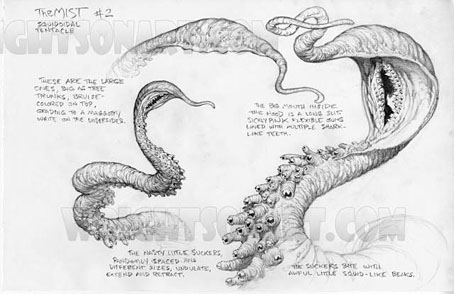
It’s not giving too much away to let enthusiasts of tentacular horror know that Frank Darabont’s film of The Mist, currently fogging up UK cinema screens, contains these questing things among its torments. The Mist is based on a 1980 novella by Stephen King and the film has a decent King pedigree for once, with the director having previously made The Shawshank Redemption and The Green Mile while the creature designs are partly the work of Berni Wrightson, one of King’s artist collaborators. Wrightson’s web gallery has a number of his sketches on display although if you haven’t seen the film you should be warned that they spoil some of the surprises.

My good friend Mark Pilkington—weirdness wrangler, editor of Strange Attractor and all-round ubiquitous presence—reviews the film in this month’s Sight and Sound where he points out some of the Lovecraftian resonances. Tentacles aside, there’s a lumbering monstrosity near the end which manages to be far more Lovecraftian than the Cloverfield creature and I wouldn’t have minded seeing more of the larger presences than the lesser beasties. The film’s lead character is a movie poster artist and the opening scene nods to an earlier film with an equally Lovecraftian atmosphere by having Drew Struzan’s art for John Carpenter’s The Thing on the wall in the background. The film’s siege situation is more the kind of story you’d get from an earlier writer, William Hope Hodgson, another purveyor of the malevolent tentacle.

Berni Wrightson and your not-so-humble narrator appeared together recently in Centipede Press’s A Lovecraft Retrospective: Artists Inspired by H.P. Lovecraft (yes, I am going to keep going on about this book for the next few months…sue me). Wrightson is represented there by his comic strip adaptation of Cool Air but his Mist drawings would have made equally worthwhile additions. If nothing else, 2008 is turning out to be a good year for horror enthusiasts.

Previously on { feuilleton }
The monstrous tome
Octopulps
Druillet meets Hodgson

Maldoror illustrated

maldoror.jpg

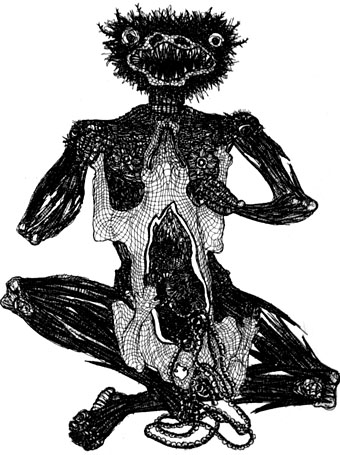
Les Chants de Maldoror by Corominas (2007).

There seems to be no escaping from HP Lovecraft just now, the illustration above having been created for a PDF publication entitled CTHULHU, Cómics y relatos de ficción oscura, produced by these people. The Cthulhu-zine seems to be unavailable but you can see more of these splendid illustrations, based on Lautréamont’s Les Chants de Maldoror (1869), at Dorian Gray BD. The artist, Corominas, has an additional blog showcasing more commercial work.

maldoror2.jpg

Les Chants de Maldoror by Jacques Houplain (1947).

Lautréamont’s delirious masterpiece isn’t exactly the easiest book to illustrate but the Corominas drawings certainly capture some of its ferocious energy. The Surrealists were big Maldoror enthusiasts, of course, and did much to establish Lautréamont’s current reputation. Salvador Dalí produced a series of engravings for a Skira edition in 1934 although his drawings look less like illustrations of the text than a rifling of the artist’s usual preoccupations. The picture above by Jacques Houplain is one of a series of twenty-seven engravings produced for a French edition in the 1940s. More recently, Jean Benoît created (among other things) a Maldororian dog and there’s even been an attempt at a comic-strip adaptation from Hernandez Palacios. On the whole I prefer the Corominas pictures but then I’m biased towards that style of drawing which owes something to all the comic artists and illustrators influenced by Franklin Booth.

Elsewhere on { feuilleton }
The illustrators archive
The etching and engraving archive

Previously on { feuilleton }
Franklin Booth’s Flying Islands
Carlos Schwabe’s Fleurs du Mal
The art of Jean Benoît

New things for July

leyendecker_flapper.jpg

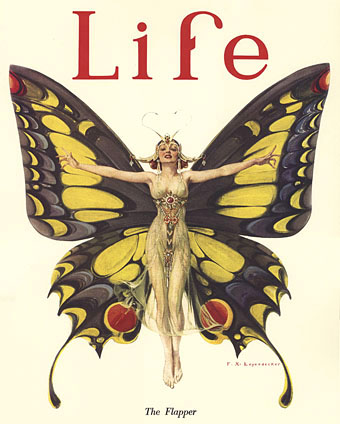
The Flapper by Frank X Leyendecker, Life magazine (1922).

• 2008 is turning out to be a great year for Lovecraft aficionados. As well as the stupendous Lovecraft Retrospective: Artists Inspired by HP Lovecraft, we’re also awaiting Frank Woodford’s feature length documentary, Lovecraft: Fear of the Unknown. I’m lucky to have my work included in Frank’s film which is easily the best documentary to date concerning the life and work of HPL. Among the interviewees are Neil Gaiman, John Carpenter, Guillermo Del Toro, Caitlin R Kiernan, Peter Straub, Ramsey Campbell and Lovecraft scholar ST Joshi. The film will receive its first (?) public screening later this month at the San Diego Comic Con:

Thursday, July 24
8:00–9:45pm
Room 26AB

• Over the weekend Arthur Magazine cleared the $20,000 it needed to keep running before the three-day deadline elapsed. A stunning piece of fund-raising which shows how much people value Jay and company’s efforts.

• The gorgeous cover above is the work of Frank X Leyendecker (1876–1924), brother of the more well-known (and gay) Joseph C Leyendecker. Makes me think I should make a post of Butterfly Women if only as an excuse to track down more pictures of Loie Fuller.

• Last but not least: happy birthday Lorraine!

The monstrous tome

hpl1.jpg

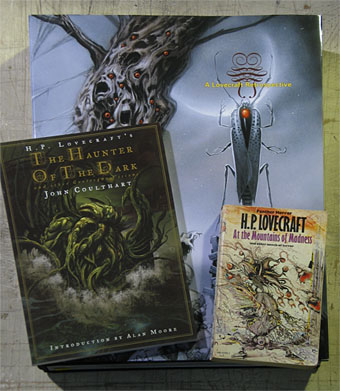
So it arrived at last, yesterday in fact, the colossal volume that is A Lovecraft Retrospective: Artists Inspired by HP Lovecraft from Centipede Press. Calling this a book is like calling the Great Pyramid of Cheops a pile of stones, technically accurate but the words somewhat fail to convey the existential reality. This is the heaviest book I’ve ever come across, 400 pages of heavy-duty art paper at BIG size. (Amazon gives the dimensions as 16.1 x 12.6 x 2.3 inches or 409 x 320 x 580 mm.) The photo above shows the scale beside an old Mountains of Madness paperback (Ian Miller‘s cover art appears in full in the new book) and my own Haunter of the Dark collection. The cover art is by Michael Whelan, a detail from his wonderful 1981 HPL panoramas.

hpl2.jpg

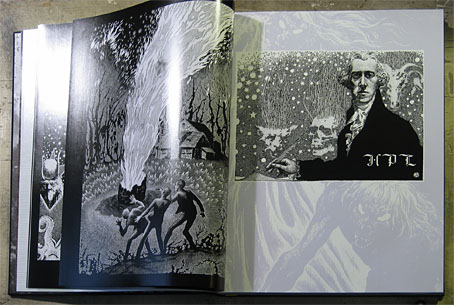
The Virgil Finlay section showing The Colour Out of Space and his definitive Lovecraft portrait.

The range of contributors past and present includes JK Potter, HR Giger, Raymond Bayless, Ian Miller, Virgil Finlay, Lee Brown Coye, Hannes Bok, Rowena Morrill, Bob Eggleton, Allen Koszowski, Mike Mignola, Howard V. Brown, Michael Whelan, Tim White, Frank Frazetta, John Holmes, Harry O. Morris, Murray Tinkelman, Gabriel, Don Punchatz, Helmut Wenske, John Stewart, Thomas Ligotti and John Jude Palencar. The introduction is by Harlan Ellison and there’s an afterword by Thomas Ligotti. Many pages fold out to reveal spreads like the Giger ones below. Print quality is exceptional, of course, but then ladling the superlatives is pointless when it’s obvious this is a sui generis masterpiece of Lovecraftian art. Naturally I’m very happy indeed to be a part of it.

Continue reading “The monstrous tome”

Aubrey by John Selwyn Gilbert

aubrey00.jpg

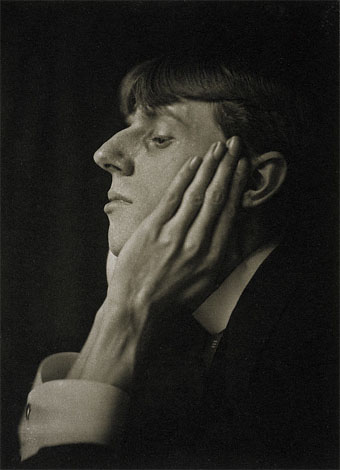
Aubrey Beardsley photographed by Frederick Evans (1894).

I’ve been going through the Coulthart VHS library recently, transferring to DVD recordings which can’t be purchased or found online. Among these is a drama from the BBC’s Playhouse strand, Aubrey by John Selwyn Gilbert, which was broadcast in 1982. This drama follows the life of artist Aubrey Beardsley from the time of Oscar Wilde’s arrest in April 1895—which event resulted in Beardsley losing his position at The Yellow Book—through the foundation of The Savoy magazine, to his tubercular death in March 1898.

aubrey01.jpg

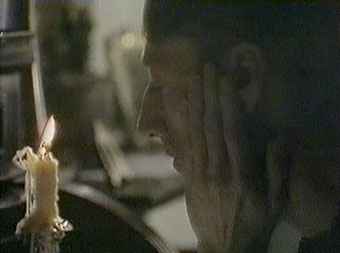
John Dicks as Aubrey.

Playhouse was a BBC 2 equivalent of Play for Today (which usually ran on BBC 1) and Aubrey, like many other dramas of the period, was shot on video in the studio. This was done for convenience as well as being cheaper than shooting on film, since scenes could be filmed using several cameras simultaneously. The drawback is that the image looks very harsh, and historical works such as this often seem unreal and artificial as a result. If you can forgive this deficiency, Aubrey was an excellent production with some great performances, especially Ronald Lacey as Leonard Smithers and Rula Lenska as Aubrey’s sister, Mabel. The details of Beardsley’s life are very accurate, down to his beloved Mantegna prints on the walls, and many of the scenes are arranged to correspond with his drawings, the production design being largely monochrome.

Continue reading “Aubrey by John Selwyn Gilbert”