
Gekko Hayashi revisited

hayashi02.jpg

It remains a fact that the most popular posts here are the sex-related ones. The post about Clayton Cubitt’s Hysterical Literature project continues to rack up views despite having been written about at greater length on far more popular sites; this weekend Facebook users were flocking to see the phallic plaster casts (why now?).

One of the perennial favourites from the gay artists archive is the post I made two years ago about the homoerotic art of Gekko Hayashi, the pseudonymous alter ego of Goji Ishihara (1923–1997). This has managed to become an almost universal point of reference despite all my knowledge about the artist being gleaned from other websites. The popularity would appear to be due to a generally high level of visibility in Google rankings combined with a tendency to write about recherché subjects which don’t receive high-profile attention elsewhere. Talking to Anne Billson yesterday about Ishihara’s monster art had me searching around for more of the Hayashi material. There’s still little to be seen outside some Japanese reprints. Given the language barrier when searching the Japanese book world it’s difficult to say whether any of these are still in print.

hayashi05.jpg

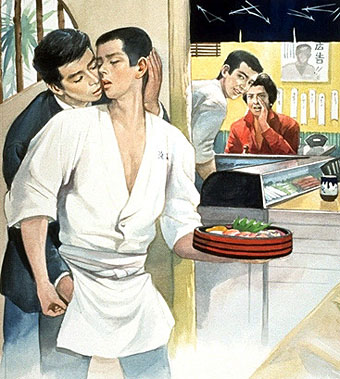
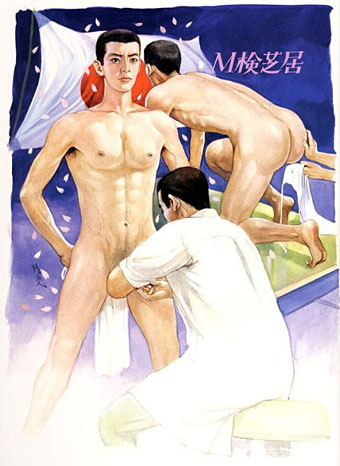
After turning up a few more examples of Hayashi’s work I’m increasingly struck by the strangeness of some of his art as well as the rare disjunction of seeing a commercial illustration style serving semi-pornographic ends. The latter effect is like seeing the libido of an artist such as Look and Learn painter Ron Embleton suddenly laid bare. A similar disjunction can be found in Oliver Frey’s work where a polished illustration and comic strip technique is applied to raw sexual scenarios. (I should note that Ron Embleton’s libido was on display in his comic strips for Penthouse magazine while—going in the opposite direction—Oliver Frey worked for a while at Look and Learn.)
hayashi07.jpg

You can find a polished style elsewhere but few artists get quite as weird with their erotic fantasies as the picture below showing a pair of penis-headed males embracing, and the one of a boy in what may be a bath full of blood being menaced (?) by an ambulatory midget phallus. Weirdness is familiar in the fetish world—everyone’s fetish is inherently weird to those who don’t share it—but always within strict limits, and besides, these aren’t fetishes. What’s odd about the pictures (especially the first) is the way they overburden the eros with a peculiarity you’d think would defeat the purpose of the painting. Hayashi/Ishihara worked as a comic artist as well as an illustrator so perhaps they’re part of a larger narrative; they may also be illustrating a text piece like some of the other pictures. For the moment they appear caught between the gay work and the monster illustration from the 1970s. This isn’t a complaint, it makes the art all the more intriguing and worth searching for.

hayashi09.jpg

Continue reading “Gekko Hayashi revisited”

Weekend links 138

durette.jpg

Heartsick (2011) by Kelly Durette.

• Now that Scott Walker’s Bish Bosch album is out and causing the usual consternation, the spotlight-shy singer/composer has been doing a surprising amount of promotional interviews. Simon Hattenstone talked to him for the Guardian at the end of last month; this week it was John Doran’s turn at The Quietus. One quote from the latter piece stood out in the light of this week’s posts: “…the music we’re making is meant to be an aural version of the HR Giger drawings for Alien. It always sounds to me like those look.”

Satanica is a limited-edition publication curated by Gio Black Peter & Christopher Stoddard “for anyone who rejects societal norms, for those dedicated to a life of pleasure, excess and self-reflection”.

• Sci-Fi-O-Rama has put five years’ worth of blog pictures onto Pinterest. I don’t really need to do that, there’s already a diverse crowd of Pinterest users compiling their own selection of things posted here.

As Susan Sontag once observed, pornography is practical. It was designed as a marital aid, and its vocabulary should follow natural biological rhythms and stick with hot-button words in order to produce a predictable climax. It is not about sex but is sex. Whereas the great sex writers (Harold Brodkey, DH Lawrence, Robert Gluck, David Plante, the Australian Frank Moorhouse) have a quirky, phenomenological, realistic approach to sex. They are doing what the Russian formalists said was the secret of all good fiction – making the familiar strange, writing from the Martian’s point of view.

Edmund White on writing about sex in fiction

• When pirate DVDs of films by Cocteau, Bresson and Pasolini are on sale in a Mexican market, life in the 21st century increasingly resembles a William Gibson novel. Joanne McNeil investigates.

• Copies of City Fun, Manchester’s premier music fanzine/alt culture mag (founded 1978), can now be read online at the Manchester District Music Archive.

• Linked everywhere during the past few days, the astonishing map of bomb hits on London during the Blitz (October 1940 to June 1941).

• At 50 Watts: 30 Vintage Magazine Covers from Japan and Alfred Kubin’s illustrations for Lesabéndio: An Asteroid Novel (1913) by Paul Scheerbart.

• Earlier this year for Frieze Magazine Geeta Dayal talked to musical collaborators of the great German producer Conny Plank.

Invisible Ink by Christopher Fowler, “the extraordinary stories of over one hundred forgotten authors”.

Cynthia Carr talks about Fire in the Belly, her biography of American artist David Wojnarowicz.

• “Blasphemy, Filth, And Nonsense” More Aleister Crowley ephemera at Front Free Endpaper.

• At Strange Flowers: Surrealist art by Jindrich Heisler (1914–1953).

Vladimir Nabokov wrote to Alfred Hitchcock in 1964.

• Scott Walker’s four tracks from the Nite Flights album (1978): Shutout | Fat Mama Kick | Nite Flights | The Electrician.

The art of George Stavrinos, 1948–1990

stavrinos1.jpg

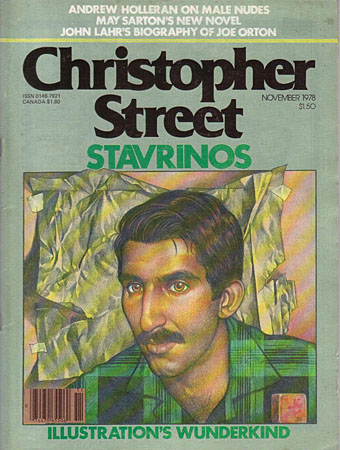
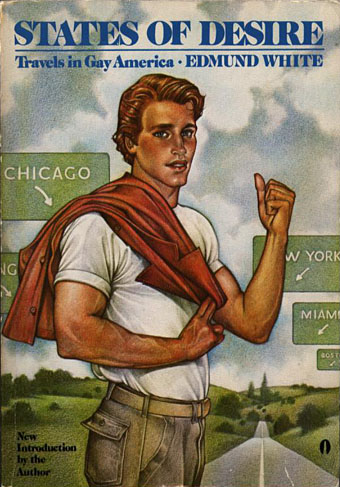
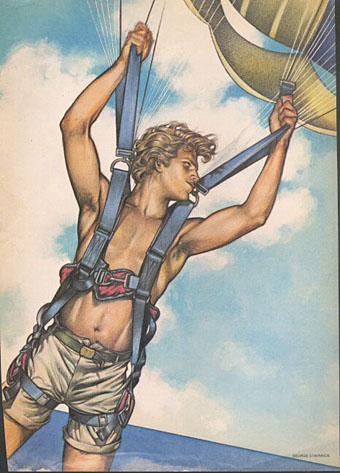
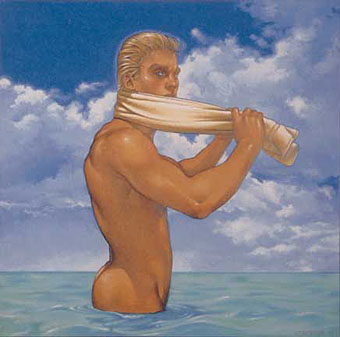
I’m still playing catch-up with the generation of gay artists who came to prominence in the 1970s or early 1980s. Many of them worked for American magazines which were seldom seen over here: both Mel Odom and George Stavrinos provided illustrations for Blueboy while Stavrinos was popular enough to be given the cover treatment from Christopher Street in 1978. Stavrinos is rightly remembered for his stunning Art Deco-styled fashion illustrations but there was enough work in the gay press for him to be regarded as an important artist in that sphere. There’s more at The Advocate and Decoy.

stavrinos2.jpg

stavrinos3.jpg

stavrinos4.jpg

Bather (1977).

stavrinos5.jpg

Elsewhere on { feuilleton }
The gay artists archive

World Fantasy Awards

infernal.jpg

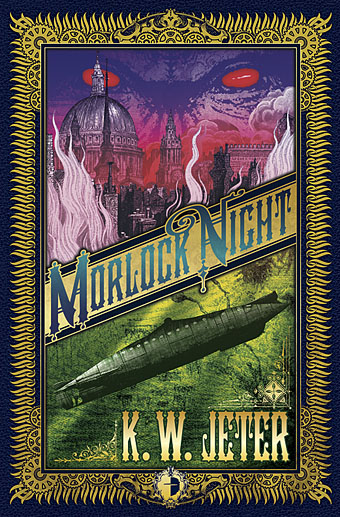
Presenting some of the cover art and interior illustration from 2011 which won me the World Fantasy Award for best artist in Toronto on Sunday. (The complete awards list is here.) It was a surprise to be nominated, and even more of a surprise to win since working in different areas—book, music, comics—is never a good way to get noticed for doing one particular thing. It’s also the case that sf/fantasy art awards tend to favour painters or virtuoso digital artists over people such as myself who I suppose are more illustrator-designers; that’s not a criticism, just an acknowledgement of the strength and popularity of highly-refined pictorial art in this area of the literary world. The recognition hazard works in the opposite direction: the design world often gives the most attention to graphic design alone, with the illustration quotient being regarded as secondary content.

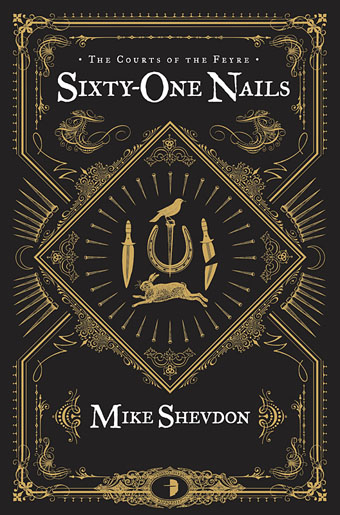
I’m not exactly sure what the judges were looking at of my work so these examples have been chosen for being published during the year under examination. They’re also covers that people seemed to like a lot, especially KW Jeter‘s Morlock Night (even though I still prefer Infernal Devices!), and those for Mike Shevdon‘s books. The Jeter and Shevdon volumes are all published by Angry Robot who will also be publishing Lavie Tidhar‘s The Bookman Histories early next year sporting another of my covers. Lavie’s novel Osama won best novel in Toronto while Ann and Jeff VanderMeer (editors of the Lambshead book below) picked up a best anthology award for their monumental The Weird. And to add to the good company, my regular publishers Tachyon saw one of their authors, Tim Powers, gaining best story collection. Congratulations to everyone, and a big thanks to Ann for collecting my award.

I’m always using these posts to point to other artists so it’s only right that I encourage everyone to go and look at the work of the other nominees. Here they are (although Jon Foster’s site appears down at the moment):

Julie Dillon
Jon Foster
Kathleen Jennings
John Picacio

John Picacio has a rather gorgeous calendar due out soon, details here.

morlock.jpg

lambshead.jpg

Title page for The Thackery T. Lambshead Cabinet of Curiosities edited by Ann & Jeff VanderMeer (Harper Voyager).

shevdon1.jpg

Continue reading “World Fantasy Awards”

Weekend links 133

woods1.jpg

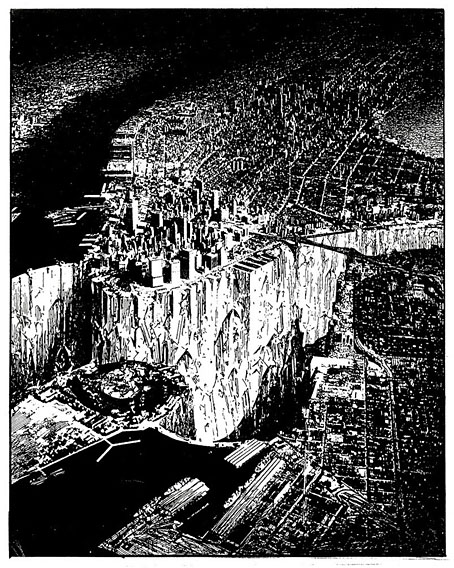
Lower Manhattan (1999) by Lebbeus Woods.

RIP Lebbeus Woods, an architect and illustrator frequently compared to Piranesi not only for his imagination and the quality of his renderings but also for the way both men built very little from a lifetime of designs. Lots of appreciations have appeared over the past few days including this lengthy piece by Geoff Manaugh at BLDGBLOG. (Geoff interviewed Woods in 2007.) Elsewhere: A slideshow at the NYT, Steven Holl remembers Lebbeus Woods and Lebbeus Woods, visionary architect of imaginary worlds. See also: Lebbeus Woods: Early Drawings and this post about Woods’ illustrations for an Arthur C Clarke story collection. Woods was at his most Piranesian with Gothic designs for an artificial planet that would have been the principal location in Vincent Ward’s unmade Alien 3.

Arkhonia draws to the end of a year of blogging about and around the Beach Boys’ errant masterwork, Smile (1967). Witty, discursive and frequently scabrous accounts of how Brian Wilson’s magnum opus was derailed and marginalised until it became convenient for commercial interests to exploit its reputation. Anyone following those posts won’t have been surprised by Wilson’s sacking from his own group by Mike Love in September.

• “We’ve been underground for 27 hours now. Everyone is caked in mud, with grit in their hair.” Will Hunt explores the catacombs and sewers of Paris.

I think the only remotely interesting drug was acid. I had a slightly peculiar attitude towards it I think. Just about everything about hippydom I hated. I liked the 60s up to about ’65 or ’66. I liked the mod clothes, I liked the look. I wasn’t a keen taker of speed because I didn’t like the comedown from it. Then everything changed and became looser, I didn’t like the clothes at all. I felt rather out of step with it. The acid thing was interesting though. I come from Salisbury and from the age of 12 I had a friend who was 30 years older than I was who I saw regularly up until when he died a couple of years ago, whose obituary I wrote in The Times. This man was called Ken James and he was deputy head at the chemical warfare unit at Porton Down [the MOD’s Defence Science and Technology Laboratory]. He then became head of the scientific civil service; he was the man who introduced computing into the civil service and he had taken acid as early as 1950. This was long before Aldous Huxley.

Sharp Suits And Sparkle: Jonathan Meades On Acid, Space And Place by John Doran. Marvellous stuff. Meades’ new book is Museum Without Walls.

• In New York later this month: A Cathode Ray Séance – The Haunted Worlds of Nigel Kneale.

• More acid: Kerri Smith talks to Oliver Sacks about his drug experiences.

• “It starts with an itch”: Alan Bennett (again) on his new play, People.

nymag.jpg

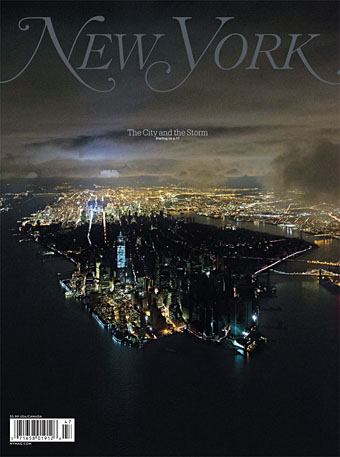
Lower Manhattan last Wednesday. Photo by Iwan Baan.

• Back issues of OMNI magazine can now be found at the Internet Archive.

• Alan Moore & Mitch Jenkins present their new film, Jimmy’s End.

• At BibliOdyssey: Atlas title pages part one & part two.

• Raw Functionality: An interview with Emptyset.

Athanasius, Underground

Vintage Caza

Stormy Weather (1979) by Elisabeth Welch.