Weekend links 115

vandamme.jpg

Untitled painting by Suzanne Van Damme (1901–1986).

Eric Berkowitz, author of Sex and Punishment: 4000 Years of Judging Desire, chooses five books for The Browser.

Venus febriculosa is running another competition: Design a new cover for Brian Eno’s Music For Films.

• Paul Mayersberg and Tony Richmond on making The Man Who Fell to Earth.

When a good idea occurs, it has been prepared by a long time of reflection. But you have to be patient. We all have what I call the invisible worker inside ourselves; we don’t have to feed him or pay him, and he works even when we are sleeping. We must be aware of his presence, and from time to time stop thinking about what we are trying to do, stop being obsessed about answers, and just give him the room, the possibility, to do his work. He is tenacious, you see. He never loses hope.

Screenwriter Jean-Claude Carrière discusses his remarkable career. Related: The Discreet Charm of the Bourgeoisie revisited.

Tragic Time Capsules: Capturing the Decay of Forgotten Olympic Venues.

Louis Menand on “The Puns and Detritus in James Joyce’s Ulysses“.

• Saul Bass’s original ending for Phase IV unearthed in Los Angeles.

Katherine Lanpher uses witchcraft to find a New York apartment.

Italo Calvino’s adolescence – that in-between time.

• The early film posters of Waldemar Swierzy.

Psychedelic nano-art in oils and ferrofluids.

David Toop has a blog.

Callum James Paper.

Bodies of Water (1995) by David Toop

O (Omicron)

omicron.jpg

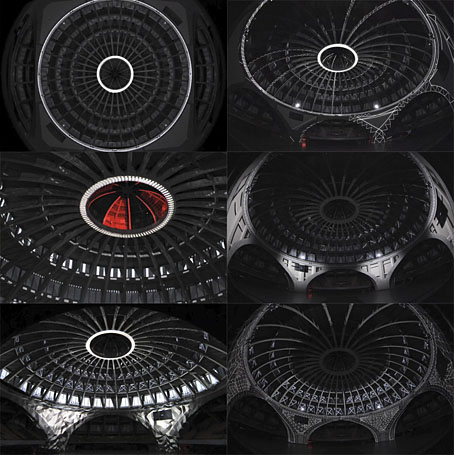
Is projection mapping becoming a lot more common or am I simply noticing it more often? O (Omicron) is a particularly stunning example, a permanent installation by Romain Tardy & Thomas Vaquié at the Hala Stulecia in Wroclaw, Poland. It helps that the building has such a distinctive shape, a concrete dome with a ribbed interior that suits being traced in glowing lines. Another link from Dressing the Air‘s weekly bulletin.

Previously on { feuilleton }
KraftWork
Lumiere at Durham
Tetragram for Enlargement

Animating Piranesi

dupond.jpg

Piranesi Carceri d’Invenzione (2010).

When Peacay at BibliOdyssey linked to this short film by Grégoire Dupond I thought it might be one I hadn’t seen before but it turns out I have, and I mentioned the exhibition it was produced for in 2010. No matter, it’s worth drawing attention to again since Monsieur Dupond makes an impressive job of sending a virtual camera through the vast spaces of Piranesi’s Carceri d’invenzione, joining several of the etchings into a series of contiguous chambers.

yoyoma.jpg

The Sound of the Carceri (1998).

Dupond’s film uses Bach’s Cello Suite #2 as a musical accompaniment. As noted earlier that choice probably came from Yo-Yo Ma’s Inspired by Bach (1998) in which Bach’s six solo cello suites are performed in different settings. Suite #2 was The Sound of the Carceri directed by François Girard which places the cellist inside a CGI rending of one of Piranesi’s Careri etchings. YouTube has a copy here.

Elsewhere on { feuilleton }
The etching and engraving archive

Previously on { feuilleton }
Carceri, thermae and candelabra
La Tour by Schuiten & Peeters
Set in Stone
Piranesi as designer
Vedute di Roma
Aldous Huxley on Piranesi’s Prisons

Recovering Viriconium

viriconium01.jpg

Detail from Assassination in the Night (c. 1600?) by Monsù Desiderio.

Yesterday’s post looked at some of the past cover designs for M. John Harrison’s Viriconium books. This post makes a few suggestions for how they might be presented in the future. Since these are mostly covers that I’d like to see they’re not necessarily ideal for the audience a publisher might be aiming at, cover design is usually a three-way process involving designer, author and publisher. In the end I’ve resisted the temptation to draft a range of original cover proposals—writing these posts has taken long enough—so almost everything here uses pre-existing art. If I was designing covers for all four Viriconium books, however, and the brief was to orient them towards a fantasy readership, the first thing I’d try would be a series of four imaginary Tarot designs. A peculiar pack of Tarot cards is a recurrent feature of the books so I’d create four emblematic cards that featured significant elements and characters from each. The characters wouldn’t be too well defined, they’d be stylised, maybe even silhouettes. Each card would feature a dominant presence: offhand these would be one of the geteit chemosit for The Pastel City, a locust for A Storm of Wings, the Barley Brothers for In Viriconium and a Mari Lwyd horse skull for Viriconium Nights. These presences together with the human characters would loom over a silhouette city at the foot of each card whose outlines would change appearance from book to book, evolving gradually from a fantastic outline of domes and towers to something that resembles a contemporary city. The colours and treatments would show a similar evolution from the bright and bold styles of the Pamela Colman Smith Tarot deck to something more photographic, collaged from elements closer to our world. Maybe.

That’s an idea for the four individual books. All the examples here use the convenience of the omnibus edition so a single image (or pair of images) has to somehow represent the entire series. To save time and effort I’ve taken the liberty of hijacking a couple of Penguin Books layouts. I hope Penguin doesn’t mind, and I should also apologise to Harrison’s UK publishers, Gollancz, for making one of their authors jump ship. The Viriconium omnibus is certainly good enough to be considered a modern classic. Penguin’s recent template for its Modern Classics series happens to be very easy to apply to a wide range of artwork.

viriconium04.jpg

The Anti-Pope (1942) by Max Ernst.

Penguin has a long tradition of using pre-existing art on its covers, especially on those in its Penguin Classics series. You can almost make this into a parlour game: match your favourite novel with the best choice of painting. The tradition was extended to its science fiction titles in the early 1960s when the art of Max Ernst was featured several times along with the work of other Surrealists. Max Ernst is a favourite artist of mine so this is one I can’t resist. Many of Ernst’s decalcomania paintings of the 1940s would suit Viriconium but The Anti-Pope with its horse heads seems especially suitable.

Also on the Penguin sf covers was a picture by the mysterious “Monsù Desiderio” one of whose works can be seen at the top of this post. Desiderio was a 17th-century painter with a vague enough presence—works have been attributed to both François de Nomé and Didier Barra—and a line in gloomy architectural fantasias to make him an ideal Viriconium artist.

Continue reading “Recovering Viriconium”

Weekend links 111

thefox.jpg

The Fox (1968). Design by Bill Gold, art by Leo & Diane Dillon.

Mark Rydell’s The Fox may be regarded unfavourably now for its retrograde idea of a lesbian relationship but that’s still a great poster by the Dillons. Equally retrograde (well it was 1957) is Anders als du und ich, a film about wayward German youth directed by ex-Nazi propagandist Veit Harlan:

Klaus is a young man in post-war Berlin. He is drawn to his friend Manfred and, under the encouragement of their acquaintance, Dr. Winkler, explores the underground world of gay clubs and electronic music. His family begins to learn of his other life and do everything they can to set him straight.

A saving grace is the conspicuous deployment of Oskar Sala’s Trautonium. They’re deviants—of course they like weird electronic music! Sala’s instrument was his own invention which means it has a unique pre-Moog sound, famously used by Alfred Hitchcock in the score for The Birds. YouTube has a collection of the electronica moments from Anders als du und ich. Wait for the wrestling scene…

Netherwood: Last Resort of Aleister Crowley by A Gentleman of Hastings. Related: Jimmy Page’s Lucifer Rising sessions part 1 and part 2.

• “This coming 16 June, [BBC] Radio 4 will be a wall-to-wall Joycefest, kicking off at 9am and running until midnight.”

A World Where Architecture is the Driving Force Behind Society, Core77 on the Cités Obscures of François Schuiten.

• At The Hooded Utilitarian an examination of the thorny problem of adapting Lovecraft for the comics medium.

• Plates from La Plante et ses Applications Ornementales (1897–1900) by Eugene Grasset.

• Coilhouse found a rough copy of Todd Haynes’ Superstar: The Karen Carpenter Story.

Three Quick Ways to Introduce Yourself to the Work of Harlan Ellison.

Daniel Buren’s Monumenta 2012 at the Grand Palais, Paris.

Our Sorrows, a new video from Julia Holter.

I, Cyclops: Monocularity in a 3-D World.

JG Ballard: The Concordance.

• RIP Pete Cosey.

• Pete Cosey with Miles Davis et al, November 1973: Ife | Turnaroundphrase