Weekend links 24

early.jpg

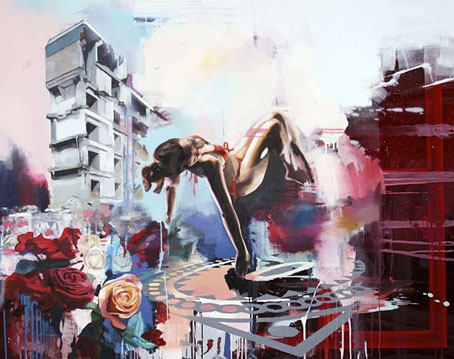
Delta-Wing (2009) by Chloe Early.

• “Feted British authors are limited, arrogant and self-satisfied, says leading academic”. Stating the bleeding obvious but it still needs to be said, apparently, especially when the announcement of the Booker list this year caused the usual confusion when Amis Jr. and McEwan weren’t included, as though the mere existence of their novels makes them prize-worthy. And as someone pointed out, the word “male” is missing from that headline.

Hero of Comic-Book World Gets Real: Alan Moore again, in the NYT this time. Related: a review of Unearthing live.

• Announcing The Hanky Code by Brian Borland & Stephen S Mills, a 40-poem book to be published next year by Lethe Press. For an explanation of the Hanky Code there’s this, and there’s also an iPhone app.

Folk—the ‘music of the people’—is now hip again, says (who else?) Rob Young who can also be heard on the archived podcast here. Related: the folk roots of Bagpuss. Related to the latter: The Mouse Mill.
zvorykin.jpg

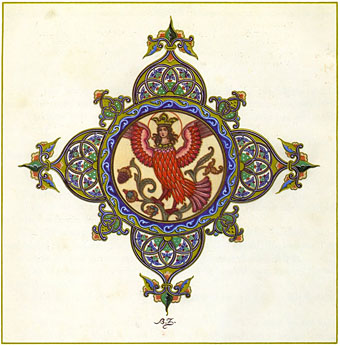
An endpiece from The Firebird and other Russian Fairy Tales by Boris Zvorykin.

‘Yes’ to Catastrophe: Roger Dean, Prog and SF. A lengthy and thoughtful analysis of Roger Dean’s early work.

Into the Media Web, the enormous Michael Moorcock book which I designed, is officially published this week.

Cassette playa: in praise of tapes. I’ve complained about tapes in the past but people continue to find them useful. Some technologies die harder than others.

Boy BANG Boy: “Quiet moments made suddenly very loud with the attitude and opinion of what it means to be a young male in an impossibly diverse world.” An exhibition opening at Eastgallery, London, on August 5th.

Empty your heart of its mortal dream: Alfred Kubin’s extraordinary novel, The Other Side.

Ghostly and Boym Partners devise a new way to deliver digital music.

Besti-mix #27: a great selection by producer Adrian Sherwood.

Agnostics are troublemakers. Amen to that.

• RIP Harry Beckett.

Acousmata.

Let Us Go In To The House Of The Lord by Pharoah Sanders (live, 1971): Part 1 | Part 2
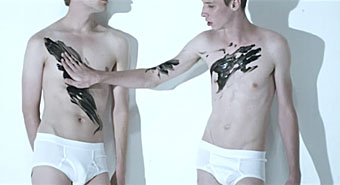
The Lady Is Dead and The Irrepressibles

lady1.jpg

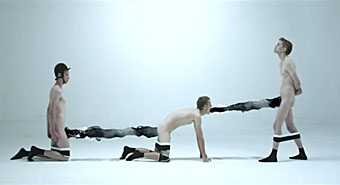
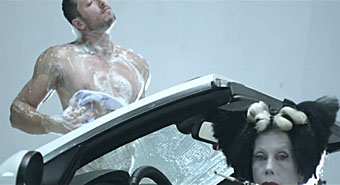
The lady may be dead but the art here is very much alive. The second great video of the week comes via the always essential Homotography, a short piece by director Roy Raz whose film features a pair of tattooed lesbians, a tennis match involving meat (or something), boys stripping out of their underwear to indulge in some peculiar—and for all we know, metaphysical—sexual congress, an elderly lady dancing round a piano, and a gang of luscious hunks who soap a car before sponging down their own bodies.

lady2.jpg

Do we have to worry about What It All Means? Of course we don’t, although the usual crowd of bewildered YouTube commenters struggle with comprehension like medieval rustics attempting to decipher so many signs and wonders. Think of it as the kind of thing Wes Anderson might create if someone dosed him with psychotropic chemicals that also turned him gay.

lady3.jpg

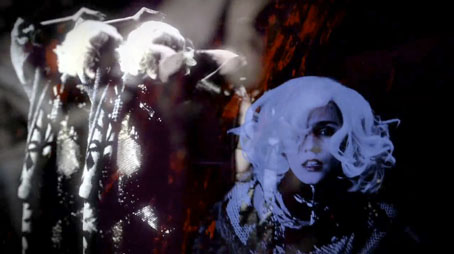
More important for me is the utterly fantastic song which Roy Raz uses, a number entitled In This Shirt by a ten-piece British group, The Irrepressibles, whose name I recognised but whose music I hadn’t heard until this. Lead singer Jamie McDermott’s voice is very reminiscent of Antony Hegarty which is no bad thing, although McDermott is probably weary of the comparison. Our musical culture would be greatly improved by more people taking their lead from Antony. The Irrepressibles’ site has a Soundcloud page where you can hear other songs from their recent Mirror, Mirror album, the CD of which is now on my shopping list. They also have a couple of videos showing their live performances which look rather spectacular. 2010 is turning out to be a good year for British music; when that music comes with cute guys attached it’s an added bonus.

lady4.jpg

Update: Roy Raz’s film is now also on Vimeo with other of his works.

The art of Jessica Harrison

harrison.jpg

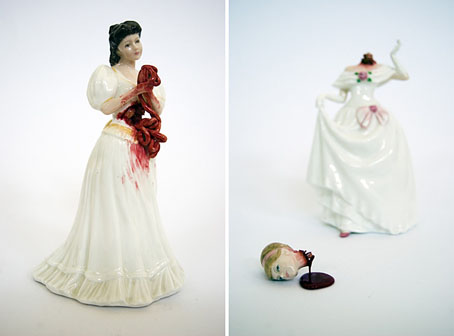
left: Maria (2010); right: Dawn (2010).

British artist Jessica Harrison undermines the saccharine innocence of porcelain figurines in a manner which would no doubt appeal to a Surrealist and black humorist like Jan Svankmajer. As well as these recent pieces, her website features further contemporary takes on Surrealism including a number of pencil drawings, one of which is a self-portrait alluding to that Švankmajer favourite, Giuseppe Arcimboldo.

Previously on { feuilleton }
Surrealism, graphic design and Barney Bubbles
Jan Švankmajer: The Complete Short Films

Schloss Falkenstein

falkenstein.jpg

Proposal for Schloss Falkenstein (c. 1883).

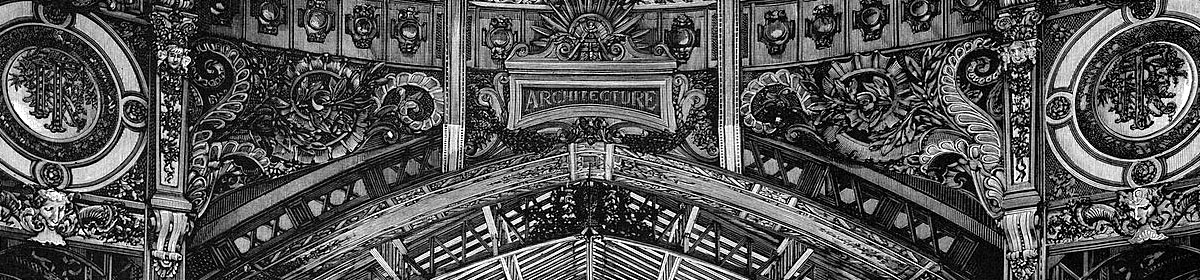
A slight return to Ludwig II. Schloss Falkenstein would have been another beetling edifice in the manner of Schloss Neuschwanstein had it ever been built, and judging by this view it might have been even more grandiose. The painting is one of the proposals by stage designer Christian Jank whose plans had already been used for Neuschwanstein. Philippe Jullian makes some scathing remarks about the Gothic interior of the earlier castle but he may have had more patience for the Byzantine interiors planned for Falkenstein. I’m not sure how these would be reconciled with Jank’s exterior, however, the style being Gothic enough to satisfy Viollet-le-Duc. Ludwig’s untimely death in 1886 drew a line under his architectural schemes but Bavaria’s loss eventually became Walt Disney’s gain as Jank’s fantasias provided the inspiration for the castle in Sleeping Beauty (1959) and all of the Disney theme park castles. What Ludwig would have made of this we can only guess. I suspect he’d be entranced by the fantasy but appalled by the vulgarisation. He was an elitist, after all, and the castles were always for him alone, not hordes of T-shirted proles.

Previously on { feuilleton }
Schloss Linderhof
Schloss Neuschwanstein
Pite’s West End folly
Viollet-le-Duc

Missoni by Kenneth Anger

missoni1.jpg

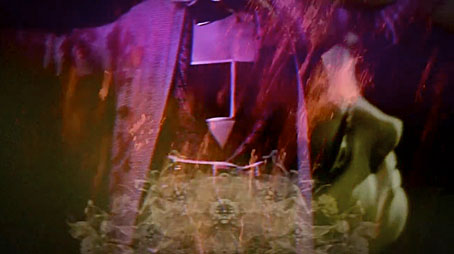
I did have another Ludwig post planned for today but that’s been set aside for a different kind of fabulosity following the news that Kenneth Anger has made a new film. Italian fashion house Missoni commissioned Anger to make a short promo for their Fall/Winter collection and you can see the delirious results in high-resolution here. The film features Missoni family members peering out from among the layered moons and stars, with titles by Arthur magazine’s Psychedelic Healing Visions Correspondent, Alia Penner.

missoni2.jpg

“I’m fascinated by Kenneth Anger’s use of colour and his ability to transform a film into a three-dimensional texture, a fabric of images in movement,” explained Angela Missoni.  This is how she introduced her decision to entrust the Missoni F/W 2011 campaign to one of America’s most famous authors and directors of avant-garde cinema.

Anger—a hyperactive octogenarian who loves working in the wee hours of the night and at dawn using sophisticated instruments such as the RED digital camera that has the characteristics of a classic 35 mm camera—flew in from Los Angeles to film the campaign in Sumirago that involved all the members of the great Missoni family. They are the stars of this campaign that was conceived as a series of superimposed and overlapping portraits. (More.)

Via Arthur!

Previously on { feuilleton }
Anger in London
Arabesque for Kenneth Anger by Marie Menken
Edmund Teske
Kenneth Anger on DVD again
Mouse Heaven by Kenneth Anger
The Man We Want to Hang by Kenneth Anger
Relighting the Magick Lantern
Kenneth Anger on DVD…finally