Weekend links 87

scott.jpg

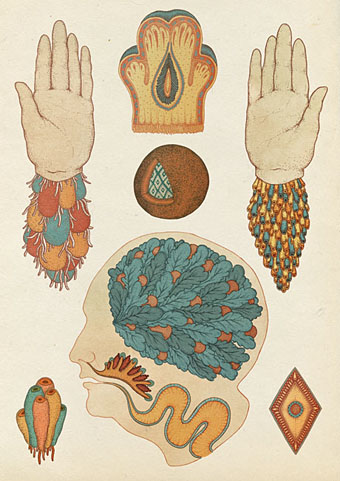
Untitled art by Katie Scott.

“…the very fact that people cannot get published by the big-name publishers in the way that they used to has meant that you’ve got some really interesting and often really beautiful little small publishing houses that are springing up and coming into existence. And the stuff that they’re providing is actually a lot better. I’m thinking of people like Tartarus Press, Strange Attractor and various other commendable small publishers that do a beautiful job and that are producing books that are good to have on your bookshelf.”

Alan Moore discussing books old and new in a lengthy interview at Honest Publishing. In part two he takes to task hardboiled moron Frank Miller and offers his thoughts on the Occupy movement. Elsewhere the Guardian finally paid some attention to the importance of design in the book world. Some of us who do this for a living have been saying for years that if publishers want to see physical books thriving they need to maintain (or improve) the quality of their design and materials. Related: The Truth About Amazon Publishing, Laura Hazard Owen at paidContent examines some the figures behind Amazon’s PR.

• “Tenniel argued for several changes to the characters as conceived by Carroll. The croquet mallets are ostriches in the original drawings, and the hoops are footmen bent over with the tails of their coats hanging down over their bottoms like an animal’s. Tenniel left them out. He told the author that a girl might manage a flamingo, but not an ostrich.” Marina Warner again on John Tenniel, Lewis Carroll and the Alice books.
schoeler.jpg

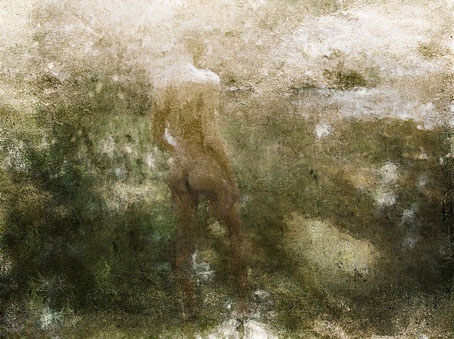
Untitled painting by Christian Schoeler who was interviewed for a second time at East Village Boys.

Shamanism and the City: Psychedelic Spiritual Tourism Comes Home and Scientists finding new uses for hallucinogens and street drugs. Related: LSD – A Documentary Report (1966), “a totally new kind of record album”.

• More books: Interview with a Book Collector. Mark Valentine, author, biographer and editor was also the co-publisher in 1988 of my adaptation of HP Lovecraft’s The Haunter of the Dark.

• The Priapus Chandelier “features six hand-sculpted phalluses cast in translucent resin, which radiate an atmospheric light.”

Stewart Lee on Top Gear, in which the comedian and Dodgem Logic contributor eviscerates the BBC’s pet trolls.

• The Beinecke Rare Book and Manuscript Library put the Voynich Manuscript online.

• The 432-page SteamPunk Magazine collection with my cover art is now on sale.

Hubble, Bubble, Toil & Trouble: The Haxan Cloak Interviewed

• The Sunn O))) chapter of The Electric Drone by Gilles Paté.

Colonel Blimp: The masterpiece Churchill hated

Submergence (2006) by Greg Haines | Reyja (2011) by Ben Frost & Daníel Bjarnason | The Fall (2011) by The Haxan Cloak.
Pádraig Ó Méalóid talks to Steve Moore

somnium.jpg

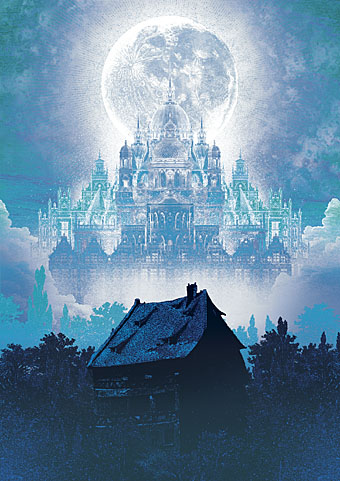
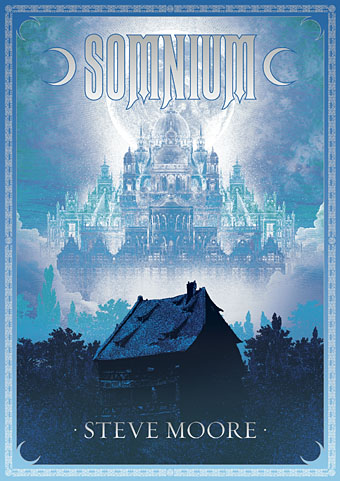
Author Steve Moore discusses Somnium, his occult novel for which I provided a cover illustration, with Pádraig Ó Méalóid at the Forbidden Planet site. In addition to examining his comics work and long friendship with Alan Moore, Steve also tells us something about his novel and his lunar obsession:

Without giving away too much of the plot, it’s a historical fantasy about a young man called Kit Morley in 1803 who, fleeing an impossible romance, arrives at an inn on Shooters Hill, where he’s intent on writing a story set in Elizabethan times, titled Somnium, which means ‘a dream’. In that story, a courtier named Sir Endimion Lee arrives on Shooters Hill and finds a lunar dream-palace called Somnium, where he encounters someone who appears to be a moon-goddess. Then there are various other stories embedded within these, set at various times, written in various styles and providing a number of layers, while Morley himself starts to question the nature of the world he’s living in. So it’s a fantasy, but a long way away from the sort of Tolkien-type adventure that a lot of people think of as fantasy.

As to what it’s about … myth (particularly that of the moon-goddess Selene and her mortal lover Endymion) and dream and the fluid nature of reality … lost love and redemption … the psychogeography and psychohistory of Shooters Hill, where I’ve lived all my life … about writing, and real and imaginary books … and goddesses, and Romantic Idealism. It’s poetic, and it’s very, very pagan …

Somnium, as mentioned before, is available direct from that splendid cabinet of curiosities, Strange Attractor.

Previously on { feuilleton }
Somnium by Steve Moore

Somnium by Steve Moore

somnium.jpg

Another new piece of illustration and design. Somnium is an occult novel by Steve Moore being published this month by Strange Attractor. Some readers here may know Steve’s work as a comics writer, ex-editor of Fortean Times and also the subject of Alan Moore’s recent Unearthing text and recording. I’ve not seen the book yet but it comes laden with praise from Michael Moorcock and Iain Sinclair, and features an afterword by Alan Moore:

Written in the early years of the 21st century, when the author was engaged in dream-explorations and mystical practices centred on the Greek moon-goddess Selene, Somnium is an intensely personal and highly-embroidered fictional tapestry that weaves together numerous historical and stylistic variations on the enduring myth of Selene and Endymion. Ranging through the 16th to 21st centuries, it combines mediæval, Elizabethan, Gothic and Decadent elements in a fantastic romance of rare imagination.

With its delirious and heartbroken text spiralling out from the classical myth of Endymion and the Greek lunar goddess Selene, Somnium is an extraordinary odyssey through love and loss and lunacy, illuminated by the silvery moonlight of its exquisite language.

The printed version should incorporate metallic silver ink on the title and border, something you can never quite replicate on a web image, hence the gradient on the title lettering. Somnium is available in a range of signed or unsigned editions and can be purchased direct from the Strange Attractor Shoppe.

Previously on { feuilleton }
Dodgem Logic again
Of Moons and Serpents

Weekend links 77

farmer.jpg

Art by Tessa Farmer.

• An exhibition of Tessa Farmer’s art is running at Viktor Wynd Fine Art, London, until October 30th. On Saturday, October 1st, Strange Attractor hosts Good Neighbours: Faeries, Folklore and the Art of Tessa Farmer also at Viktor Wynd.

Unearthing The Psychedelic Harp: “David Moats talks to harpist and songwriter Serafina Steer about her work with John Foxx and Patrick Wolf, being classically trained, the difficulties of doing live soundtracks and psychedelia.”

• And speaking of psychedelia, Arkhonia is still blogging up a storm here, here and here about the lost Beach Boys album, Smile, the farthest Brian and co. ventured into the tripped-out weirdness of 1967. The complete original recordings will finally be released in November.

• “‘We’ve arrived at a level of commodification that may have negated the concept of counterculture,’ Gibson says in the Paris Review.” William Gibson profiled by Thomas Jones.

One of the qualities I always stress when talking about this design work influenced by Surrealism is its enormous boldness and creative freedom, which is something of a paradox in many cases, since the Czech and Polish designs were created under communist regimes. So, while Uncanny documents a significant current in the history of 20th-century visual culture, the show also has a polemical intention aimed, quite deliberately, at our circumstances now. Students who encounter these images in lectures sometimes feel constrained by their conception of what they — or their teachers — regard as acceptable in today’s marketplace. At times, this has struck me as being a form of insidious self-censorship. (more)

Rick Poynor: Jan Švankmajer and the Graphic Uncanny.

• The exhibition curated by Mr Poynor last year, Uncanny: Surrealism and Graphic Design, is now showing at the Kunsthal in Rotterdam until early December. Related: MizEnScen’s somber, surrealist collages.

Howard Pyle’s Book of Pirates (1921) at Golden Age Comic Book Stories, the Urtext of buccaneer imagery.

bonnat.jpg

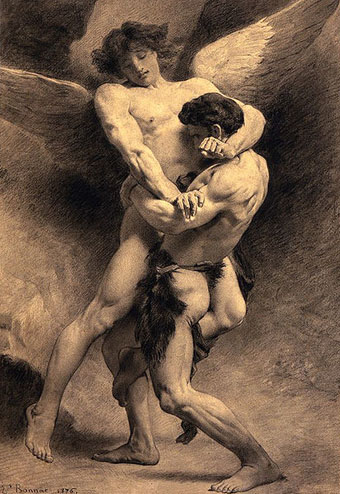
Another of those homoerotic religious pictures: Jacob Wrestling with the Angel (1876) by Léon Bonnat. Via Babylon Baroque.

• Celebrating the 250th anniversary of Laurence Sterne’s marbled page: Emblem of My Work.

John Martin’s Pompeii painting finally restored after 1928 Tate flood damage.

The Spectral Dimension: “where the paranormal and popular culture collide”.

The Writing of Stones (1970) by Roger Caillois at 50 Watts.

Mercury Arc Rectifiers.

• When silliness was an avant garde strategy: video from 1974 of Brian Eno performing China My China and (in better quality) The Seven Deadly Finns. (Go here for lyrics of the latter.)

Art is magic. Magic is art.

millidge.jpg

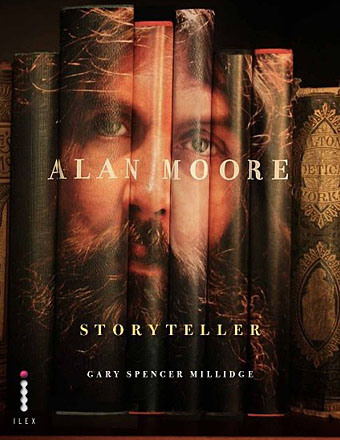
Cover concept by Chip Kidd.

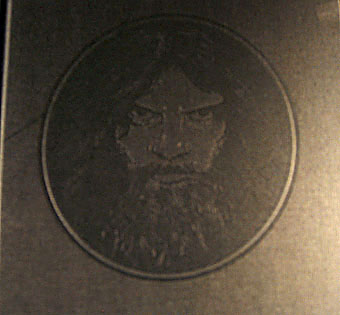
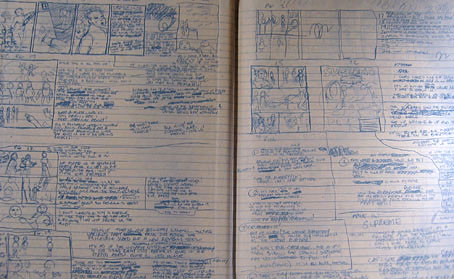
I noted the imminent arrival of Gary Spencer Millidge’s labour of love last month and the volume itself turned up this week, and what a book it is, a heavyweight hardback that’s far more lavish than I anticipated. The first surprise comes when removing the dust jacket to find Alan’s scowling visage embossed on the boards. Inside there’s a wealth of Moore ephemera from biographical material (lots of family photos) to insights into the scripting process behind the comics. I already knew Alan made little thumbnail sketches of his comic layouts before writing his scripts, having been fortunate enough to see one of the work-in-progress books for From Hell one time when I was chez Moore. Now everyone can have that opportunity. In addition there’s a thorough overview of Alan’s career, from the earliest juvenilia through to recent issues of Dodgem Logic. The comics career often overshadows his other work but in a later part of the book there’s considerable attention given to his collaborations with musicians, dancers and others for the Moon and Serpent performances. For my part it’s a pleasure to see some of the designs I created for the Moon and Serpent CDs printed large-size and in better quality than pressing plants manage with compact discs. None of those releases sold in great quantities and all are now out-of-print so the artwork often feels lost.

moore01.jpg

The front board.

What else? How about two sections of the book with fold-out pages? How about the first ever public appearance of Alan’s huge chart mapping the progress of every character through the unfinished Big Numbers? How about an introduction by Michael Moorcock where he calls Alan “a Robert Johnson of the Age of Doubt; questioning, confronting, mourning and yearning, representing his readers in profound ways, an intellectual autodidact, one of my few true peers for whom I have limitless respect.”? How about a compact disc featuring extracts from the Moon and Serpent CDs plus many other previously unreleased songs including pieces by the Emperors of Ice Cream? This is a gorgeous production designed by Simon Goggin and art directed by Julie Weir, and I haven’t even begun to read it yet. Is it necessary to state that it’s an essential purchase for anyone with more than a passing interest in Mr Moore and his many talented collaborators? Yours for twenty-five quid from Ilex Press. Some page samples follow.

moore02.jpg

Front endpapers showing Alan’s working notes and sketches.

Continue reading “Art is magic. Magic is art.”