Weekend links 689

cossard.jpg

Salammbô (1899) by Adolphe Cossard.

• At Unquiet Things: “A mystery that no longer exists: Wrinkle in Time cover artist revealed”. S. Elizabeth explains. I did a little research of my own into this enigma without success. Good to know that it’s been resolved.

• James Balmont’s latest guide to Japanese cinema is an examination of the transcendental oeuvre of Yasujiro Ozu.

• At Spoon & Tamago: Trains intersect with everyday life in nostalgic illustrations by Shinjiro Ogawa.

• DJ Food discovered a set of Zodiac posters by Bruce Krefting from 1969.

• At Wormwoodiana: John Howard on looking for misplaced Machens.

• At Vinyl Factory: Discovering Mort Garson with Hilary Wood.

• At Dennis Cooper’s: More Ozu in Yasujiro Ozu Day.

• New music: Multizonal Mindscramble by Polypores.

• Mix of the week is a mix for The Wire by Aho Ssan.

• Ioneye in conversation with Bill Laswell.

Train Song (1969) by Pentangle | Love On A Real Train (1984) by Tangerine Dream | Tokyosaka Train (2002) by Funki Porcini

Weekend links 663

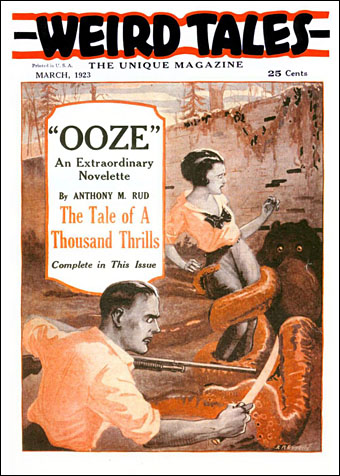
wt.jpg

Weird Tales celebrates its centenary this month (although the first issue was on the shelves in February, 1923). Thirty years later, one of the last issues from the initial run had Slime by Joseph Payne Brennan as the story featured on its cover. The magazine maintained a viscous consistency if nothing else. Tentacular art by RR Epperly.

• A big surprise in yesterday’s Bandcamp Friday was the announcement of Singularity, a new album by synth ensemble Node. Or new-ish since the previously unreleased recording is almost 30 years old:

Singularity is the legendary “lost” Node album. Recorded at the same time as their original sessions in 1994 this has DiN stalwart Dave Bessell join Buller & Flood alongside original member Gary Stout who was later replaced by Mel Wesson for the two DiN releases. Presented here for the first time, mastered to modern standards but otherwise untouched and in its original form and recorded to two track with no overdubs.

Node have never been very prolific—two decades separate their first album from their second—so this was very welcome. The new release includes a bonus addition of the 16-minute version of Terminus, one of their best pieces which has only been available previously on a scarce CD-single.

• Steven Watson at Print Mag on skeuomorphic magazine design that turns print into play. Now I want to design a book that fits inside a cassette box.

• RIP jazz giant Wayne Shorter, and David Lindley, co-founder of one of my favourite psychedelic groups, the incredible Kaleidoscope.

• S. Elizabeth at Unquiet Things on The Sensitive Plant, a poem by Percy Shelley illustrated by Charles Robinson.

• Christopher Parker at Smithsonian Magazine asks “Did Salvador Dalí paint this enigmatic artwork?” Yes, he did.

Tangerine Dream in 1973 playing Atem live (with pre-recorded drums) on Spotlight, an Austrian TV show.

• New music: Mohanam by Shakti, and Area Code 601 by William Tyler & The Impossible Truth.

• At Spoon & Tamago: Bento boxes inspired by notable Japanese architecture.

• At Tentaclii: Ian Miller cover art for metal albums.

Northern lights seen across the UK.

New Blue Ooze (1970) by Kaleidoscope | Ooze Out And Away, Onehow (1986) by Harold Budd/Simon Raymonde/Robin Guthrie/Elizabeth Fraser | Ooze (1986) by 23 Skidoo

Weekend links 653

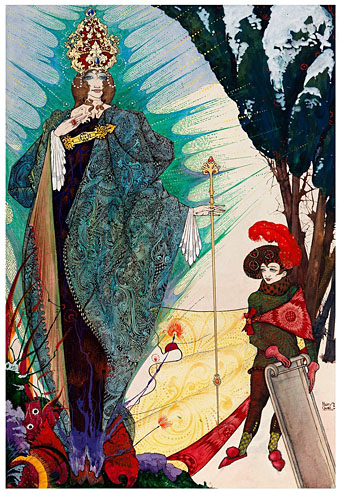
clarke.jpg

The Snow Queen (1916) by Harry Clarke.

• “…blogging remains my favourite format precisely because the writing so rarely feels like labour. Liberated from the need to pitch an idea or wield credentials, blogging—for a professional writer—frees you up to address topics outside your perceived expertise. It feels like a leisure activity because it’s leisurely—a ramble across fields of culture and knowledge, during which you sneak short cuts and trespass into areas you are not meant to go. A post doesn’t have to have a destination, a point. You can bundle or concatenate several different topics, push into adjacency things that don’t obviously or naturally belong together—like oddments inside a Cornell box. You can start somewhere and end up somewhere completely different, without any obligation to tie things up neatly.” Simon Reynolds reflecting on 20 years of the blogging thing, and neatly summarising the attractions of the medium. For some of us, anyway…

• At Smithsonian Magazine: “Structural colour was first documented in the 17th century, in peacock feathers, but it is only since the invention of the electron microscope, in the 1930s, that we have known how it works.” Tomas Weber on Andrew Parker’s nanotechnology developments which are creating some of the brightest hues in the world.

• “Bring back the Cailleach, beloved Scottish goddess of winter, shaking out the snow on the land. Bring back Mother Holda, with her wild geese and her snowflakes landing on the tongue like a gift from the sky…” Yvonne Aburrow would like to see the festival of Yule returned to its anarchic origins.

Merry Christmas Mr Lawrence, an extract from a recent audience-less concert by Ryuichi Sakamoto which he says is liable to be his last.

• At Unquiet Things: S. Elizabeth posts some of the pictures that couldn’t be fitted into The Art of Darkness.

• Mix of the week: A Tribute to Manuel Göttsching by Low Light Mixes.

• It’s the end of December so it must be time for Alan Bennett’s diary.

• RIP Mike Hodges.

Vale Berfrois.

Snow (1985) by Takashi Toyoda | Snowfall (2000) by Haruomi Hosono | Snowfall (2005) by Robin Guthrie & Harold Budd

Weekend links 639

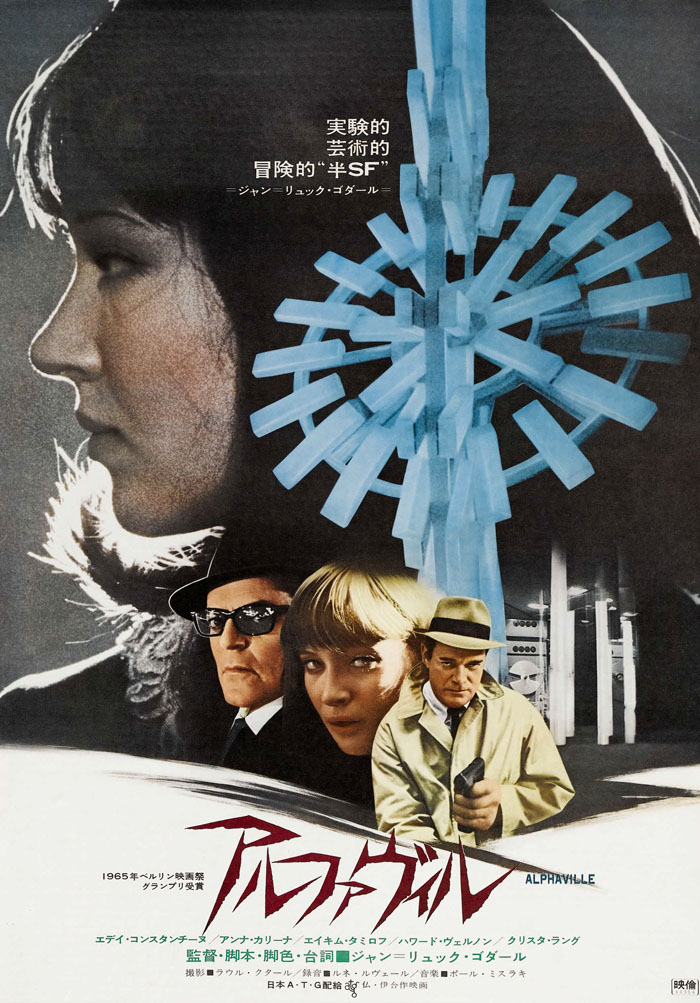
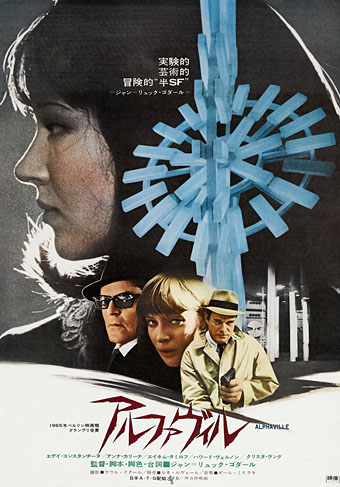
alphaville.jpg

Japanese poster for Alphaville (1965).

Peter Bogdanovich: I think we’d better have your thoughts on Godard.

Orson Welles: Well, since you’re so very firm about it. He’s the definitive influence if not really the first film artist of this last decade, and his gifts as a director are enormous. I just can’t take him very seriously as a thinker—and that’s where we seem to differ, because he does. His message is what he cares about these days, and, like most movie messages, it could be written on the head of a pin. But what’s so admirable about him is his marvellous contempt for the machinery of movies and even movies themselves—a kind of anarchistic, nihilistic contempt for the medium—which, when he’s at his best and most vigorous, is very exciting.

• RIP JLG. I was watching Alphaville again just two weeks ago after a DVD turned up in the local charity shop. Still the only Godard film I like 100% but “liking” seems beside the point. His influence today is everywhere, so fully absorbed into the language of cinema that people barely notice it.

• “The things that cause my gaze to linger are usually the portraits or landscapes that spark a feeling of unease, disquiet and discomfort. A shadow amongst the summer trees, a lurking silhouette reflected in a perfect blue iris, a vibrant flower in the early stages of decay.” S. Elizabeth talking to Beautiful Bizarre about her new book, The Art of Darkness: A Treasury of the Morbid, Melancholic and Macabre.

• Allow John Waters (again) to dictate your film viewing with a Letterboxd list of his favourite films, based on comments in his writings and interviews. On the subject of Godard, Waters’ Crackpot book contains a whole chapter about Hail Mary.

• Astor’s Electrical Future: Iwan Rhys Morus explores a vision of the year 2000 recounted in A Journey in Other Worlds (1894), a “scientific romance” by John Jacob Astor IV, with illustrations by Daniel Carter Beard.

• Strange Attractor has announced a Kickstarter campaign to fund the publication of an Austin Osman Spare Tarot deck.

• At Wormwoodiana: The Parrot, the Unicorn and the Golden Dragon: Some 17th Century Booksellers’ Signs.

• At Bandcamp: Andy Thomas on Chris Watson‘s post-Cabaret Voltaire career in nature recordings.

• A new outlet for cinematic obscurities: Radiance Films.

Alphaville (1978) by Klaus Schulze | Alphaville (1979) by The Monochrome Set | Alphaville (1999) by Scanner

Weekend links 634

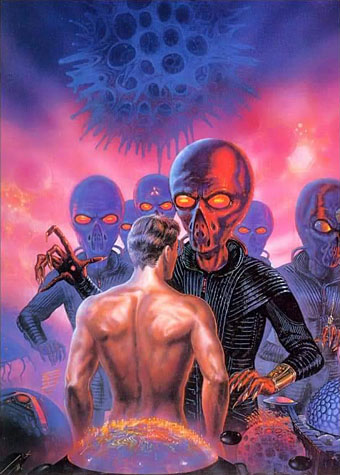
chaffee.jpg

Cover for Amazing Stories, October 1992, by Douglas Chaffee. A delightfully strange painting that suggests a no doubt unintentional homoerotic scenario when divorced from its original context. Via.

• “The most curious aspect of Buckminster Fuller’s arc is that he became a counterculture icon while entrenched in the very things that betrayed its spirit.” Pradeep Niroula on Buckminster Fuller (again) whose self-importance is deflated in a new biography, Inventor of the Future: The Visionary Life of Buckminster Fuller by Alec Nevala-Lee.

• “I love both King Diamond and Weird Al. Lana del Rey and Anna von Hausswolff. Golden age illustrations of elegantly levitating fairies in a lush vibrant summer garden and the gothic charcoal rendering of melancholy moth singed by a candle’s flame.” S. Elizabeth talking to Luna Luna Magazine about inspirations and The Art of Darkness.

• “I’m writing this from my office which has a record player, currently about eight thousand records, and just one CD.” Vinyl-head Jonny Trunk talking to Norman Records about the finding and releasing of rare music.

A painter’s brilliant achievements, the unique traits of his particular style, rest on an abiding substratum of coordinated specialized crafts, a body of knowledge and practice safeguarded by a tradition upheld by the guilds. Beneath the glimmer and foreground of art history, like a powerful underground river, flow the patterns of training and production developed in the crafts. Art history is centred on individual talents romantically bringing forth their creations on their own, out of nothing. Craft is collective and anonymous. Someone had to weave the pieces of cloth that form the giant canvas of Las Meninas. Someone had to sew them together so that the stitching would show as little as possible. Someone had to cut and to assemble the struts for its support and then nail to them a canvas which in fact is not of the highest quality. It seems that Velázquez enjoyed the roughness of a surface that favoured his subtle veils and ambiguities. The loose manner of painting developed in Venice is linked to the quality of the pigments that could be purchased there, as well as to the oil medium and the thick, porous quality of a cloth that allowed subtle veils and ambiguities that are impossible to achieve on the surface of a wood panel.

Antonio Muñoz Molina on the materiality of painting, and its highest expression in the art of Diego Velázquez

• The films of Japanese director Kinuyo Tanaka are criminally overlooked, says James Balmont.

Winners of the Nature TTL Photographer of the Year 2022.

• From 2012: The Disappeared by Salman Rushdie.

• At Dennis Cooper’s: Standish Lawder Day.

• New music: Octopus by Sunfear.

Come Sta, La Luna (1974) by Can | Fontana Di Luna (1978) by Michael Rother | La Luna En Tu Mirada (2003) by Ry Cooder & Manuel Galbán