The voice of Oscar Wilde

record.jpg

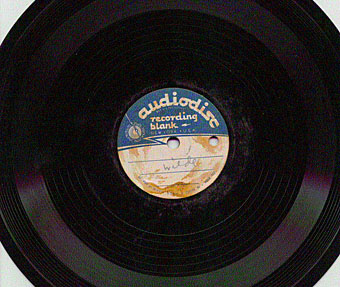
How to combine two recent {feuilleton} obsessions? Ask whether Oscar Wilde had his voice recorded on an Edison machine at the Exposition Universelle in Paris, 1900. It’s a tantalising question. We know from Wilde’s letters that he visited the Exposition several times; he talked with Rodin and admired a self-portrait by his old painter friend Charles Shannon in the British pavilion. Edison staff were prominent at the exposition and did us a favour by filming parts of it. Several of the Wilde biographies mention the rumoured recording, the details of which are recounted at Utterly Wilde:

According to H Montgomery Hyde’s 1975 biography of Oscar Wilde: “…It was during one of these visits to the Exhibition that Wilde was recognized in the American pavilion, where one of the stands was devoted to the inventions of Thomas Edison. One of these inventions was the ‘phonograph or speaking machine,’ and Wilde was asked to say something into the horn of the recording mechanism. He responded by reciting part VI of The Ballad Of Reading Gaol, which consists of the last three stanzas of the poem, and identifying it with his name at the end.” (More.)

The purported wax cylinder is lost but an acetate copy surfaced in the 1960s. Wilde’s son, Vyvyan Holland, identified his father’s voice then changed his mind later on. An analysis by the British Sound Archive threw further doubt on the recording so we’re left to make up our own minds which you can do for yourself here. It doesn’t sound to me like the voice one would expect from a man of Wilde’s physical size, but then I also never expected Aleister Crowley’s voice to be so highly-pitched. If anyone knows of more recent research or detail about the Wilde recording, please leave a comment.

Elsewhere on { feuilleton }
The Oscar Wilde archive

Steven Berkoff’s Salomé

salome1.jpg

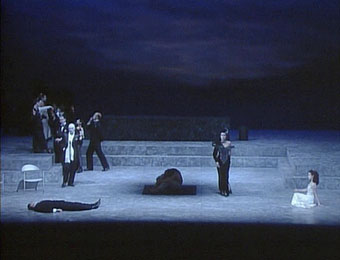
A new production of Oscar Wilde’s Salomé is touring the UK this month, a presentation of the Headlong company which will appear in a number of venues throughout the country but not in Manchester, unfortunately. My disappointment at this news prompted me by way of compensation to finally order a DVD of the Steven Berkoff production, a live performance filmed in Tokyo in 1992. I wish I’d done so sooner.

salome2.jpg

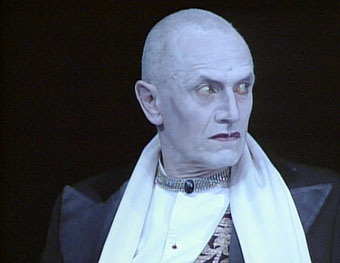
Herod (Steven Berkoff).

Berkoff’s production was first staged at the Gate Theatre, Dublin, in 1988. The play’s success led to a run at the National Theatre in London (with a Beardsley-derived poster) followed by performances worldwide. I don’t know how significant the original choice of venue was but the Gate Theatre was founded by Micheál MacLiammóir and Hilton Edwards in 1928. MacLiammóir was a great Wilde enthusiast whose one-man portrait of the writer, The Importance of Being Oscar, achieved considerable success in the 1960s. He would have relished Berkoff’s production.

salome3.jpg

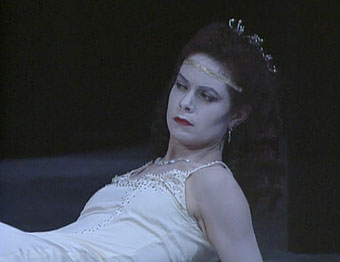
Salomé (Myriam Cyr).

Continue reading “Steven Berkoff’s Salomé”

Wildeana 2

wilde1.jpg

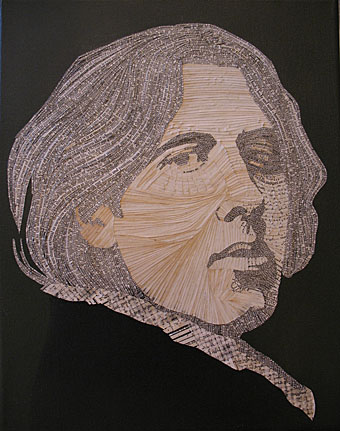
Further flotsam from the wilds (so to speak) of the web. The above portrait is a collage constructed by this Flickr user with pages from The Picture of Dorian Gray as the raw material. A remarkable work.

wilde2.jpg

Wilde’s face in the collage portrait comes from one of the famous photographs taken by Napoleon Sarony on the writer’s visit to America in 1882. Another of Sarony’s photographs was used as the basis for this cigar advert which sought to exploit Wilde’s fashionable notoriety. Possibly the first and last time that cigars have ever been offered for sale as “aesthetic”.

Continue reading “Wildeana 2”

Mark Twain

twaintesla.jpg

Nikola Tesla and Mark Twain, 1894.

Mark Twain died 100 years ago today, April 21st, 1910, and the anniversary is being marked in America by a variety of events throughout the year, some of which are listed on this dedicated site. I’ve always been grateful to Twain for cheering a portion of my dismal school days with The Adventures of Huckleberry Finn, one of two books we were forced to read that I actually enjoyed. (The other was Lord of the Flies; both stories, perhaps significantly, concern Wild Boys.) I’ve wanted to re-read Huckleberry Finn for years, perhaps now would be a good time to actually do so.

Unlike many writers of his generation, Twain’s work still seems vital today, and not only his fiction. His broadsides and polemics return continually to basic issues of tolerance and humanity and are often as relevant now as they were a century ago. Twain had little patience for the hypocrisies of his fellows when it came to matters of religion, warfare or the treatment of other human beings; like his contemporary, Oscar Wilde, he’s always been endlessly quotable. Consider these two extracts:

Citizenship? We have none! In place of it we teach patriotism which Samuel Johnson said a hundred and forty or a hundred and fifty years ago was the last refuge of the scoundrel—and I believe that he was right. I remember when I was a boy and I heard repeated time and time again the phrase, ‘My country, right or wrong, my country!’ How absolutely absurd is such an idea. How absolutely absurd to teach this idea to the youth of the country. True Citizenship at the Children’s Theater, 1907

But the truth is, that when a Library expels a book of mine and leaves an unexpurgated Bible lying around where unprotected youth and age can get hold of it, the deep unconscious irony of it delights me and doesn’t anger me. Letter to Mrs FG Whitmore, February 7, 1907

(more)

…then wonder what Twain would have to say about America’s current crop of blustering yahoos with their flags and crosses and misspelled signs.

A copy of the first edition of The Adventures of Huckleberry Finn, illustrated throughout by EW Kemble, can be downloaded at the Internet Archive. For Twain’s dim view of the Bible and its adherents, see his Letters from the Earth. The Tesla Memorial Society has another photograph of Twain in the great inventor’s laboratory.

Manuel Orazi’s Salomé

orazi1.jpg

The Biblical bad girl returns in three pictures from an illustrated edition of Oscar Wilde’s play, published as a limited run in 1930. Manuel Orazi (1860–1934) was a French artist whose work has appeared here before, and no doubt will do again very soon since I’ve been finding further examples of his illustrations and designs. These drawings are closer to Gustav Klimt or George Barbier than his earlier illustrations which owed much to the stylisation of Mucha’s Art Nouveau.

orazi2.jpg

orazi3.jpg

Elsewhere on { feuilleton }
The illustrators archive
The Salomé archive