Night’s black agents

dulac.jpg

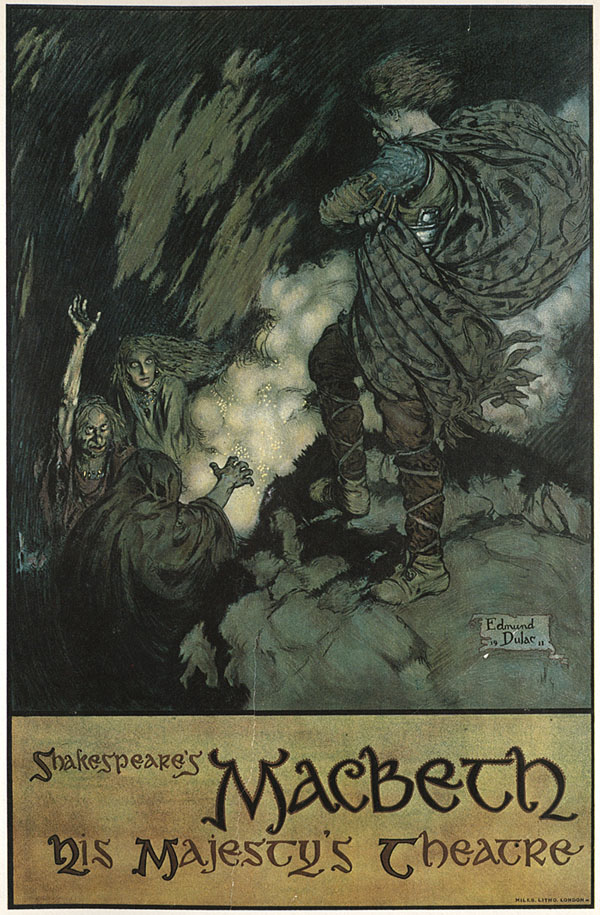
Poster by Edmund Dulac (1911).

This month sees a profusion of events marking the 400th anniversary of Shakespeare’s death so here’s my contribution, a rundown of Macbeths-I-have-seen on screen and stage. I’ve mentioned before that Macbeth and The Tempest are my favourite Shakespeare plays, two dramas concerned with magic of very different kinds. Macbeth is the more popular play, not least for being the more easily adaptable: the supernatural dimension may not suit every circumstance but the themes of treachery, fear, paranoia and a murderous struggle for power are universal. This list contains a wide range of adaptations but there are many film versions I’ve yet to see, including the most recent directed by Justin Kurzel.
welles.jpg

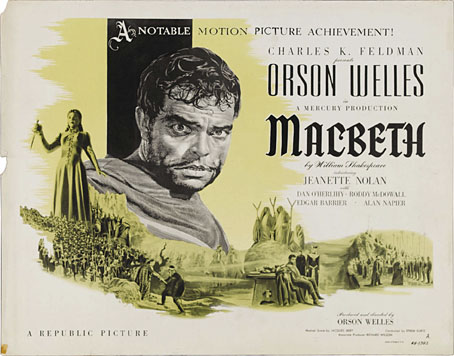
Macbeth (1948), directed by Orson Welles
Orson Welles as Macbeth
Jeanette Nolan as Lady Macbeth

I think the Welles adaptation was the first Macbeth of any kind that I saw so it’s fitting that it begins this chronological list. Famously shot over three hectic weeks on the sound stages of Republic Studios, and with sets made from props previously used in cheap westerns, the result is often eccentric. I’ve a lot of time for Welles as a director but this is one film of his that I’ve never enjoyed very much. His theatre performances (and productions) of Shakespeare began at school, and he was seldom precious with the texts: Chimes at Midnight is a fusion of several different plays while this version of Macbeth uses the same doctored script that he directed for the Voodoo Macbeth in Harlem in 1936. I don’t mind some editing—short scenes such as the witches’ meeting with Hecate are often excised—but some of Welles’ changes are made to support his belief that the witches are directly responsible for Macbeth’s actions, a theory I don’t agree with, and which I’ve never seen given credence elsewhere. This explains oddities such as the appearance of the witches at the very end of the film delivering words from the beginning of the play: “Peace! The charm’s wound up.”

Worse than this is the decision to have most of the cast speaking with vague Scottish accents (a “burr” Welles called it), something that would work with a Scottish cast but which courts disaster with a group of Americans working in haste. The accents may be warranted by the setting but the words of the play are English ones, free of common Scottish colloquialisms such as “ken”, “bairn” and the like. On the plus side, it’s good to see Harry Lime-era Welles performing Shakespeare, and the mist-shrouded production has a barbaric quality that Jean Cocteau appreciated. The forked staff that each witch carries is a detail that I’ve borrowed for drawings on a number of occasions.
joemacbeth.jpg

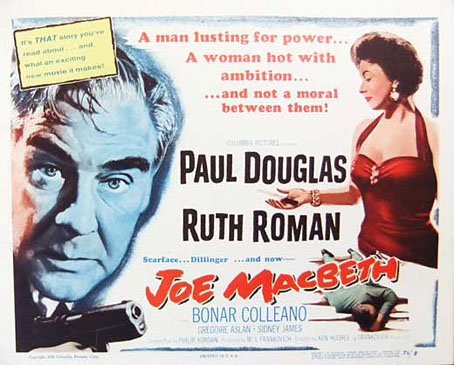
Joe MacBeth (1955), directed by Ken Hughes
Paul Douglas as Joe MacBeth
Ruth Roman as Lily MacBeth

The play reworked as a cheap gangster picture set in the Chicago of the 1930s but made in Britain with a partly American cast. I’ve only seen this once (and many years ago) but I recall it being pretty ludicrous, not least for another accent problem with the English actors doing bad impersonations of Chicago hoodlums. Anyone who grew up watching the Carry On comedy films has a hard time taking Sid James seriously in heavy roles, and here he plays the Banquo character, “Banky”. Joe MacBeth is chiefly notable today for being the first entry in the Macbeth-as-gangster sub-genre; after this there was Men of Respect (1990), Maqbool (2003, an Indian film set in Mumbai), and Macbeth (2006, an Australian film set in Melbourne), none of which I’ve yet seen.
Continue reading “Night’s black agents”

Weekend links 269

cluster.jpg

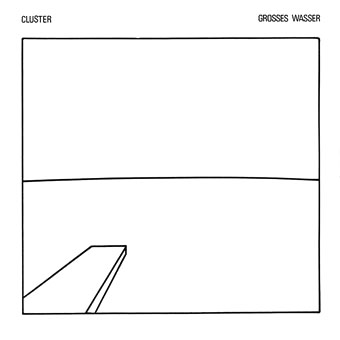
Grosses Wasser (1979) by Cluster. Cover art by Dieter Moebius.

• RIP Dieter Moebius: one half of Cluster (with Hans-Joachim Roedelius), one third of Harmonia (with Roedelius and Michael Rother), and collaborator with many other musicians, including Brian Eno and Conny Plank. Geeta Dayal, who interviewed Moebius for Frieze in 2012, chose five favourite recordings. From 2008: Cosmic Outriders: the music of Cluster and Harmonia by Mark Pilkington. At the Free Music Archive: Harmonia playing at ATP, New York in 2008. Live recordings of Cluster in the 1970s have always been scarce but in 1977 they played a droning set at the Metz Science-Fiction Festival, a performance that was broadcast on FM radio (the Eno credit there seems to be an error).

• “I’ve since had the feeling that, if the attacks against The Satanic Verses had taken place today, these people would not have defended me, and would have used the same arguments against me, accusing me of insulting an ethnic and cultural minority.” Salman Rushdie on the fallout from the Charlie Hebdo killings.

• “The effect of these memories is to make you think you know the film better than you do, and wonder what it’s like actually to sit down and watch it.” Michael Wood on rewatching Orson Welles’ Touch of Evil (1958). Related: Tipping My Fedora on the film’s source novel, Badge of Evil (1956).

“To me, it’s simple,” he says. “Fantasy became as bland as everything else in entertainment. To be a bestseller, you’ve got to rub the corners off. The more you can predict the emotional arc of a book, the more successful it will become.

“I do understand that Game of Thrones is different. It has its political dimensions; I’m very fond of the dwarf and I’m very pleased that George [R R Martin], who’s a good friend, has had such a huge success. But ultimately it’s a soap opera. In order to have success on that scale, you have to obey certain rules. I’ve had conversations with fantasy writers who are ambitious for bestseller status and I’ve had to ask them, ‘Yes, but do you want to have to write those sorts of books in order to get there?’”

Michael Moorcock talking to Andrew Harrison about fantasy, science fiction, the past and the present.

• “Architects love Blade Runner, they just go bonkers. When I was working on the film, it was all about, let’s jam together Byzantine and Mayan and Post-Modern and even a little bit of Memphis, just mash it all together.” Designer and visual futurist Syd Mead talking to Patrick Sisson.

• “Lucian of Samosata’s True History reads like a doomed acid trip,” says Cecilia D’Anastasio, who wonders whether or not the book can be regarded as the earliest work of science fiction.

• Mixes of the week: A Tribute to Dieter Moebius by Vegan Logic, and another by Totallyradio.

• The Phantasmagoria of the First Hand-Painted Films by Joshua Yumibe.

Islamic Geometric: calligraphic tessellations by Shakil Akram Khan.

Michael Prodger on The Dangerous Mind of Richard Dadd.

A chronological list of synth scores and soundtracks.

Touch Of Evil (Main Theme) (1958) by Henry Mancini | Badge Of Evil (1982) by Cabaret Voltaire | Touch Of Evil (2009) by Jaga Jazzist

Weekend links 258

stalenhag.jpg

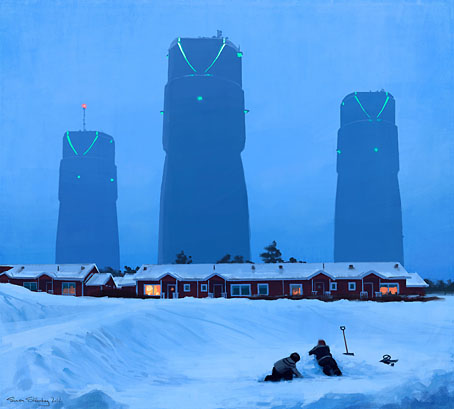
Simon Stålenhag‘s SF artwork will be published in book form if funding is secured. In the future everything will be crowdfunded for 15 minutes.

• Mixes of the week: FACT Mix 494 is a fantastic dub selection by Colleen; Secret Thirteen Mix 151 is by Sally Dige; Stephen Mallinder‘s return to the doom-laden Industrial music of the 1980s suits the post-election mood. Mallinder’s mix is helping promote Industrial Soundtrack for the Urban Decay, a documentary by Amélie Ravalec.

• “…it felt more like real life to me than the average hour-long television show.” Sopranos creator David Chase on what he enjoyed about Twin Peaks. Related: Twin Peaks Tarot cards.

Sound & Song in the Natural World edited by Tobias Fischer & Lara Cory. A book about animal music and communication with a 60-minute CD of field recordings.

• “The psychedelic renaissance has already begun, and for the most part I welcome it,” says Erik Davis in a wide-ranging interview with Sean Matharoo.

• It rumbles on: Brown Pundits on “An Embarrassment at PEN”. A useful collection of stories, reactions and polemic from the past two weeks.

Fanny and Stella: The Shocking True Story, a play by Glenn Chandler about Victorian London’s scandalous pair of cross-dressing men.

• Artist Charles Ray causes a problem for the Whitney Museum of American Art with his sculpture of a naked Jim and Huckleberry Finn.

• “Don’t believe Orson Welles,” says his biographer Simon Callow, “especially when he calls himself a failure.”

• A return to Adolph Sutro’s Cliff House features several photos I’d not seen before.

• More Tarot: Arcana: The Tarot Poetry Anthology is looking for funding.

• At Dangerous Minds: The ancient magic of the record label.

Foreign Movie Posters

Tarot (Ace of Wands theme, 1970) by Andy Bown | Distant Dreams (Part Two) (1980) by Throbbing Gristle | The Devil In Me (1982) by Stephen Mallinder

The Marty Feldman Comedy Machine

feldman.jpg

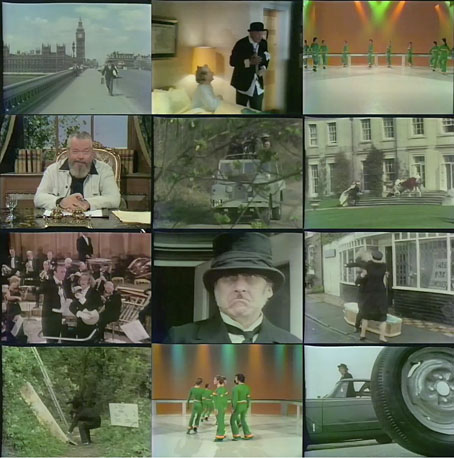
A final Orson Welles post for this week of Wellsiana. Welles was a familiar face on UK television in the early 70s, mostly for the notorious sherry adverts but he was also popular on chat shows. For Anglia Television he presented a number of short story adaptations in Orson Welles’ Great Mysteries, but had nothing else to do with the series. His appearance on The Marty Feldman Comedy Machine (1971) is unusual for being an acting role in a sketch series, with Welles presenting and narrating a film about the preservation of endangered British aristocrats. There’s some crossover here with the London sketches Welles had filmed a couple of years before (see yesterday’s post): Welles played an English Lord in one of those sequences, and one of his co-actors was Tim Brooke-Taylor, a writer on Comedy Machine.

I’d hope that Marty Feldman needs no introduction. Most people know him as Igor in Mel Brooks’ Young Frankenstein but in the late 60s and early 70s he was almost another member of the Monty Python team, writing and performing in the pre-Python At Last the 1948 Show (the origin of the Four Yorkshiremen sketch). The Marty Feldman Comedy Machine, which ran for 14 episodes, is very Pythonesque—there’s even a Terry Gilliam title sequence—but the format is much more traditional. Besides Orson Welles, a highlight of this episode is Spike Milligan reading some of his nonsense poetry, and performing in a sketch about competing undertakers. Watch it here:

The Marty Feldman Comedy Machine Part 1 | Part 2

Previously on { feuilleton }
Orson Welles: The One-Man Band
The Immortal Story, a film by Orson Welles
Welles at 100
The Fountain of Youth
The Complete Citizen Kane
Return to Glennascaul, a film by Hilton Edwards
Screening Kafka
The Panic Broadcast

Orson Welles: The One-Man Band

omb1.jpg

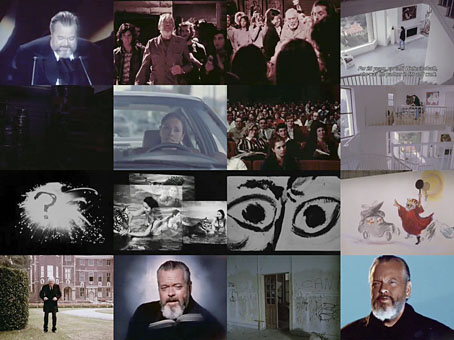
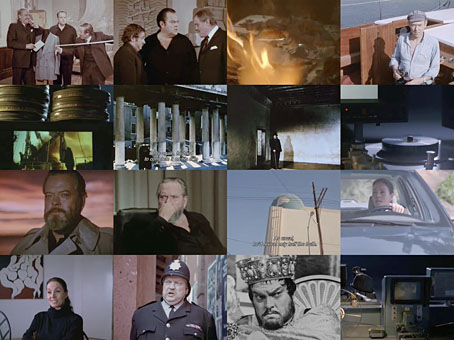
Vassili Silovic’s 90-minute documentary about the uncompleted films of Orson Welles’ later years was a revelation when it appeared in 1995. Orson Welles: The One-Man Band was shown on UK TV as The Lost Films of Orson Welles but “one-man band” is more appropriate, not only because of the bizarre song-and-dance sequence he filmed in London, but also because it’s an apt description of Welles’ approach to filmmaking. Directors who also write and produce are rare but not too uncommon; directors who write, produce and also act in major roles are in a minority. Welles did all those things and often much more, including editing, set decoration and providing voices for minor characters. The latter habit can be distracting in some of the films, especially Mr Arkadin where it often seems he was doing the voices for everyone who wasn’t already a known actor.

omb2.jpg

The One-Man Band is a compendium of clips from footage bequeathed to his partner, Oja Kodar, together with interviews, TV appearances, a witty and duplicitous trailer for F for Fake, and other odds and ends. This was the first public airing of scenes from The Deep, an unfinished feature based on a thriller, Dead Calm (1963) by Charles Williams (later filmed by Philip Noyce as Dead Calm in 1989.) There’s also a sequence from The Other Side of the Wind, another feature that was closer to completion, and which may yet receive a proper release. The sequence showing Welles discussing The Trial with an audience is now available in full on YouTube. The London clips were intended for US TV, part of an unfinished special entitled Orson’s Bag. These were filmed in the late 60s, and the song-and-dance sequence is probably the strangest thing he directed. I’m more taken with the Tailors sketch which has Jonathan Lynn and the wonderful Charles Gray as a pair of disrespectful outfitters.

Previously on { feuilleton }
The Immortal Story, a film by Orson Welles
Welles at 100
The Fountain of Youth
The Complete Citizen Kane
Return to Glennascaul, a film by Hilton Edwards
Screening Kafka
The Panic Broadcast