Steven Soderbergh’s Kafka

kafka_poster.jpg

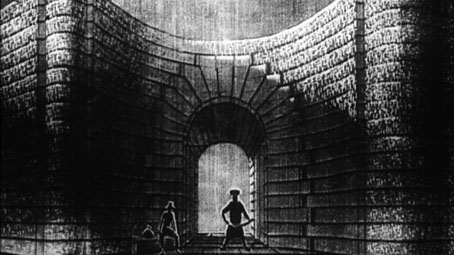
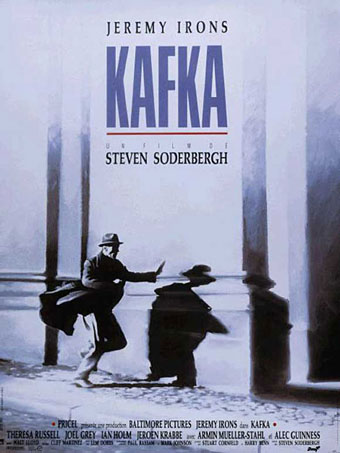
Do you detect a theme this week? The recent Pragueness had me watching this favourite film again. I unfairly dismissed Soderbergh after his debut, Sex, Lies and Videotape (1989), which I found to be two hours of yuppie tedium despite its winning the Palme D’Or at Cannes. The prize did enable him to make Kafka (1991), however, so I shouldn’t complain although I didn’t get to see this until it turned up on TV years after its release. The film was a major flop and put Soderbergh in the wilderness until Out of Sight (1998), his first outing with George Clooney.

Kafka is one of a small group of works wherein well-known writers become embroiled in stories which parallel their fiction. Joe Gores’ Hammett (filmed by Wim Wenders in 1982) did this with Dashiell Hammett while Mark Frost in his novel, The List of Seven, had a pre-Sherlock Holmes Arthur Conan Doyle becoming involved in a Holmesian mystery. The screenplay for Kafka by Lem Dobbs has the author falling in with anarchist revolutionaries in order to solve the death of a co-worker and a bureaucratic conspiracy. This was obviously too clever for a general audience, being littered with references to Kafka’s life and work and also to German Expressionist cinema with names like “Orlac” and “Murnau” comprising key plot elements. Dobbs wrote a couple of other noteworthy screenplays after this, Dark City, a noirish fantasy that does what The Matrix did only with greater imagination, and The Limey (1999), another Soderbergh film with a great performance by Terence Stamp as a vengeful Cockney gangster on the loose in Los Angeles.

kafka.jpg

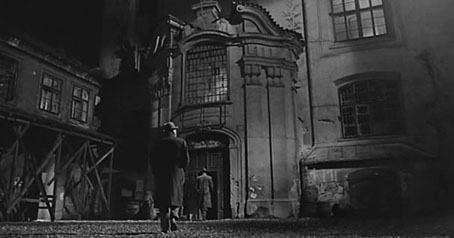
Alan Bennett had already written something similar to Kafka in his 1986 TV film for the BBC, The Insurance Man, which concerns a dye worker becoming enmeshed in the labyrinthine bureaucracy of the Worker’s Accident Insurance Institute where Kafka worked as a clerk. Daniel Day-Lewis made a marvellous Franz Kafka in Bennett’s play, and was much more suited to the role than Jeremy Irons is in Soderbergh’s film. This is a shame since everything else about Kafka is excellent, from Walt Lloyd’s moody photography, and the fabulous cymbalom-inflected score by Cliff Martinez, to the cast which includes the wonderful Theresa Russell, Joel Grey, Ian Holm and, in one of his last performances, Alec Guinness.

Kafka is also the Prague film par excellence, making great use of the city’s Old Town and landmarks such as the Charles Bridge and Prague Castle, a building which dominates the story as well as many of the outdoor scenes. In fact I find myself watching it as much for the settings than anything else. Soderbergh enjoys cinematic pastiche and Kafka owes a great deal to The Third Man (which did for post-war Vienna what Kafka does for Prague) and—inevitably—Orson Welles’ Kafka adaptation, The Trial. Theresa Russell brings Vienna with her via Nicolas Roeg’s Bad Timing, Joel Grey was in Cabaret, of course, and Alec Guinness isn’t so far removed from his role as retired spy George Smiley in the BBC’s John le Carré films. And halfway through the film there’s a great surprise which I won’t spoil here.

Kafka is available on DVD finally, although if you’re in the US you’ll have to import it. Soderbergh has talked about reworking the film in a longer version which I’d like to see if he ever gets round to it. Not an easy film to find but it’s worthy of your attention.

Previously on { feuilleton }
Kafka and Kupka
Alexander Hammid
How to disappear completely
Karel Plicka’s views of Prague
Giant mantis invades Prague
Nosferatu
Barta’s Golem

Michelangelo Antonioni, 1912–2007

passenger.jpg

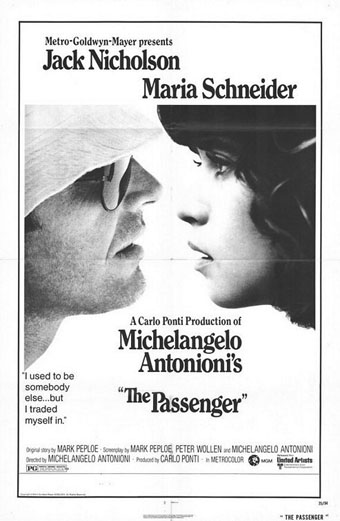
Another one bites the dust… What are the odds against two of the last surviving big names of cinema expiring in the same week? I could never get fully behind Antonioni the way I could with Bergman, I didn’t think much of the Neo-Realist school that Antonioni began as a member of while later films such as L’Avventura seemed like empty stylistic exercises. He divided opinion even among his peers—Orson Welles couldn’t bear his work whereas Stanley Kubrick put La Notte in a “ten best” list in 1963. I always enjoyed Blow-up (1966) even though it seems fatuous next to Performance while Zabriskie Point (1970) is a joke. But I like The Passenger (aka Professione: Reporter, 1975) very much.

A simple story—reporter in the Sahara swaps identities with a dead arms dealer then goes on the run—featured Jack Nicholson giving one of his last good performances before his descent into gurning self-parody. Also Ian Hendry, Steven Berkoff (between Kubrick films) and Jenny Runacre shortly before she was in Jubilee for Derek Jarman. The film works as an extended travelogue, ranging from Africa to England then into Spain as Nicholson’s character picks up student Maria Schneider on his travels and is pursued by his wife (who doesn’t believe he’s dead) and men intent on killing him. Events are resolved during a celebrated seven-minute single take where the camera passes miraculously through the iron bars of a hotel window. One of Antonioni’s finest qualities was his appreciation of architectural and cinematic space and the final shot of the film is a perfect example of this. The Passenger was out of circulation for years but is now available on DVD.

Guardian obituary | David Thomson appreciation

Previously on { feuilleton }
Further Back and Faster

Voodoo Macbeth

voodoo.jpg

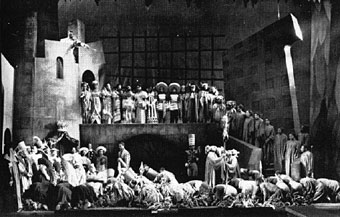
In my obsession with all things Orson Welles, his 1936 production of Macbeth holds a special fascination, partly for being my favourite Shakespeare play, and partly for the curiosity of its production—an all-black cast that included genuine Haitian drummers who famously claimed to have drummed a Broadway critic to death after he gave the play a hostile review. The De La Warr Pavilion in Bexhill-on-Sea is hosting an art event based on Welles’ production.

In 1936, whilst the UK was celebrating the new De La Warr Pavilion, and exciting artistic movement was reaching its close in New York—the Harlem Renaissance. A significant event within of this movement was an all-black African American version of Macbeth, presented by The Federal Theatre Project at the New Lafayette Theatre, Harlem and directed by writer and actor Orson Welles. This production became known as ‘Voodoo Macbeth‘.

There are many things that were remarkable about this unique and innovative project. The play was one of the first explorations of a modern and diasporic spin on the Shakespearian tale. It was also the point at which Welles was introduced to John Houseman, which then led to the formation of the Mercury Theatre Company that produced seminal works such as the War of the Worlds and Citizen Kane. Furthermore, the ‘Voodoo Macbeth‘ production displayed visual and aural motifs using lighting, stage design and overlapping sound which became signature elements to Welles’s later film projects.

The essence, spirit, and cross-artform experimentality of ‘Voodoo Macbeth‘ is the basis for a contemporary art, film and performance season at the De La Warr Pavilion and has been named after the production. This unique project looks at the historical and contemporary dialogue that Welles’s work had and still has with performance, film and visual art.

The curatorial concept of the De La Warr Pavilion’s exhibition Voodoo Macbeth focuses on the debate and the ideas around Welles’s unique and defining aesthetic which continues to attract much critical attention. The exhibition suggests that Welles’s approach has informed the work of many contemporary artists working in film today.

Both the historical and contemporary context of Voodoo Macbeth are explored within the exhibition and wider season of events. Original works by Orson Welles are presented alongside those of his contemporaries including Jean Cocteau, Jacques Tourneur and Lee Miller. These artists were working with film and photography during the period of the 1940s onwards and have a shared concern in exploring visual ideas and motifs around the idea of an ‘expansive frame’. As artists, they blurred the boundaries between visual art, theatre, literature and film, to produce lyrical and poetic visual works.

Work by contemporary artists within the exhibition have been selected on the basis that their work embodies the artistic narrative and the spirituality of Welles’s use of light, dark and spatial composition. The exhibition includes work by Phyllis Baldino, Glenn Ligon, Steve McQueen, Mitra Tabrizian and Kara Walker. In this context, Voodoo Macbeth explores how, for artists today, the genre and its relationship to installation practice in performance, film, sound and visual art is an important part of the process. Importantly, they do not mimic the formalist structure of film, painting and sound but endeavour to embed these works with elements of popular culture, critique and humour. Like Welles, who was a masterful story teller, these artists have developed works which take on the character of an intimate 21st century tale. Unlike Welles, these tales are tailor-made, for a gallery audience to explore and enjoy.

Produced by the De La Warr Pavilion in association with Brighton Photo Biennial and curated by associate curator David A Bailey in collaboration with BPB curator 2006 Gilane Tawadros.
The Galleries are open 10am–6pm except on Christmas Eve (closing
at 5pm), Christmas Day (closed all day) and New Year’s Eve (closing at 3pm). Free.

Voodoo Macbeth, Oct 7th–Jan 7th.

The Voodoo Macbeth exhibition is a part of the Brighton Photo Biennial, for more details on the BPB please visit their website www.bpb.org.uk, or contact them via the details below.
Biennial Office
University of Brighton
Grand Parade
Brighton BN2 0JY

Tel: +44 (01)273 643 052
Email: mail@bpb.org.uk
Kiss Me Deadly

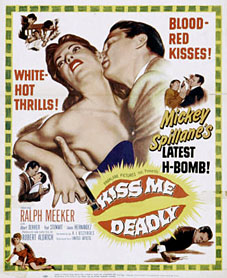
Va-va-voom! Kiss Me Deadly (1955) and Orson Welles’s great Touch of Evil (1958) both came at the end of the film noir cycle in the late 1950s. Both films look into the dark heart of American life during that decade, with Aldrich tackling nuclear paranoia and Welles dealing with racism towards Latin-Americans and political and legal corruption. Both films have long been favourites of mine and both remain startlingly relevant now, as Alex Cox discusses below. Cox might have mentioned another film that borrows the motif of the baleful nuclear box, his own Repo Man (1984).

* * *

kiss_me_deadly.jpgNuclear-powered nastiness
It’s one of the darkest noirs ever made. But, says Alex Cox, the classic Kiss Me Deadly is a parable at heart

It begins with titles that famously run backwards. Deadly … Kiss Me … Aldrich … Robert … Directed by … Then, two scenes in, a women we have assumed to be the heroine is tortured to death. This is no art film, though; no knowing homage. Instead, it’s the roughest, least compromising film noir of them all – Kiss Me Deadly.

The hero (if we can call him that) is Mike Hammer, a tough, no-nonsense detective created by pulp fiction author Micky Spillane. Spillane’s Hammer was of a different breed from the detectives who had gone before. Dashiell Hammett’s Continental Op and Raymond Chandler’s Marlowe were tough and cynical, but also intelligent, decent and insightful. Spillane’s Hammer was an indecent thug. A product of Senator McCarthy and the blood-lust of the Korean war, he liked nothing better than pounding commie sympathisers’ heads against a wall until their eyeballs popped.

Robert Aldrich’s Hammer – played by the oddly named Ralph Meeker – is worse than Spillane’s. Aldrich’s protaganist is cynical and dumb; a thug without insight, a detective who fails to detect. In a way, he is a prototype for the automaton-hero played by Lee Marvin in 1967’s Point Blank, and done to a turn by Arnold Schwarzenegger in The Terminator. (More.)