James Cawthorn: The Man and His Art

cawthorn-cover.jpg

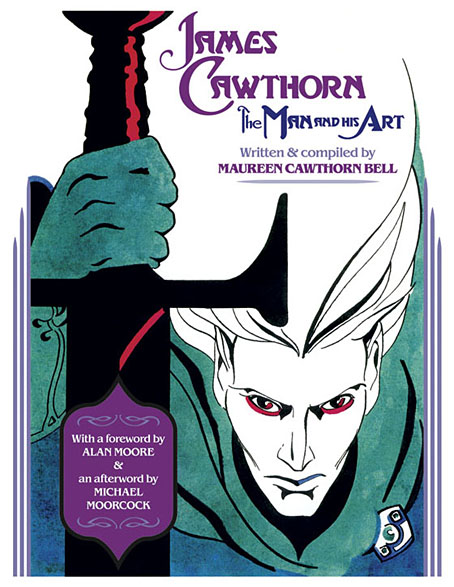
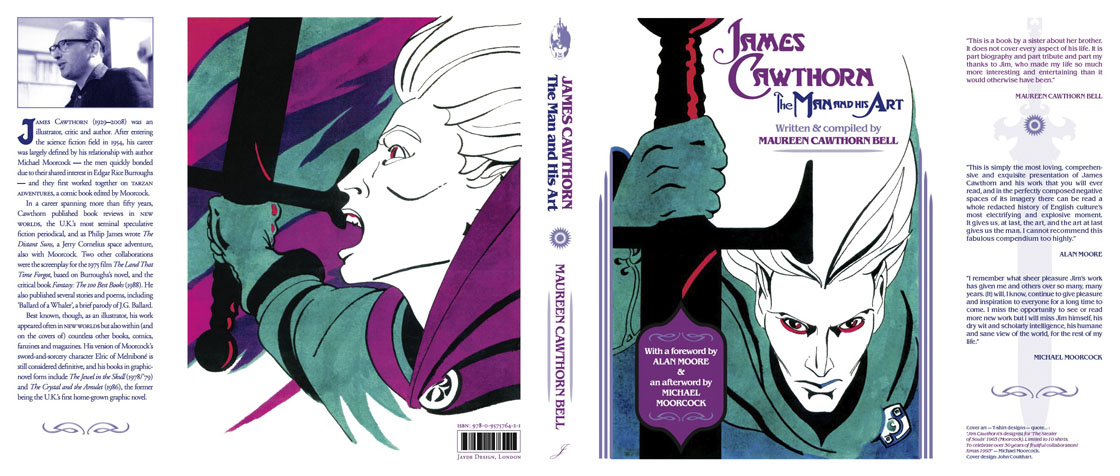
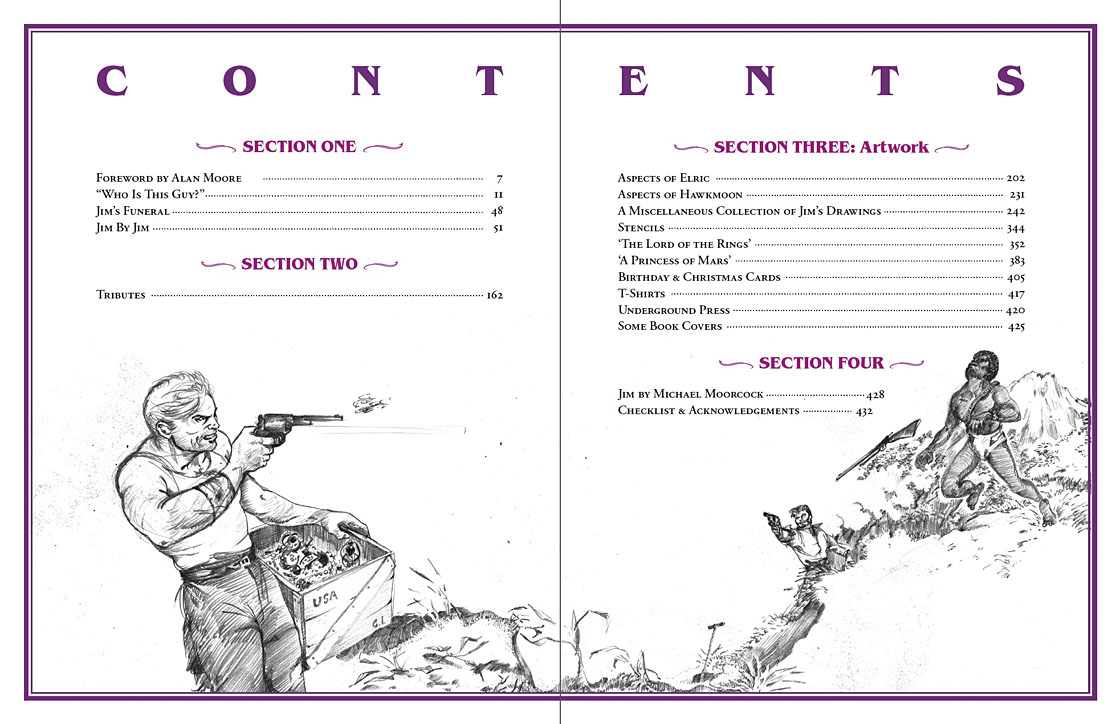
The past year would have been busier than usual with the amount of illustration work I had to deal with, but it was made even busier with my having to design this book at the same time. James Cawthorn: The Man and His Art was originally intended to be a modest memorial by Maureen Cawthorn Bell for her artist brother following his death in 2008, but the book grew into a heavyweight volume of 448 pages containing over 800 individual pieces of art: book covers, illustrations for magazines and fanzines, private pieces for friends and relatives, and many sketches or preliminary works, most of which have never seen print before.

cawthorn-coverspread.jpg

Given Jim Cawthorn’s long association with Michael Moorcock, as both friend and collaborator, the task of collating the artwork and editing the book went to Moorcock bibliographer John Davey, who also serves as the book’s publisher. John spent three years locating over 3000 pieces of artwork, large and small. Some of these pieces are now lodged with the Moorcock archives in the Bodleian Library, Oxford, while others may only be found in the pages of the many science fiction and fantasy fanzines that Jim illustrated, copies of which are stored at the British Library. From this body of material Maureen and John selected a core of representative work from Jim’s private as well as public life, although no-one at the outset of the project was expecting the final picture tally to be so high.

cawthorn-spread-01.jpg

My task as the book’s designer involved making the text presentable (easy) and corralling the artwork (not so easy, and I also had to either clean or colour-adjust every single piece). Maureen had divided the book into several sections, beginning with a lengthy biographical reminiscence. Following this was “Jim by Jim”, a selection of interviews, magazine pieces, some fiction, essays and book reviews. There was also a lengthy extract from Fantasy: 100 Best Novels (1988), a book credited to Jim and Michael Moorcock but, by Moorcock’s admission, mostly Jim’s work. Jim Cawthorn was very well-read, especially in the genres—he was old enough and interested enough to have read The Lord of the Rings when it was first published—and could also present his erudition engagingly for a reader, so the text section of Maureen’s book is far from indulgent.

cawthorn-spread-02.jpg

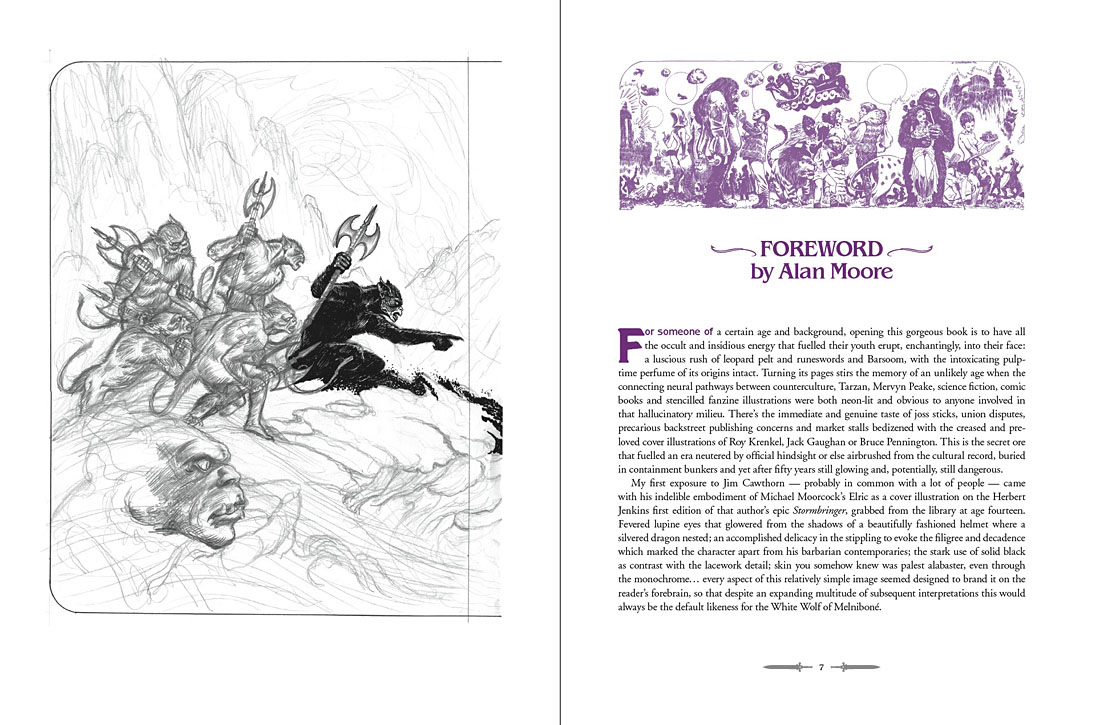
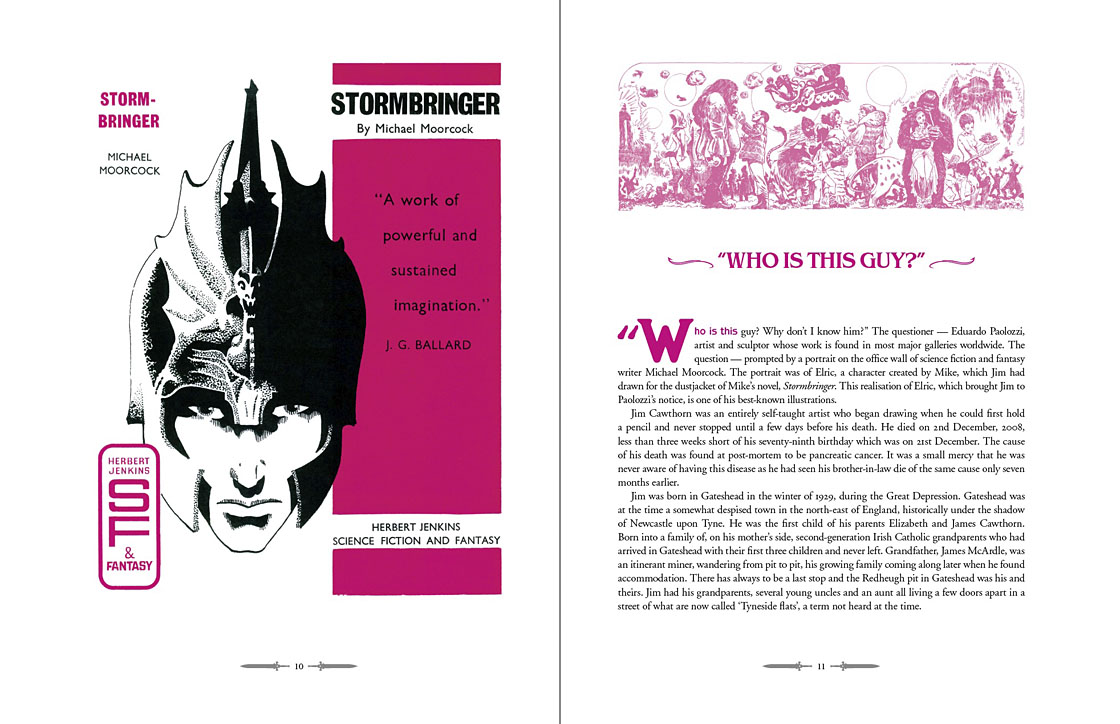
The book design isn’t as elaborate as some I’ve worked on but it didn’t need to be when the pictorial material is rich with what Moorcock calls “wizardry and wild romance”. Maureen wanted a particular picture of Moorcock’s Elric character on the cover so I took details and motifs from some of Jim’s many Elric illustrations to give the book a thematic thread and internal consistency. Cawthorn was present at the creation of Elric in the early 1960s; he not only provided Moorcock’s characters with their first illustrations but even helped plot one of the earliest stories, Kings in Darkness.

cawthorn-number.jpg

Page numbers are framed by the swords from the Elric stories.

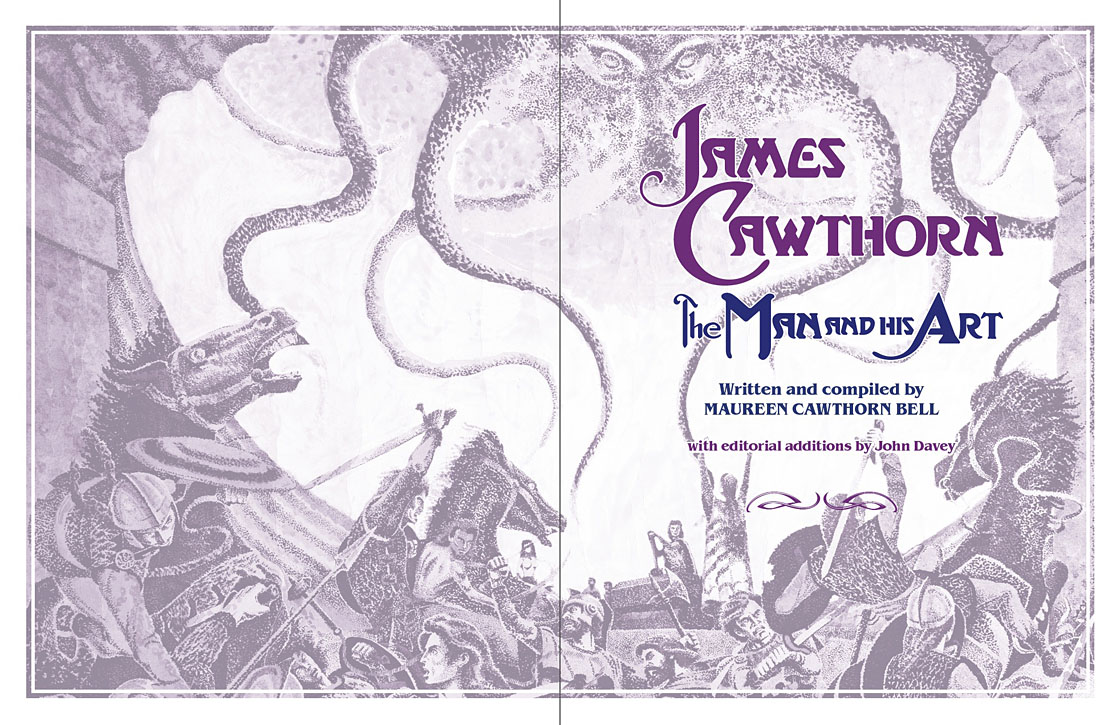
Using motifs such as the sword silhouette and Elric head is something I frequently do with book designs but for this book I also went to the trouble of creating a one-off font for the drop capitals based on Jim’s hand-drawn lettering. Jim drew titles and other lettering throughout his career, so again this was a decision warranted by the book’s contents. The few times we met I never asked him about this but I’ve always thought his lettering designs were derived from the stylised titles that J. Allen St. John created for many of the early Edgar Rice Burroughs books. Jim spent most of his life drawing Burroughs’ characters, and was very familiar with the work of Burroughs’ original illustrators. I was hoping to find a title design of Jim’s that I could rework for the book’s title but none of the examples worked as well as I hoped. For this reason the title lettering is based on different styles from the John Carter novels that were Jim’s favourites among Burroughs’ works.

cawthorn-spread-03.jpg

Other features include a foreword by Alan Moore, an afterword by Michael Moorcock, a gallery of Jim’s Lord of the Rings drawings and character sketches from the early 1960s (which predate all others bar those by Tolkien himself), artwork for Hawkwind (including Dave Brock’s “Meliadus” T-shirt), and even a handful of photos from the set of The Land that Time Forgot (1975), the ER Burroughs-derived feature film scripted by Jim with Michael Moorcock. The page samples here are necessarily few given the size of the book.

cawthorn-spread-04.jpg

For the moment James Cawthorn: The Man and His Art is available exclusively from publishers Jayde Design at a special pre-publication price of £20. After publication on 6th August the price will rise to £35. Further page samples follow.

Continue reading “James Cawthorn: The Man and His Art”

Weekend links 419

ellison.jpg

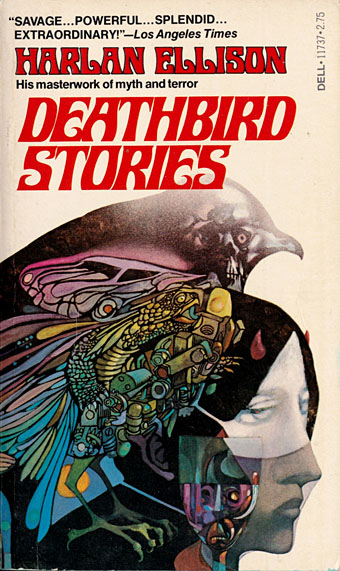
Cover art by Leo & Diane Dillon, 1975.

Art is not supposed to be easier! There are a lot of things in life that are supposed to be easier. Ridding the world of heart attacks, making the roads smoother, making old people more comfortable in the winter, but not Art. Art should always be tough. Art should demand something of you. Art should involve foot-pounds of energy being expended. It’s not supposed to be easier, and those who want it easier should not be artists. They should be out selling public relations copy.

Typical of the late Harlan Ellison to describe his vocation in terms of difficulty and struggle even when his prolific output made writing seem effortless. When my colleagues at Savoy Books published a Savoy issue of New Worlds magazine in 1979 one of the features they ran was an introduction by Michael Moorcock to an Ellison story collection. (They also published two books of Ellison’s around this time.) A copy of the magazine was duly sent to the subject of the essay since Ellison always liked to keep track of his print appearances. The back page of that particular issue is blank but for a few words in bold type from singer PJ Proby: “I am an artist; and should be exempt from shit.” Ellison cut this slogan from the magazine then glued it to his typewriter, no doubt transferring it to later models since it was still visible in the 2008 Ellison documentary, Dreams With Sharp Teeth.

My first encounter with Ellison’s work was also my first encounter with what became labelled the new wave of science fiction, via a reprint of I Have No Mouth, and I Must Scream in a book in the school library. I was only about 12 or 13 at the time, and found Ellison’s story so shocking and disturbing that it overpowered everything else in the collection. The only other story that made an equivalent impression at the time was The Colour Out of Space by HP Lovecraft, so it’s perhaps fitting that Ellison gave my work a favourable mention in his introduction to the huge Centipede Press collection of Lovecraft artwork, A Lovecraft Retrospective: Artists Inspired by HP Lovecraft. I still haven’t got over that one. After the initial encounter, the Ellison-edited Dangerous Visions and Again, Dangerous Visions were just as important for me as the paperback reprints of stories from the Moorcock-edited New Worlds: a handful of books that showed science fiction to be a literary form of limitless possibilities, as opposed to the stereotype of space adventure and future technology. The Ellison and Moorcock anthologies led me to William Burroughs, James Joyce and all points beyond; they also soured for me the preoccupation with space adventure and future technology which persists today.

My final connection with Ellison replayed his compliment in a small way, when editor Jill Roberts and I took extra care with the typesetting of Jeffty is Five for The Very Best of Fantasy & Science Fiction, Volume 2. Ellison was the only author I’ve encountered in the digital age whose corrections were still handwritten comments on printed sheets; these had to be faxed to San Francisco then scanned and emailed to me (to this day I still don’t know why the oft-reprinted story required so many adjustments). It was awkward but amusingly so, a benign taste of a legendary bloody-mindedness and insistence on precision.

• “Laughing about an acid trip with members of Can and opening up about some of the ‘scars’ left from his association with Brian Eno and David Byrne’s My Life In the Bush of Ghosts, [Jon] Hassell is candid in a way that comes naturally to those who’ve lived life on their own terms.”

• Drone Metal Mysticism: Erik Davis talks with music scholar and ethnographer Owen Coggins about amplifier worship, sonic pilgrimage, “as if” listening, metal humour, and his new book Mysticism, Ritual and Religion in Drone Metal.

Psychedelic Prophets: The Letters of Aldous Huxley and Humphry Osmond; “Letters between the men who coined the term ‘psychedelic’ and opened doors to a different way of thinking about human consciousness.”

Artaud 1937 Apocalypse: Letters from Ireland by Antonin Artaud; translated and edited by Stephen Barber.

• “I thought female sexuality was an OK thing?” says writer and porn performer, Stoya.

• “How did a major label manage to lose a John Coltrane record?” asks Ted Gioia.

• Welcome to the dollhouse: Alex Denney on a century of cinematic cutaways.

• The trailer for Mandy, a new (and much-awaited) film by Panos Cosmatos.

• Rest in Anger, Harlan Ellison (1934–2018) by Nick Mamatas.

• Mix of the week: FACT Mix 659 by BD1982.

Emily Gosling on library music design.

Record Label Logos

The Deathbird Song (1997) by The Forbidden Dimension | Eidolons (2017) by Deathbird Stories | Deathbird (2017) by Tempos De Morte

Weekend links 355

carrington.jpg

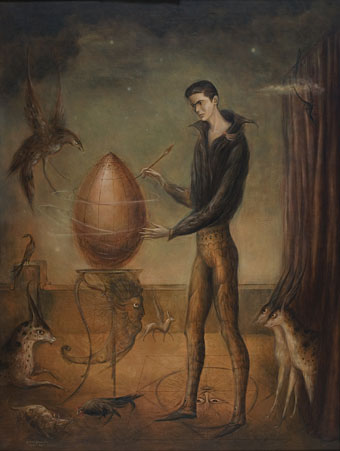
Quería ser pájaro (1960) by Leonora Carrington.

• Artist and author Leonora Carrington was born 100 years ago this week. Marina Warner, an advocate of Carrington’s work in the years when the artist was “forgotten” (ie: ignored by those who should have known better), remembered her friend as someone adept at making “visible the invisible”. Elsewhere, Carrington’s centenary was noted by Phantasmaphile (with many links), Strange Flowers and the LRB, the latter being a Leonora Carrington A-Z by Chloe Aridjis.

Geeta Dayal on Ikutaro Kakehashi who died this week. The synthesizers, drum machines, effects units and other gear produced by Kakehashi’s Roland Corporation are inextricably entwined with the development of electronic music in the 1970s and 80s.

• Do we really need a compilation of singles by Can? Not when all the music has been available for years on albums and compilations. Of more interest is Rob Young‘s forthcoming (well…not until next year) biography of the band, All Gates Open.

• Out from Thames & Hudson this week: Vinyl . Album . Cover . Art: The Complete Hipgnosis Catalogue by Aubrey Powell.

• At Dangerous Minds: The Master of Moorcock: The psychedelic sci-fi book covers and art of Bob Haberfield.

Abigail Ward on Queer Noise: the history of LGB music & club culture in Manchester.

FullFathom5, home of “something rich and strange” makes a welcome return.

• At Flickr: Occult Beliefs and Themes in British Popular Culture (1875–1947)

• At I Love Typography: Jamie Clarke on the evolution of chromatic fonts.

• Mix of the week: a mix for The Wire by Patterned Air Recordings.

Invisible Cities (1990) by Invaders Of The Heart | Invisible Architecture (1997) by John Foxx | Invisible (2005) by Monolake

Weekend links 338

lee.jpg

At the mountains of madness, fragment I (2014–16) by Céli Lee.

Spirits of Place, edited by John Reppion: new writings from Bryndís Björgvinsdóttir, Vajra Chandrasekera, Maria J. Pérez Cuervo, Warren Ellis, Alan Moore, Silvia Moreno-Garcia, Kristine Ong Muslim, Dr. Joanne Parker, Mark Pesce, Iain Sinclair, Gazelle Amber Valentine and Damien Williams.

• “Are we wrong to neglect [Jean Cocteau]? We are.” Kevin Jackson reviews Jean Cocteau: A Life, a biography by Claude Arnaud that’s finally available in an English edition (translated by Lauren Elkin & Charlotte Mandell). Related: Jean Cocteau speaks to the year 2000.

Void Beats / Invocation Trex by Cavern of Anti-Matter has been one of my favourite music releases this year. Tim Gane talks about the inadvertent origin of the group, and there’s also the welcome news of a reissue for the scarce first album, Blood Drums.

• Pauline Oliveros: 1932–2016; Geeta Dayal looks back on the life of US composer Pauline Oliveros, including reflections from, amongst others, Betsey Biggs, Fred Frith, Terry Riley, and Morton Subotnick.

• The relaunched Jayde Design website is selling copious Moorcock publications and ephemera, back issues of New Worlds magazine, and much else besides, including rare works of my own.

• New from Mute Records: Richard H. Kirk #7489 (Collected Works 1974–1989) and Sandoz #9294 (Collected Works 1992–1994).

• Drawings by Austin Osman Spare are on display for the next two weeks at the Atlantis Bookshop, London.

The Architecture of the Overlap: Sir John Soane’s Museum, London, scanned in three dimensions.

• Mixes of the week: Secret Thirteen Mix 201 by Félicia Atkinson, and FACT mix 579 by Jenny Hval.

• “No one has the slightest idea what is and isn’t cultural appropriation,” says Fredrik deBoer.

• I’m never keen on end-of-year lists but I’ll read any list that John Waters writes.

• “The Driller Killer and the humanist behind the blood and sickening crunch”.

• More Lovecraft: Stories to make you say UGH! by Pete Von Sholly.

Alan Moore talks to Stewart Lee.

At The Mountains Of Madness (1968) by H.P. Lovecraft | Mountains Falling (2001) by Bluebob | Mountains Crave (2012) by Anna von Hausswolff

Old Weird and New Weird

savdreams.jpg

Savoy Books, 1984.

A couple more recent arrivals that feature my work. These are of minority interest but worth noting since academic articles don’t always travel beyond a small audience of subscribers.

A recent issue of Foundation (The International Review of Science Fiction), Volume 45.1, number 123, contains an article by Mark P. Williams, Underground Assemblages: Savoy Dreams and The Starry Wisdom. This examines the legacy of New Worlds magazine under the editorship of Michael Moorcock (from 1964 to 1974) via two writing collections, Savoy Dreams (Savoy Books, 1984) and The Starry Wisdom (Creation Books, 1994). The two collections are very different: Savoy Dreams, edited by David Britton and Michael Butterworth, was an eclectic overview of Savoy’s publishing endeavours up to that point. Among the original writing there’s fiction by Butterworth, M. John Harrison (the first publication of the Viriconium story, Lords of Misrule) and others, plus a reaction by Michael Moorcock to William Burroughs’ Cities of the Red Night, a book that Savoy had contracted to publish before police harassment forced the company’s bankruptcy. The rest of the book is taken up with press reviews of Savoy books.

starrywisdom.jpg

Creation Books, 1994. Cover art by Peter Smith.

The Starry Wisdom should require less of an introduction since the book has been in print since 1994, and has a small, possibly notorious, reputation among HP Lovecraft enthusiasts. Editor DM Mitchell felt that the assembling of post-Lovecraftian fiction up to that point had been too cosy and insular: too many story collections were being edited and written by groups of friends in the genre fiction “community”, with the result that the stories were often stale and complacent. The startling newness of Lovecraft’s imagination in comparison to many of his contemporaries in Weird Tales seemed to have been bled away into pastiche, a process that began soon after Lovecraft’s death. Mitchell’s solution was to commission original pieces of Lovecraft-inspired work from writers outside the genre world, notably Alan Moore, Grant Morrison, and newcomer David Conway; he also reprinted pieces that would never appear elsewhere as Lovecraftian fiction, including Wind Die. You Die. We Die. by William Burroughs, and Prisoner of the Coral Deep by JG Ballard. Burroughs and Ballard connect directly to New Worlds, of course (Ballard wrote about Burroughs for the magazine), while the pair cast a shadow over many of Savoy’s book productions. Both Savoy Dreams and The Starry Wisdom featured comic strips; Tales of the Cramps by Kris Guidio appeared in Savoy Dreams, while The Starry Wisdom contained strips by Mike Philbin & James Havoc, Rick Grimes, and the first publication of my own adaptation of The Call of Cthulhu.

I was surprised—and pleased—that my comic strip receives a fair amount of scrutiny in Williams’ piece. My Lovecraft strips have received almost no attention from the comics world, a consequence of having been printed by book publishers and distributed to book shops. (A rare exception was this recent piece by Matt Maxwell.) When you’ve been overlooked in this manner it’s a surprise to find your work receiving serious evaluation from an entirely different quarter. Mark P. Williams’ essay examines the contents of both collections, my strip included, as “assemblages”. This is a valid critique in the case of the Cthulhu strip since Lovecraft’s story is itself an assemblage of what seems at first to be unrelated data. The comic adaptation assembles a range of cultural references—some genuine, others invented—to parallel the narrator’s investigation, and even uses genuine documents in places, including columns from The New York Times. I don’t know if Williams has seen the blog post I made that points out many of the cultural references but he notes some of the more overt ones, such as Joseph Conrad appearing as the doomed Professor Angell, Arnold Böcklin’s The Isle of the Dead, and so on. While I was drawing the strip I was trying to imagine the story as an RKO production, a hybrid of two island films—The Most Dangerous Game and King Kong—and Orson Welles’ unmade Heart of Darkness. These references, many of which aren’t very obvious, were largely for my own amusement. The series I created with David Britton that followed the Lovecraft strips, Reverbstorm, puts assemblage and cultural reference at the forefront.

genre.jpg

Cover art is my illustration for Remnants from Lovecraft’s Monsters, edited by Ellen Datlow.

The Cthulhu strip and the Reverbstorm series—now collected as Lord Horror: Reverbstorm—are the subject of a very perceptive piece by Benjamin Noys in the latest edition of Genre, an academic journal published by Duke University Press. This number of the journal is a kind of Weird special edited by Benjamin Noys and Timothy S. Murphy. Noys’ Full Spectrum Offence: Savoy’s Reverbstorm and the Weirding of Modernity is the final article in a publication that examines aspects of the “Old Weird” (ie: the Lovecraft-era Weird Tales) and contrasts it with the more recent “New Weird”. The latter was a short-lived label coined by M. John Harrison in 2003 for a range of fiction that was ignoring genre boundaries, and consciously developing the Weird as a project. China Miéville was one of the most visible proponents of the New Weird, and Harrison’s term emerged in part as a response to Miéville’s fiction. Miéville is interviewed in this issue of Genre where, as usual, he has some very worthwhile things to say. He prefers the term “haute Weird” for the original manifestation, possibly because it avoids the negative connotations of the word “old”.

reverbstorm.jpg

A spread from part 7 of Reverbstorm.

Benjamin Noys’ article is lengthy and resists easy summary, but it begins by investigating the way my work on the Lovecraft strips permeated the Lord Horror comics and dictated some of the imagery, in particular the architectural forms and eruptions of monstrosity. Later discussion concerns the way that Reverbstorm forces the Weird and Modernism together, a collision that I believe is still unique anywhere, never mind in the comics medium. Noys’ piece has given me a lot to think about, not least for its being the first substantial critical appraisal of Reverbstorm. The series is a difficult one, being deliberately excessive and avant-garde, and presenting the reader with a torrent of interrelating cultural references. Many of these are itemised in the appendix but the success (or not) of their working together, and the potential sparking of connections, depends very much on the prior knowledge of the individual reader. Noys is not only knowledgeable but adept at forging his own connections while situating the series in the larger context of the Weird, old (or haute) and new. Even without the inclusion of my work inside the journal and on the cover, I’d recommend this issue of Genre to anyone with an interest in the subject. One of the reasons I favour the Weird as a chosen work label is the way it evades (or ignores) generic boundaries. Years ago I realised that many of the things I liked the best in the arts were the chimeras, those works that transgress boundaries and created new hybrids. No surprise then that I enjoy a genre that refuses easy definition. There aren’t many masts I pin my colours to but the Weird is one of them.

Previously on { feuilleton }
The Weird