Weekend links 458

scott.jpg

Photo by Dezo Hoffmann, 1968.

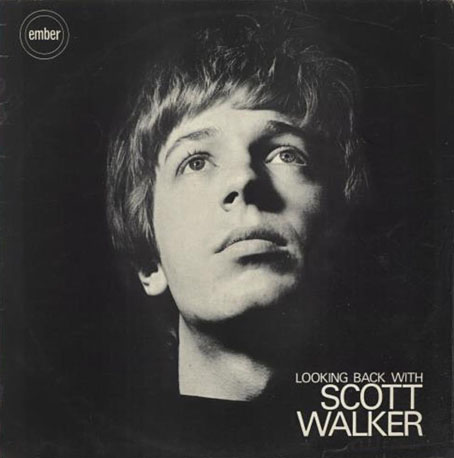
If there’s one thing everyone can agree on about the late Scott Walker it’s that his career was not only improbable but almost impossible in its range and trajectory. My mother saw the Walker Brothers perform in Blackpool 52 years ago, headlining a touring bill that featured Cat Stevens (the artist she most wanted to see) and the soon to be very famous Jimi Hendrix. She enjoyed good pop songs and big orchestras, so even though she’s never expressed a preference for the Walker Brothers or Walker solo I’m sure she could listen to an album or two. But she wouldn’t be able to stand more than a minute of Walker’s output from Tilt (1995) onwards, and even the four watershed tracks on Nite Flights (1978) would be deemed unacceptable. Walker’s progress inverted the stereotype of the 20th-century pop career, the all-too-common descent into blandness and irrelevance, by following a course closer to that taken by painters and literary artists. He walked the walk.

• When Scott Walker’s Climate Of Hunter was announced in 1984, Richard Cook persuaded its introverted creator to talk to the press for the first time in many years. Cook and Walker met again in 1995 when Tilt was released. From 2008: Sean O’Hagan talking to Scott Walker two years after the release of The Drift; at The Wire again: a recording of Rob Young discussing Walker’s career; at the BFI: Scott Walker’s selection of some favourite films; at The New Yorker: Amanda Petrusich on the weird and vast and periodically devastating music of Scott Walker.

• At The Paris Review: Jane Alison suggests meanders, spirals, radials, fractals and cells as alternative to the narrative arc, while Peter Bebergal argues for seeing belief and disbelief in a superposition when it comes to art and the occult.

Sarasota Half in Dream, a feature-length documentary by Derek Murphy and Mitchell Zemil about a decaying Florida suburb.

• Chris Marker, Always Moving: Max Nelson on a Paris exhibition, Chris Marker, les 7 vies d’un cinéaste.

• There’s a little more Scott Walker, inevitably, in this interview with Stephen O’Malley of Sunn O))).

Michael Moorcock talking to The Austin Chronicle about his long association with Hawkwind.

M. John Harrison chooses favourite stories for Jonathan Gibb’s Personal Anthology series.

• Rat Cunning and Bloodshed: An interview with Simon Sellars by Lee Rourke.

In Search of the Seas of Pleiades, a free download by Jenzeits.

• Rammstein are back with a video epic: Deutschland.

Sex Magick is Satanic doo-wop by Twin Temple.

Time, Forward! by Georgi Sviridov.

Orpheus (1967) by The Walker Brothers | Lullaby (By-By-By) (2000) by Ute Lemper | Darkness (2006) by Scott Walker

Weekend links 434

klint.jpg

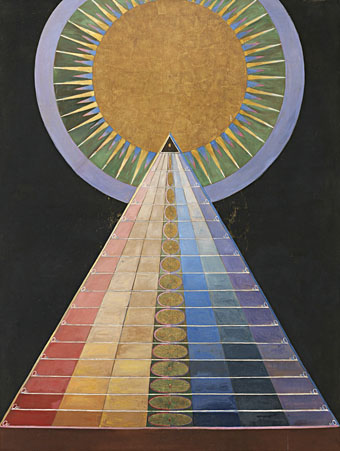
Group X, No. 1, Altarpiece (1915) by Hilma af Klint.

“Like Kandinsky, and other pioneers of abstract art, af Klint was deeply immersed in theosophy and anthroposophy. But she seems to have taken that interest much further than her male counterparts, participating in (and later leading) séances with a group of women friends. Whatever the spirits said, af Klint did.” Nana Asfour on pioneering abstract painter, Hilma af Klint.

• Four electronic artists reflect on the influence of composer Laurie Spiegel. Spiegel’s The Expanding Universe (1980) is reissued by Unseen Worlds next month. Related: Laurie Spiegel in 1977 playing the Bell Labs Digital Synthesizer.

• At Expanding Mind: Gurdjieffean writer and DuVersity director Anthony Blake talks with Erik Davis about dialogue, synergy, mind between brains, the trouble with teachers, and the gymnasium of beliefs in higher intelligence.

• Mixes of the week: Flashing Noise Mix by Tim Gane, Secret Thirteen Mix 268 by Bérangère Maximin, and Samhain Séance Seven: A Very Dark Place – Prologue by The Ephemeral Man.

Geeta Dayal on Broken Music (1989), a book about sound art edited by Ursula Block and Michael Glasmeier which is now available in a new edition from Primary Information.

• The Sainsbury Archive showcases the graphic design of several decades of the supermarket chain’s products.

• More of the usual suspects: Michael Moorcock and Alan Moore in 2006 discussing Moorcock’s career.

• “Karloff the Uncanny”: Joe Dante talks to Stephanie Sporn about the attraction of old film posters.

Mexico City, another preview (and a psychedelic one) of Randall Dunn’s forthcoming solo album.

• At Haute Macabre: Timeless Phantom Interludes: The Photography of Jason Blake.

Mark Valentine on the current state of Britain’s secondhand book shops.

• At I Love Typography: Unicorns, Frogs and the Sausage Supper Affair.

• “I never wanted to be a cult film-maker,” says John Waters.

• Artist Arik Roper chooses some favourite album covers.

Broken Head (1978) by Eno, Moebius, Roedelius | Broken Horse (1984) by Rain Parade | Broken Aura (2000) by Coil

The Cardinal and the Corpse

cardinalcorpse.jpg

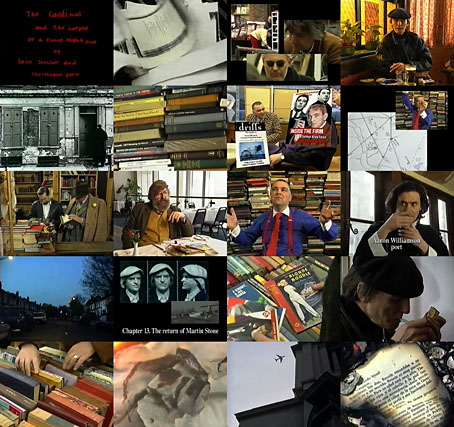
Appearing at last on YouTube (although I think it may have been there once before) is the curious TV film that Iain Sinclair (writer & “freak wrangler”) and Chris Petit (director) made for Channel 4’s Without Walls series in 1992. This is a must for enthusiasts of Sinclair’s early novels since it features the real-life models for several of his characters—guitarist/bookdealer Martin Stone, artist/author Brian Catling, crazed bookdealer Driffield—plus Sinclair’s friends Michael Moorcock and Alan Moore. The latter is seen searching for a copy of Francis Barrett’s grimoire, The Magus (1801), a year before he attached the magus label to himself; I still don’t know whether this quest was Alan’s suggestion or Sinclair’s.

Elsewhere there are fleeting portraits of crime writer Robin Cook (aka Derek Raymond), and Kray gang member Tony Lambrianou. Other notable appearances include poet Aaron Williamson, artist John Latham and David Seabrook, a writer whose Jack of Jumps book I designed a cover for in 2006. The narrative, such as it is, is a series of quests and meetings, threaded together with anecdotes about the various personalities who are the real subject of the film. It’s all very hermetic, and what sense it makes to the uninitiated I can’t say, but it holds the attention for 40 minutes. These obscurities have a way of vanishing, so if you’re interested watch it now or download it for later.

Previously on { feuilleton }
Terror and Magnificence
Mister Jarman, Mister Moore and Doctor Dee
Compass Road by Iain Sinclair

Weekend links 427

davis.jpg

Inside an O’Neill Cylinder, an orbital megastructure. Painting by Don Davis, 1975.

• RIP Lindsay Kemp: dancer, actor, choreographer and (if we have to drop names) mentor to David Bowie and Kate Bush. Kemp’s work has been featured here on a number of occasions, particularly his landmark productions of an all-male Salomé, and Flowers, A Pantomime for Jean Genet. There was also considerable overlap with Kemp’s troupe and the films of Derek Jarman via appearances by Kemp himself, David Haughton and the irrepressible Jack Birkett. The Genet production was filmed in 1982, and is now available on DVD. (There’s also a rougher copy with unmatched audio and video.) From 1970: Pierrot in Turquoise, or The Looking Glass Murders, a Commedia dell’arte performance for Scottish TV featuring David Bowie. And reversing roles, Mick Rock’s video for Bowie’s John, I’m Only Dancing featuring Kemp and company.

• At Expanding Mind: Erik Davis in conversation with activist and writer David Nickles about “the DMT Nexus, psychedelic militancy, extraction tek, the Statement on Open Science for Psychedelic Medicines, MAPS, and the trouble with for-profit psilocybin companies”.

• From the end of August to January 2019: Spellbound at the Ashmolean; “Spellbinding stories, fascinating objects…from crystal balls and magic mirrors to witch bottles and curse poppets”.

On Earth, as on the International Space Station, the collective misperception of a flat plane helps build community and culture. We are all equal in our geometric relationship to one another. The reality, of course, is that we do not stand parallel. Each of our bodies corresponds with a distinct radial vector on the surface of a sphere, pointing away from a common center that we can never perceive or occupy. Our vectors diverge by imperceptible angles.

In “inside-out” worlds like the Bernal Sphere and the concave Earth, the situation is reversed. Our feet all point outward, into an inaccessible, but technologically habitable void, while our heads point inward, some of us apparently “upside-down.” Standing, we rise toward a visible center, which can be reached simply by climbing a hill, strapping on wings, and jumping into the air, as low-tech as Icarus.

The Shape of Space by Fred Scharmen

Michael Moorcock again, interviewed this time by Bernard Braden in 1968. I think this one was for a Braden TV series which was never broadcast.

• “Stupid things are best”: Neil Fox on Conny Plank: The Potential of Noise, a documentary about the great music producer.

• Mixes of the week: XLR8R Podcast 556 by Helios, and An Ode to Eris with An Other Ode to Eris by The Ephemeral Man.

• A monstrous primer on the works of HP Lovecraft by Emma Stefansky. With illustrations by Michael Bukowski.

Silent Agents by Julius-Christian Schreiner: photographs of hostile architecture from around the world.

• Back to the Futuro: Mark Hodgkinson on the spaceship house that landed in Yorkshire.

• The Great Chinese Art Heist by Alex W. Palmer.

Rhizome: a new recording by Drew McDowall.

The Starman Tarot

Mad Pierrot (1978) by Yellow Magic Orchestra | Spellbound (1981) by Siouxsie And The Banshees | Sphere (2011) by Emptyset

Weekend links 426

slinger.jpg

Self Preservation (1970–77), a collage by Penny Slinger from the series An Exorcism.

• RIP John Calder, one of the most important British publishers of the last century whose death was acknowledged in the Washington Post (and in the Telegraph, a paper that would have given him no support during his censorship battles) but at the time of writing hasn’t been mentioned at all in the increasingly useless Guardian. The omission in the latter seems even more surprising when Calder himself wrote obituaries for the paper, and they ran an archive piece two weeks ago for the 50th anniversary of Calder & Boyars’ successful court defence of Last Exit to Brooklyn. “Publishing is an industry run by capitalists now.

• Another 50th anniversary: David Bushman asked Alan Moore for his memories of Patrick McGoohan’s superb TV series The Prisoner.

Michael Moorcock in conversation with Hari Kunzru at Shakespeare and Company, Paris.

Stephen O’Malley presents Acid Quarry Paris – In Session with Richard Pinhas (Heldon).

• When a rock is a stone: Louise Steinman on finding Robert Smithson’s Spiral Jetty.

• Victorians, Vaults, and Violet Water: a profusion of links at Greydogtales.

• Mix of the week: FACT mix 666 by Róisín Murphy.

• The amazing adventures of Melinda Gebbie.

Starbirthed

Exorcism (1971) by Lucifer | The Final Calling (Physical Exorcism) (1984) by CTI | Exorcism Of The Hippies (2010) by Mater Suspiria Vision