Weekend links: Hodgson edition

hodgson.jpg

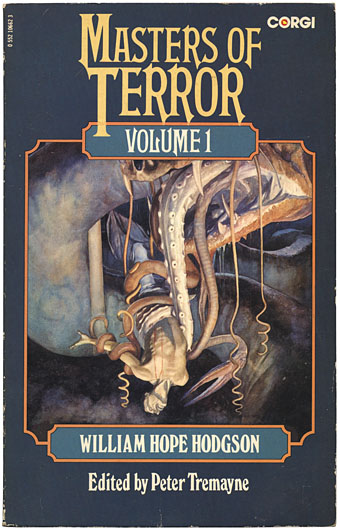
Masters of Terror, Vol 1, Corgi Books, 1977. No illustrator credited.

It was all happening this week so there’s a lot to get through. Are you ready? Deep breath…

For ye Hogge doth be of ye outer Monstrous Ones, nor shall any human come nigh him nor continue meddling when ye hear his voice, for in ye earlier life upon the world did the Hogge have power, and shall again in ye end.

The Hog (c. 1910) by William Hope Hodgson.

• “The Hog is Hodgson’s most nakedly Jungian setpiece; fetid waves of archetypes sweep repeatedly against the thin walls of quotidian reality.” Thus Iain Sinclair, writing in a 1991 afterword to Carnaki the Ghost-Finder which I highly recommend to both Hodgson and Sinclair enthusiasts. China Miéville dissected Hodgson’s Hog on Wednesday and a few hours later a student protest in London turned into an assault on the Tory HQ. Coincidence? Here at {feuilleton} we only offer the facts, it’s up to you to join the dots. M John Harrison approved. Of the protest, that is, not the raising of Porcine Malevolence from the Gulfs Beyond, although he might approve of that as well.

• Further Hodgsonia: Science of The Night Land: Dying Suns and Earth Energy while for real devotees there’s Andy Robertson’s Night Land site.

• “Amplifying the vibrations of the ether” for a view “beyond the limits of ordinary life”: The Fugitive Futurist (1924), a remarkable short film at the BFI’s YouTube channel in which Trafalgar Square is flooded, a monorail crosses Tower Bridge and a dirigible takes to the air over the Houses of Parliament. Also Trafalgar Square Riot (1913), a newsreel with suffragettes at the centre of a civil disturbance. Some of the critics of Wednesday’s events seem to have forgotten that women gained the vote in this country only after repeatedly smashing windows and causing trouble.

• Related to the above: How to Hex a Corporation at Arthur magazine. And let’s not forget Hakim Bey’s Occult Assault on Institutions.
ian_miller4

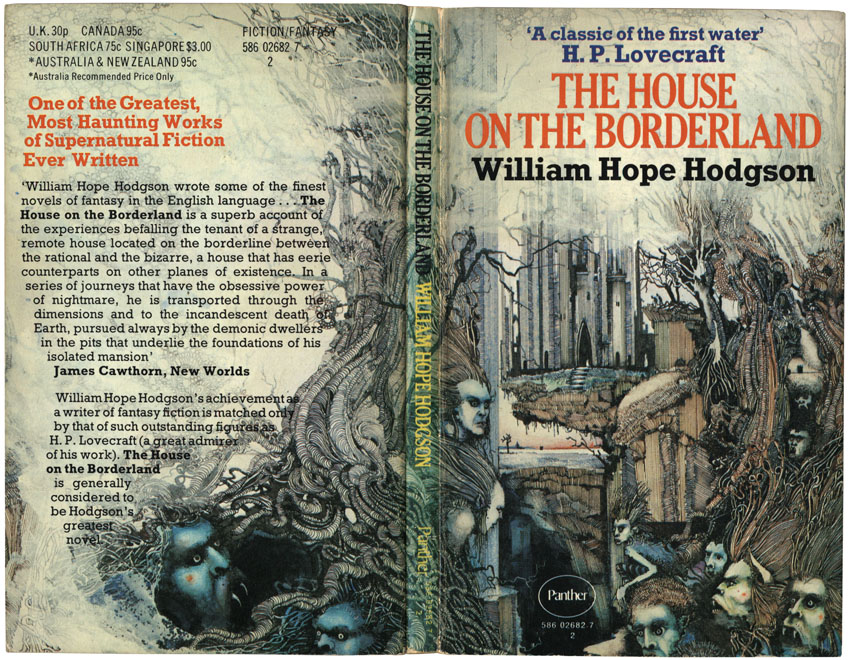
Cover illustration by Ian Miller (1972). The other great cover for THOTB was by Ed Emshwiller in 1962.

The wanderings of the Narrator’s spirit through limitless light-years of cosmic space and Kalpas of eternity, and its witnessing of the solar system’s final destruction, constitute something almost unique in standard literature.

HP Lovecraft reviewing Hodgson’s The House on the Borderland in Supernatural Horror in Literature.

• Lovecraft has long cast a shadow over Hodgson’s fevered visions even though words of praise like those above have done much to keep the earlier writer’s work in print. I’ve been talking for years about doing a series of illustrations for The House on the Borderland and may yet make good on that threat; never say never. Meanwhile, Rick Poyner returned to Design Observer this week pondering the challenge of non-Euclidean architecture in What does HP Lovecraft look like?
hodgson2.jpg

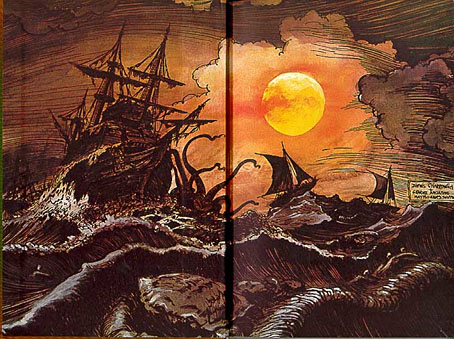
Druillet illustrates Hodgson (1971).

• In his latest piece of Barney Bubbles detective work, Paul Gorman discovered the identity of BB’s first design employer, the alluded to but never named Michael Tucker. More surprising for me than the Robert Brownjohn connection is that there’s now a tenuous link between Barney Bubbles and William Gerhardi.

777 classical music album covers from the collection of Dr Horst Scherg. Related: The Golden Age of Wacky Classical LP Covers — Westminster Gold and the Westminster Gold discography.

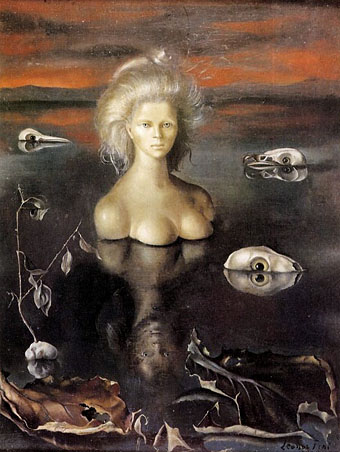
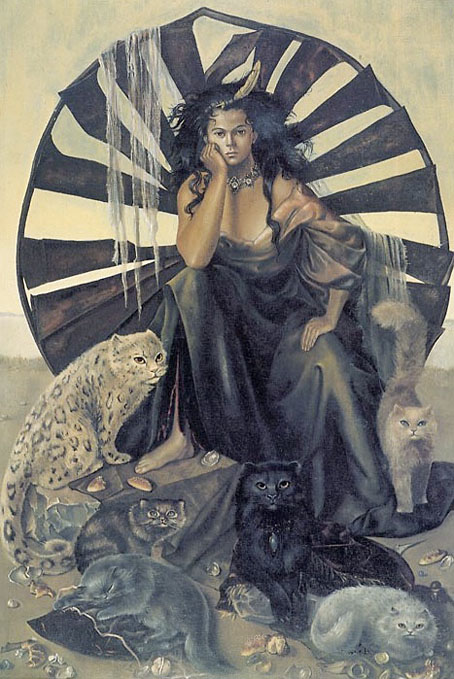
Chez Fini: Little Augury looks at the work and workplaces (and cats!) of the marvellous Leonor Fini.

• There’s yet more Lovecraft (and much else besides) in Nomad Codes, a new book from Erik Davis.

• The Irrepressibles: “They’re scared of what we’re going to do next”.

• New Scientist asks Is this evidence that we can see the future?

Of Electricity And Water: A Thomas Dolby Interview.

Jarvis Cocker talks to Brian Eno.

Fuck Yeah, Gay Vintage

Hog Callin’ Blues (1962) by Charles Mingus. Play loud and often.
Marsi Paribatra: the Royal Surrealist

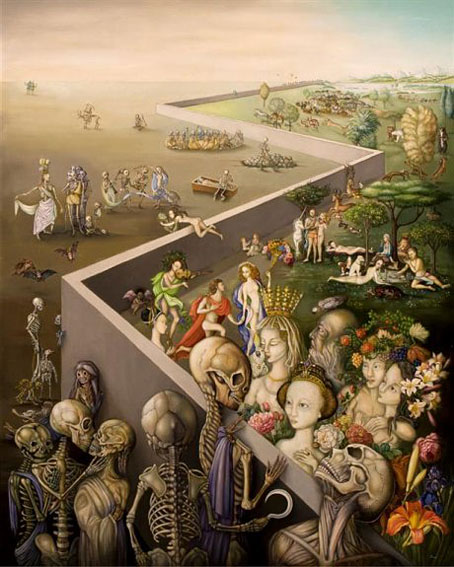
marsi1.jpg

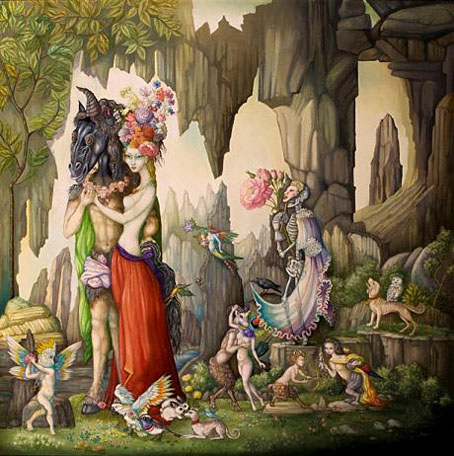
La Menace (1994).

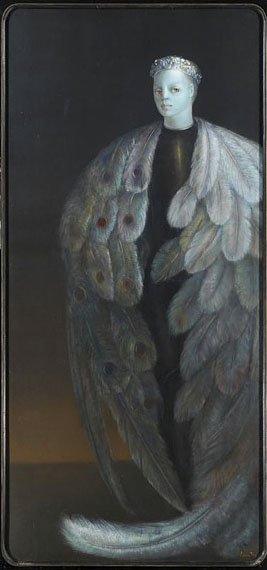
Two paintings by Princess Marsi Paribatra, a member of the royal family of Thailand who lists Dalí, Arcimboldo and Titian among her artistic influences. If it seems surprising that a princess should not only be an accomplished painter but also be possessed of a distinctly vivid imagination we might ask why this is the case. There’s no reason why a member of a royal family shouldn’t be as good a painter as anyone else although it’s the case that here in Britain our views of royalty are inevitably tainted by the uninspiring members of the current House of Windsor. Prince Charles in particular is a singularly dreary and frequently philistine figure, and also a painter whose daubs would never have received any attention at all were it not for his being born into the right family.

This hasn’t always been the case. It used to be that being an aristocrat gave you the free time and the wealth to indulge no end of manias and eccentricities. The British Isles are littered with architectural follies of various kinds built to appease the whims of rich landowners; William Beckford (1760–1844) is renowned for having written the Gothic melodrama Vathek and also for having built the lavish (and unfortunately short-lived) pile of Fonthill Abbey. In the 20th century we had Edward James (1907–1984), a lifelong champion of Surrealism who spent much of his later life building Las Pozas in the Mexican jungle at Xilitla, a concrete fantasia which looks like something dreamed up by Antonio Gaudí and JG Ballard. James collected the work of Leonora Carrington and Dorothea Tanning and I’d imagine him being equally entranced by some of Marsi Paribatra’s paintings. The recurrence of skeletal figures in her work invokes the Mexican Day of the Dead traditions which always excited the Surrealists.

marsi2.jpg

No title or date available.

Dali House has more about Marsi Paribatra’s life and art while further examples of her paintings can be found here and here. Thanks again to Monsieur Thombeau for pointing the way!

Elsewhere on { feuilleton }
The fantastic art archive

Previously on { feuilleton }
Angels of Anarchy: Women Artists and Surrealism
Return to Las Pozas
The art of Leonor Fini, 1907–1996
Surrealist women
Las Pozas and Edward James

Weekend links 18

fini.jpg

Rogomelec (1978) by Leonor Fini. Via.

Moving Through Old Daylight: A recording of Mark Fisher, Jim Jupp and Julian House of Ghost Box Recordings and Iain Sinclair in conversation at the Roundhouse, Camden, London, 5 June 2010. Topics under discussion included Nigel Kneale, TC Lethbridge, John Foxx, BBC Radiophonic Workshop, alchemies of sound, the homogenisation of culture, imagining space and the impersistence of memory.

The Surreal House, “a mysterious dwelling infused with subjectivity and desire” at the Barbican, London.

Ars Homo Erotica at the National Museum of Warsaw. Related: “(Gothenburg) Museum stops exhibition about homosexuality in religion“.

• A lot of people still arrive here looking for art by Zack aka Oliver Frey. Bike Boy, 96 pages of Frey’s exuberantly homoerotic comic strips, is published in August by Bruno Gmünder.

• “EM Forster was a virgin until the age of thirty-nine, when he had his first ‘full’ sexual experience (a ‘hurried sucking off’, Wendy Moffat informs us) with a passing soldier on a beach in Alexandria.”

• JG Ballard’s archive is accepted by the British Library, or “saved for the nation” as they rather grandiloquently describe the process. Samples from the documents to be preserved at the BBC and the Guardian.

• Shades of Ballard’s singing sculptures, Sun Boxes is a solar-powered audio installation by Craig Colorusso. There’s more at Designboom.

• Nathalie visited the MAXXI, Rome’s new museum of contemporary art designed by Zaha Hadid.

Stephen Pinker wants everyone to stop fretting over the alleged distractions of electronic media.

• “It basically comes from love”: John McLaughlin in conversation with Robert Fripp, 1982.

• More collections of print ephemera: Agence Eureka and Ephemera Magica.

The Serpent and the Sword, an Alan Moore rarity from 1999.

Gulliverovy Cesty (1968) at A Journey Round My Skull.

Within the Without: a new Thombeau Tumblr.

The Hidden Posters of Notting Hill Gate.

The Letters of Sylvia Beach reviewed.

• It’s Kubrick Season in St Albans.

Riot In Lagos (1980) by Ryuichi Sakamoto still sounds futuristic thirty years on.

Angels of Anarchy: Women Artists and Surrealism

fini.jpg

Le Bout du monde by Leonor Fini (1948).

Yes, I’ll definitely be going to see this one.

The first major exhibition of women artists and Surrealism to be held in Europe, Angels of Anarchy, opens this autumn at Manchester Art Gallery.

Featuring over 150 artworks by 32 women artists, the exhibition is a celebration of the crucial, but at the time not fully recognised, role that women artists have played within Surrealism. Paintings, prints, photographs, surreal objects and sculptures by well-known international artists including Frida Kahlo, Meret Oppenheim, Leonora Carrington and Lee Miller will be exhibited alongside works by artists less well-known in the UK, such as Emila Medková, Jane Graverol, Mimi Parent, Kay Sage and Francesca Woodman. Manchester Art Gallery is the only venue for this exhibition, making it a once-in-a-lifetime opportunity to see the works of so many significant women artists displayed together, with many of the works on loan from international public and private collections.

Angels of Anarchy runs from 26 September 2009–10 January 2010 at Manchester Art Gallery, and it’s a paying event with tickets at £6 (concessions £4, free entry for under 18s and Manchester Art Gallery Friends).

Elsewhere on { feuilleton }
The fantastic art archive

Previously on { feuilleton }
The art of Leonor Fini, 1907–1996
Surrealist women

The art of Leonor Fini, 1907–1996

fini.jpg

Painter, illustrator and novelist Leonor Fini has been mentioned here before in a post about women Surrealist artists but her wonderful paintings deserve renewed attention. There’s an official site and galleries here (follow the links at the bottom of the page) and here but her work is so profuse and varied there could easily stand to be more.

Elsewhere on { feuilleton }
The fantastic art archive

Previously on { feuilleton }
The art of Michel Henricot
Surrealist women