Two films by Clive Barker: The Forbidden and Salome

forbidden1.jpg

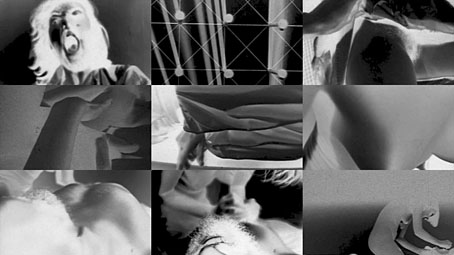
The Forbidden.

Clive Barker announced late last month that arrangements were being made for a remake of Hellraiser. This isn’t the first time such an announcement has been made so we’ll have to wait and see what comes of that. I think I’m in a minority of people who’ve always been well-disposed to Barker and his works (the early stories in particular) but have never really enjoyed Hellraiser. I saw it when it was first released, and was disappointed that Barker and co. hadn’t manage to successfully negotiate the pitfalls of making a British film for demanding American producers. The soundtrack that Barker commissioned from Coil was dropped (a serious error); the film’s awkward mid-Atlantic tone makes suspension of disbelief difficult, and considering Barker’s success as a storyteller the narrative is often confused and disjointed. Without all the memorable imagery it’s doubtful it would have had much of a lasting reputation, or birthed so many sequels.

forbidden2.jpg

The Forbidden.

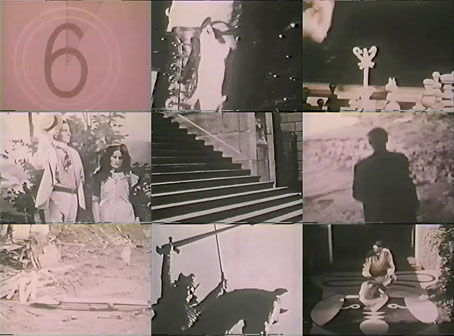
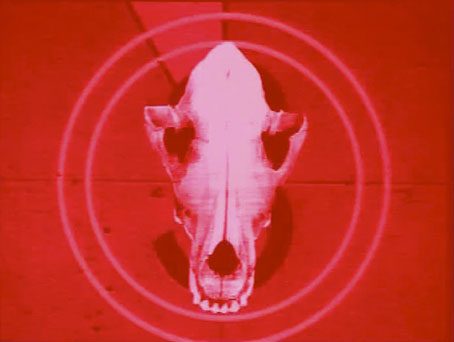
Barker and his theatre colleagues made The Forbidden in 1978, a 35-minute 16mm film of entirely negative images which shows how different Hellraiser might have been if fewer capitulations had been made to the marketplace, and to the clichés of horror cinema. Both films concern an occult ritual, an occult puzzle, and the subsequent consequences of the ritual. Where Hellraiser has to connect its most striking scenes with mundane business such as Julia’s murder spree and screaming teens, The Forbidden presents its imagery as raw data, leaving it to the viewer to piece together its fragments.

Barker’s work since Hellraiser has been almost completely generic so it’s surprising to see something of his that’s this open and abstract. In tone it’s closer to the films of Derek Jarman or Kenneth Anger than anything else, especially the sequence of Barker himself dancing with an erection, something which will ensure this doesn’t get many TV screenings. (Barker has referred to Kenneth Anger when discussing the film.) The final section, featuring a man being lovingly flayed by a number of scalpel-wielding hands, offers the same spectacle as Hellraiser‘s skinless Frank but without any of the accompanying frenzy. This won’t necessarily be on YouTube for very long so watch it while you can. The uploaded version is from the Redemption DVD, music included. Since the film is silent you can watch it with a score of your choice; I’d suggest Coil’s themes for Hellraiser.

salome.jpg

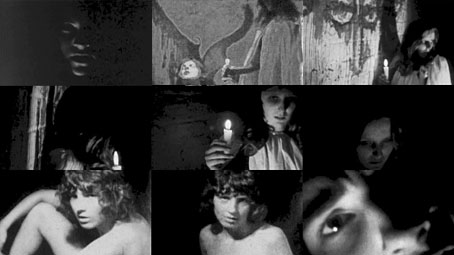
Salome.

Where The Forbidden is a successful piece of avant-garde cinema, Barker’s 17-minute dramatisation of Salome (1973) is closer to a well-made home movie. This is silent as well, and even has the quality and feel of a very old silent film. For an amateur work it still manages to convey a greater sense of dread than some of the other Salomé-related films which have been featured here, and I believe that’s the director himself playing the femme fatale.

Elsewhere on { feuilleton }
The Salomé archive

Previously on { feuilleton }
Clive Barker, Imaginer

Weekend links 182

iwami.jpg

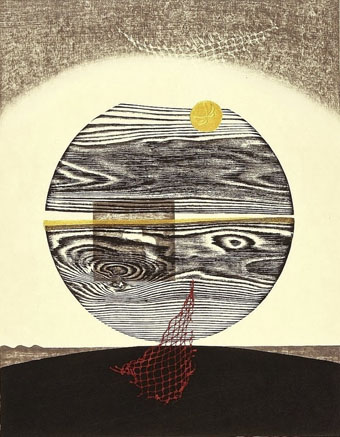
Mirror of Water (1981) by Reika Iwami.

• The week in comics: Paul Gravett interviews Enki Bilal. | Paul Kirchner’s wordless and inventively surreal strip, The Bus, was republished in France last year but it’s been out-of-print for years everywhere else. Read it online here. | Bill Watterson has made the entire run of Calvin and Hobbes available for free.

• “…seek and learn to recognize who and what, in the midst of the inferno, are not inferno, then make them endure, give them space.” Leland de la Durantaye reviews Italo Calvino: Letters 1941–1985.

• Artist Charles Ross says “My interest in science is related to how mysterious it is.” Ross Andersen visited Ross’s Star Axis, “a masterpiece forty years in the making”.

There is a satirical intent at work here, as well as mordant humour, a potent mix that reminds one more of the absurdist fictions of the French jazz musician Boris Vian than of anything in the SF canon. Science fiction is not central in Harrison’s work – not even as a target of his sharp wit – and it is a mistake to regard him as being chiefly interested in demolishing a genre that is only one of several he has mastered.

John Gray on M. John Harrison’s Kefahuchi Tract trilogy. This week Harrison posted a new piece of fiction on his blog.

• Mixes of the week: Secret Thirteen Mix 091 by Sugai Ken, and Bride of the Abominable Marshman, an early Halloween mix by Hackneymarshman.

• Clive Hicks-Jenkins on Schandmasken (masks of shame), and the clay visage of Paul Wegener’s Golem.

• A version of Kraftwerk’s Trans Europe Express by Chicago band Disappears.

Postcards to the Curious: MR James-themed artwork by Alisdair Wood.

Clive Barker: Why I Once Gave Up Horror Movies Entirely.

• Artist Melinda Gebbie at Phantasmaphile.

Fragment, a new video from Emptyset.

38 photos of airships through the ages.

• This Much I Know: Kenneth Anger.

• Trans Europe Express (2000) by Señor Coconut Y Su Conjunto | Trans Europe Express (2007) by Receptors | Trans Europe Express (2012) by Daniel Mantey

8 x 8: A Chess Sonata in 8 Movements

8x8-1.jpg

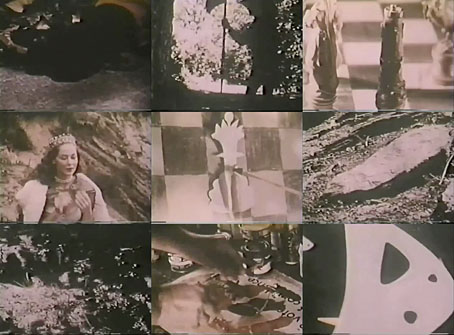
Continuing the Cocteau theme, this fascinating film remains (for the time being) unavailable in a better copy despite its artistic all-star cast. 8 x 8: A Chess Sonata in 8 Movements (1957) can be regarded as a follow-up to Hans Richter’s Surrealist anthology Dreams That Money Can Buy (1947), the directorial credit this time being shared between Richter, Jean Cocteau and Marcel Duchamp. The latter famously quit the art world to devote more time to chess-playing so his involvement with a chess-based fantasy (self-described as “a fairytale for grownups”) isn’t so surprising:

It explores the realm behind the magic mirror which served Lewis Carroll 100 years ago to stimulate our imagination.

The cast comprises famous friends including Cocteau himself, Max Ernst, Dorothea Tanning, Paul Bowles, Fernand Leger, Alexander Calder, Duchamp, and, in the Venetian episode, Peggy Guggenheim in her favourite sunglasses. In places it’s closer to Kenneth Anger’s Inauguration of the Pleasure Dome (1954) than Dreams That Money Can Buy, especially since Anger’s film was another assemblage of unique personalities. One detail I’ve not seen remarked upon elsewhere is the presence behind the camera of Louis & Bebe Barron who assisted with the sound. The Barrons are better known today for their still astonishing all-electronic score for Forbidden Planet (1956). Watch 8 x 8 at Ubuweb or YouTube.

8x8-2.jpg

Previously on { feuilleton }
Dreams That Money Can Buy

My Surfing Lucifer by Kenneth Anger

anger.jpg

One for completists only, My Surfing Lucifer (2009) is one of those recent Kenneth Anger shorts that would receive little attention if we didn’t know the director. Anger’s surfing friend, Bunker Spreckels, is memorialised in a sequence of home movie shots set to the Psychic TV version of Good Vibrations. For me the main point of interest is the use of “Lucifer” in the title, here used not in the context of Anger’s favourite angel but in the sense of a more mundane figure worthy of veneration. Putting a mythic frame around something that in other hands would be quite unremarkable connects this piece, however tenuously, to the more substantial productions of the director’s career.

Anger turned 86 this year, and he’s still keeping busy. His most recent film is another short entitled Airships. He talks a little about that here.

Previously on { feuilleton }
Inauguration of the Pleasure Dome: The Eldorado Edition
Brush of Baphomet by Kenneth Anger
Anger Sees Red
Kenneth Anger’s Hollywood Babylon
Lucifer Rising posters
Missoni by Kenneth Anger
Anger in London
Arabesque for Kenneth Anger by Marie Menken
Edmund Teske
Kenneth Anger on DVD again
Mouse Heaven by Kenneth Anger
The Man We Want to Hang by Kenneth Anger
Relighting the Magick Lantern
Kenneth Anger on DVD…finally

Inauguration of the Pleasure Dome: The Eldorado Edition

anger.jpg

More Cameron, and her finest cinematic moment as she plays two roles—The Scarlet Woman and Kali—in Kenneth Anger’s erotic/psychedelic/thaumaturgic Bacchanal from 1954. Ordinarily there wouldn’t be much reason to draw attention to this, it’s been available on DVD and Blu-ray for several years, and various plunderings are scattered all over YouTube. The version here, however, gives an opportunity to experience the film as it was screened in the 1970s.

anger2.jpg

Inauguration of the Pleasure Dome, like many of Kenneth Anger’s films, existed in several different forms, with the tinkering and re-editing going on for years after the original footage had been captured. An early edit made in the 1950s was fashioned into a version known as the “Sacred Mushroom Edition” which Anger screened to acid heads in the 1960s. I’ve never seen any mention of the soundtrack used for this version, or the other early editions, but in 1978 Anger released a new version with the film soundtracked by most of the Eldorado (1974) album by the Electric Light Orchestra. The note on the Vimeo page says the 1978 edition has only ever been publicly screened once but this isn’t the case. My first viewing of the film was in 1990 when the Magick Lantern Cycle was touring arts cinemas in the UK, and I very well remember sitting in the dark thinking “What the hell?… Is this the Electric Light Orchestra?” The version that’s seen today is soundtracked with Janácek’s Glagolitic Mass, a choice that seems much more suitable. For some time I’d thought of getting hold of the ELO album and running it with the film to remind myself of that initial viewing but there’s no need now that this version exists. The implication is that what you see here is the actual 1978 edit but the footage seems no different from the DVD version aside from missing a few seconds of credits at the beginning. The ELO album came with a cover photo showing Dorothy’s ruby slippers from The Wizard of Oz, a detail that may explain why the Hollywood-obsessed Anger was drawn to the album in the first place.

Previously on { feuilleton }
Brush of Baphomet by Kenneth Anger
Anger Sees Red
Kenneth Anger’s Hollywood Babylon
Lucifer Rising posters
Missoni by Kenneth Anger
Anger in London
Arabesque for Kenneth Anger by Marie Menken
Edmund Teske
Kenneth Anger on DVD again
Mouse Heaven by Kenneth Anger
The Man We Want to Hang by Kenneth Anger
Relighting the Magick Lantern
Kenneth Anger on DVD…finally