Weekend links 92

bmc1.jpg

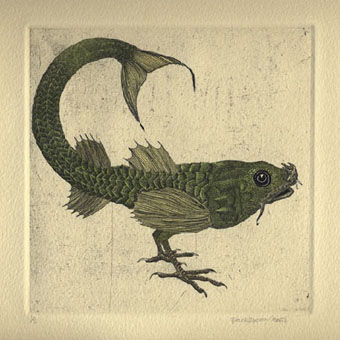
Untitled etching by Briony Morrow-Cribbs.

• An interview with author Paul Russell whose new novel, The Unreal Life of Sergey Nabokov, concerns the gay brother of the celebrated Vladimir.

• Joseph Cornell turns up again in a report at Strange Flowers about Locus Solus, an exhibition in Madrid devoted to the work of Raymond Roussel.

Night of Pan: 42 seconds of occult freakery by Bill Butler featuring Vincent Gallo, Twiggy Ramirez plus (blink and you miss him) Kenneth Anger.

Jan Švankmajer talks (briefly) about his new film Surviving Life. A subtitled trailer is here; the very different Japanese trailer is here.

Cormac McCarthy turns in his first original screenplay. I’d rather he turned in a new novel but any new Cormac is better than none at all.

Barnbrook show off another design for the latest CD from John Foxx & The Maths.

Melanie McDonagh asks “Where have all the book illustrators gone?”

• Congrats to Evan for getting his poetry in the New York Times.

Margaret Atwood on writing The Handmaid’s Tale.

Subliminal Frequencies: An Interview With Pinch.

The (Lucas) Cranach Digital Archive

The M.O.P. Radionic Workshop

• Music promos of the week from the Weird Seventies: All The Years Round (1972) by Amon Düül II, and Supernature (1977) by Cerrone.

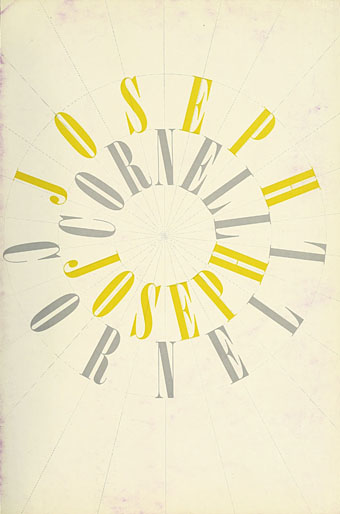
Joseph Cornell, 1967

cornell1.jpg

More Surrealism (sort of) from 1967. Joseph Cornell is a catalogue for an exhibition selected and presented by Diane Waldman at the Solomon R. Guggenheim Museum in 1967. The book is one of a number of new and very welcome additions from the Guggenheim Museum to the stock of scanned books at the Internet Archive. Old art books and catalogues often feature black-and-white reproductions but that drawback doesn’t invalidate the usefulness of their textual content. The Museum’s own pages for the archived books may be browsed here.

cornell2.jpg

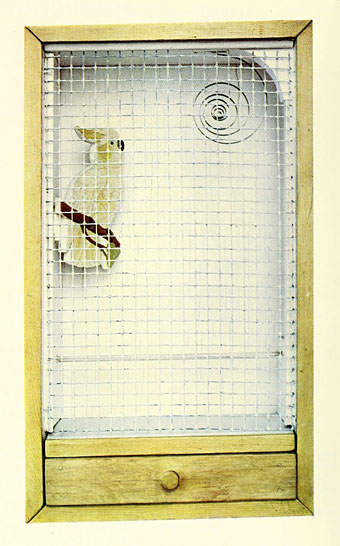
Cockatoo: Keepsake Parakeet (1949–1953).

For more on the Magus of Utopia Parkway I’d suggest the BBC’s documentary film Joseph Cornell: Worlds in a Box (1991) but only if you can find a copy since I’ve not seen it online anywhere. That’s a shame because it’s an excellent introduction to Cornell’s life and work, with the added bonus of commentary from Susan Sontag and Cornell’s film collaborators Stan Brakhage and Rudolph Burckhardt. There’s also a surprise appearance from Tony Curtis who was friends with the artist and who reads from his diaries.

cornell3.jpg

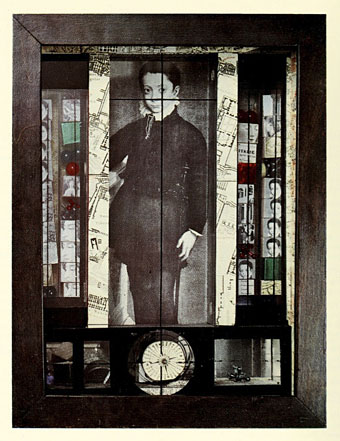
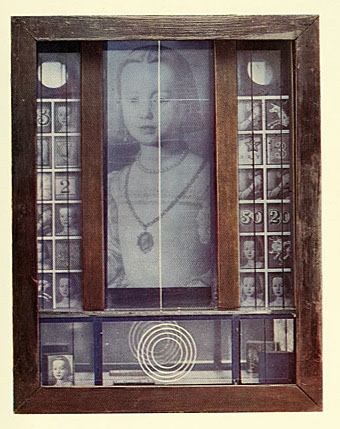
Medici Slot Machine (1942).

Elsewhere, Ubuweb has Cornell’s short films which proceed from the radical re-editing of Rose Hobart (1936) to more lyrical works such as Nymphlight (1957). And I’ve mentioned this before but it’s always worth another look: Americana Fantastica, the edition of Charles Henry Ford’s View magazine edited and illustrated by Cornell in 1943.

cornell4.jpg

Medici Princess (1952).

Previously on { feuilleton }
Rose Hobart by Joseph Cornell
View: The Modern Magazine

Metamorphosis Victorianus

bucaille1.jpg

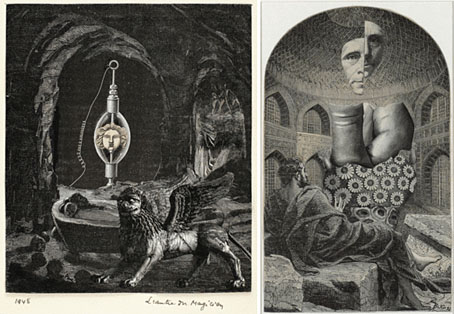
left: L’antre du magicien (1948); right: La Distribution des soleils (1945).

I’m rather late with this one, Metamorphosis Victorianus—Modern Collage, Victorian Engravings & Nostalgia is an exhibition running at the Ubu Gallery, New York until the end of the month. Lots of the names one would expect to see in a collection of engraving collagists although no Wilfried Sätty. The examples shown here are by Max Bucaille.

Max Ernst (1891–1976), with such work as his shocking and seminal illustrated collage-novel, La Femme 100 têtes (1929), influenced an entire wave of artists who looked towards the Surrealist and his use of 19th Century engravings as a point of departure within their own work in this medium. The first generation of artists were Ernst’s contemporaries, who worked primarily in the 1930s with significant connection to the Surrealists: Joseph Cornell (1903–1972), Jind?ich Štyrský (1899–1942), Otto Hofmann (1907–1994), Franz Roh (1890–1965), Max Bucaille (1906–1992), and Gerome Kamrowski (1914–2004). Those a generation later, including Ray Johnson (1927–1995), Bruce Conner (1933–2008), and Jess (1923–2004), each separately rediscovered Ernst, specifically choosing to use this type of collage as a jumping off point towards other conceptual ends.

bucaille2.jpg

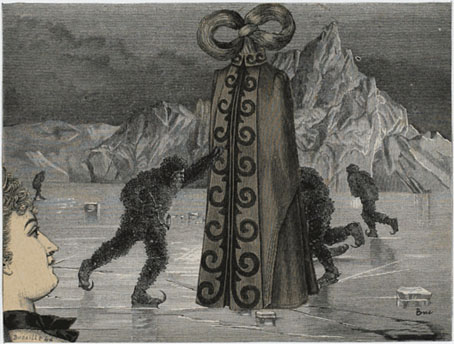
Capture (1946).

Previously on { feuilleton }
Max (The Birdman) Ernst
The Robing of The Birds
Gandharva by Beaver & Krause
The art of Stephen Aldrich

A Clockwork Orange: The Complete Original Score

aco_sleeve.jpg

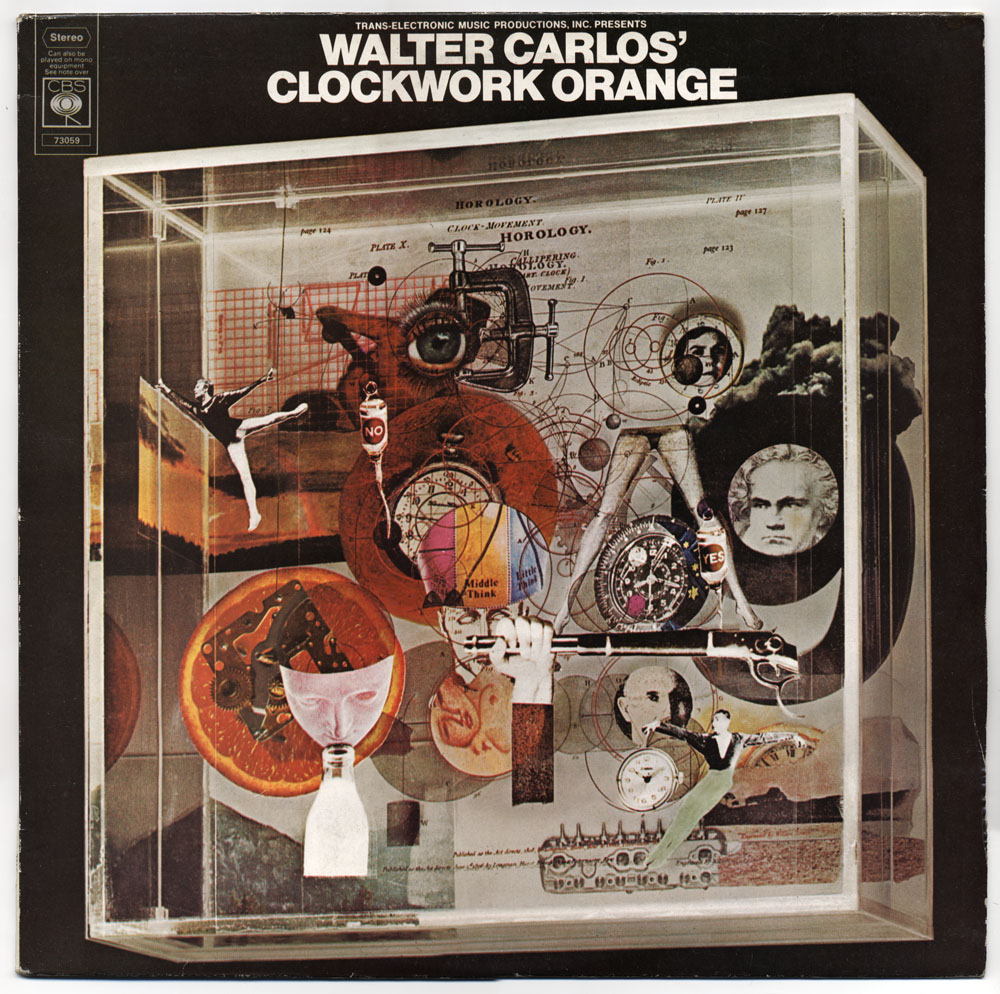
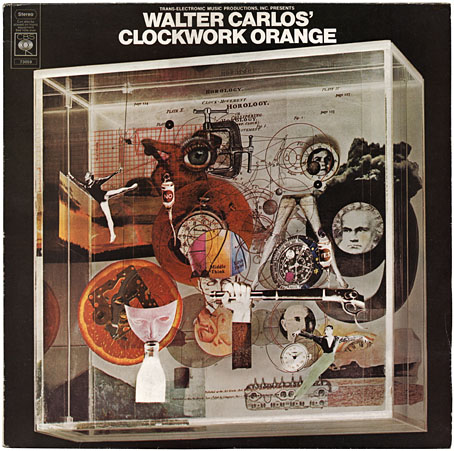
CBS 73059; construction by Karenlee Grant, photo by David Vine (1972).

A1 Timesteps (13:50)
A2 March From A Clockwork Orange (7:00)
B1 Title Music From A Clockwork Orange (2:21)
B2 La Gazza Ladra (5:50)
B3 Theme From A Clockwork Orange (1:44)
B4 Ninth Symphony: Second Movement (4:52)
B5 William Tell Overture (1:17)
B6 Country Lane (4:43)

Viddy well the stuff of obsessions, O my brothers: Kubrick, cover design and electronic music in one convenient 12-inch package. Those of us in Britain who were too young to see A Clockwork Orange during its initial run had to wait a long time for its re-release after Stanley K withdrew the film from circulation. Until bootleg VHS copies started to turn up in the 80s I knew the film mostly from the MAD Magazine parody and the soundtrack album which was ubiquitous in secondhand record shops. Having become familiar with the score, an additional layer of frustration was added when it became apparent that two soundtrack albums had appeared in the 1970s, the “official” one, which was a mix of the orchestral and electronic music used in the film, and another which contained all the music Walter (later Wendy) Carlos recorded.

The Wendy Carlos music was the principal attraction for this electronic music obsessive and I fretted for a long while trying to find a copy of her Complete Original Score album which was paraded in all its elusive glory on old CBS vinyl inner sleeves. Half the tracks are present on the official release but the omissions are crucial: Timesteps, the incredible composition which accompanies Alex’s first deprogramming session was edited down from thirteen to five minutes, there was Carlos’s Moog version of Rossini’s La Gazza Ladra (an orchestral version is used in the film) and also an original piece, Country Lane, intended to accompany Alex’s police brutality session at the hands of his former droogs. The score was one of the first projects to successfully incorporate a vocoder into electronic compositions; Rachel Elkind, Carlos’s regular collaborator, provided the vocalisations. Finally securing a copy was no disappointment, in fact I was overwhelmed. This is still my favourite Wendy Carlos album and one of my top five favourite analogue synth albums. The transcription of La Gazza Ladra is nothing short of miraculous, thundering away with the power of a full orchestra yet created by laboriously recording one note at a time. (Wendy Carlos’s very thorough website goes into detail about the recording process.)

Continue reading “A Clockwork Orange: The Complete Original Score”

Entr’acte by René Clair

entracte.jpg

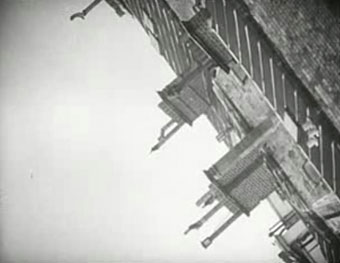
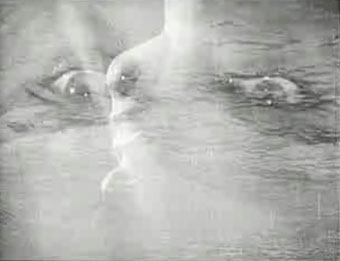
One of the best—and most entertaining—films to come out of the Dada/Surrealist period, Entr’acte (1924) is also worth watching for the appearance of notable figures such as Francis Picabia (who initiated the project), Marcel Duchamp, Man Ray and Erik Satie.

This extraordinary early film from director René Clair was originally made to fill an interval between two acts of Francis Picabia’s new ballet, Relâche, at the Théâtre des Champs-Elysées in Paris in 1924. Picabia famously wrote a synopsis for the film on one sheet of note paper, headed Maxim’s (the famous Parisian restaurant), which he sent to René Clair. This formed the basis for what ultimately appeared on screen, with some additional improvisations. Music for the film was composed by the famous avant-garde composer Erik Satie, who appears in the film, along side its originator, Francis Picabia. The surrealist photographer Man Ray also puts in an appearance, in a film which curiously resembles his own experimental films of this era.

entracte2.jpg

Entr’acte is a surrealistic concoction of unrelated images, reflecting Clair’s interest in Dada, a fashionable radical approach to visual art which relied on experimentation and surreal expressionism. Clair’s imagery is both captivating and disturbing, giving life to inanimate objects (most notably the rifle range dummies), whilst attacking conventions, even the sobriety of a funeral march.

Entr’acte can be watched and downloaded at Ubuweb. Tate Modern is running a major exhibition of the works of three of the participants, Duchamp, Man Ray, Picabia, until 26 May, 2008.

Previously on { feuilleton }
Alexander Hammid
Impressions de la Haute Mongolie revisited
Short films by Walerian Borowczyk
The South Bank Show: Francis Bacon
Rose Hobart by Joseph Cornell
Some YoYo Stuff
Beckett directs Beckett
Meshes of the Afternoon by Maya Deren
Not I by Samuel Beckett
La Villa Santo Sospir by Jean Cocteau
Un Chant D’Amour by Jean Genet
Borges documentary
Film by Samuel Beckett
Towers Open Fire