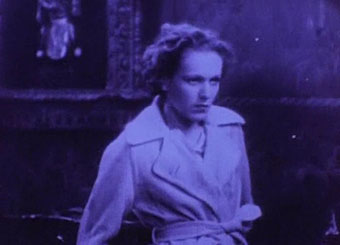
Rose Hobart by Joseph Cornell

cornell.jpg

Rose Hobart (1936)
Dir: Joseph Cornell
17mins, tinted B&W

The first experimental film by Surrealist artist Joseph Cornell (1903–1972) is available for viewing at Ubuweb (where they list the years of his birth and death incorrectly). Cornell’s famous boxes are highly-regarded and still influential but his films receive less attention. This is the first one of them I’ve seen.

Rose Hobart consists almost entirely of footage taken from East of Borneo, a 1931 jungle B-film starring the nearly forgotten actress Rose Hobart. Cornell condensed the 77-minute feature into a 20-minute short, removing virtually every shot that didn’t feature Hobart, as well as all of the action sequences. In so doing, he utterly transforms the images, stripping away the awkward construction and stilted drama of the original to reveal the wonderful sense of mystery that saturates the greatest early genre films.

While East of Borneo is a sound film, Rose Hobart must be projected at silent speed, accompanied by a tape of ‘Forte Allegre’ and ‘Belem Bayonne’ from Nestor Amaral’s Holiday in Brazil, a kitschy record Cornell found in a Manhattan junk store. As a result, the characters move with a peculiar, lugubrious lassitude, as if mired deep in a dream. In addition, the film should be projected through a deep blue filter, unless the print is already tinted blue. The rich blue tint it imparts is the same hue universally used in the silent era to signify night.

View magazine, 2nd series no 4: Americana Fantastica, January 1943
(Cover and many pages by Joseph Cornell)

Previously on { feuilleton }
Meshes of the Afternoon by Maya Deren
L’Amour Fou: Surrealism and Design
The Surrealist Revolution
La Villa Santo Sospir by Jean Cocteau
View: The Modern Magazine

The Surrealist Revolution

bunuel.jpg

The riddle of the rocks by Jonathan Jones
It was the art movement that shocked the world. It was sexy, weird and dangerous—and it’s still hugely influential today. Jonathan Jones travels to the coast of Spain to explore the landscape that inspired Salvador Dalí, the greatest surrealist of them all.

The Guardian, Monday March 5, 2007

I AM SCRAMBLING over the rocks that dominate the coastline of Cadaqués in north-east Spain. They look like crumbling chunks of bread floating on a soup of seawater. Surreal is a word we throw about easily today, almost a century after it was coined by the poet Guillaume Apollinaire. Yet if there is anywhere on earth you can still hope to put a precise and historical meaning on the “surreal” and “surrealism”, it is among these rocks. To scramble over them is to enter a world of distorted scale inhabited by tiny monsters. Armoured invertebrates crawl about on barely submerged formations. I reach into the water for a shell and the orange pincers of a hermit crab flick my fingers away.

The entire history of surrealism—from the collages of Max Ernst to Salvador Dalí’s Lobster Telephone—can be read in these igneous formations, just as surely as they unfold the geological history of Catalonia.

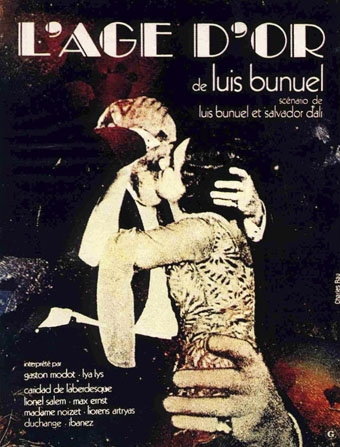
I sit down on a jagged ridge. What if I fell? Would they find a skeleton looking just like the bones of the four dead bishops in L’Age d’Or, the surrealist film Luis Buñuel shot here in 1930?

Buñuel had been shown these rocks by his college friend Dalí years earlier. It was here they had scripted their infamous film Un Chien Andalou. Dalí came from Figueras, on the Ampurdán plain beyond the mountains that enclose Cadaqués, and spent his childhood summers here, exploring the rock pools and being cruel to the sea creatures. In most people’s eyes, this is a beautiful Mediterranean setting. It certainly looked lovely to Dalí’s close friend, the poet Federico García Lorca, when Dalí brought him here in the 1920s: in his Ode to Salvador Dalí, Lorca lyrically praises the moon reflected in the calm, wide bay…

Continues here.

Previously on { feuilleton }
The persistence of DNA
Salvador Dalí’s apocalyptic happening
The music of Igor Wakhévitch
Dalí Atomicus
Las Pozas and Edward James
Impressions de la Haute Mongolie

View: The Modern Magazine

charles_henri_ford.jpg

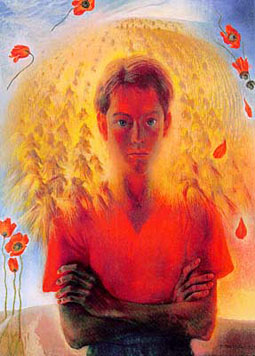
Portrait of Charles Henri Ford in Poppy Field by Pavel Tchelitchew (1933).

View magazine was an American periodical of art and literature, published quarterly from 1940 to 1947 with heavy emphasis on the Surrealist art of the period. The astonishing list of contributors included Jorge Luis Borges, Alexander Calder, Albert Camus, Marc Chagall, Joseph Cornell, Jean Dubuffet, Lawrence Durrell, Max Ernst, Jean Genet, Paul Klee, Henry Miller, René Magritte, André Masson, Joan Miró, Georgia O’Keefe, Pablo Picasso, Man Ray, Edouard Roditi, Yves Tanguy, and Pavel Tchelitchew.

Continue reading “View: The Modern Magazine”