“Through the eyes of poets”: View magazine

viewcovers.jpg

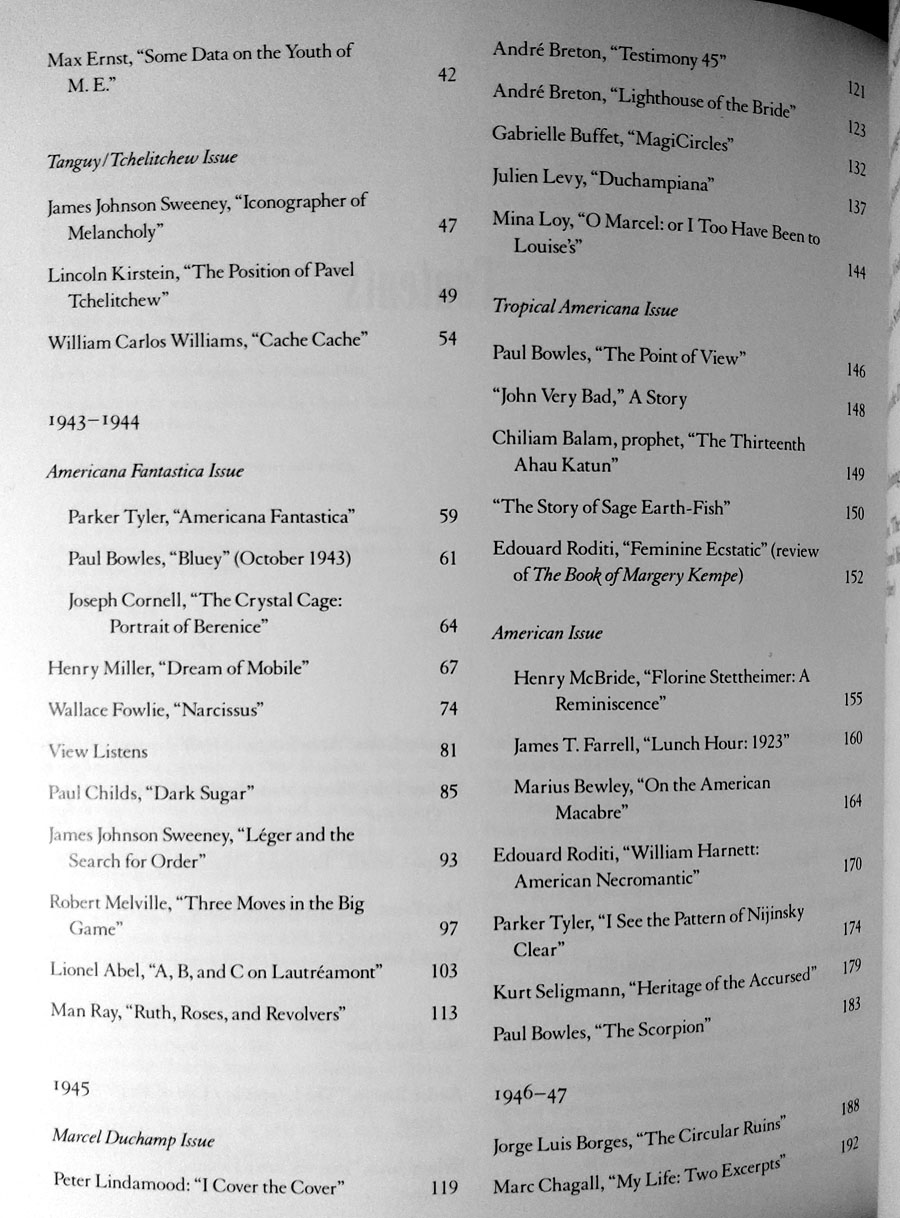
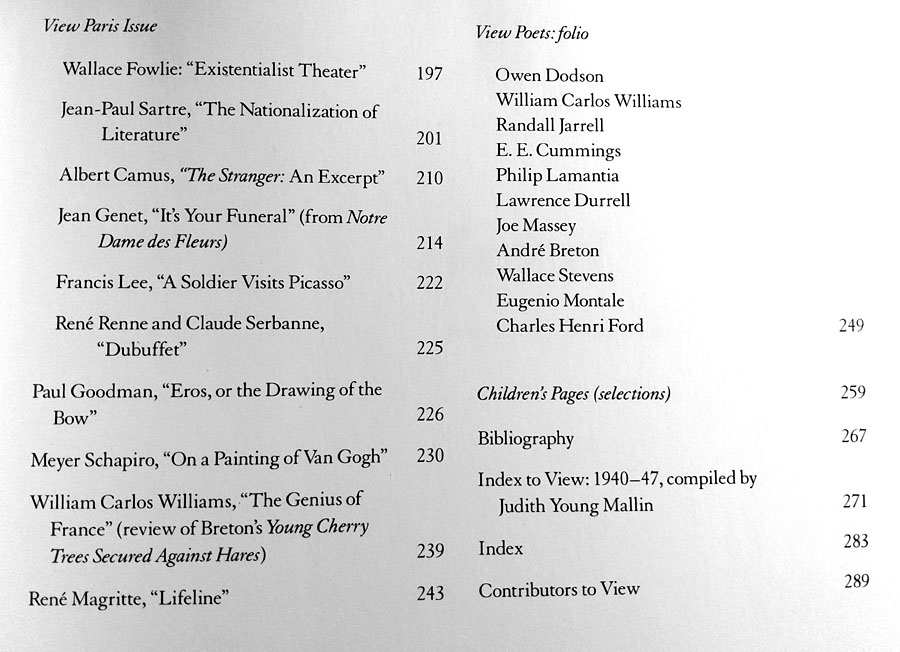
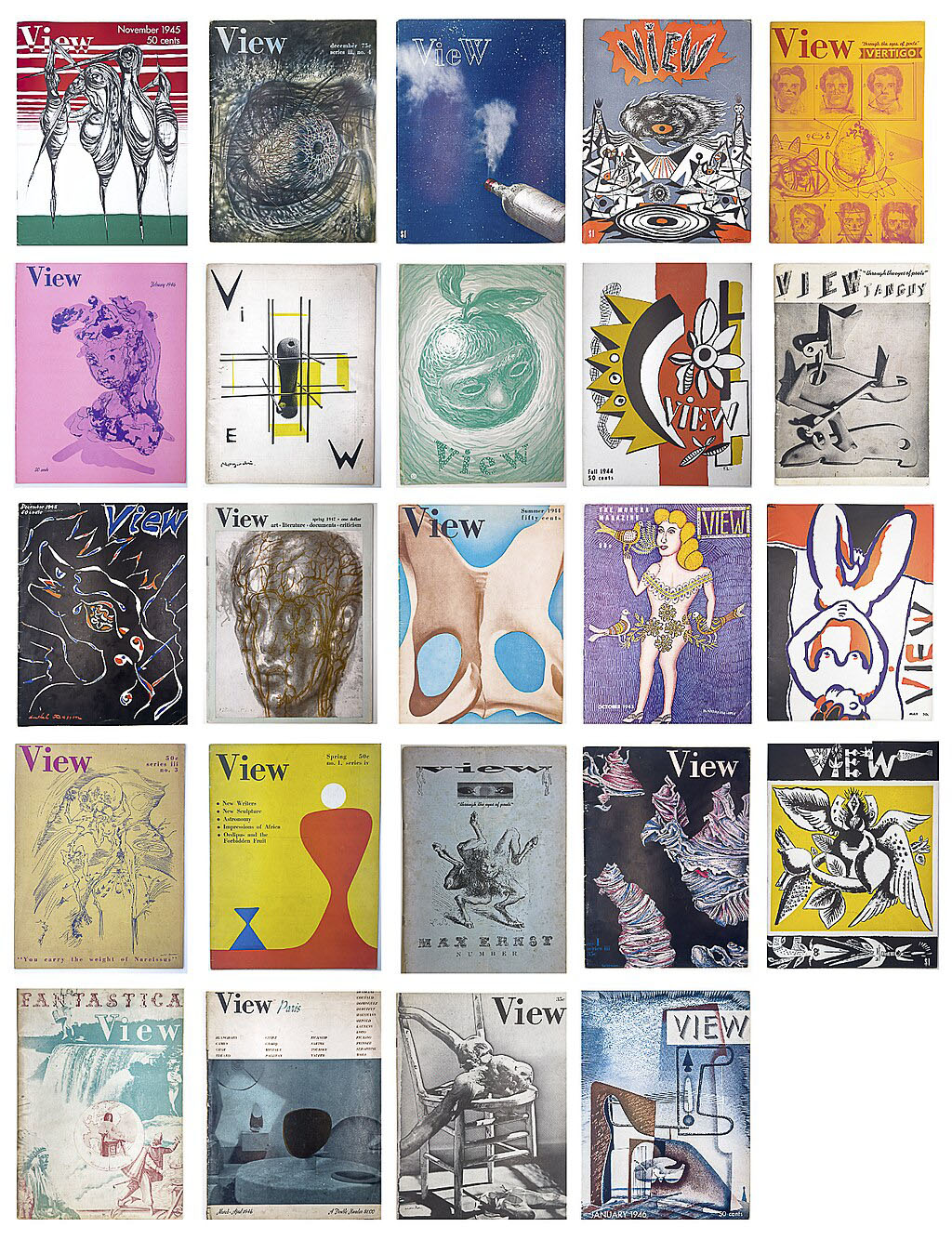
Charles Henri Ford’s avant-garde magazine has been a sporadic visitor to these pages over the past 20 years, the subject of occasional posts as well as my complaints about the difficulties of finding online sources for important magazines and journals. The difficulties are now over where View is concerned…or almost over because this cache is an incomplete run, with the last seven issues absent. That still gives us 30 complete issues to look through, however, so I’ll temper my complaints. The run is further compromised by being taken from a single-volume reprint which has reduced all the colour to black and white, but the covers at least are easy to find elsewhere. The first few issues of View were simple newsprint affairs, but the design soon became more ambitious and properly magazine-like, with coloured paper used for interior pages.
view-ernst.jpg

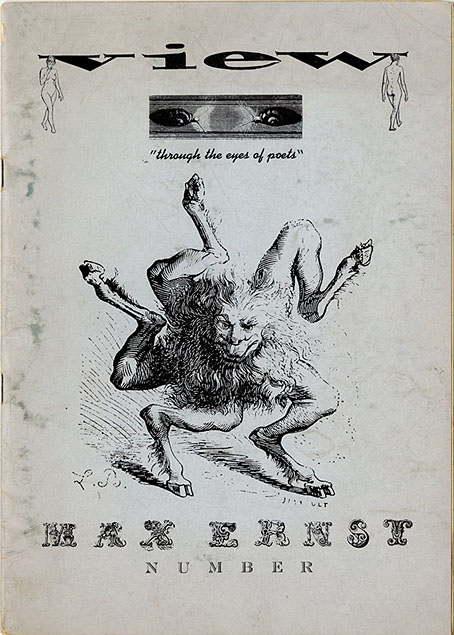
Vol 2, issue 1; April 1942.

View (1940–47) was an important arts magazine for a number of reasons, chief among them the title’s status as the leading American journal devoted to Surrealism. The Surrealist movement in Europe had been destroyed by the advent of war but Surrealism found itself revitalised in the United States when artists and writers fleeing the Nazis made their way to New York. In a very short space of time the movement went from being a European curiosity to a local novelty, with the same delayed impact that occurred when modern art was revealed to a bewildered American public by the Armory Show in 1913. View magazine took advantage of the wave of aesthetic immigration, positioning itself as a showcase and promoter of the new art of “the Marvellous”. The range of the magazine’s contributors is astonishing (per Wikipedia):

…writers like Wallace Stevens, an interview with whom was featured in the first number of View, William Carlos Williams, Joseph Cornell, Edouard Roditi, Henry Miller, Lawrence Durrell, Paul Bowles, Brion Gysin, Philip Lamantia, Paul Goodman, Marshall McLuhan, André Breton, Raymond Roussel, Albert Camus, Jean-Paul Sartre, Jean Genet or Jorge Luis Borges and artists like Pablo Picasso, Paul Klee, Fernand Léger, Georgia O’Keeffe, Man Ray, Joan Miró, Alexander Calder, Isamu Noguchi, Marc Chagall, René Magritte and Jean Dubuffet.
view-cornell.jpg

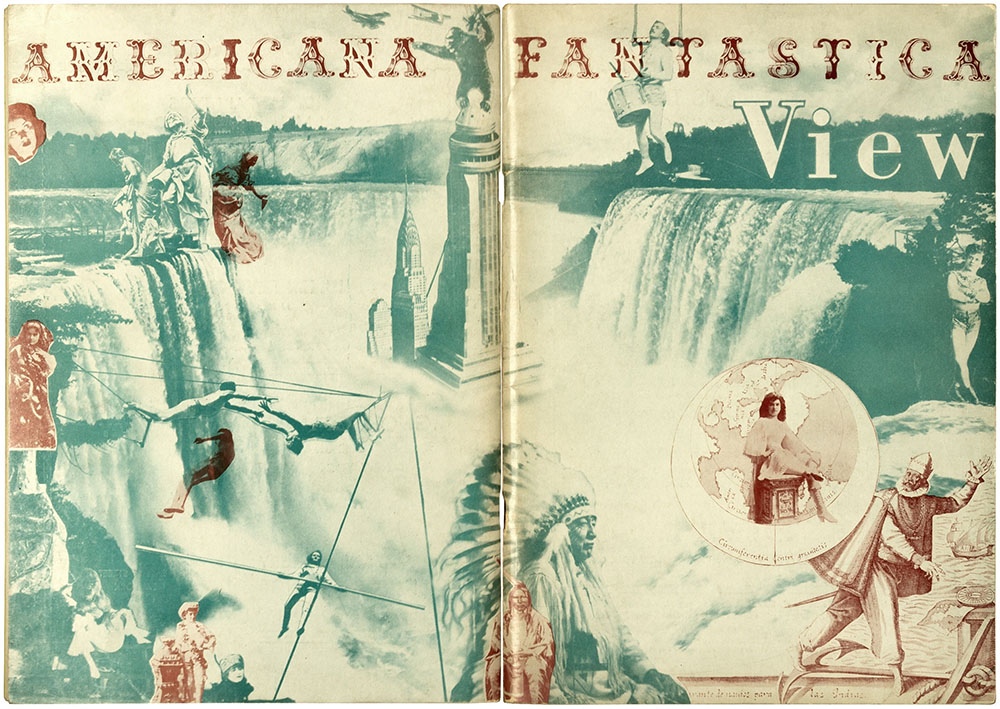
Volume 2, issue 4; January 1943. Cover collage by Joseph Cornell.

To the names above can be added Leonora Carrington, René Magritte and Leonor Fini. Several of the early issues were devoted to a single theme: Max Ernst was the subject of an entire issue, Yves Tanguy and Pavel Tchelitchew shared an issue, while other numbers explored specific subjects—“Vertigo”, “Americana Fantastica”, “Narcissus”, “Tropical Americana”, “America”, “Italy”, and “Surrealism in Belgium”. The magazine also helped promote Surrealism-adjacent Americans like Joseph Cornell and Morris Hirshfield. Cornell was a virtual unknown in the art world of the early 1940s; Charles Henri Ford helped him a great deal when he gave his collages and constructions an equal platform with the Europeans. “Americana Fantastica” is pretty much a Cornell issue, while elsewhere Cornell creates print works like the one-page “Story Without a Name” in the Max Ernst issue, a homage to Ernst using collaged engravings. Some of this material was reprinted in 1992 in Parade of the Avant-Garde, Ford’s book-length compilation of the magazine’s greatest hits, and a very commendable publication in itself. But magazines, especially ones as rich as this, have to be seen as entire issues, with all their minor pieces, decorative vignettes and advertising pages intact. What we have here is a compromised View but it’s still a sight worth seeing.

Elsewhere on { feuilleton }
The Surrealism archive

Previously on { feuilleton }
Minotaure, 1933–1939
The nightingale echo
Max Ernst’s favourites
Viewing View
Cornell’s Constellations
Joseph Cornell: Worlds in a Box
Joseph Cornell, 1967
Rose Hobart by Joseph Cornell
View: The Modern Magazine

The nightingale echo

ernst3.jpg

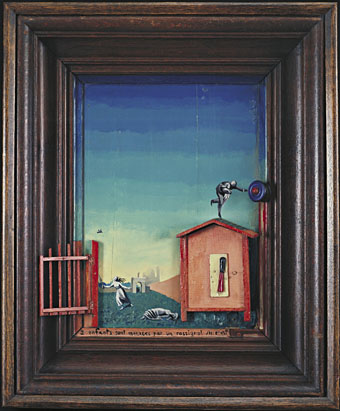
Two Children Are Threatened by a Nightingale (1924) by Max Ernst.

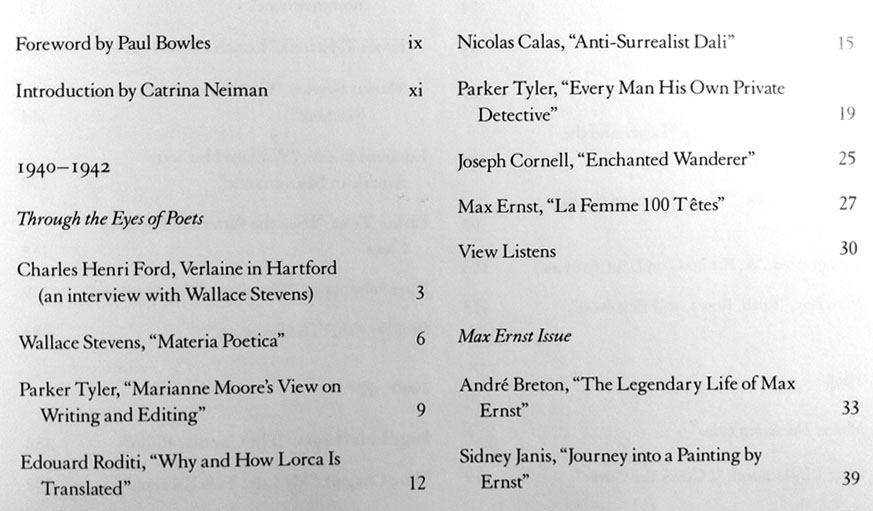
Another discovery from Charles Henri Ford’s View: Parade of the Avant-Garde. Sidney Janis devotes several pages to one of the earliest Surrealist paintings by Max Ernst, Two Children Are Threatened by a Nightingale. After describing the picture in detail he makes this comparison:

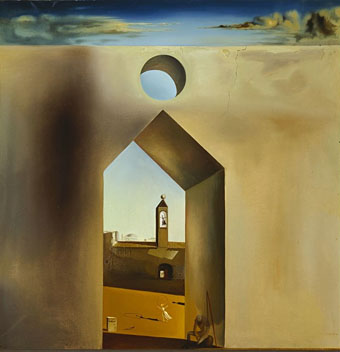
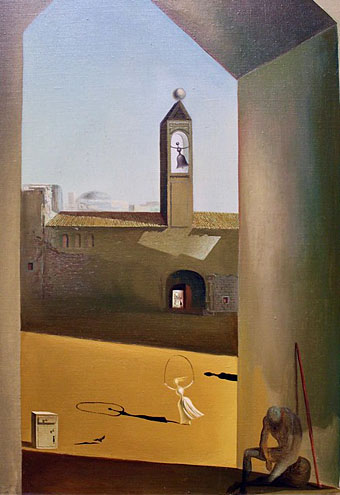
In 1935, Dalí painted a Nostalgic Echo, obviously of this very picture by Max Ernst. Eleven years divided the two paintings; still the lapse of time has not interrupted a continuity of idea which takes place between them. For now we have the next sequence of events. Ernst’s adolescent with the knife appears again in the Dalí, her gesture identical but free of her earlier emotional tension. We find her contentedly skipping rope, her contour and movement echoed in the belfry as a ringing bell. And here it is the nightingale that is menaced. It alights, and as it does, a shadow moves toward it in the form of a snare. This shadow-snare is thrown by the girl and the rope. Finally, the nimble-footed man no longer leaps the rooftops—he is brought to earth to brood in the shadow of his own senility. Relegated to a humble corner of the foreground portal, he is a sorry sight, while in the belfry-tower which repeats the image of the portal, the feminine form triumphantly dominates the aperture, swinging against the sky. The play of ideas in the two pictures is like a Surrealist game in which one participant carries on where the other leaves off.

dali1.jpg

Nostalgic Echo (1935) by Salvador Dalí.

Dalí’s paintings frequently quoted other artists but seldom, if ever, the work of his contemporaries so I’m sceptical that Nostalgic Echo is a response or a sequel to the Ernst. But paranoiac-critical-Sherlock Holmes would agree that the comparison is a suggestive one.

dali2.jpg

Nostalgic Echo (detail).

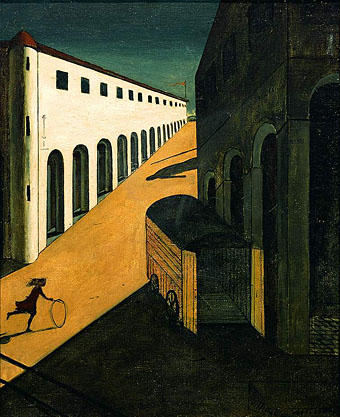
A more obvious echo for Dalí is Giorgio de Chirico’s The Mystery and Melancholy of a Street (below), where we find a similar girl at play among plastered walls, arched portals and elongated shadows. Three paintings, and three stages in a narrative whose events rearrange themselves depending on the order in which they are viewed.

dechirico.jpg

The Mystery and Melancholy of a Street (1914) by Giorgio de Chirico.

Previously on { feuilleton }
Max Ernst’s favourites
Viewing View
Max Ernst album covers
Maximiliana oder die widerrechtliche Ausübung der Astronomie
Max and Dorothea
Dreams That Money Can Buy
La femme 100 têtes by Eric Duvivier

Max Ernst’s favourites

ernst1.jpg

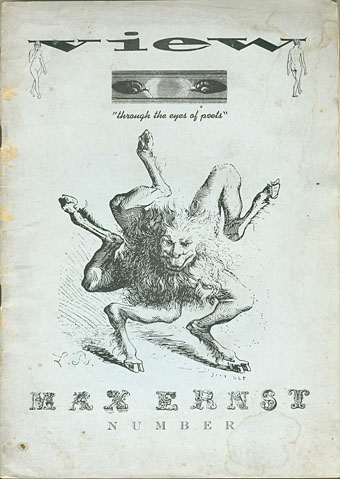
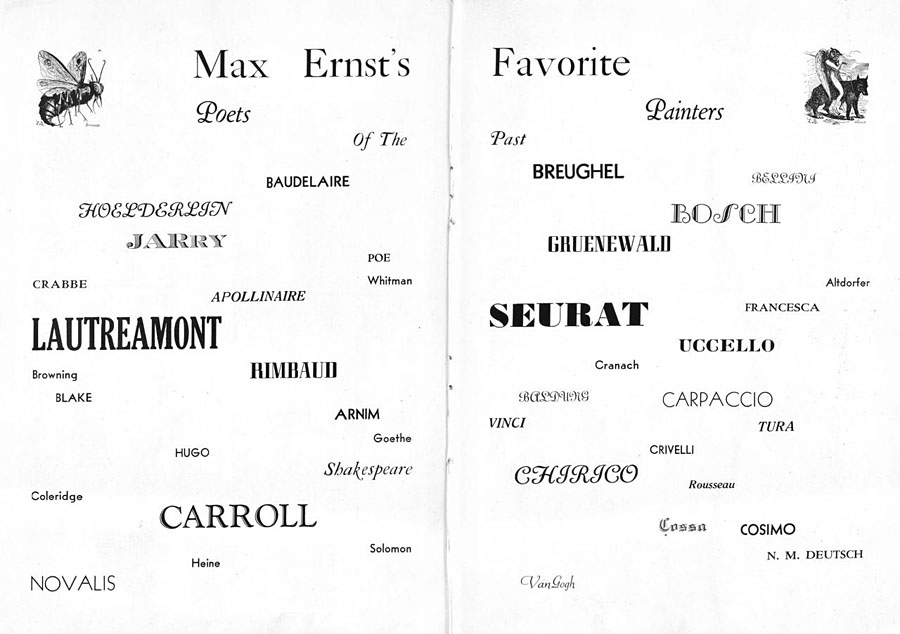
The cover for the Max Ernst number of View magazine (April, 1942) that appears in Charles Henri Ford’s View: Parade of the Avant-Garde was one I didn’t recall seeing before. This was a surprise when I’d spent some time searching for back issues of the magazine. The conjunction of Ernst with Buer, one of the perennially popular demons drawn by Louis Le Breton for De Plancy’s Dictionnaire Infernal, doubles the issue’s cult value in my eyes. I don’t know whether the demon was Ernst’s choice but I’d guess so when many of the De Plancy illustrations resemble the hybrid creatures rampaging through Ernst’s collages. Missing from the Ford book is the spread below which uses more De Plancy demons to decorate lists of the artist’s favourite poets and painters. I’d have preferred a selection of favourite novelists but Ford was a poet himself (he also co-wrote an early gay novel with Parker Tyler, The Young and Evil), and the list is still worth seeing.

ernst2.jpg

Poets: Charles Baudelaire, Friedrich Hölderlin, Alfred Jarry, Edgar Allan Poe, George Crabbe, Guillaume Apollinaire, Walt Whitman, Comte de Lautréamont, Robert Browning, Arthur Rimbaud, William Blake, Achim von Arnim, Victor Hugo, Johann Wolfgang von Goethe, William Shakespeare, Samuel Taylor Coleridge, Lewis Carroll, Novalis, Heinrich Heine, Solomon (presumably the author of the Song of Solomon).

Painters: Pieter Bruegel the Elder, Giovanni Bellini, Hieronymus Bosch, Matthias Grünewald, Albrecht Altdorfer, Georges Seurat, Piero della Francesca, Paolo Uccello, Lucas Cranach the Elder, Hans Baldung, Vittore Carpaccio, Leonardo Da Vinci, Cosimo Tura, Carlo Crivelli, Giorgio de Chirico, Henri Rousseau, Francesco del Cossa, Piero di Cosimo, NM Deutsch (Niklaus Manuel), Vincent van Gogh.

I’ve filled out the names since some of the typography isn’t easy to read. Some of the choices are also uncommon, while one of them—NM Deutsch—is not only a difficult name to search for but the attribution has changed in recent years. The list of poets contains few surprises but it’s good to see that Poe made an impression on Ernst; the choice of painters is less predictable. Bruegel, Bosch and Rousseau are to be expected, and the same goes for the German artists—Grünewald, Baldung—whose work is frequently grotesque or erotic. But I wouldn’t have expected so many names from the Italian Renaissance, and Seurat is a genuine surprise. As for Ernst’s only living contemporary, Giorgio de Chirico, this isn’t a surprise at all but it reinforces de Chirico’s importance. If you removed Picasso from art history de Chirico might be the most influential painter of the 20th century; his Metaphysical works had a huge impact on the Dada generation, writers as well as artists, and also on René Magritte who was never a Dadaist but who lost interest in Futurism when he saw a reproduction of The Song of Love (1914). Picasso’s influence remains rooted in the art world while de Chirico’s disquieting dreams extend their shadows into film and literature, so it’s all the more surprising that this phase of his work was so short lived. But that’s a discussion for another time.

Previously on { feuilleton }
Viewing View
De Plancy’s Dictionnaire Infernal
Max Ernst album covers
Maximiliana oder die widerrechtliche Ausübung der Astronomie
Max and Dorothea
Dreams That Money Can Buy
La femme 100 têtes by Eric Duvivier

Viewing View

view1.jpg

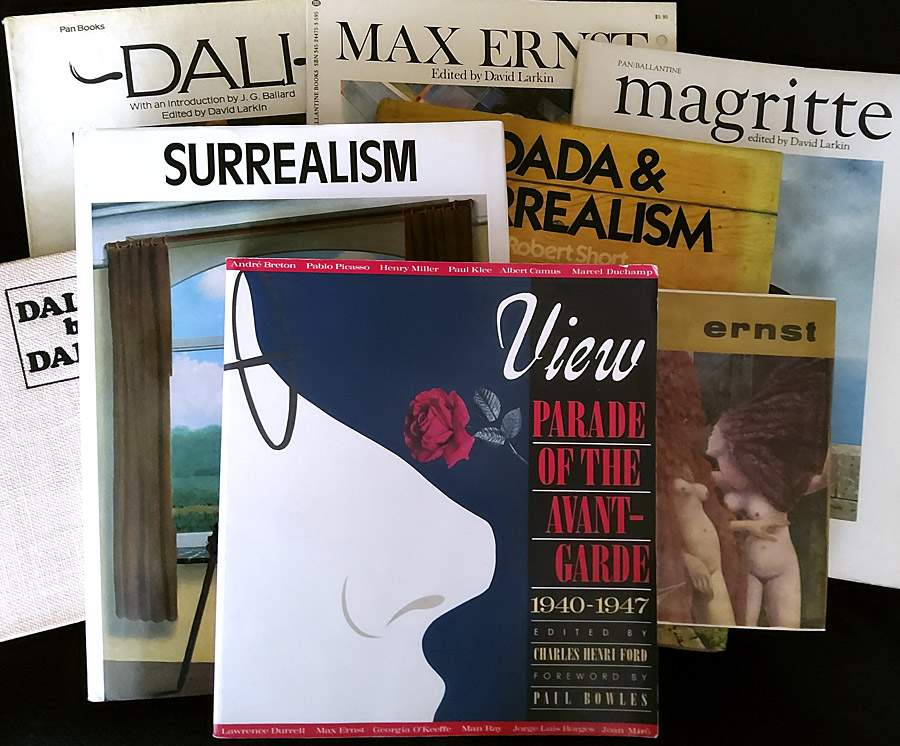
“Convulsive beauty” continues to be the order of the day around here. Reading Deborah Solomon’s Joseph Cornell biography back in April I was wishing again that there might be a way of seeing back issues of Charles Henri Ford’s View magazine, a heavily Surrealist art journal published in New York in the 1940s with an incredible list of contributors. (See this post.) Cornell was good friends with Ford and his artist-partner, Pavel Tchelitchew, and provided material for several issues of the magazine, including a substantial contribution to the Americana Fantastica special of January 1943. So I was delighted—convulsed, even—when the generous Mr TjZ of Connecticut offered to send me a copy of View: Parade of the Avant-Garde, a 290-page reader compiled by Ford for Thunder’s Mouth Press in 1992. Ideal reading just now. Thanks, Joe!

view2.jpg

view3.jpg

view4.jpg

Previously on { feuilleton }
View: The Modern Magazine

View: The Modern Magazine

charles_henri_ford.jpg

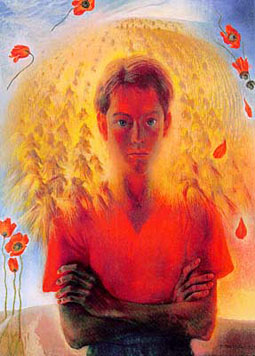
Portrait of Charles Henri Ford in Poppy Field by Pavel Tchelitchew (1933).

View magazine was an American periodical of art and literature, published quarterly from 1940 to 1947 with heavy emphasis on the Surrealist art of the period. The astonishing list of contributors included Jorge Luis Borges, Alexander Calder, Albert Camus, Marc Chagall, Joseph Cornell, Jean Dubuffet, Lawrence Durrell, Max Ernst, Jean Genet, Paul Klee, Henry Miller, René Magritte, André Masson, Joan Miró, Georgia O’Keefe, Pablo Picasso, Man Ray, Edouard Roditi, Yves Tanguy, and Pavel Tchelitchew.

Continue reading “View: The Modern Magazine”