The Plutonian Drug

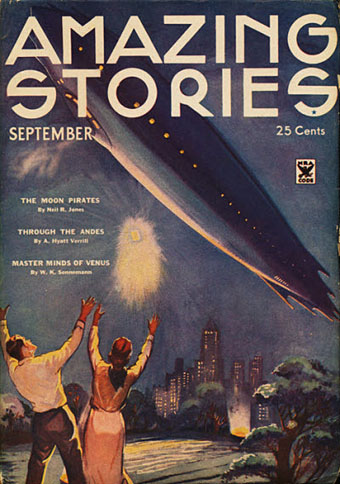
amazing.jpg

Cover art by Leo Morey.

To HP Lovecraft, Pluto was the planet Yuggoth, home to the fungoid, brain-harvesting Mi-go whose exploits are detailed in The Whisperer in Darkness (1931). Clark Ashton Smith wasn’t averse to imagining the planets of the Solar System as exotic worlds, but in The Plutonian Drug, a short story published in Amazing Stories for September 1934, he stayed closer to what was known of Pluto at the time, albeit with an exception or two:

“There are some other drugs, comparatively little known, whose effects, if possible, are even more curious than those of mnophka. I don’t suppose you have ever heard of plutonium?”

“No, I haven’t,” admitted Balcoth. “Tell me about it.”

“I can do even better than that — I can show you some of the stuff, though it isn’t much to look at — merely a fine white powder.”

Dr. Manners rose from the pneumatic-cushioned chair in which he sat facing his guest, and went to a large cabinet of synthetic ebony, whose shelves were crowded with flasks, bottles, tubes, and cartons of various sizes and forms. Returning, he handed to Balcoth a squat and tiny vial, two-thirds filled with a starchy substance.

“Plutonium,” explained Manners, “as its name would indicate, comes from forlorn, frozen Pluto, which only one terrestrial expedition has so far visited — the expedition led by the Cornell brothers, John and Augustine, which started in 1990 and did not return to earth till 1996, when nearly everyone had given it up as lost. John, as you may have heard, died during the returning voyage, together with half the personnel of the expedition: and the others reached earth with only one reserve oxygen-tank remaining.

This vial contains about a tenth of the existing supply of plutonium. Augustine Cornell, who is an old school friend of mine gave it to me three years ago, just before he embarked with the Allan Farquar crowd. I count myself pretty lucky to own anything so rare.

“The geologists of the party found the stuff when they began prying beneath the solidified gases that cover the surface of that dim, starlit planet, in an effort to learn a little about its composition and history. They couldn’t do much under the circumstances, with limited time and equipment; but they made some curious discoveries — of which plutonium was far from being the least.

“Like selenine, the stuff is a bi-product of vegetable fossilization. Doubtless it is many billion years old, and dates back to the time when Pluto possessed enough internal heat to make possible the development of certain rudimentary plant-forms on its blind surface. It must have had an atmosphere then; though no evidence of former animal-life was found by the Cornells.

“Plutonium, in addition to carbon, hydrogen, nitrogen, and oxygen, contains minute quantities of several unclassified elements. It was discovered in a crystalloid condition, but turned immediately to the fine powder that you see, as soon as it was exposed to air in the rocketship. It is readily soluble in water, forming a permanent colloid, without the least sign of deposit, no matter how long it remains in suspension.”

“You say it is a drug?” queried Balcoth. “What does it do to you?”

“I”ll come to that in a minute — though the effect is pretty hard to describe. The properties of the stuff were discovered by chance: on the return journey from Pluto, a member of the expedition, half delirious with space-fever, got hold of the unmarked jar containing it and took a small dose, imagining that it was bromide of potassium. It served to complicate his delirium for a while — since it gave him some brand-new ideas about space and time.

“Other people have experimented with it since then. The effects are quite brief (the influence never lasts more than half an hour) and they vary considerably with the individual. There is no bad aftermath, either neural, mental, or physical, as far as anyone has been able to determine. I”ve taken it myself, once or twice, and can testify to that.

“Just what it does to one, I am not sure. Perhaps it merely produces a derangement or metamorphosis of sensations, like hashish; or perhaps it serves to stimulate some rudimentary organ, some dormant sense of the human brain. At any rate there is, as clearly as I can put it, an altering of the perception of time — of actual duration — into a sort of space-perception. One sees the past, and also the future, in relation to one’s own physical self, like a landscape stretching away on either hand. You don’t see very far, it is true — merely the events of a few hours in each direction; but it’s a very curious experience; and it helps to give you a new slant on the mystery of time and space. It is altogether different from the delusions of mnophka.”

The most immediately notable detail here is the word “plutonium” which Smith was using as his own six years before the radioactive element was officially named. (By coincidence, transuranic plutonium was discovered the year Smith’s story was published.) Also of note is yet more discussion in a Smith story of real drugs such as opium and hashish. I’ve never seen any evidence that Smith was a drug user but he was happy to exploit the visionary potential of these substances. The time-viewing effects of Smith’s plutonium might have made for an effective weird tale but the piece runs out of steam fairly quickly; this is one of those stories with a promising idea that needs someone like HG Wells to do it justice. Many of Smith’s stories were written in haste so this isn’t too surprising but The Plutonian Drug lacks the imaginative scope of a piece of psychedelic science fiction like The City of the Singing Flame. Nevertheless, it was druggy enough to open Michel Parry’s Strange Ecstasies which is how I came to revisit it recently.

I was hoping the story might have been illustrated for its early printings but it seems not. The best I can find is this card design; there’s also a metal song by a band named Innsmouth that was released as a double-bill single in 2012. Smith’s story may be read in full at Eldritch Dark.
Previously on { feuilleton }
More trip texts
Yuggoth details
The Garden of Adompha
The City of the Singing Flame
Haschisch Hallucinations by HE Gowers
Odes and Sonnets by Clark Ashton Smith
Clark Ashton Smith book covers

More Esteban Maroto

maroto05.jpg

Psychedelic Kali from Vampirella 18.

Copies of the Dracula comics may be scarce these days but two of the artists who appeared in the title—Esteban Maroto and José Beá—were also appearing regularly in Vampirella around the same time. The Internet Archive has a large collection of Warren titles including an almost complete run of Vampirella. Esteban Maroto’s work stands out for me for his draughtsmanship, his page layouts, the atmosphere of heady eroticism, and the frequent touches of psychedelia of which the panel above is one of the more striking examples. The best strips are the ones he wrote himself; when he works with American writers the results tend to be more restrained. It’s a shame Vampirella was mostly a black-and-white title, so many of these pages would benefit from the same colour treatment as Wolff.

maroto01.jpg

Wolf Hunt from Vampirella 14.

And speaking of wolves, there’s a similar collection of witches and lycanthropes in these stories.

maroto02.jpg

Tomb of the Gods: Horus from Vampirella 17.

Tomb of the Gods is a short series in which mythological stories are explored Maroto-style. The exception is Gender Bender, a piece of science fiction with masculine and feminine psyches pitted against each other in a virtual arena. The story title is a surprise for anyone thinks that phrase originated in the 1980s.

maroto03.jpg

Tomb of the Gods: Kali from Vampirella 18.

Continue reading “More Esteban Maroto”

The Dracula Annual

wolff1.jpg

A comment by Modzilla in last month’s post about psychedelic comic book Saga de Xam is responsible for this recent book purchase. Dracula was a full-colour large-format comic book from notorious pulp imprint New English Library (later to be distributors for my colleagues at Savoy Books) that repackaged Spanish horror strips for a British audience. The comic ran for 12 issues in the early 1970s; the pages shown here are from the hardback annual that gathered all the issues into a single volume. I remember this being around in secondhand shops for years but I never paid it any attention at all so the artwork has been a revelation.

NEL’s Dracula isn’t much of a horror comic, despite its title; Dracula himself only appears in one story, and that’s a jokey throwaway piece. The two main episodic strips are Wolff, a Conan clone searching for his lost wife in a world ravaged by witches, werewolves and other supernatural threats; and Agar-Agar, a deliriously psychedelic picaresque concerning a hyper-sexual “sprite” (or a hippyish young woman with blue hair and magic powers) from the planet Xanadu. Everything in the book is redolent of the early 1970s when strains of psychedelia were still percolating through pop culture. Watered-down psychedelia used to bore me because I wanted the authentic stuff but forty years on this kind of work is much more attractive.

wolff2.jpg

Wolff is the work of Esteban Maroto whose splash pages and inventive layouts give Barry Windsor-Smith’s Conan the Barbarian (which was running at this time) some serious competition. Wolff is very much in the Conan mould—he even shouts “Crom!” at crucial moments—a pawn of supernatural forces he often fails to comprehend. The artwork in Smith’s Conan was often praised for its details and decor but the Art Nouveau influence in Maroto’s work is much more overt. Maroto’s flame-haired witches are like Alphonse Mucha sirens—one panel even borrows from Mucha’s Salammbô—and he’s no slouch with the Frazetta-like demons either. The scripting is perfunctory but I don’t mind that when it turns up pages like these. There’s also a brief nod to Lovecraft when “R’Lyeh” is mentioned.

wolff3.jpg

wolff4.jpg

Continue reading “The Dracula Annual”

In the Key of Yellow

td1.jpg

My Easter weekend was profitably spent watching True Detective again, a series I enjoyed even more the second time around. For the past year I’ve been pondering off and on the connections the series makes with the suite of weird tales that Robert Chambers published in 1895 as The King in Yellow, also the relationship between Chambers’ book and the chromatic preoccupations of the 1890s. The influence of Chambers on later writers such as HP Lovecraft is well established; this post traces some of the less obvious connections and correspondences.


1: À Rebours (1884) by JK Huysmans

huysmans.jpg

It begins, as many things do, with the bible of the Decadence. Neither Huysmans’ novel nor its dissipated central character, Des Esseintes, have much to say about the colour yellow but the first edition arrived in a yellow wrapper, a common feature of French novels of the period. This detail is significant in light of the following connection.


2: The Picture of Dorian Gray (1890) by Oscar Wilde

lippincott.jpg

The decade that came to be called the Yellow Nineties opened with the publication of Oscar Wilde’s only novel. The influence of À Rebours may be felt most strongly in the chapters where Dorian indulges his senses, and his passion for precious stones. Then there’s this famous section describing the unnamed novel that Lord Henry gives him to read:

His eye fell on the yellow book that Lord Henry had sent him. What was it, he wondered. He went towards the little, pearl-coloured octagonal stand that had always looked to him like the work of some strange Egyptian bees that wrought in silver, and taking up the volume, flung himself into an arm-chair and began to turn over the leaves. After a few minutes he became absorbed. It was the strangest book that he had ever read. It seemed to him that in exquisite raiment, and to the delicate sound of flutes, the sins of the world were passing in dumb show before him. Things that he had dimly dreamed of were suddenly made real to him. Things of which he had never dreamed were gradually revealed.

It was a novel without a plot and with only one character, being, indeed, simply a psychological study of a certain young Parisian who spent his life trying to realize in the nineteenth century all the passions and modes of thought that belonged to every century except his own, and to sum up, as it were, in himself the various moods through which the world-spirit had ever passed, loving for their mere artificiality those renunciations that men have unwisely called virtue, as much as those natural rebellions that wise men still call sin. The style in which it was written was that curious jewelled style, vivid and obscure at once, full of argot and of archaisms, of technical expressions and of elaborate paraphrases, that characterizes the work of some of the finest artists of the French school of Symbolistes. There were in it metaphors as monstrous as orchids and as subtle in colour. The life of the senses was described in the terms of mystical philosophy. One hardly knew at times whether one was reading the spiritual ecstasies of some mediaeval saint or the morbid confessions of a modern sinner. It was a poisonous book. The heavy odour of incense seemed to cling about its pages and to trouble the brain. The mere cadence of the sentences, the subtle monotony of their music, so full as it was of complex refrains and movements elaborately repeated, produced in the mind of the lad, as he passed from chapter to chapter, a form of reverie, a malady of dreaming, that made him unconscious of the falling day and creeping shadows.

Two things are connected here that coalesce in Chambers’ stories: the colour yellow, and the idea of “a poisonous book”, compellingly readable and thrilling in its capacity to corrupt. The “repairer of reputations” in Chambers’ story of the same name (the first in the King in Yellow cycle) also happens to be a Mr Wilde. Yellow is still only a detail at this point, but not for long.


3: The Yellow Book (1894)

yellowbook.jpg

Cover design by Aubrey Beardsley. The second story in Chambers’ King in Yellow cycle is The Mask.

John Lane’s quarterly periodical almost lived up to its sensational reputation for the first year of its publication, a reputation derived in part from its implied association with scandalous French literature. Aubrey Beardsley was the art editor, and was well aware of these associations. The sight of his bold drawings on bright yellow covers was a shock to many Victorian readers even if the literary contents were more restrained. When Oscar Wilde was arrested in 1895 he was described by the newspapers as carrying “a yellow book”; many readers took this to refer to the yellow book, and there were protests at the publisher’s door. Guilt by unwholesome association led to the dismissal of Beardsley from his editorial position even though he and Wilde had never been close.


4: The King in Yellow (1895) by Robert W. Chambers

chambers.jpg

Chambers’ own design for the cover of his story collection.

Of the four stories that comprise the King in Yellow cycle, three concern some form of artistic activity. Prior to writing the stories Chambers had been studying and working as an artist in Paris, an experience that supplies the background to the third tale, In the Court of the Dragon. As an illustrator for Vogue and Life in the 1890s Chambers could hardly have been unaware of the fashion for yellow, especially when the colour is a feature not only of the title of his book’s “poisonous” play and its central character, but is also central to the fourth story in the cycle, The Yellow Sign:

We had been speaking for some time in a dull monotonous strain before I realized that we were discussing The King in Yellow. Oh the sin of writing such words,—words which are clear as crystal, limpid and musical as bubbling springs, words which sparkle and glow like the poisoned diamonds of the Medicis! Oh the wickedness, the hopeless damnation of a soul who could fascinate and paralyze human creatures with such words,—words understood by the ignorant and wise alike, words which are more precious than jewels, more soothing than music, more awful than death!

In Chambers’ novel, The Common Law (1911), a disapproving description of an art club shows his familiarity with the avant-garde personalities of the Yellow Nineties:

A near-sighted study of various masters, brilliant, morbid, or essentially rotten, was the basis of this cult—not originality. Its devotees were the devotees of Richard Strauss, of Huysmans, of Manet, of Degas, Rops, Louis Le Grand, Forain, Monticelli…


5: The Boom in Yellow (1896) by Richard le Galliene

hardy.jpg

The Yellow Girl (c. 1895) by Dudley Hardy.

Richard le Galliene’s “prose fancy” describes at some length the colour of the decade:

Yellow is becoming more and more dominant in decoration—in wall-papers, and flowers cultivated with decorative intention, such as chrysanthemums. And one can easily understand why: seeing that, after white, yellow reflects more light than any other colour, and thus ministers to the growing preference for light and joyous rooms. A few yellow chrysanthemums will make a small room look twice its size, and when the sun comes out upon a yellow wall-paper the whole room seems suddenly to expand, to open like a flower. When it falls upon the pot of yellow chrysanthemums, and sets them ablaze, it seems as though one had an angel in the room. Bill-posters are beginning to discover the attractive qualities of the colour. Who can ever forget meeting for the first time upon a hoarding Mr. Dudley Hardy’s wonderful Yellow Girl, the pretty advance-guard of To-Day? But I suppose the honour of the discovery of the colour for advertising purposes rests with Mr. Colman; though its recent boom comes from the publishers, and particularly from the Bodley Head. The Yellow Book with any other colour would hardly have sold as well—the first private edition of Mr. Arthur Benson’s poems, by the way, came caparisoned in yellow, and with the identical name, Le Cahier Jaune; and no doubt it was largely its title that made the success of The Yellow Aster. In literature, indeed, yellow has long been the colour of romance. The word ‘yellow-back’ witnesses its close association with fiction; and in France, as we know, it is the all but universal custom to bind books in yellow paper. Mr. Heinemann and Mr. Unwin have endeavoured to naturalise the custom here; but, though in cloth yellow has emphatically ‘caught on,’ in paper it still hangs fire.


6: Il Giallo Mondadori (1929)

giallo.jpg

La Figlia di Satana (1933), an Italian edition of an Edgar Wallace crime novel. “I Romanzi Gialli”.

Everything associated with the 1890s was deeply unfashionable by the 1920s, florid Art Nouveau having been replaced by rectilinear Art Deco. Yellow is transformed here from a signifier of artistic and spiritual decadence to the symbol of a more material form of corruption: crime. The giallo paperbacks published in Italy by Mondadori were so-named for their predominantly yellow covers. There’s nothing particularly weird or Chambers-related about these novels but their name was later transferred to a type of cinematic thriller being made in Italy in the 1960s. Those thrillers quickly mutated into supernatural horror films, and the giallo label went with them.


7: The King in Yellow (1938) by Raymond Chandler

chandler.jpg

The masked figures on the first number of The Yellow Book reminded me at this point that Raymond Chandler had been writing for Black Mask magazine in the 1920s. Chandler’s King in Yellow is a murder mystery which in its magazine version concerns an investigation by detective Steve Grayce into the death of jazz trumpeter King Leopardi:

The King wore yellow silk pajamas, the slip-on kind, with a turned collar. They were loose and thin. Over his breast they were dark with blood that had seeped into the silk as if into blotting-paper. There was a little blood on his bare brown neck.

Steve stared at him and said tonelessly: “The King in Yellow. I read a book with that title once. He liked yellow, I guess. I packed some of his stuff last night. And he wasn’t yellow either. Guys like him usually are—or are they?”

Grayce’s name was changed to Philip Marlowe when the story was reprinted in a collection in 1945. In 1983 Powers Boothe played Marlowe in a series of TV adaptations.


8: True Detective, series one (2014) by Nic Pizzolatto

td2.jpg

True Detective: pages from Dora Lange’s diary.

td3.jpg

And so to the latest TV detectives. What struck me most about the Chambers thread this time round was how little is explained or revealed about the natures of “the yellow king” or Carcosa, and how much of the characterisation is concerned with figurative masks. Camilla’s words from the opening of Chambers’ The Mask—”You sir, should unmask”—are paraphrased by the killer in the final episode, something I missed the first time; elsewhere there’s a great deal of deception in the personal and professional spheres and, of course, Rust Cohle’s undercover exploits. Leaving all the Carcosa business unexplained is a strength; it’s what Chambers does himself in the stories, and it’s just what many of the lesser writers who’ve tried to expand his mythos don’t do at all.

td4.jpg

What next for the King in Yellow? As the old lady says in episode 7: “Death is not the end!” The sinister regent will be back again, all we have to do is wait.

Previously on { feuilleton }
Intertextuality
Lovecraft’s Monsters
The Court of the Dragon
The King in Yellow

Haunted Corridors: The Temporal Enigmas of Sapphire and Steel

sands01.jpg

All irregularities will be handled by the forces controlling each dimension. Transuranic, heavy elements may not be used where there is life. Medium atomic weights are available: Gold, Lead, Copper, Jet, Diamond, Radium, Sapphire, Silver and Steel.

Sapphire and Steel have been assigned.

Voiceover at the beginning of each episode

Having revisited a fair amount of old television in the past few years I thought I was past being surprised, but this came as a revelation. Sapphire and Steel appeared at exactly the wrong moment for me to fully appreciate it the first time round. The six storylines ran on the ITV network from 1979 to 1982, a period when my home and personal life was so chaotic that I saw little television at all. At any other time a series featuring a pair of cosmic investigators immersed in mysteries involving haunted railway stations and people escaping from photographs would have been essential viewing. Sapphire and Steel was never repeated after those original screenings so watching the entire run recently has been like seeing it for the first time. In recent years the series has been included in discussion of the weirder British television of past decades; China Miéville in his interview in The Twilight Language of Nigel Kneale describes Sapphire and Steel as the strangest thing ever screened on British TV. After reading that, and a couple of other appraisals, I felt obliged to refresh my vague memories.

sands02.jpg

Assignment One: Sapphire (Joanna Lumley) and Steel (David McCallum).

Superficially, Sapphire and Steel belongs to the occult-detective subgenre, a minor category of weird fiction that in its early days included characters such as Sheridan Le Fanu’s Dr Martin Hesselius, Algernon Blackwood’s John Silence, William Hope Hodgson’s Thomas Carnacki and others. But several factors set Sapphire and Steel apart from their more staid predecessors: occult detectives are generally solitary figures whereas Sapphire and Steel operate as a pair; Sapphire is a woman in a field more commonly occupied by middle-aged men; and most striking of all, both Sapphire and Steel are supernatural beings themselves, dispatched to Earth by agencies we never see and learn nothing about, in order to mend ruptures in the flow of Time. Supernatural detectives had appeared in comic books before this but there’s no evidence that series creator PJ Hammond was considering such antecedents when he wrote The Time-Menders (as Sapphire and Steel was originally known). A few years earlier Hammond had been writing for Ace of Wands (1970–72), a mildly hippyish children’s TV series whose hero, Tarot, was a youthful stage magician with genuine occult powers. Between stage shows, Tarot and friends investigated supernatural events. Sapphire and Steel had originally been planned as a series for children but before the first script was finished it was moved to an early evening slot, thus allowing for darker and more adult-oriented material.

sands03.jpg

Assignment Two: the haunted railway station. The clothing worn by the pair changes with each assignment; on this occasion they’re in evening dress.

One of the attractions of Sapphire and Steel in a genre replete with origins and canonical histories is how little is explained about the two main characters, the source of their assignments, or even the true nature of the malevolent forces they have to face. Sapphire (Joanna Lumley) and Steel (David McCallum) embody the materials after which they’re named, the pair being part of a team of elemental operatives some of whose names are listed in the voiceover that introduces each episode. We only encounter two others: Lead (Val Pringle), a huge African-American man with superior strength; and Silver (David Collings), an effete and dandyish Englishman with the ability to mould metals, fix machines and replicate objects. Sapphire’s abilities are mainly psychometric—she reads the history and condition of people and places—but she can also rewind time for short periods; Steel is as cold and unyielding as his name; he’s fiercely analytical, often bad-tempered and also strong enough to tie a knot in a lift cable.

Continue reading “Haunted Corridors: The Temporal Enigmas of Sapphire and Steel”